
Kitting Services: What They Are, Costs & When to Outsource
Kitting is a value-added fulfillment service: a 3PL assembles several separate SKUs into one kit that gets its own SKU and barcode, then stores, picks, packs, and ships it as a single item. It's most common for gift sets, starter kits, promotional bundles, and subscription boxes — anything where the combination is set before an order arrives.
What does it cost? You'll typically pay $0.50–$3.00 per kit for a simple assembly, and $4.00–$8.00 for a complex one with custom packaging and branded inserts. The outsourcing decision usually turns on 200–500 kits per month: below that, in-house assembly can still pay; above it — especially for complex or branded kits — a 3PL is almost always cheaper.
Here's the full picture: how kitting differs from packing, what the service actually includes, where the money goes, and when to keep it in-house versus hand it off.
What Is Kitting?
Kitting turns several items that arrived separately into one product you can sell and ship. In fulfillment terms, you place multiple individual SKUs under a single new SKU. Each item inside the kit is a "component"; the finished result is the "kit." Once assembled, the kit carries its own SKU and barcode and is treated as one unit across storage, sales, picking, packing, and shipping — so a picker grabs one item instead of chasing three or four SKUs around the warehouse.
It doesn't have to be a big job. Unwrapping a unit from its factory packaging, inspecting it, and adding a sticker so it's ready to pick all count as kitting — as does building dozens of items into a custom gift box.
Full kitting is often used interchangeably with kitting. In fulfillment, they mean the same thing: assembling everything that will be sold and shipped together into a complete kit that's ready for pick-and-pack. The term comes from manufacturing, where it describes staging all the materials, tooling, programs, and components a job needs before it's released, so the line never stops to wait for a missing part.
Warehouse kitting is the most common form. Components arrive, move into a dedicated kitting area, and get built into finished kits against a work order, then barcoded and shelved so they can be picked as one unit. It suits high-velocity SKUs, subscription runs, and seasonal promotions — the "same set ships over and over" cases.
Kitting vs. Bundling: What's the Difference?
This is where people get confused, and the difference is timing and method.
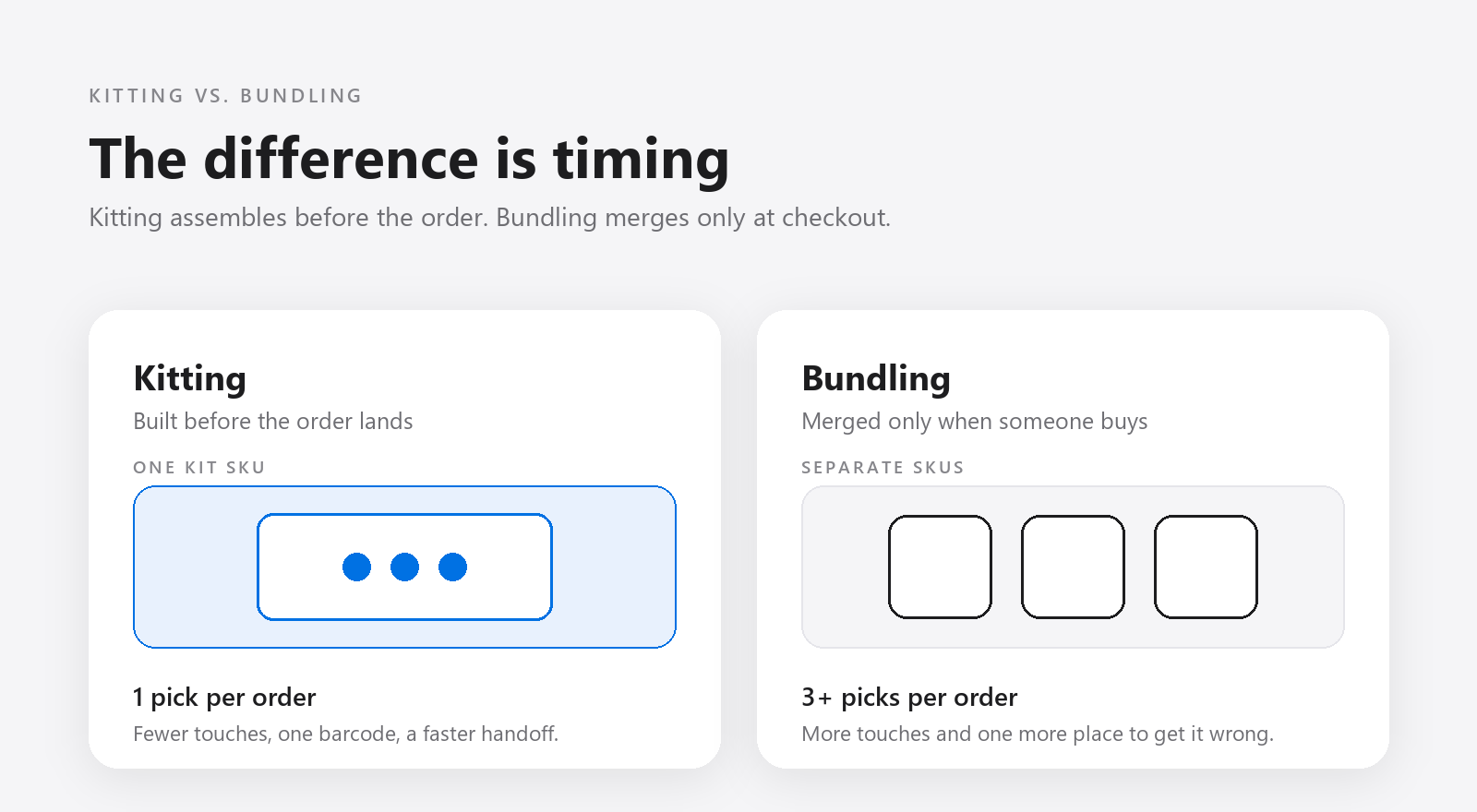
- Kitting assembles the set in advance, before orders arrive. The kit is a physical unit sitting on a shelf.
- Bundling is a sales and merchandising move, pulled together after a customer buys. A bundle is just a "virtual container" grouping SKUs under a parent SKU — no assembly happens up front.
The short version: kitting is an operational question (how do I ship this set?); bundling is a sales question (how do I sell this set?). Both group products under one SKU, which is why they get confused — but one builds a physical unit ahead of time, and the other merges only after the order.
To settle all three terms at once, here's kitting, bundling, and on-demand (assemble-to-order) side by side. On-demand sits between the other two: components stay separate in storage and get assembled only when an order arrives — the right fit when combinations vary and volume is still low.
| Dimension | Kitting (pre-built) | Bundling (merchandising) | On-demand (assemble-to-order) |
|---|---|---|---|
| When assembled | Before orders, in batches | Not assembled; picked per order | After the order, on the spot |
| Physical form | One finished kit with its own SKU | A virtual product grouping | Components combined into one parcel |
| Inventory handling | Components become kit inventory in advance | Components stay separate, decremented at sale | Components stay separate, consumed per order |
| Picking efficiency | One pick, fastest | Several picks per order | Pick, then assemble on the spot |
| Best for | Fixed combos, high volume, subscription/gift | Flexible mixes, items also sold alone | Changing combos, low volume, testing |
| Main risk | Over-building locks inventory | More packing-station work and errors | Assembly becomes the peak bottleneck |
What Does a Kitting Service Actually Do?
A 3PL's kitting work goes well beyond "putting things in a box." The typical list includes: constructing or closing boxes, placing items into kits, affixing stickers/labels/barcodes (including exact positioning), removing packaging or inserts, adding dunnage, building dividers, wrapping and sealing, running inspections, changing an item's SKU to the kit SKU, and de-kitting (breaking a finished kit back into components).
One easy point to miss: the actions a provider supports and what you'll actually pay are two different things. Most of these are billed per unit, so how many you need — and how precise they are — directly shapes your quote. List every action before you ask for pricing.
Common Kit Types
Kitting usually shows up as gift sets, starter kits, promotional kits, product-and-accessory sets, seasonal sets, and subscription boxes. Subscription boxes are the classic case — contents barely vary between customers and repeat on a fixed cadence, so building ahead saves real time and delivers a consistent unboxing experience.
The Four-Step Kitting Process
Details vary by provider, but most ecommerce kitting follows four steps:
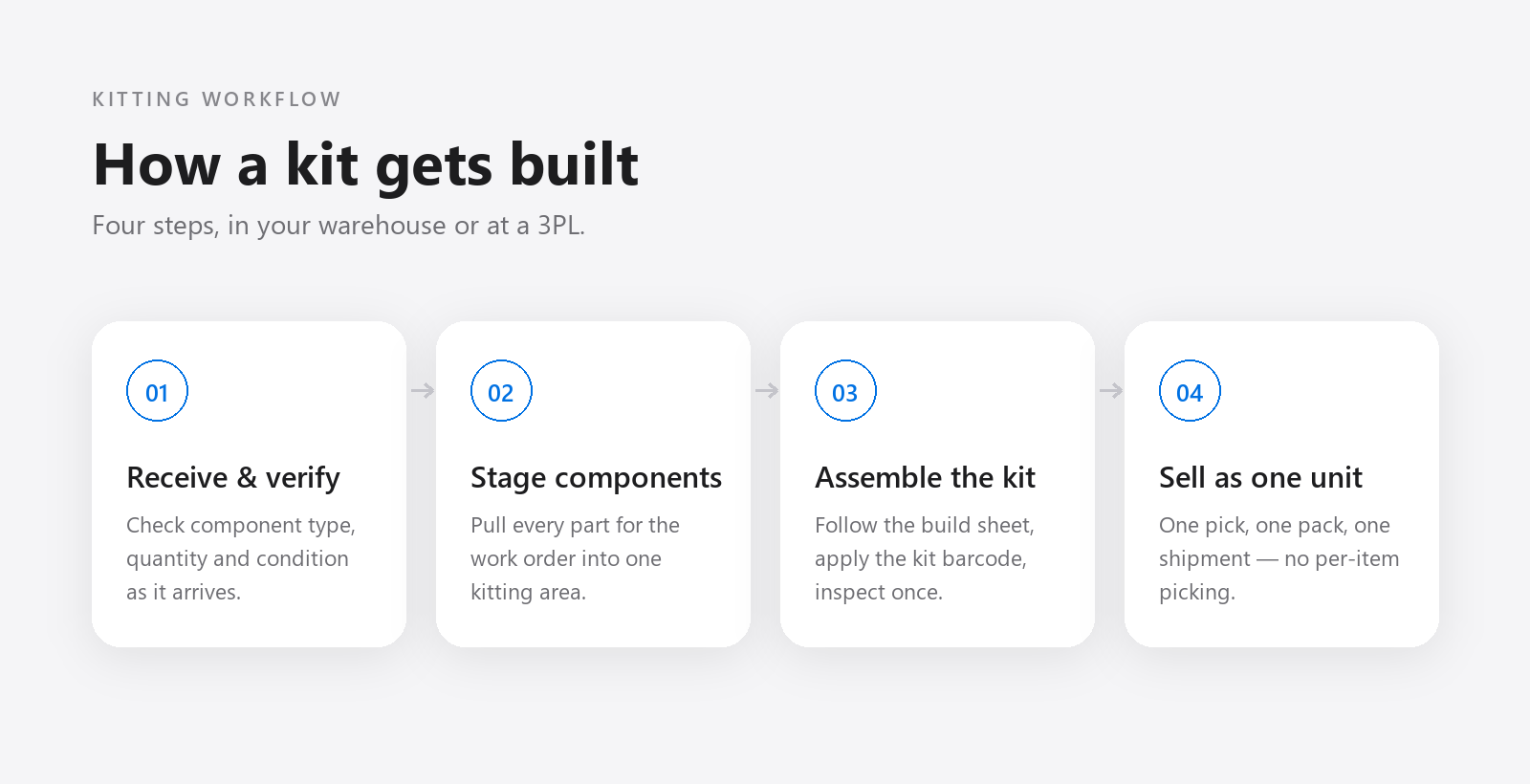
- Receive and verify components — confirm the type and quantity as they arrive, and that they're usable.
- Stage the components — gather what's needed into a dedicated kitting area against the work order.
- Assemble the kit — place each component into its designated box following documented instructions, then apply the kit barcode and SKU label and run a quick inspection.
- List the kit for sale — shelve it as a single item. When an order arrives, it's picked, packed, and labeled.
One action runs through all of this: barcode scanning at receiving, assembly, storage, and pick. It's what keeps the right components in every kit — and it's the foundation of inventory accuracy, which we'll come back to.
What Does Kitting Cost?
Let's be honest up front: there's no standard price. Kitting is priced by the work itself, and you get a quote per work order. Rather than guess a number, understand what it's built from:
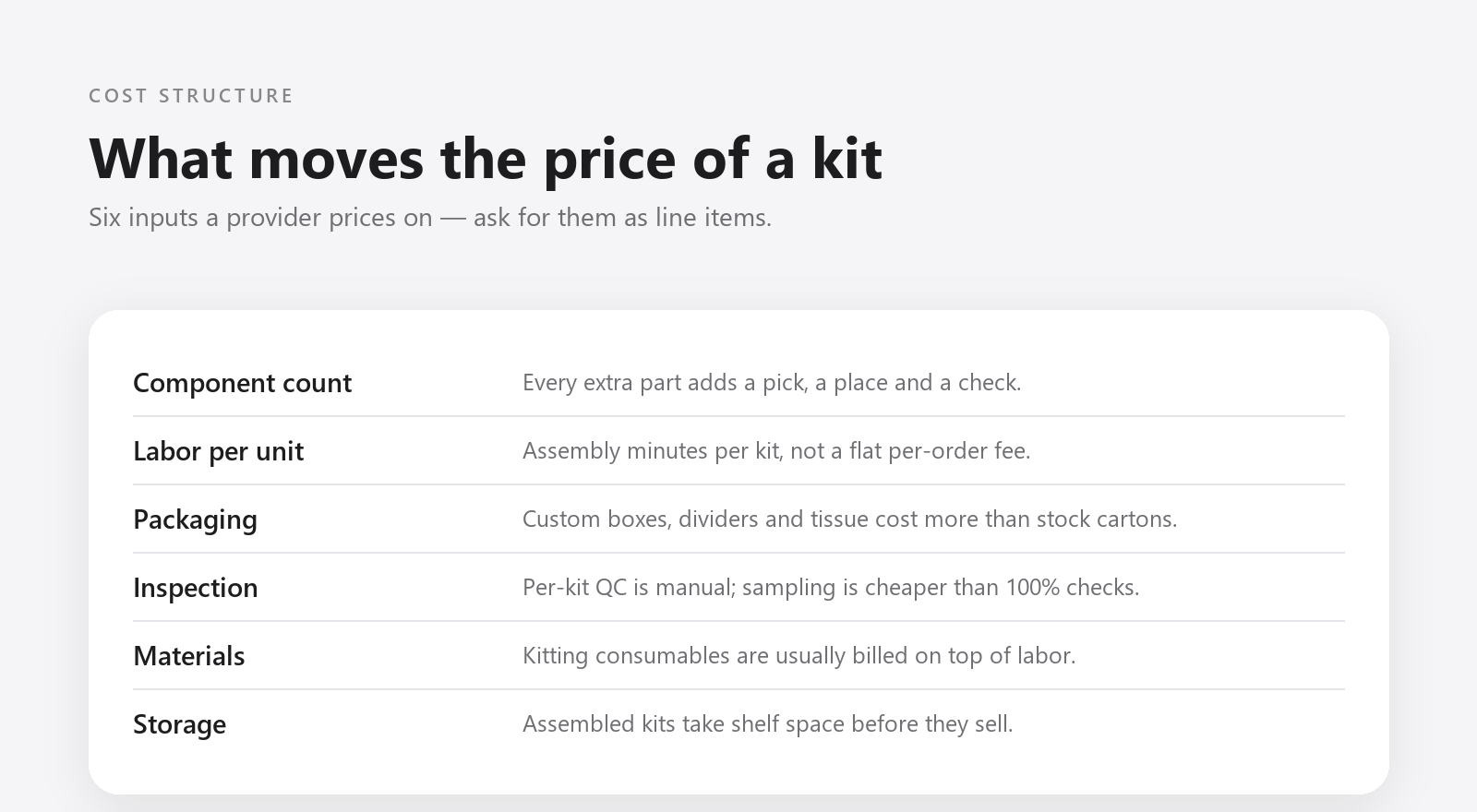
- Labor per unit — how many manual actions each kit takes. More components and finer steps mean more labor.
- Component count — how many items go in each kit.
- Packaging — folding custom boxes, inserting dividers, placing stickers in exact spots.
- Inspection — per-kit quality checks are an additional action.
- Materials — custom boxes, dunnage, stickers.
- Storage — a finished kit occupies a shelf slot, billed by volume or usage.
Here are typical ranges (from third-party pricing data, not our own quote):
| Fee item | Typical range |
|---|---|
| Kit assembly labor | $0.50–$2.50 per kit |
| Component pick fee | $0.10–$0.30 per component |
| Packaging materials | $0.25–$3.00 per kit |
| Custom insert / branding | $0.10–$0.50 per insert |
| QC / verification | Included, or $0.10–$0.25 per kit |
| Project setup fee | $50–$250 one-time |
| Storage (finished kits) | $0.50–$2.00 per bin/month |
The short version: a simple 3-component kit with standard packaging runs about $1.00–$2.50 per unit; a complex 8+ component kit with custom packaging and branded inserts runs $4.00–$8.00. Simpler combos and larger batches drive per-kit cost down; heavier customization and finer inspection drive it up.
Three hidden costs to watch for: ① a project setup fee (BOM setup, training, first run — $50–$250 one-time); ② peak-season surcharges (Q4 often adds 15–20%); ③ low-cost 3PLs sometimes bury a "shrinkage allowance" of up to 4% of inventory value into contracts, so a cheap-looking monthly bill can mask unbilled inventory loss.
When Should You Outsource Kitting?
This is the real question for most people, and the answer is a set of signals, not a date. When two or three of these apply, in-house kitting has usually run its course:
- Order volume is growing faster than your team can prep.
- Seasonal spikes overwhelm your labor — assembly becomes the peak bottleneck.
- Complexity is up and error rates are climbing — more components means more manual mistakes.
- Your space or headcount is constrained — no room for an assembly area, no one dedicated to it.
- The assembly is highly repetitive and standardizable — the same set built over and over is what a professional line does best.
The flip side: if volume is still low, the combination is simple, and your own warehouse can handle it, staying in-house is the easier call.
A useful threshold: 200–500 kits per month. Below it, in-house (or factory pre-assembly) can still be profitable. Above it — especially for complex or branded kits — outsourcing almost always delivers a lower per-unit cost and more consistent quality. It's not a hard line, but it tells you which side you're on.
In-House, Outsource, or Have the Factory Do It
There's a third option people overlook: have your manufacturer pre-assemble at the source. The decision comes down to where assembly is cheapest and least error-prone.
| Option | Best fit | Main advantage | Main cost / risk |
|---|---|---|---|
| Factory pre-assembly | Fixed combos, high volume, controlled shipping | Cheapest when assembled at source | Low flexibility; rework when promotions change |
| Outsource to a 3PL | Changing combos, multi-channel, fast turnaround | Scale, specialization, integrated systems | Minimum order thresholds, per-unit billing |
| In-house | Low volume, simple combos, strong brand control | Full control, close to customers | Hidden labor + space + rework costs |
The point isn't which option is "better" — it's which cell your current volume and complexity fall into. At a certain scale, the right answer switches on its own. Don't assume kitting belongs with a 3PL by default; first ask whether your factory can pre-assemble at the source.
How to Choose a Reliable Kitting Provider
Kitting is a value-added service — not every warehouse offers it, and not every one does it well. Focus on whether a provider solves your sharpest pain point. For most brands, that's inventory accuracy.
Inventory Accuracy: The Most Underestimated Risk
Kitting looks like a packaging job, but it's really an inventory job. When the same component SKU sells on its own, inside a kit, and across multiple channels (your store, Amazon, Walmart, TikTok Shop, B2B), component-level stock has to decrement in real time everywhere at once. The risk: one missing component makes an entire kit unfulfillable — even when every other item is sitting on the shelf.
The bill of materials (BOM) is the most important document here. It tells the warehouse exactly what goes into each kit: component SKUs, quantities, assembly sequence, packaging specs, label placement, and quality checkpoints. An incomplete or ambiguous BOM is the leading cause of kitting errors, rework, and disputes over who pays for mistakes.
So ask exactly how a provider keeps component and kit SKU counts in sync, whether reorder alerts fire at both levels, and how BOM changes are versioned.
10 Questions to Ask Before You Choose
- Which kitting actions do you support? (labeling, inserts, custom boxes, dividers, inspection…)
- What's your minimum order quantity? Below how many kits won't you run it?
- What's the turnaround for a standard work order, and what extends it?
- How is pricing broken down — labor, materials, storage? Any setup fee or peak surcharge?
- How do you sync component and kit inventory across channels?
- Can you de-kit — break slow kits back into sellable components?
- What happens when a component is out of stock? Do you alert me or stop shipping?
- Can I upload photos or GIFs to define the assembly standard? How is QC verified (barcode scan, weight check)?
- Who supplies materials, and how are custom boxes and stickers billed?
- How do you version BOM changes? How long — and how much — to adjust a kit's composition?
These ten questions will filter out providers that "just pack boxes" and can't manage inventory.
Conclusion
Kitting is really about trading up-front assembly for faster picking and consistent shipping after the order. Whether it's worth doing — and who should do it — depends on your volume, combination complexity, and cost structure, not on "everyone else uses a 3PL so I should too."
If the combination is simple and volume is still low (under a few hundred kits a month), in-house or factory pre-assembly may be cheaper. If combinations are complex, you're selling across channels, and inventory sync is becoming painful, a 3PL that ties assembly, inventory, and shipping into one system is where the real savings are.
Need custom assembly, split shipments, or global recipient handling? Contact us for a quote based on your specific combinations, or see how our kitting and assembly service works end to end.
References (Neutral Third-Party Sources)
Facts and concepts in this article were verified against neutral third-party sources. No competitor pages are cited.
- DHL — Logistics of Things glossary, "Kitting": general definition and the logistics vs. warehouse kitting split. https://lot.dhl.com/glossary/kitting/
- UNIS Freight & Logistics glossary, "Kitting": definition, benefits, and implementation challenges. https://www.unisco.com/zh-CN/freight-glossary/kitting
- Nventory glossary, "What is Kitting?": kit SKU and bill-of-materials structure, and component/kit dual-level inventory sync. https://nventory.io/fi/glossary/kitting
- Pipe17 — "Kitting and Product Bundling in Ecommerce": the operational (kitting) vs. merchandising (bundling) distinction, and pre-kitting vs. on-demand tradeoffs. https://pipe17.com/how-to-use-product-bundles-as-a-competitive-advantage
- Wikipedia / Reddit (r/ecommerce and related): kitting concepts and common seller concerns about outsourcing, provider selection, and inventory management.