
Crowdfunding Fulfillment Services: What They Do & How to Choose
A crowdfunding fulfillment service is a project manager with a warehouse attached. It takes the order file you export from the platform, turns it into pick lists, moves goods through customs, releases them in agreed batches, and cleans up the parcels that go wrong. What it does not do is own the promise: the reward, the date and the apology stay with you.
That distinction is the purchase decision. Providers built for subscription fulfillment often struggle here, because a campaign is not a steady trickle of orders — it is one large, time-boxed project that arrives at once and then stops, except when it doesn't.
Six segments, and the one you keep
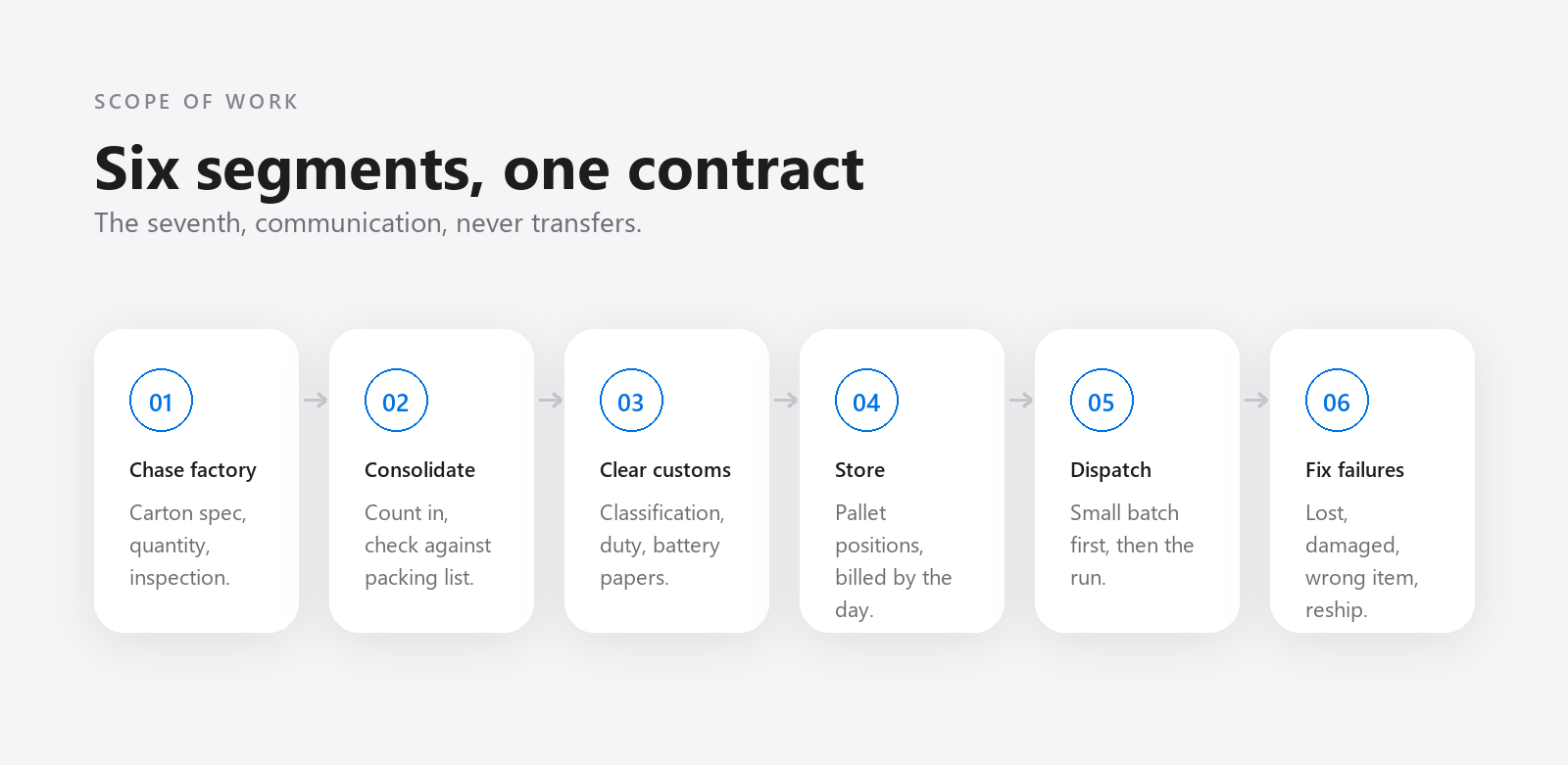
Production follow-through. Not the factory, but the chasing: quantity confirmations, carton dimensions, label artwork, and the pre-shipment inspection before the goods leave. A provider with campaign experience asks for the carton spec weeks ahead of the ship date, because the rate depends on it.
Consolidation. Goods from two or three suppliers land in one place, get counted, and get checked against the packing list. This is where a short shipment is discovered — if anyone counts.
Customs clearance. Classification, duty, and for battery-powered hardware the declarations and certification that decide whether the container sits or moves. Paperwork prepared after the vessel sails is prepared too late.
Storage. Pallet positions for a few weeks, billed monthly or per pallet per day.
Batched dispatch. The part that needs crowdfunding experience: releasing 300 parcels, checking what broke, then releasing 3,000.
Exception handling. Lost, damaged, wrong item, address that does not exist. This segment decides your comment section in month four.
You keep the seventh thing, which is communication. No provider can write your update.
"One-stop" is a sales word, not a contract term
Every provider calls itself end-to-end. In practice the chain holds three or four companies: a freight forwarder (the agent that books the ocean or air leg and handles export paperwork), a customs broker, the warehouse, and the last mile — the carrier that puts the parcel on a doorstep.
The question is not whether they subcontract. Everyone does. It is who you call when the container is held, and whether the answer is a name, a phone number and a liability clause, or an email address.
One version of that risk is documented in Chinese trade press: a forwarder's cash flow broke while 56 containers sat at port holding goods from more than 300 sellers, and the mediation proposals asked sellers to pay per kilogram to release their own cargo — or abandon title. Nobody in that story was a crowdfunding creator; the mechanism is identical. When the intermediary fails, the goods are the collateral.
The quote is six prices, not one
A single landed figure per parcel is the fastest way to get burned, because it hides which unit each charge is applied to. Ask for the quote broken into units.
| Line | Billed per | What you must confirm in writing |
|---|---|---|
| Inbound receiving and put-away | Per carton or per unit | Whether a mixed-SKU carton is billed once or per SKU |
| Storage | Per pallet per day, or per pallet per month | The start date, and what happens after the last wave |
| Pick, pack and label | Per order, plus a per-item charge | The threshold where the second item becomes a new order |
| Assembly or kitting | Per unit or per kit | Who supplies components, and who eats the shortfall |
| Postage | Per parcel, by service and zone | Whether remote-area and oversize surcharges are included |
| Customs advance | Per shipment, plus the duty itself | Who fronts the duty, at what rate, and when it is repaid |
Two lines do most of the damage. Storage that starts the day goods arrive, rather than the day they are received into the system, bills you for a week in a queue. And customs advance — the provider pays duty, invoices you later — is a loan with interest hidden in the exchange rate.
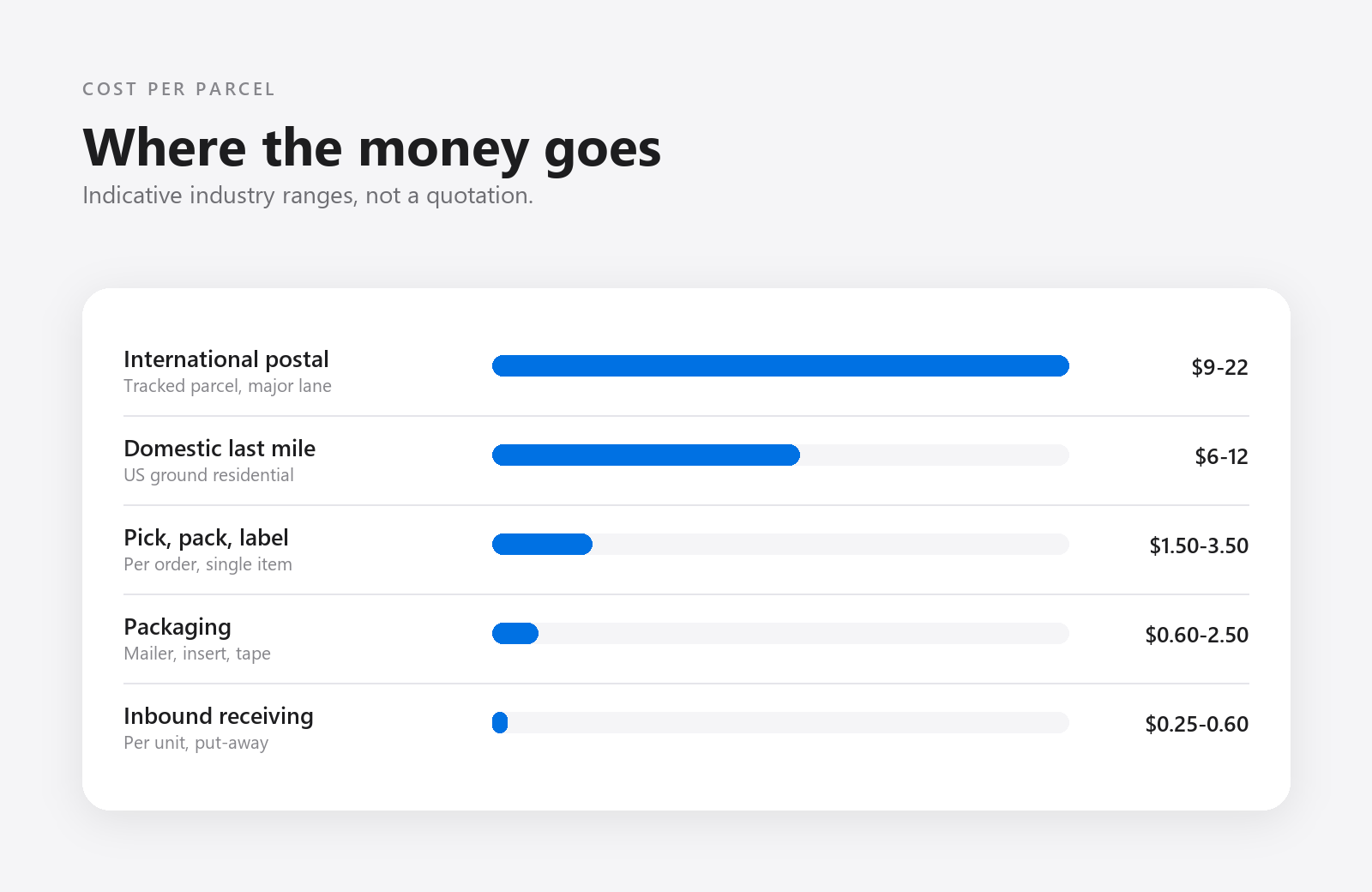
Those bars are industry ranges, not a quotation. The shape matters: postage dominates, warehouse labour is second, and every surcharge sits outside both.
Ask for the wave plan before the price
Any provider can price a parcel. Fewer can hand you a release schedule. Ask for one in writing before you discuss money — it is the cheapest test of whether they have done this before.
A usable wave plan has four columns: batch, units, destination countries, and the date the batch goes to the carrier. Around it, three numbers:
- First batch size. A hardware team running an Indiegogo campaign shipped 200 production units first, then a second batch mid-month, releasing parcels in order-number sequence. Two hundred units surfaces label, packaging and manual problems while the blast radius is small.
- Split. 60–70% in the first wave, 30–40% held for the tail and the exceptions, beats an even split. Too small a first wave never finds the problem; too large distributes it to everyone.
- Cut-off. The date after which an address change becomes a reship. On Indiegogo that is a Each Order Status change with no undo; on Kickstarter it is a survey lock plus whatever your provider agrees to. Put it on the calendar, not in a chat.
If the answer is "we ship everything at once", the rest of the call is about how much of the file you will rebuild by hand.
The numbers that predict a bad run
Four figures separate a warehouse that has shipped campaigns from one that has shipped pallets.
| Measure | What good looks like | Why it matters here |
|---|---|---|
| Pick error rate | Under 0.3% on multi-SKU orders | A 1% error rate on 3,000 parcels is 30 wrong boxes and 30 support threads |
| Dispatch cut-off compliance | Same-day dispatch before the cut-off, with A-scan — the carrier's first acceptance scan — above 97% | Crowdfunding waves are dated promises, not steady demand |
| Inbound turnaround | 24–48 hours from arrival to sellable stock | A container that sits is storage you pay for and a wave you delay |
| Damage and reship rate | Tracked monthly, with a stated replacement window | The only number that predicts your month-four inbox |
Those figures come from warehouse operators describing their own service levels: benchmarks to negotiate against, not a standard. The point is to ask at all. A provider answering "very low" has not measured.
Error prevention is mechanical, and worth asking about: a unique barcode per unit, a quantity check, a weight check against the expected parcel, video retained at each packing station. The absence of any one explains most wrong-item complaints.
Where the money leaks after signature
The quote covers the work you described; the invoice covers what happened.
- Remote-area and oversize surcharges. Postage to Alaska, Hawaii, Puerto Rico or an island address costs more, and averages hide it. Ask which surcharges pass through at cost and which are marked up.
- Storage after the last wave. There is always a residue: 40 parcels, 6 returns, a pallet of manuals. Monthly storage on a nearly empty account is pure margin.
- Second attempt and return-to-sender fees. A parcel refused at the door comes back or is destroyed, and both are billable.
- Minimum batch charges. Some warehouses charge a minimum per pick day: release 80 parcels and you may pay for 200.
- Currency and duty float. If the provider advances duty, you are borrowing at their rate.
None of it is dishonest. It is simply not in the number you compared.
Due diligence: ten questions with a pass mark
- How many one-time bulk projects have you run in the last 12 months, and can you name two ship windows?
- Which platform exports do you accept, and how do you Clothing Brands Handle orders that never generated a survey?
- Send a wave plan you have actually executed, with batch sizes.
- What is your measured pick error rate, and how is it sampled?
- What are your inbound turnaround and dispatch cut-off, in hours?
- Which carriers do you hold accounts with for my destination mix, and what happens in a peak-season capacity crunch?
- Who clears customs, under whose importer of record, and who fronts the duty?
- What is your liability cap per parcel — retail value or declared value?
- What is the replacement window for a lost parcel, and who pays the second postage?
- Show me the clause covering goods still in your warehouse 60 days after the last wave.
A number for question 4, a document for question 3, a name for question 7. If any of the three is missing, keep calling.
Red flags that show up in the first call
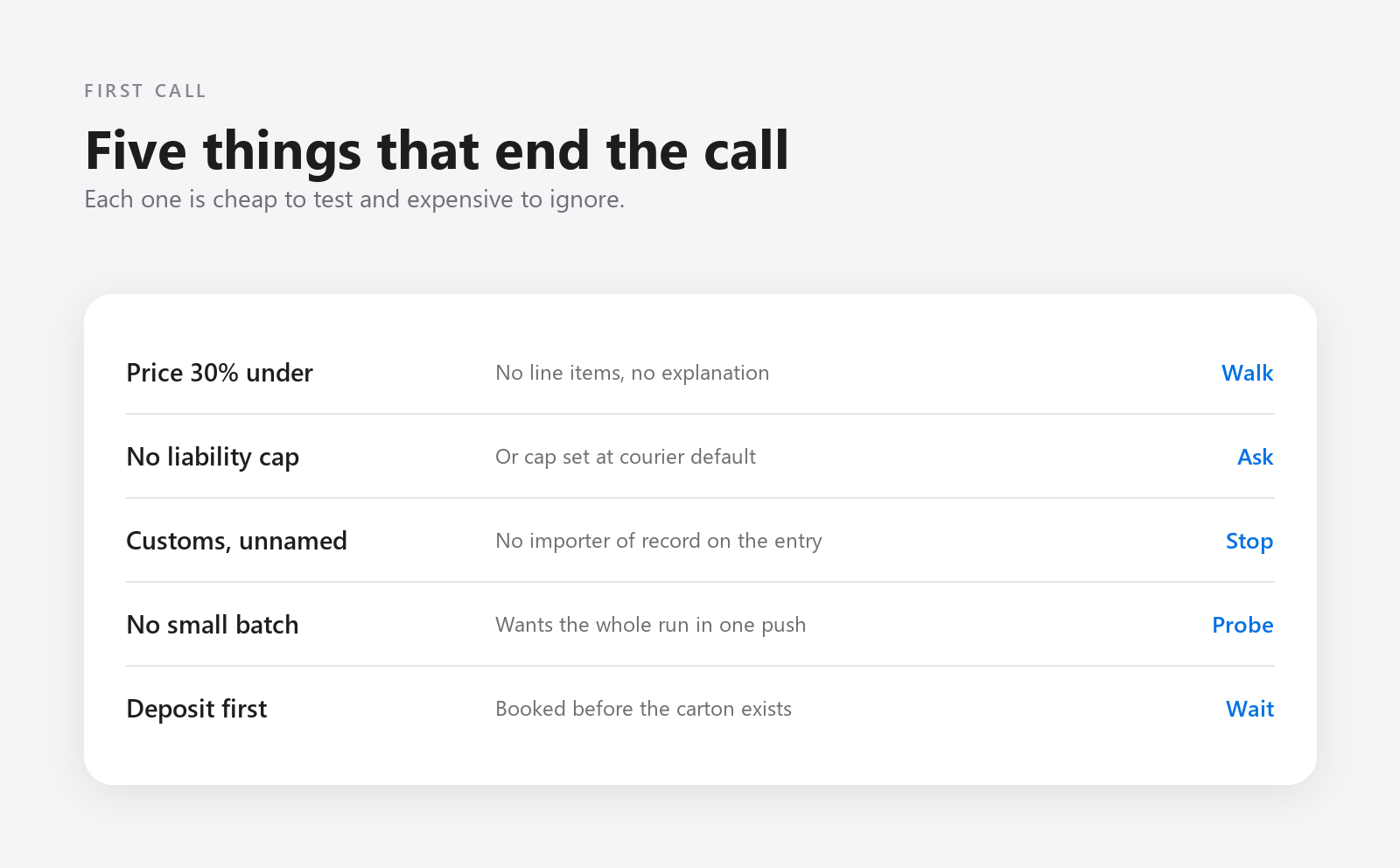
- A price per parcel 30% below everyone else's, with no line-item breakdown. Loss-leading rates here tend to be funded by someone else's cargo, until the funding runs out.
- No written liability cap, or a cap set at the courier's default — usually a fraction of what the backer paid.
- "We will handle customs" with no importer-of-record named. Somebody's name is on that entry; it should be a decision, not a surprise.
- No appetite for a first small batch. A provider that wants the whole run at once is optimizing their labour, not your risk.
- Pressure to book capacity before a carton spec exists. Capacity pressure is real in peak season; a deposit before the box does is not.
The short version
You are not buying warehousing. You are buying a sequence: goods in, counted, cleared, released in dated batches, exceptions closed. Price it by unit, test it with a wave plan, check the four operational numbers before you sign.
One more thing, plainly: if your campaign promises a delivery date, treat it as a shipping commitment with a refund attached, not a marketing estimate. In the US, the Mail, Internet, or Telephone Order Merchandise Rule requires a reasonable basis for a stated shipping date and a refund path when you miss it — whether a reward campaign falls inside that rule depends on the offer's structure, which is a question for your lawyer, not your warehouse.
If you are comparing providers and want a second read on their wave plans, send the two schedules with the parcel counts. We will tell you which one survives contact with a factory.
References (Neutral Third-Party Sources)
Platform documentation, a government rule and public sources only. Every link below is nofollow; no fulfillment provider is cited or named.
- Kickstarter Creator Handbook — Fulfillment: the 500-package threshold for working with a fulfillment partner, the 3% inventory overage, address collection after funding, and the customs-broker pointer. https://www.kickstarter.com/help/handbook/fulfillment
- Kickstarter Help — How can I get my backers' information to fulfill rewards?: survey and pledge-manager reminder cadence and the Apple private relay limitation, which decide how complete your order file is before dispatch. https://help.kickstarter.com/en-us/articles/16236402
- Indiegogo Help — How to Manage Access and Close Your Pledge Manager: Shipping Only mode, soft close versus permanent hard close, and the add-on toggle, which set the date after which an address change becomes a reship. https://help.indiegogo.com/article/479-closing-pledge-manager
- Indiegogo Help — Shipping Stages (Multi-Wave Shipping): how a run is split into waves, and the warning that a stage status change cannot be undone. https://help.indiegogo.com/article/627-shipping-stages-multi-wave-shipping
- U.S. Federal Trade Commission — Business Guide to the FTC's Mail, Internet, or Telephone Order Merchandise Rule: the 30-day shipping rule, the requirement for a reasonable basis for any stated shipping date, and refund obligations when a date is missed. https://www.ftc.gov/business-guidance/resources/business-guide-ftcs-mail-internet-or-telephone-order-merchandise-rule
- Indiegogo — Fees: platform and processing charges that apply to the shipping money collected through a pledge manager. https://www.indiegogo.com/info/fees