
Corporate Gift Boxes: How to Build Branded Gift Kits at Scale
Fifty gift boxes is a purchase. Five thousand is a production line. Below about 300 units you can assemble on a table, with a spreadsheet and two people who care. Above roughly 800, the work changes shape: components arrive on pallets, one late item stops the whole run, and the document that decides whether the programme succeeds is not the design proof. It is the packing list.
Most gift box programmes fail on a component that arrived a week late, a card paired with the wrong name, or a dispatch list sorted by surname instead of carrier.
A box is a bill of materials with a deadline
Five thousand boxes with five components each is 25,000 picks, 5,000 assemblies and 5,000 pairings. At that volume, "roughly" and "about right" turn into hundreds of reworks.
So the first artefact is not a box. It is a bill of materials: shell, insert, filler, quantity per SKU, card version, outer carton specification. Every line needs an owner and an arrival date. One missing line stops the line, and a stopped line is expensive by the hour.
Tooling first: the dieline decides the programme
The dieline — the cutting and creasing drawing that decides how the box folds — locks everything downstream: print method, insert, outer carton, pallet count. Changing the box shape later is not a design revision. It is a new die.
That is why the first month of a gift box project is usually prototyping, not production. Chinese suppliers quote two ways, and both describe the same cost structure: a 500-unit minimum, or 30 units at roughly 50% more per unit. One die, one proof, one labour setup — none of it halves at 30.
Lead time follows. Bulk runs 30 days from scheduling through inspection and freight; small batches often ship in 7 to 15 days. When the delivery date is fixed, choose the process before you negotiate the price. Projects that do it the other way round finish in a rush.
MOQ is a price curve, not a wall
Minimum order quantity — the smallest run a factory will accept without a surcharge — is usually negotiable in process rather than in volume. Below is what actually changes as the quantity steps up.
| Quantity | Print method | Tooling and proof | Assembly | Packaging cost per box |
|---|---|---|---|---|
| 50 | Digital, no plates | Charged per run, never amortised | One table, one or two people | Highest, up to 15% of contents |
| 500 | Digital or short-run offset | Starts to amortise | Three or four stations | Clearly lower |
| 2,000 | Offset, spot colours viable | Negligible per unit | Short line, five or six stations | Near normal |
| 5,000 | Offset plus foil or UV | Cents per box | Full line with a QC station | Lowest, but labour share rises |
The useful move is not haggling the quantity down. It is swapping the process: foil stamping to laser engraving, spot colour to single black, rigid box to corrugated with a printed wrap. At 300 units that keeps the unit price sane.
Volume also decides who builds it. Under about 300 boxes, assemble in-house: a meeting room, a few tables, two evenings, and your own labour beats any minimum. Between 300 and 800 is the awkward band, where in-house costs a week of attention and outsourced volume is too small for a price break. Above 800, outsourcing pulls ahead, because packaging, labour and freight all get cheaper at once.
The packing list is the product
On a 5,000-box programme the master document is not the artwork. It is the packing list, and it needs six columns: recipient, full address and phone, SKU with size or colour, card number, carton ID, carrier.
Three rules:
- One row per recipient. No merged cells, no "plus one" in a cell.
- The carton ID on the list matches the carton ID on the box. This is what SSCC codes do — one unique identifier per logistic unit, whether that unit is a case, a pallet or a parcel — so a scan answers "whose box is this" without opening it.
- Write the freeze date into the schedule. Five business days before dispatch, addresses can still change; contents cannot. A contents change means re-picking that row.
The last handshake is the shipping label. Mature operations scan it against the order a second time, and if the barcodes disagree the label will not print. That one rule blocks the most expensive error in gifting: A's gift wearing B's address.
Cards get paired, not printed
The card is the only component whose failure is invisible. A wrong box gets questioned. A wrong card gets silence.
Two methods:
- Variable-data printing. Name plus a personalised line, printed from the list. Fast, and the right choice above roughly 500 boxes. It inherits every flaw in the list, in ink.
- Handwriting. Realistic between 50 and 200 cards. Past that, split the stack across several writers; the variation reads as authenticity.
Either way, pairing happens at one station. Number the cards in packing-list order, then apply the name label, drop the card, close the lid, one box at a time. Carrying cards to a separate room to be matched later is the single most reliable way to produce mismatches.
Build stations, not heroics
Five thousand boxes over ten working days, eight hours a day, at 85% productive time, is 1.23 boxes per minute — 49 seconds per box. Any station slower than that is the bottleneck, however hard the team works.
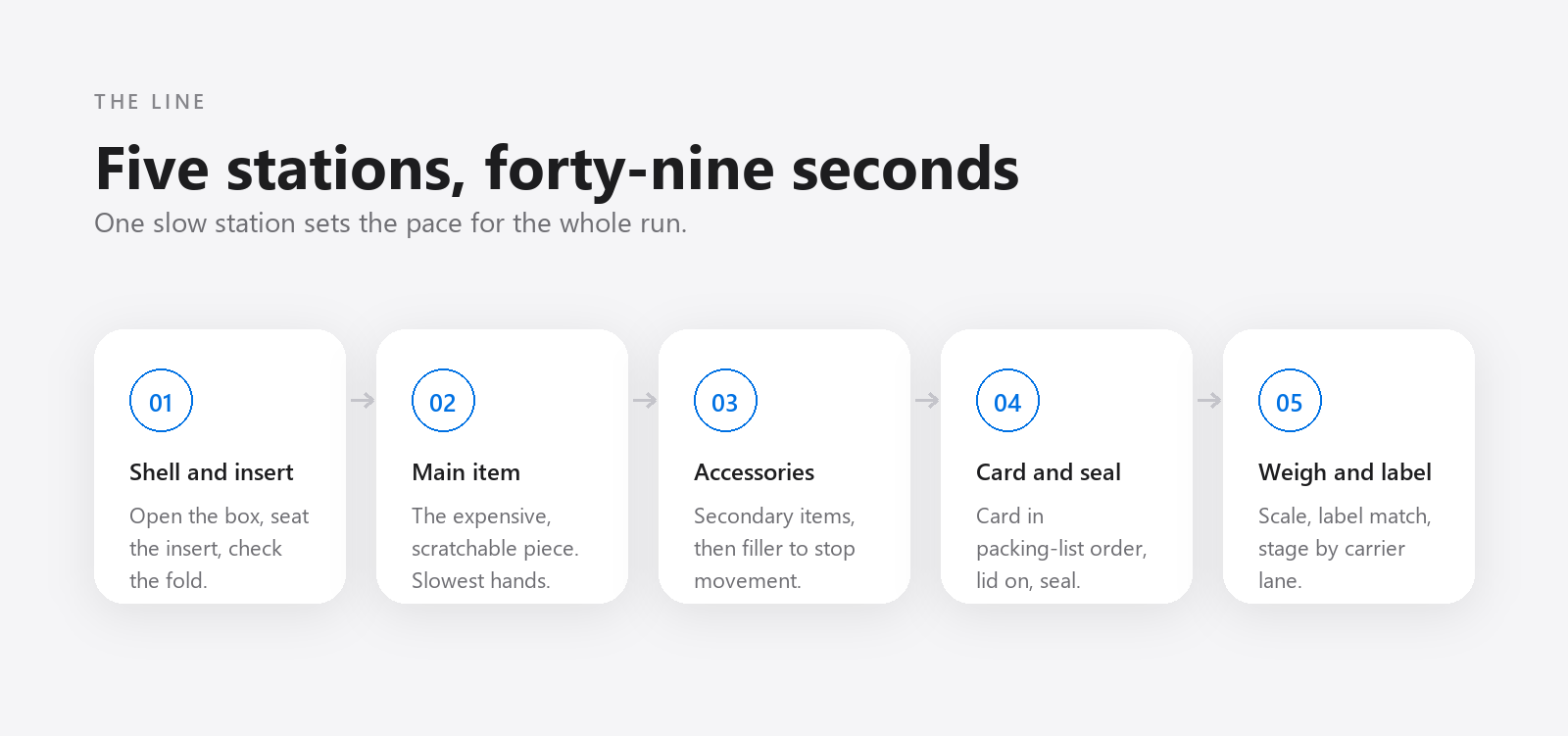
Five:
- Open the shell and seat the insert.
- Place the main item — the expensive, scratchable one, always at this station.
- Add accessories and filler.
- Card in, lid on, seal.
- Weigh, label, stage by carrier.
Staff the two accuracy-critical stations with experienced people on piece rate plus an accuracy bonus; in warehouse practice that supports a pay gap of about 30% over general hands, and it keeps the people who protect quality. Fill opening, filling and staging from a flexible pool booked about seven days ahead, trained in half a day because the system checks the work, not their memory. New starters reach veteran accuracy in about three days when scanning does the verifying.
Before the real dispatch, run the line on 50 boxes: clocked, weighed, three of them opened and checked. The station that jams and the step that gets skipped both show up within the hour.
One detail decides whether 49 seconds survives contact: where the stock sits. Fast-moving positions beside the bench need to turn at least three times a day, and anything unmoved for seven days gets cleared out. A pallet of shells ten metres away turns 49 seconds into 70.
Sort by address, not by name
Finished boxes stacked alphabetically will be handled twice. Sort by lane instead.
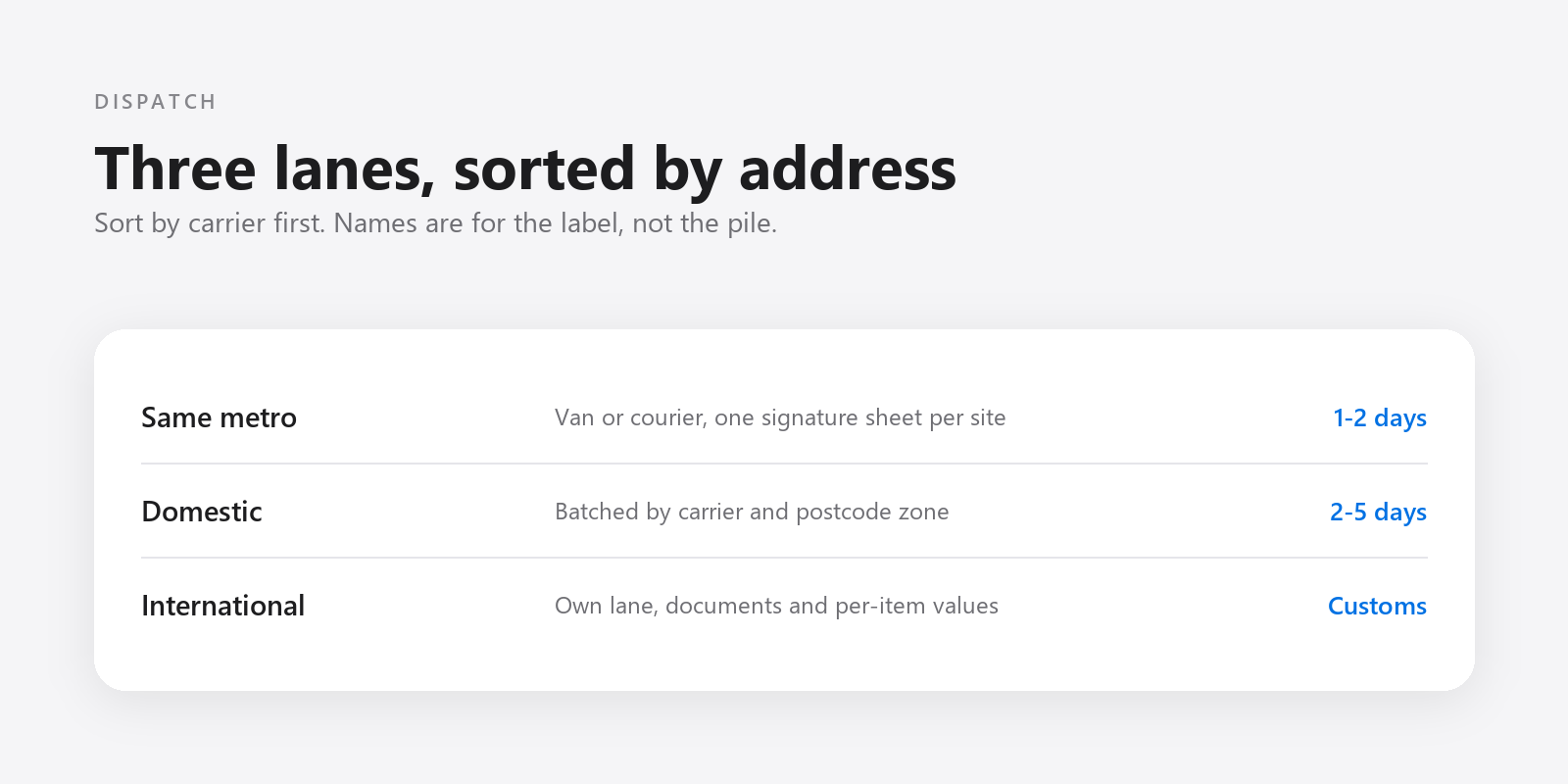
- Same metro. Local courier or a van to the office, consolidated by building or department, with one signature sheet.
- Domestic. Batched by carrier and postcode, one cage per zone.
- International. Its own lane, documents travelling with the carton. Every item needs a specific description and its own value — "gift set" is not a description customs will accept. Mixed boxes also raise classification: a set is classified by the item that gives it its essential character, so the duty can land on the main component.
International is usually 5–10% of the list and 30–40% of the admin time. A separate lane costs an afternoon of planning and saves a week of exceptions.
The weight gate is the cheapest insurance
A good warehouse picks at under 0.3% error. A gift programme should be specified around 0.005%, five errors in a hundred thousand. The gap becomes concrete when multiplied:
- 25,000 picks at 0.3% is 75 wrong items, and potentially 75 spoiled boxes.
- 5,000 boxes at 0.005% is 0.25 of a box, which is another way of saying "none".
Three independent checks get you there: scan the SKU at pick, weigh the assembled box, and match the label to the order before it prints. A tolerance of about 5 grams is tight enough to catch a missing accessory and loose enough not to fire on a slightly heavier insert. The Gifting at Scale cannot tell you the colour is wrong. It catches most of the missing and extra items, which is where most of the money goes.
What a box costs, line by line
| Cost line | Planning range | Sensitive to volume |
|---|---|---|
| Outer box, printed | $1.20–$4.50 | Strongly, via MOQ |
| Insert and filler | $0.35–$1.20 | Moderately |
| Card and print | $0.15–$0.60 | Weakly |
| Assembly labour | $0.80–$2.50 | Strongly, priced by the minute |
| Pick and check | $0.60–$1.80 | Moderately |
| Outer carton and void fill | $0.40–$1.10 | Moderately |
| Domestic last mile | $6–$12 | Weakly |
| Replacement reserve | 2–3% of volume | Fixed ratio |
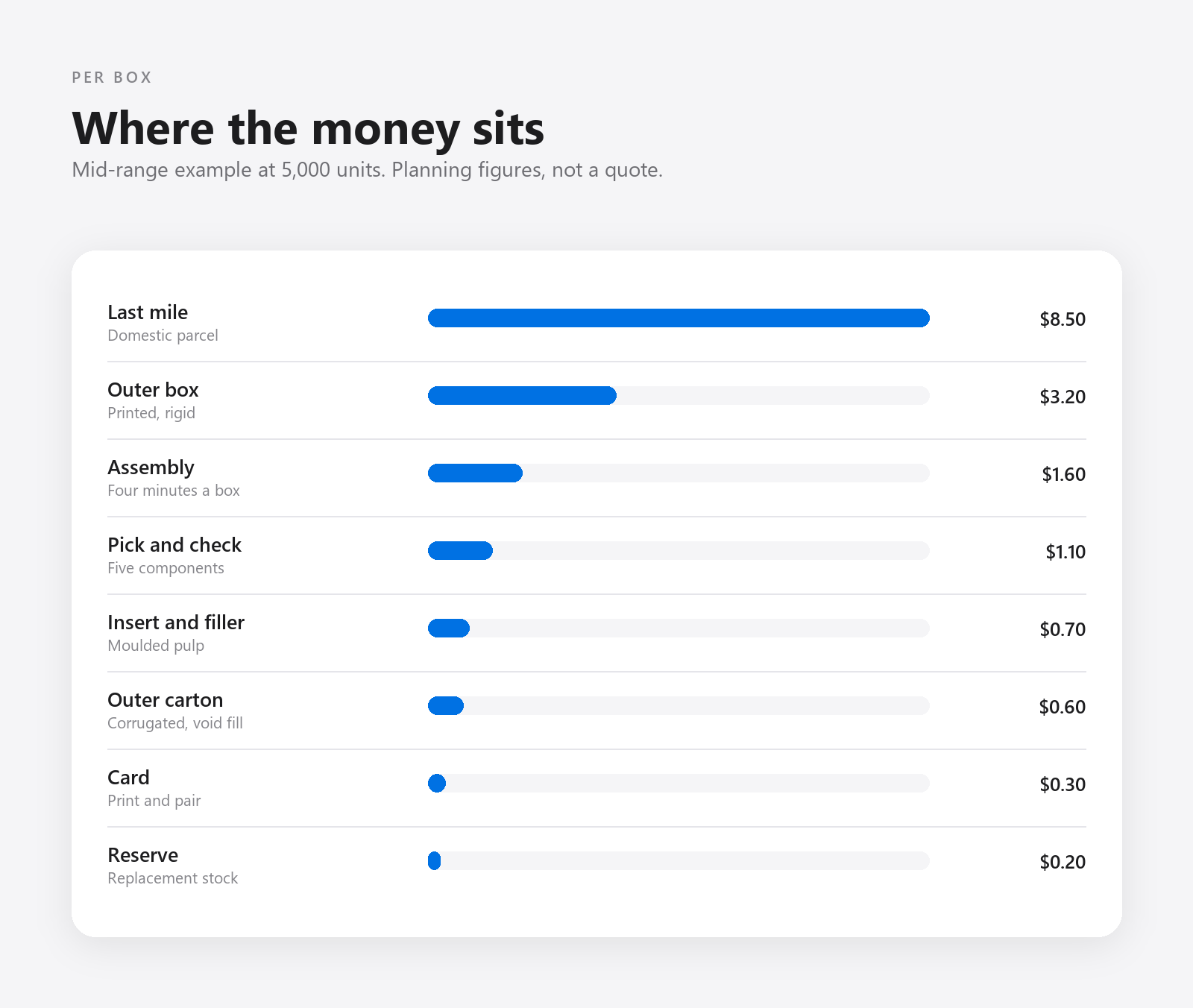
Labour anchors to public data: US stockers and order fillers averaged $15.87 an hour in May 2021, so a four-minute box carries about $1.06 of direct labour before benefits. Stretching that to six minutes costs an extra $2,650 across 5,000 boxes — usually more than a nicer shell.
Packaging maths only counts when multiplied out. Saving 0.3 yuan per box is 1,500 yuan across 5,000 boxes; the same saving at 100,000 orders a day is 30,000 yuan a day. Negotiate the line with the largest total, not the most impressive unit.
The short version
Gift box programmes fail on components, cards and addresses, not on taste. Fifty boxes run on people; five thousand run on three documents — the packing list, the card pairing sheet and the dispatch lane plan. Build those first, and the line holds at 49 seconds.
If you have a headcount, an address split and a fixed delivery date, send them over. We will come back with a station and lane plan before we discuss the per-box price.
References (Neutral Third-Party Sources)
- U.S. Bureau of Labor Statistics — Occupational Employment and Wages, May 2021: Stockers and Order Fillers (53-7065): mean hourly wage of $15.87, median $14.48, and 338,100 employed in warehousing and storage, used for the per-box labour arithmetic. https://www.bls.gov/oes/2021/may/oes537065.htm
- GS1 — Serial Shipping Container Code (SSCC): one unique identifier per logistic unit, whether case, pallet or parcel, which is what lets a carton ID match a packing-list row. https://www.gs1.org/standards/id-keys/sscc
- International Trade Administration — Harmonized System (HS) Codes: how six-digit classification drives duty, and how goods sold as a set are classified by essential character. https://www.trade.gov/harmonized-system-hs-codes
- USPS — Customs Forms: per-item value and specific description requirements for international parcels. https://www.usps.com/international/customs-forms.htm