
Client Appreciation Gifts: 20 Ideas to Strengthen Relationships
A client Employee Appreciation gift is judged by its date, not its price. A bottle of wine that arrives the week a contract closes says something. The same bottle, delivered eight weeks later with no note, says the opposite: that someone remembered the account existed and delegated the remembering.
Most gifting advice starts with the object. This starts with the calendar, the list and the address, then gives twenty ideas pinned to the moments where they make sense.
Why client appreciation Thank You Gifts fail on the calendar
There are four windows in a client relationship where a gift reads as deliberate rather than random. Outside those windows, the same spend produces a polite email and a drawer.
The failure is usually logistical. Suppliers quote 7–15 days for a small custom batch and 30 days or more for a full run, because a large order is slotted into a factory's existing schedule. Add a week for addresses and two for transit and the parcel that goes missing: five to six weeks from decision to delivery. Most teams start three days before the date.
Four triggers worth putting in a calendar
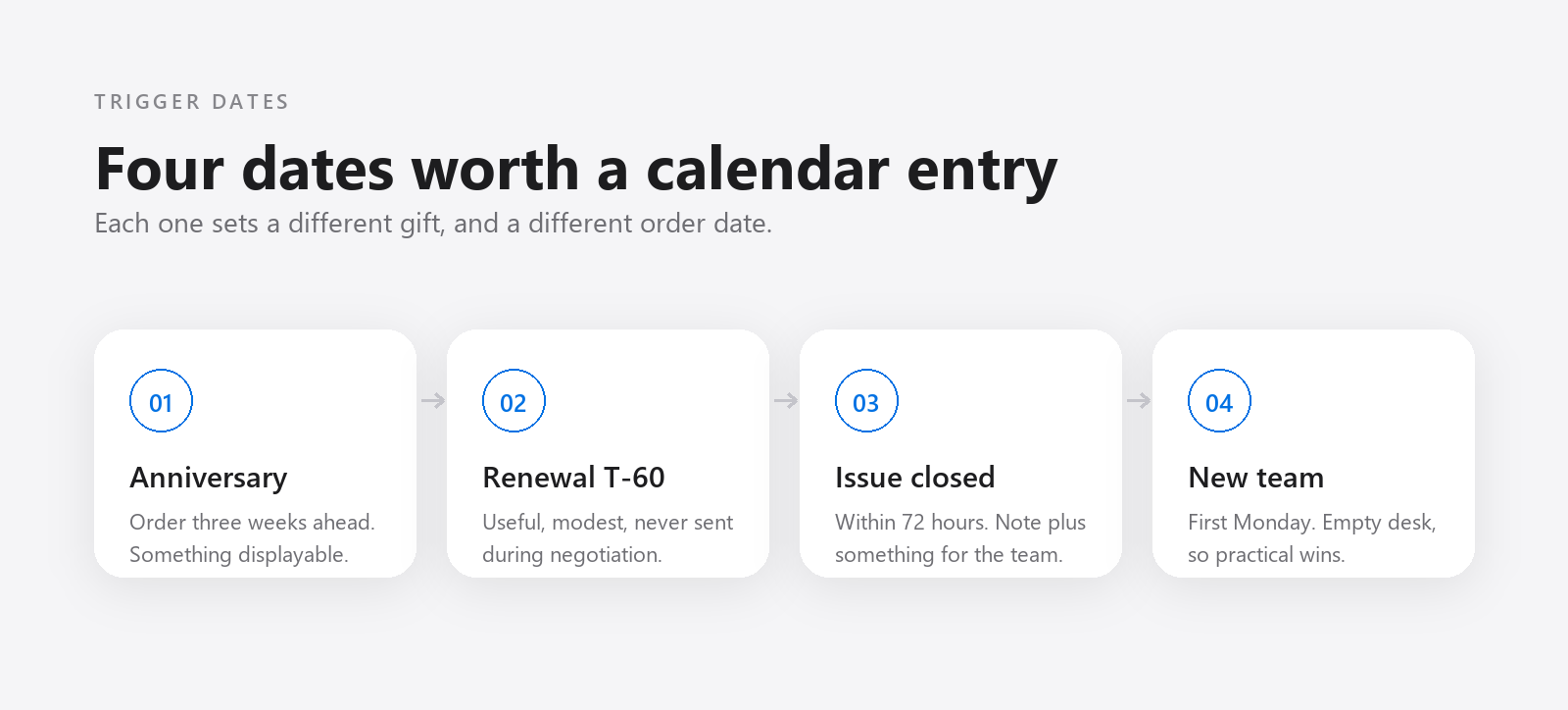
Signing anniversary. The date is in the contract, so there is no excuse for missing it. Order three weeks ahead, and choose something displayable that carries the year.
Sixty days before renewal. The highest-leverage window, and the easiest to ruin. At T-60 a gift reads as "we are thinking about next year"; at T-10 it reads as pressure, or in regulated industries as a compliance problem.
Within 72 hours of fixing a problem. A refund closes a ticket; a small gift and a handwritten note close the memory of it. Wait for the quarterly review and the recipient has already filed you under "resolved, eventually."
The week a new team takes over the account. Send something for the first Monday, when useful beats beautiful: the recipient has an empty desk and no stapler.
Twenty ideas, sorted by the moment they fit
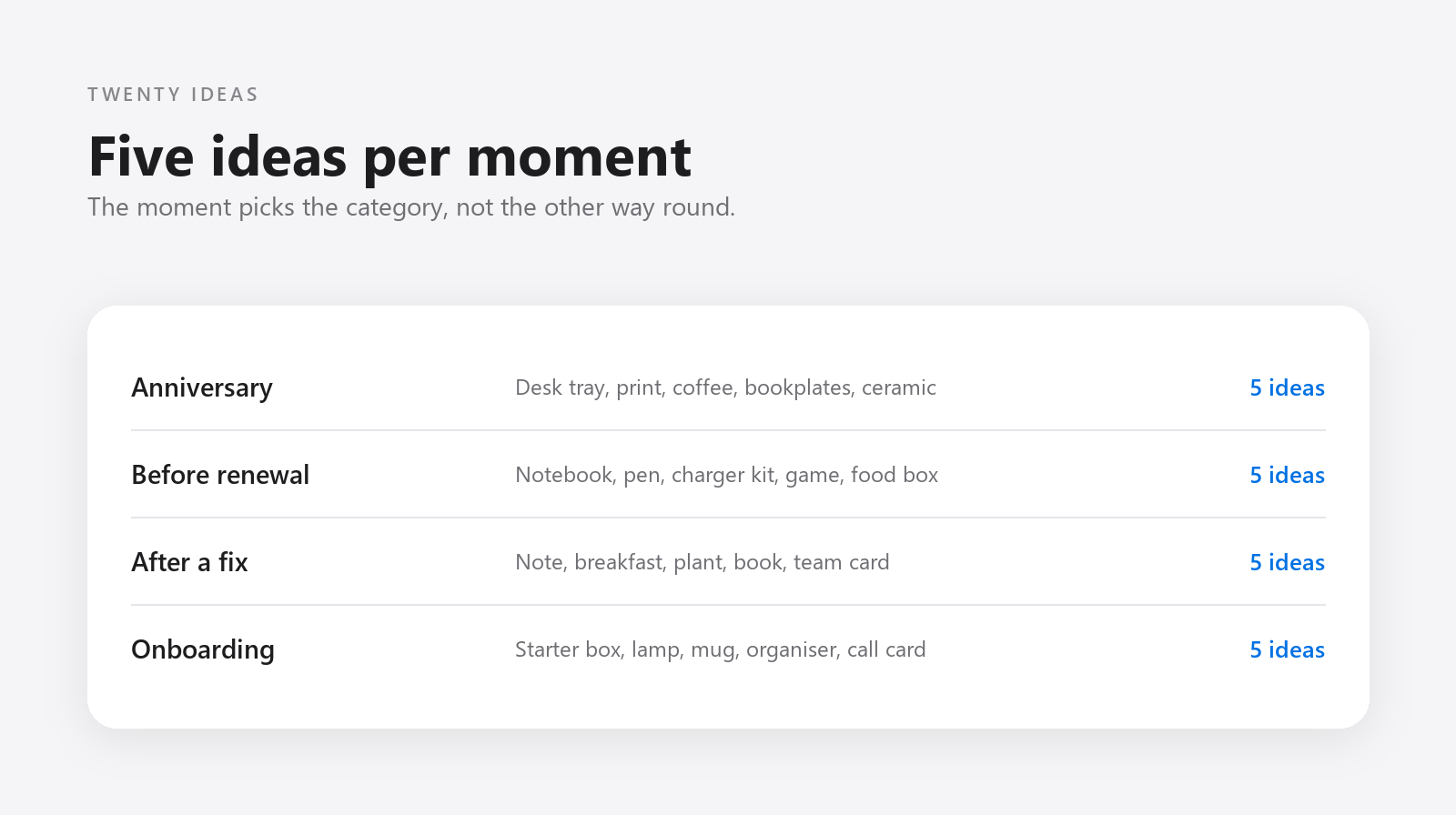
Anniversary (displayable, dated)
- A leather desk tray, year debossed inside the lid.
- A framed print by a local artist, sized for a shelf.
- A coffee subscription starting on the anniversary date.
- A custom bookplate set with their name.
- A small ceramic piece, with a card naming the maker.
Sixty days before renewal (useful, never expensive-looking)
- A refillable notebook with a spare insert.
- A good pen, engraved on the barrel rather than the cap.
- A desk charger kit that removes one daily annoyance.
- A two-person game for the account team, not the executive.
- A seasonal food box sized for an office kitchen.
Problem resolved (immediate, human)
- A handwritten note on good paper, sent by courier.
- Coffee and pastries for their team the next morning.
- A plant with a care card, for whoever worked the weekend.
- A book on the problem you just solved, key chapter marked.
- A modest team gift card, only where policy allows cash-equivalents.
Onboarding (empty-desk practical)
- A notebook, pen and sticky notes in one box.
- A desk lamp, for the person reading contracts at 7pm.
- A good mug, plus real coffee to put in it.
- A cable organiser and phone stand, for a desk with neither.
- A printed "who to call" card with direct numbers.
The anchor matters more than the category: a 39.8-yuan gift box that buyers describe as looking twice the price beats an expensive object in a plain carton.
Tier the account list before you buy anything
The most common failure in a gifting programme is not the wrong object. It is the same account receiving three gifts while forty receive none, because three people in the company each acted independently.
Tier the book first, then let the tier set the cap.
| Tier | Share of accounts | Per-gift cap | Annual cap | Who approves |
|---|---|---|---|---|
| A — strategic | Top 5% | $100–200 | $300 | Sales lead plus finance |
| B — growth | Next 20% | $50–100 | $150 | Sales lead |
| C — standard | Remaining 75% | $20–40 | $60 | Account owner |
| Public sector | Any | $20 per occasion | $50 | Compliance, before ordering |
Two notes. The C tier is where the volume is, and where a $25 consumable beats a $100 object, because the recipient compares it with nothing. The public-sector row is not optional: U.S. federal Swag Ideas Employees are capped at $20 per occasion and $50 per year from one source, cash is barred, and bank-issued gift cards count as cash.
Minimum order quantities complicate the tiering. Factories typically run 500 units and accept 30 at a 50% unit premium, because tooling and sample costs do not scale down. If A and B total 40 people, you either pay the premium or buy 500 and store 460. Both are defensible; not deciding is not.
Where the address comes from
The gift is only as good as the label, and the label is usually the weakest link.
Office reception, with a phone number. This is the default for anything going to a company address. Someone signs, someone can be called, and a parcel that arrives on a Friday does not sit in a lobby until Monday. Put the recipient's name and the company name on the label, and the reception number as the contact — not yours.
The client's assistant. Useful when the recipient travels, unreliable when the assistant changes jobs. Confirm the address in writing the same week you ship.
A home address. Only when the client gave it themselves. One collected from a website, a badge or a CRM field is a privacy problem, not a convenience — and a gift opened in front of a family should not look like a sales document.
Whichever route you use, the dispatch step needs a second pair of eyes: pack to the carrier's requirement, print the label, then check that order, goods and label match. Errors caught there cost a reprint; errors caught at the door cost a replacement.
DDP or DDU: who pays at the door
Cross-border gifting has one decision that outweighs every aesthetic choice: does the recipient have to pay to receive the parcel?
Under DDP the sender clears the goods and pays duty and import tax. Under DAP (still called DDU by most forwarders) the recipient is the importer of record, so duty and tax are collected before release. The duty is identical; only the message asking for money changes hands.
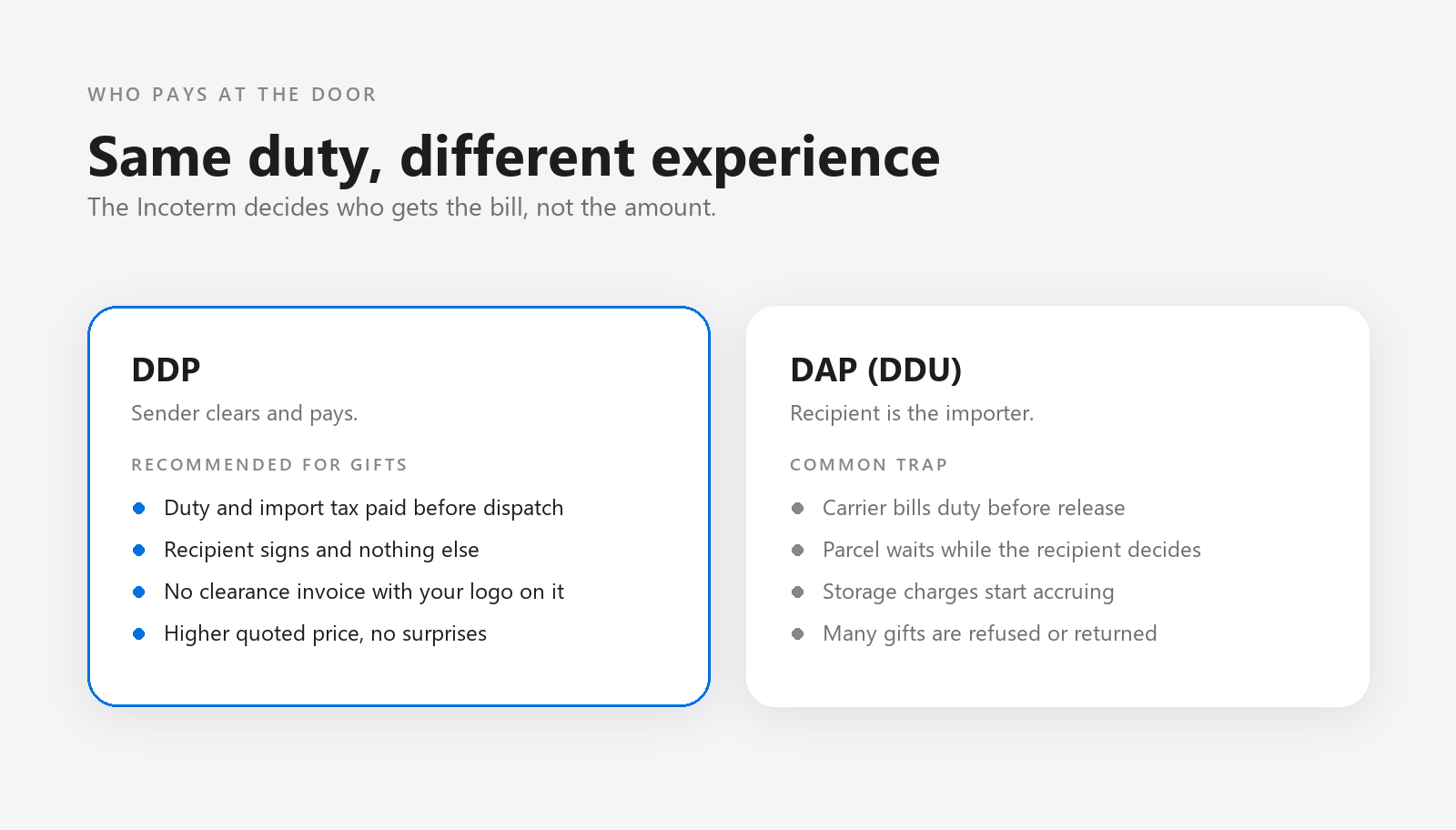
For a gift, DDP is the default and DDU is a mistake. A client paying $34 in duty to collect a $90 hamper is not receiving a gift. They are receiving an invoice with your logo on it. On heavy gifts the freight is the bigger surprise: a set over 10kg can cost more than $100 per delivery on an international lane, which is why DDP quotes for food and drink hampers look so high.
Two paperwork details decide between smooth clearance and a held parcel:
- Describe the goods, not the gesture. "Gift" as a description is a customs flag. Each item needs a plain description of what it is, what it is made of, and what it is for.
- Declare per item. Customs works line by line. Marking a $150 item as $20 is a misdeclaration, and under DDP the penalty lands on the sender.
Most markets have a duty-free threshold; in the US the allowance for bona fide gifts is lower than the commercial one. Confirm the figure for the lane.
Three ways a gift never arrives, and one that comes back
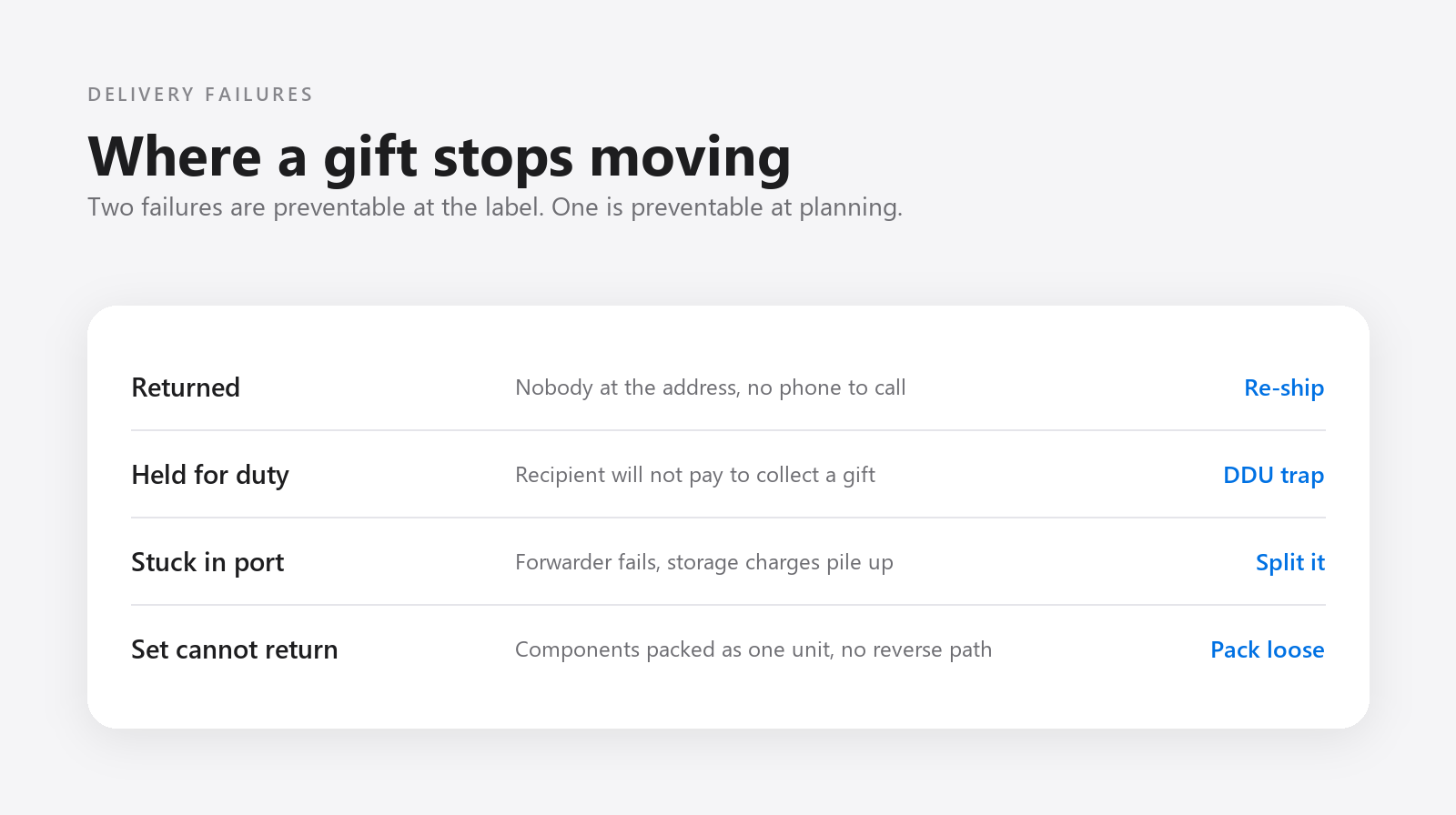
Returned, because nobody was there. Undeliverable parcels come back and are re-shipped at full cost or written off. The fix is unglamorous: a phone number on the label, a ship day that is not Friday, an email the day before.
Held for duty the recipient will not pay. The DDU failure in practice: the parcel sits in a clearance facility, the payment request looks like a scam, and three weeks later it goes back. Prepaying duty removes the scenario.
Stuck in a batch that never clears. When a forwarder's finances fail, containers sit at the port while storage charges accumulate daily; in one widely reported case, customers were asked to pay to redeem their own containers. Gift volumes are small enough to split — if someone decides to split them before the season.
A fourth, quieter failure: the gift that cannot be returned. A set assembled from several products is sold as one unit, so a return means unpacking it and shipping components separately. If a gift might come back, pack and label the components individually.
A dispatch checklist that fits on one page
| Check | Why it fails without it |
|---|---|
| Recipient, company, and a phone that is answered | Couriers call the number on the label, not the CRM |
| Address confirmed in writing this week | Assistants change; floors get renumbered |
| Item description in plain words | "Gift" alone invites a hold |
| Declared value per item | One total blocks clearance |
| Duty terms stated (DDP or DAP) | Decides whether the recipient pays |
| Ship date and arrival date both written down | A gift that misses the date is a refund |
| 10% spares for damage and re-sends | A second run at 30 units costs a 50% premium |
| One owner per shipment, by name | Shared ownership means nobody checks the label |
Two habits sit behind it. Batch shipments by week: one consolidated dispatch is cheaper than twenty parcels. And keep tracking numbers in the recipient sheet, so "did it arrive?" is a lookup.
The short version
Put the four dates in a calendar and work backwards five weeks. Tier the list before anyone shops. Send to a reception desk with a phone number, prepay the duty, describe the contents honestly, and check the label against the goods before the parcel leaves.
If you are planning a season of gifts and the list is still moving, send the tier counts and the delivery month. We will come back with a dispatch schedule and a landed cost per parcel.
References (Neutral Third-Party Sources)
Facts were checked against trade rules, carrier documentation and public regulations. No gift platform or fulfillment provider is cited.
- International Chamber of Commerce — Incoterms® 2020: the eleven rules, including DDP and DAP, and how cost, risk and clearance obligations move between seller and buyer. https://iccwbo.org/resources-for-business/incoterms-rules/incoterms-2020/
- USPS — Customs Forms: per-item value declaration, the requirement for specific content descriptions, and how HS codes are assigned. https://www.usps.com/international/customs-forms.htm
- Cornell Legal Information Institute — 19 U.S.C. § 1321: the statutory low-value import exemption and the separate, lower allowance for bona fide gifts. https://www.law.cornell.edu/uscode/text/19/1321
- Federal Trade Commission — Mail, Internet, or Telephone Order Merchandise Rule: the 30-day shipping baseline when no date is promised, and the consent-or-refund requirement when a shipment slips. https://www.ftc.gov/legal-library/browse/rules/mail-internet-or-telephone-order-merchandise-rule
- International Trade Administration — Harmonized System (HS) Codes: how goods are classified for duty, including sets and composite goods. https://www.trade.gov/harmonized-system-hs-codes
- eCFR — 5 CFR § 2635.204: the $20 per occasion and $50 per year gift limits for federal employees, the bar on cash, and the treatment of gift cards. https://www.ecfr.gov/current/title-5/chapter-I/subchapter-B/part-2635/subpart-B/section-2635.204