
Thank You Gifts for Clients: 15 Memorable Ideas
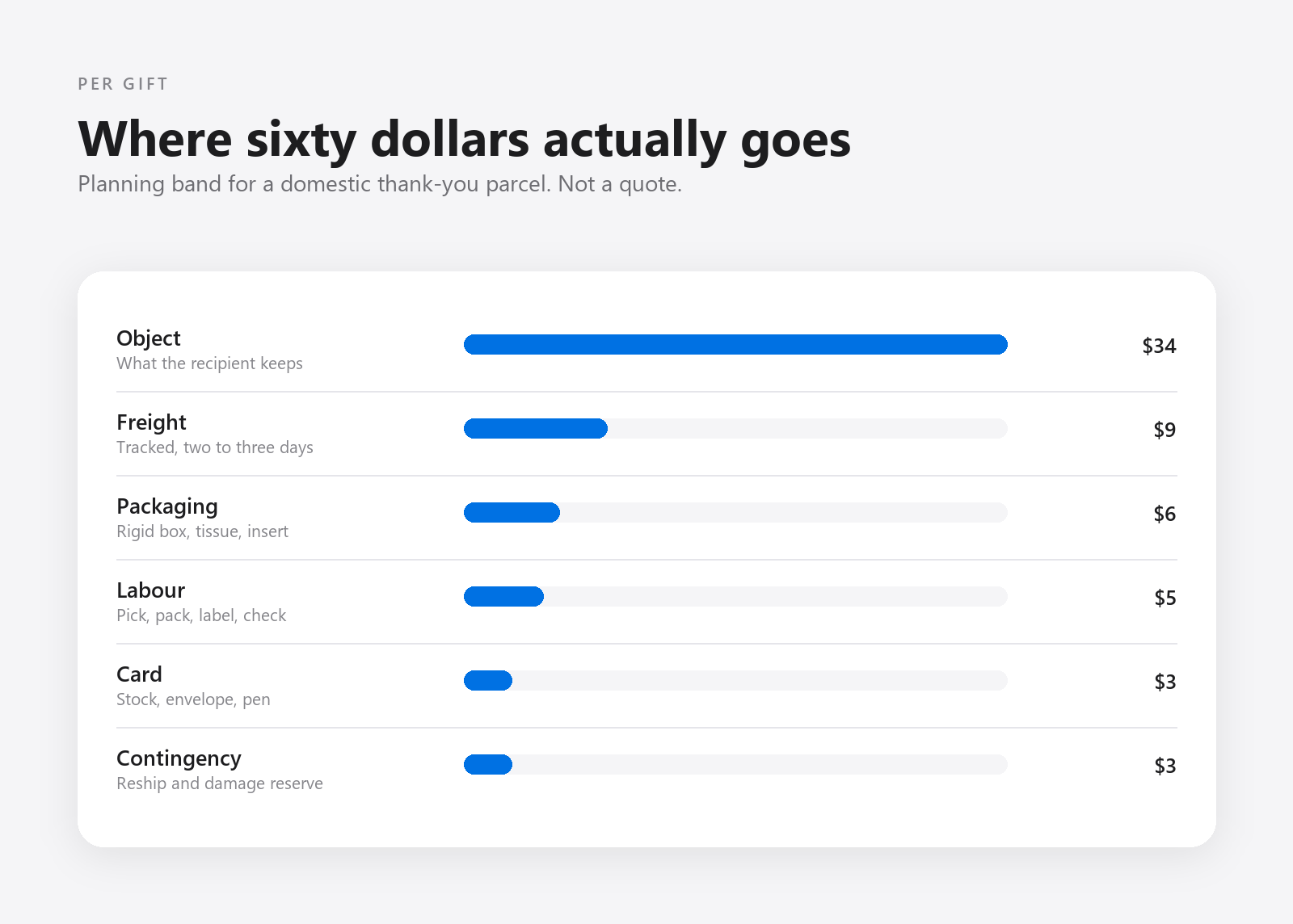
A thank-you gift has one job: arrive while the reason for it is still fresh. A $40 object delivered in two days beats a $200 object delivered in three weeks — the first is a memory of the thing you did together, the second is a memory of a box.
That constraint — fast, cheap, specific — eliminates most of the gifting advice online, which is organised around what to buy rather than when it lands. Below: fifteen things that work in the $20–$80 band, three ways to hit 48 hours, and the part that decides whether any of it matters, which is what the card says.
Why the band is $20 to $80
Below $20, the object starts speaking for itself, and what it says is "merchandise." Above $80, the recipient starts wondering whether they need to declare it, and you start explaining why you spent that much.
There is a practical reason for the floor. Small-batch customisation carries fixed costs that do not shrink — a tooling setup, a sample run, a scheduling slot. Suppliers answer either with a 500-unit minimum or with a 30-unit run at roughly a 50% per-unit premium. At thank-you volumes, you are always paying that premium, so the per-unit price has a floor no negotiation removes.
So the number to compare is unit price times quantity. Ten Luxury Corporate Gifts at $40 and two gifts at $200 are the same money and five times the number of relationships touched. Most programmes that feel expensive are not spending too much per gift; they are spending it on too few people.
Fifteen ideas that survive the band
The test is not "is it unusual." It is "will this still be in their life in ninety days." Anything that fails that test is a donation to a cupboard.
| Gift | Cost | Best for | Watch out |
|---|---|---|---|
| Two bags of single-origin coffee | $26–32 | Anyone with a grinder | Check whether they drink coffee at all |
| Loose-leaf tea set with a strainer | $22–28 | Non-coffee drinkers | Avoid scented blends as a default |
| Good olive oil and flaky salt | $28–36 | Clients who cook | Glass; pack it properly |
| Notebook and machined pen | $32–40 | Anyone in meetings | Skip if it carries a big logo |
| Desk plant in a ceramic pot | $26–34 | Office-based clients | Some offices ban soil plants |
| Beeswax candle pair | $24–30 | Home offices | Scent is personal; keep it neutral |
| Stone or marble coasters | $30–38 | Anyone with a desk | Heavy; dimensional weight bites |
| Plain insulated tumbler | $28–36 | Commuters | No logo, or a small one |
| Cocktail kit: jigger, spoon, bitters | $45–58 | Clients who entertain | Bitters contain alcohol; check the lane |
| Two-player board game | $32–45 | Close working relationships | Reads as personal, not corporate |
| Engraved kitchen board | $40–55 | Closing gifts, house moves | Heavy and awkward to ship |
| Wireless charging pad | $38–48 | Anyone with a phone | Electronics need a compliant lane |
| Framed letterpress print | $45–65 | Design-literate clients | Taste risk; pick abstract |
| Leather card holder | $55–75 | Senior contacts | Sizing and personalisation add days |
| Three-month coffee subscription | $60–80 | Long relationships | First shipment only counts as the gift |
Two rows deserve a warning: the engraved board is heavy and the charging pad is regulated, so both are likelier to arrive late. If the date is fixed, How to Choose the tea.
Who gets one, and who doesn't
Segment by what happened this year, not by title. Four groups: people who went out of their way for you, people who just signed, people who just renewed, and everyone else.
The first three get something. The fourth group gets nothing, and that is a decision rather than an oversight — a gift with no reason behind it reads as a mailing list, and the recipient can tell.
At 200 names, a $40 gift is $8,000 plus freight; at 40 names it is $1,600, and you can afford the card stock, the tissue and the time to write properly. Programmes usually improve when the list shrinks.
48 hours is a radius, not a promise
"Arrives in 48 hours" is routine in domestic e-commerce and fiction almost everywhere else. It holds when the goods are already sitting in a warehouse within a few hundred miles of the recipient.
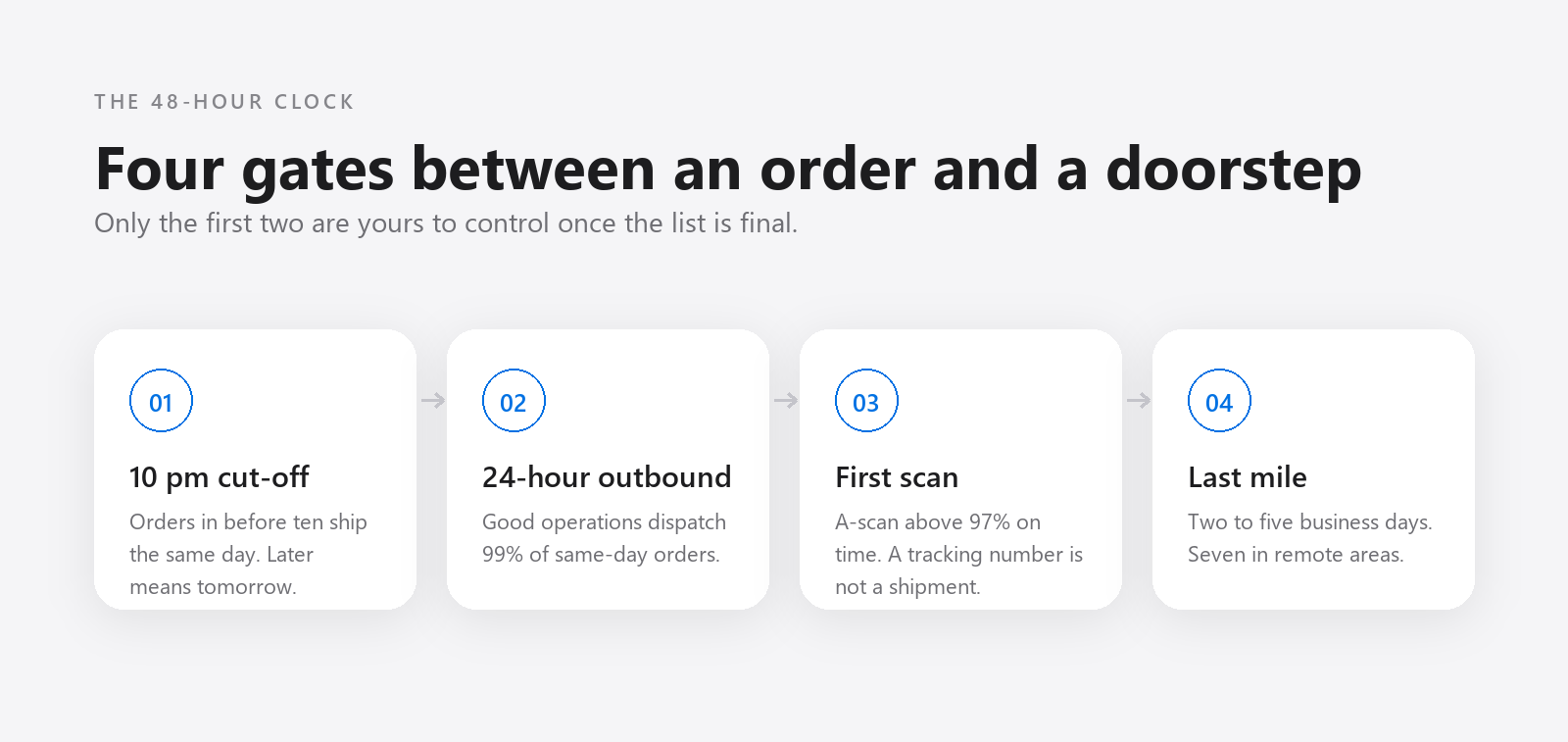
Three numbers decide whether it holds, and all three are warehouse numbers rather than carrier numbers:
- Cut-off — orders received before 10pm ship the same day. Miss it and you have lost a full day, not an hour.
- Outbound — 24 hours from order to dispatch. Good operations hold a 99% same-day dispatch rate.
- A-scan — the carrier's first physical scan, running above 97% on time. A tracking number is not a shipment; an A-scan is.
After that the parcel is on the last mile, which runs 2–5 business days domestically and up to 7 in remote areas. So the honest version of "48 hours" is: same metro, yes; same state, usually; cross-country, three to five days; cross-border, two weeks and a customs conversation.
Packing moves the price as much as the carrier does. Priority Mail bills on dimensional weight with a 139 divisor and rounds fractions of an inch up, so a box slightly too tall can bill at a weight the contents never reach. Long boxes add $4.50 at 22–30 inches and $21 above 30. The offset: tracking, up to $100 of insurance, and no fuel, residential or Saturday surcharge.
Three routes, three compromises
| Route | Realistic lead time | What you give up |
|---|---|---|
| Regional warehouse plus courier | Ships same day before cut-off, delivers in 1–3 days | Uneconomic under roughly 30 parcels, because the setup cost does not shrink |
| Supplier direct to recipient | Ships in 1–3 days, arrives in 2–5 | Control of the box, the insert and the card — the parts the recipient judges first |
| Hand delivery | Same day | Collapses outside your own city; costs your calendar instead of your budget |
| Overnight courier | Next business day | $25–60 per parcel; weather and address quality decide the outcome |
The middle row is where most programmes quietly fail. Drop-shipping is cheap and fast, and it delivers a parcel in a poly mailer with a packing slip. That is a shipment, not a thank-you.
The card, written eighty times
A handwritten note at volume is a production problem with a writing problem inside it.
Three sentences do the work. The first states the fact — "the revised quote you sent on Wednesday bought us two days." The second adds a detail only you would know. The third points forward — "I'll bring the sample by when it lands." Nothing about "valued partnership."
Divide the labour. One or two people write; a partner or founder can sign; but the first sentence has to come from whoever was actually in the room. When nobody can write a specific first sentence, that is information: the gift is doing work a conversation should be doing.
Write in batches of ten, same day, same pen. Handwriting degrades after about fifteen cards, and a tired-looking note reads as an obligation.
What gets binned in the first minute
The recipient forms a judgement in roughly the first minute: how the box feels, whether the print is clean, whether the lid closes. That judgement is about care, and it happens before anyone reads the card.
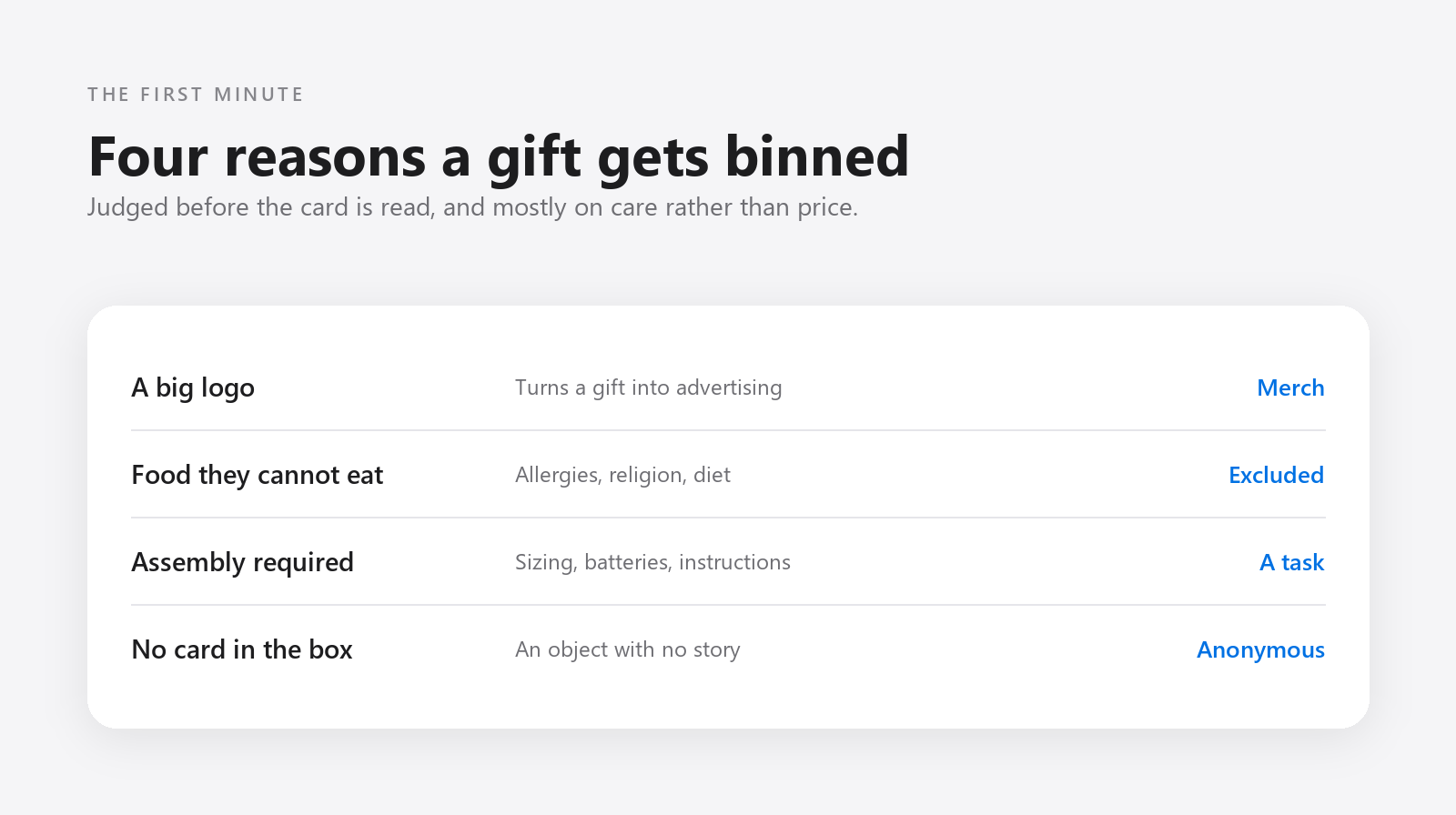
Four failures account for most waste. A big logo, which converts a gift into advertising. Food the recipient cannot eat — allergies, religious restrictions, a team that has gone sugar-free. Anything that requires assembly, sizing or a decision, which turns a gift into a task. And a box with no card, which leaves the recipient holding an object and no story.
The "generic merchandise" problem is the one worth internalising: a branded item the recipient could have bought themselves reads as inventory clearing. The fix is not a more expensive gift. It is a smaller logo and a better sentence.
The follow-up almost nobody does
A gift buys one conversation. Most programmes spend the money and skip the conversation, which leaves an object and no next step.
Day seven: one specific question. Not "did it arrive" — "is the tumbler surviving your commute." It answers easily, confirms delivery and reopens the thread.
Day thirty: one low-pressure ask. A referral, a review, fifteen minutes on a problem they already have. By then the gift is background, the right condition for asking — it no longer looks like a trade.
Two rules. Never attach the ask to the gift in the same message; a gift with an invoice attached stops being a gift. And log the outcome, or next year you will send the same thing to the same people and wonder why it lands flat.
The short version
Twenty to eighty dollars, delivered inside 48 hours of the moment, with one specific sentence in the box. Check that the route actually reaches the address — 48 hours is a radius, and beyond it the honest number is three to five days. Keep alcohol, perishables and heavy objects out of the plan when the date is fixed. Write the cards in batches of ten. Then ask for something on day thirty, because a gift that starts no conversation is a cost, not an investment.
Send us the list, the address spread and the date you want it to land — we will tell you which of the three routes can actually hit it.
References (Neutral Third-Party Sources)
Facts were checked against carrier and government publications. No gift retailer, gifting platform or fulfillment provider is cited.
- USPS — Domestic Shipping Prohibitions, Restrictions & HAZMAT: beer, wine and liquor may not be sent through the mail except in limited circumstances; perishables travel at the mailer's own risk and must be packed to arrive before deterioration; lithium-battery devices are restricted. https://www.usps.com/ship/shipping-restrictions.htm
- USPS — Priority Mail: tracking and up to $100 insurance, no fuel/residential/Saturday surcharge, dimensional weight at a 139 divisor with fractions rounded up, and the nonstandard-length fees that apply to long boxes. https://www.usps.com/ship/priority-mail.htm
- USPS Postal Explorer — Publication 52, §42 Intoxicating Liquors: the 0.5% alcohol-by-weight definition behind the mailing restriction. https://pe.usps.com/text/pub52/pub52c4_005.htm
- IRS — Are business gifts deductible?: the $25 per-recipient deduction limit and the incidental-cost exclusion for engraving, packing and shipping. https://www.irs.gov/faqs/small-business-self-employed-other-business/income-expenses/income-expenses-8