
Custom Packaging for Small Business: Big-Brand Unboxing on a Budget
Custom packaging is not expensive because board is expensive. It is expensive because a die, a set of plates and a press setup cost the same whether you order 300 boxes or 30,000. At 300 units those three lines can be half your invoice. At 3,000 they almost disappear.
Most first-time buyers see "die $450, plates $680" at the bottom of a quote and go buy plain kraft boxes instead. The better move is to divide those numbers by the quantity you actually need, then decide whether the batch is worth tooling at all. Sometimes it is not, and the honest answer is a sticker.
What you are actually buying
A custom box has three cost layers that move differently as volume changes.
Board and construction — flute, wall, ECT rating, dimensions. A 22×14×6 single-wall 32 ECT carton runs about $1.50–$1.80 unprinted at 1,000 units. This layer falls slowly and predictably.
Tooling — the cutting die (a plywood board with steel rule bent to your dieline, the flat template of the box before folding) and the plates that carry artwork to the press. Bought once per design, reused on every reorder.
Makeready — registration, ink density, colour matching, and the material burned getting there. Charged per press run, not per box.
Every quote has these three lines inside it somewhere. They land as a lump at the bottom, which is why small brands read the total as "custom is not for us."
The fixed fee, divided
Published US price lists put a folding-carton die at $250–$850, a corrugated die at $200–$1,600, a single-colour flexo plate at $150–$300, four CMYK plates at $600–$1,000, and makeready at $100–$300 per run. Reorders usually skip the plate charge, sometimes the makeready.
Put those into one four-colour corrugated mailer:
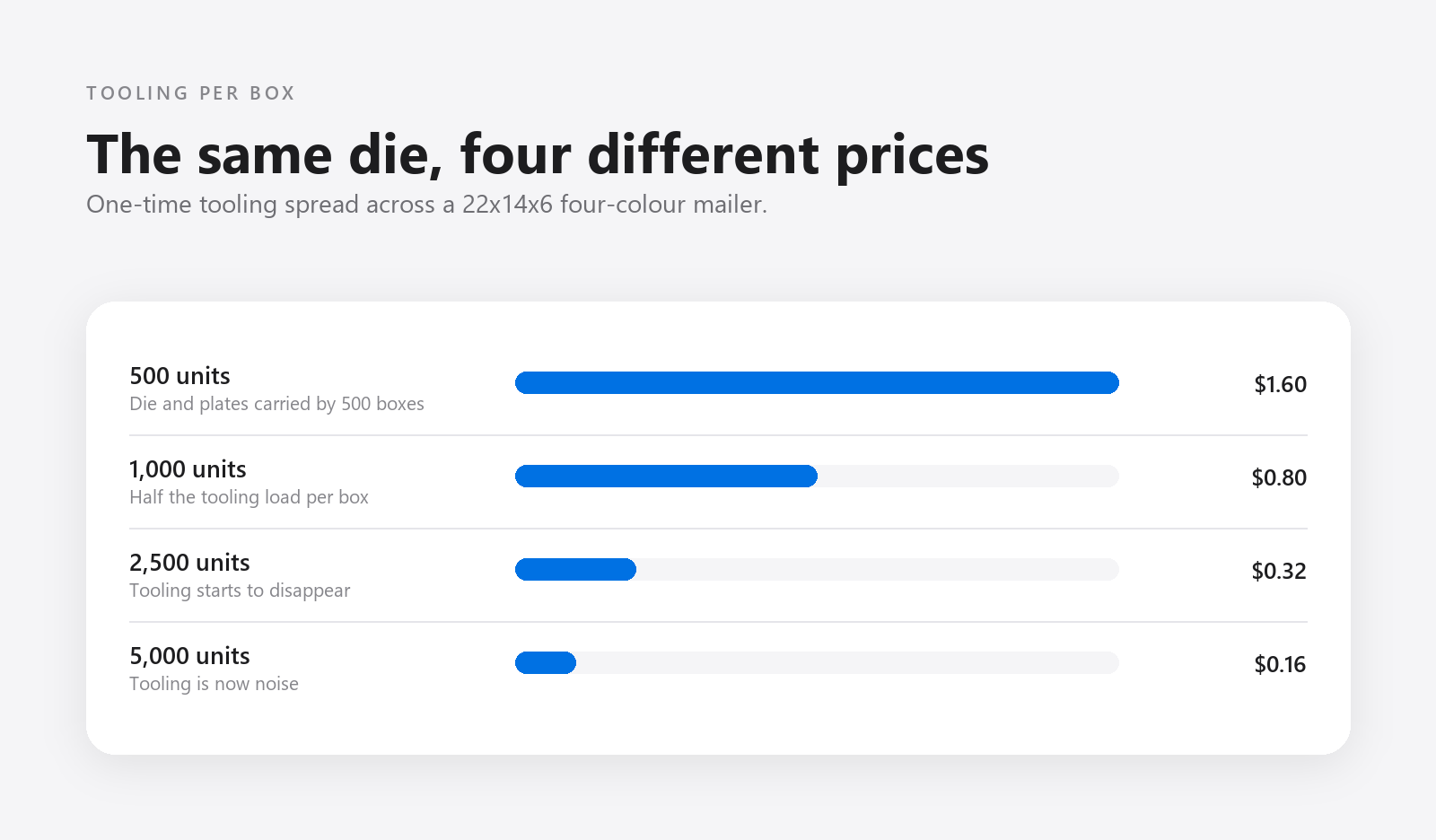
| Run size | Tooling per box | Landed unit price (22×14×6, four-colour) | Cash out the door |
|---|---|---|---|
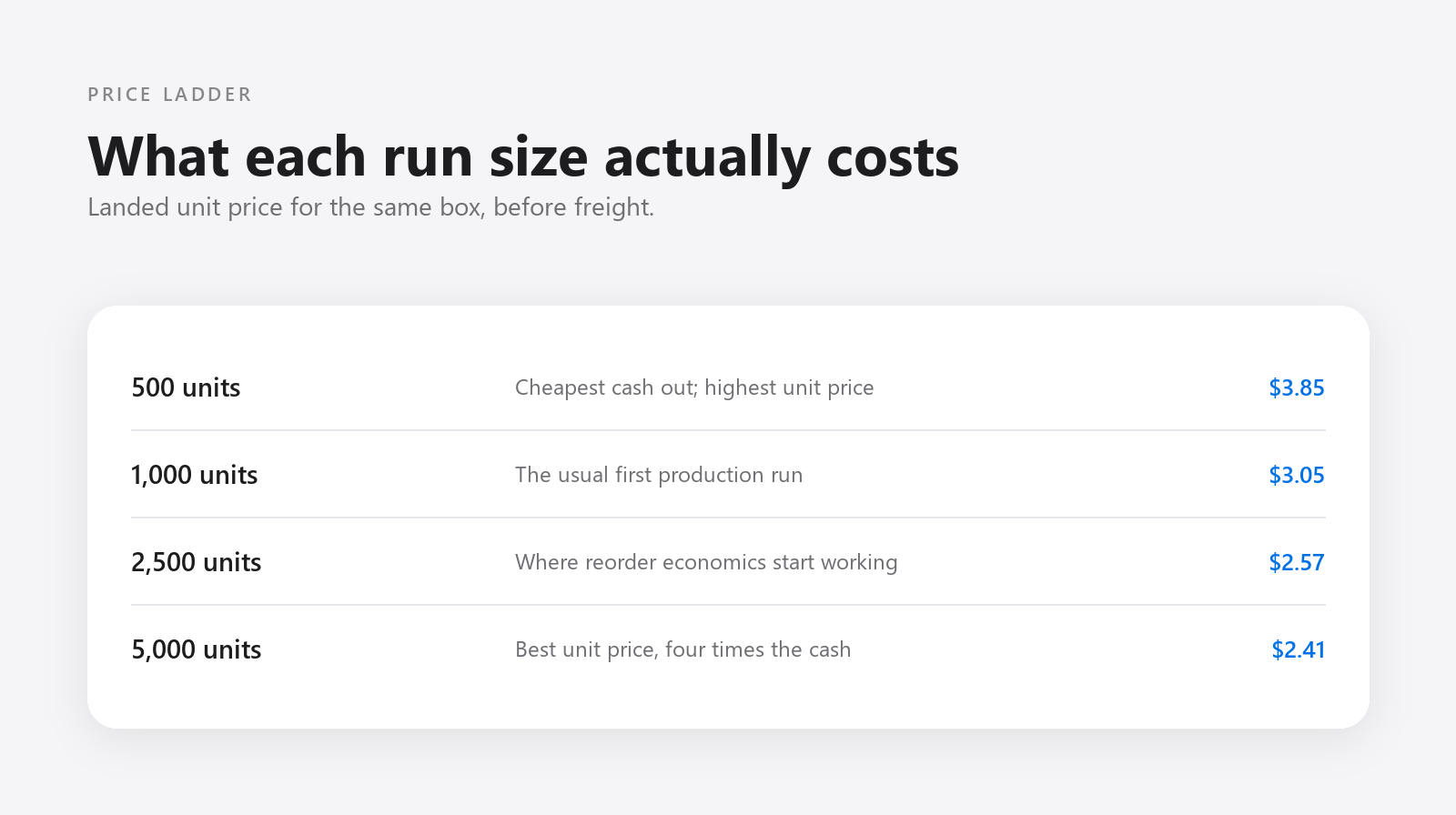
| 500 | $1.60 | $3.85 | $1,925 |
| 1,000 | $0.80 | $3.05 | $3,050 |
| 2,500 | $0.32 | $2.57 | $6,425 |
| 5,000 | $0.16 | $2.41 | $12,050 |
Read the last two columns together. Going from 500 to 1,000 cuts the unit price about 21%. Going from 1,000 to 5,000 cuts it another 21% and multiplies your cash outlay by four.
That is the squeeze: the quantity with a decent unit price needs money you would rather spend on ads, and the quantity you can afford has an ugly unit price. The usual compromise is 500–1,000 to validate, then reorder print-only.
Which raises a question worth asking before signing — who owns the die? If the answer is "we do," ask what transfer costs and get the reorder price in writing. Dies move between converters more often than suppliers admit.
Why the 500-unit quote is not the 1,000-unit quote
Chinese trading desks describe the same mechanic from the other side: a 500-set minimum is standard, 30 sets is possible, and the unit price at 30 goes up roughly 50% because opening a mould, running a sample and rescheduling a line are fixed costs that do not halve when the order does.
Same arithmetic, different currency. A factory quoting 30 units at +50% is not punishing you. It is spreading one setup across a tenth of the boxes.
Two consequences. Ask for the reorder price, not just the first-order price — the gap is the true cost of your artwork. And never split one design across two suppliers to "compare": you pay two dies and two setups, and learn nothing.
One colour on kraft versus four
Single-colour print — black, white, or one Pantone spot — on kraft is the best-value tier in packaging. One plate, thin ink film, and the corrugated texture hides registration sins that would be obvious on a coated sheet.
Four-colour is a different product. Kraft is brown, so CMYK needs a white underbase to read true, which doubles the ink layers and slows drying. The per-unit print premium goes from roughly $0.05–$0.15 for one colour to $0.20–$0.50 for four. Digital removes the plate fee but carries a higher per-unit premium, around $0.40–$1.00.
The line is not "premium versus cheap." Under ~1,000 units, with several colours and artwork still moving, digital wins. Over ~1,000, with one or two colours and a locked file, flexo pays you back on every box. Offset rarely takes runs under 1,000 at all.
Full-bleed four-colour is not what makes packaging look expensive. A plain kraft box with one spot logo and a clean seal reads more premium than a busy carton, which shows every registration slip and flute line.
The box size decides your freight bill
Print gets the attention; dimensions take the money. Carriers bill the greater of actual weight and dimensional weight — a billed weight calculated from the space a parcel occupies rather than what it weighs.
The USPS rule is concrete. On parcels over 1,728 cubic inches (one cubic foot), divide length × width × height by 139 and round up to the next whole pound. Round each measurement up to the nearest inch first, because the carrier will.
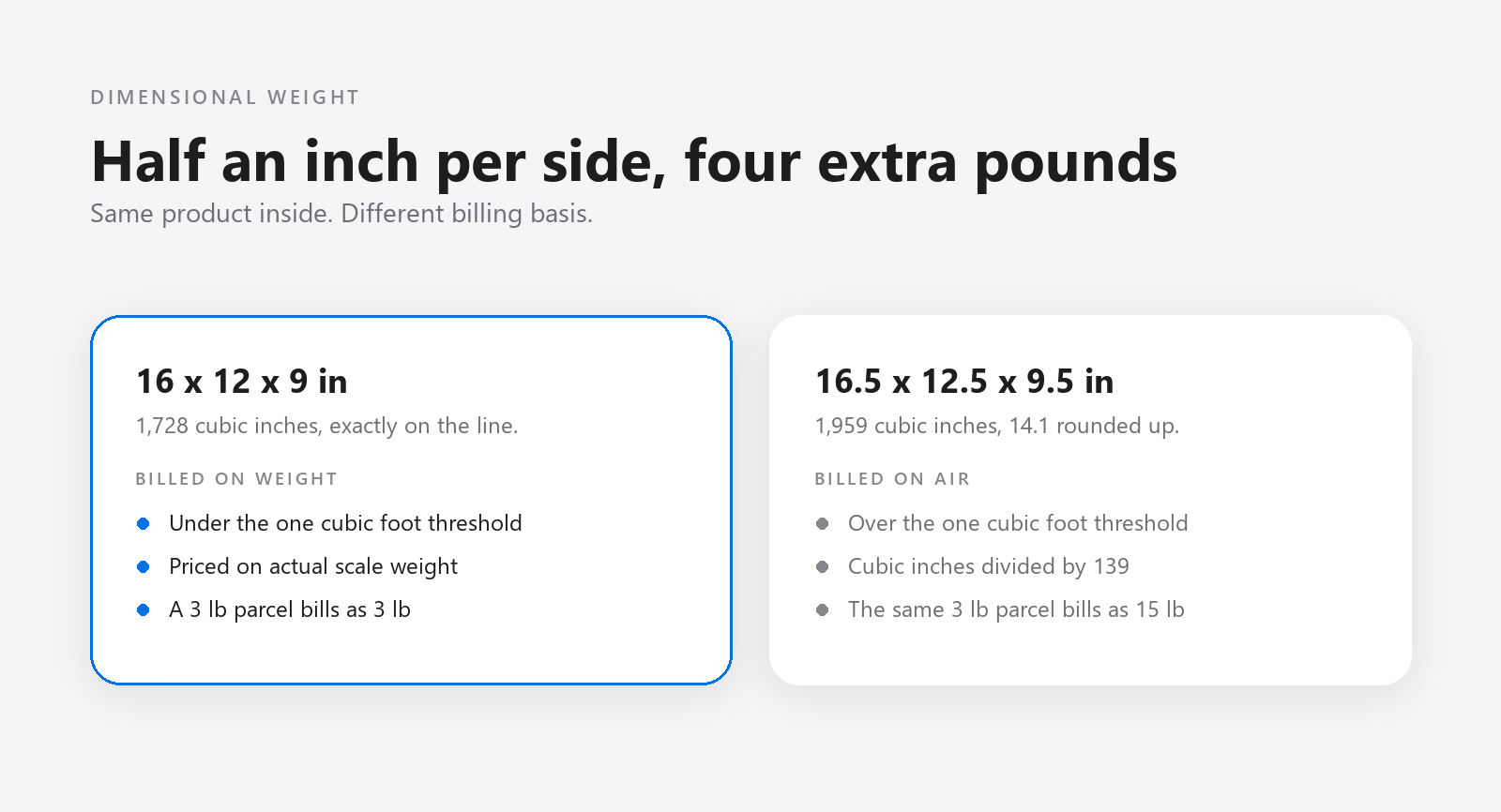
A 16×12×9 box is exactly 1,728 cubic inches — right on the line. Add half an inch to each side and you get 1,959, which divides to 14.1 and bills as 15 lb. The product inside might weigh three.
That is the difference between a parcel priced on weight and one priced on air. It is also why "size up so there is room for void fill" is the most expensive advice in e-commerce.
Set the box in this order: measure the product as packed, add the cushioning you will actually use, then check the result against three thresholds — 1,728 cubic inches, 22 inches in length, 2 cubic feet. Only then talk about what goes on the outside. Change the box after tooling and you buy a second die.
Three upgrades that look expensive and are not
When a full print run is out of reach, three moves carry most of the unboxing impression. Each has a failure mode worth knowing before you Gifting at Scale.
A sticker. A plain box with a 38 mm round label sealing the flap costs $0.04–$0.20 per sticker at 250–1,000 units. It rotates seasonally and photographs well. Where it fails: coated or very dark board, where adhesion is poor and corners lift, and side placement, which reads as a logo slapped on rather than a seal being broken.
A belly band. A printed strip wrapped around the box, $0.08–$0.30 at 500–1,000, plus a die. It makes a stock mailer look 15 Thoughtful Gifts-wrapped and is the cheapest way to run a holiday edition without reprinting cartons. The catch is labour, not paper. Packing is piece-rate work in most warehouses; a band adds a step to every order, and at volume that step costs more than the band.
An insert card. $0.05–$0.15 each, carrying most of the personal feeling — a short note, a discount code, a QR to a review page. Where it fails is fit and weight. Too thick and it holds the lid open; too heavy and it changes the parcel weight. If your warehouse runs a weight-check gate, update the SKU master data first or the batch alarms at the scale.
All three stack. Price the labour before you do: materials might total under $0.40 per order while the extra handwork adds $0.30–$0.60.
Lead time is a cost line too
Large runs start at 30 days and often run longer. Small batches compress to 7–15 days, because they slot into gaps rather than waiting for a full line changeover.
That gap shows up in cash flow before it shows up in price: a 30-day run means stock, freight and storage are paid for six weeks before the first sale.
Overseas is more extreme — unit prices 30–60% lower, a 500-unit floor before the rate makes sense, 30–45 days on the water, sample rounds on top. For a first batch, print domestically at 300–500, validate the fit, then move volume offshore once the dieline is frozen.
A 300-unit budget you can copy
Same structure, costed at 300 units on mid-range published pricing. Design and freight excluded.
| Line item | Unit cost basis | 300 units |
|---|---|---|
| Stock corrugated mailer (12×9×4) | $1.10 each | $330 |
| Cutting die (one time) | $450 | $450 |
| One-colour plate plus makeready | $220 + $150 | $370 |
| One-colour print premium | $0.10 each | $30 |
| Round stickers (1,000 minimum) | $0.09 each | $90 |
| Insert cards (500 minimum) | $0.10 each | $50 |
| Tissue and void fill | $0.25 per order | $75 |
| Total | $1,395 | |
| Packaging cost per order | $4.65 |
At 1,000 units the per-order figure drops to roughly $2.30, because the die and the plate do not change.
If $4.65 feels too high, the fix is rarely a new supplier. It is one of two levers: combine two SKUs into one box size so the fixed cost divides across more orders, or drop to one colour plus a sticker and halve the numerator.
What to put in the email before you approve a proof
A converter will not decide these for you, and anything vague becomes your cost.
- Inside dimensions, not outside — plus packed weight.
- Strength: single or double wall, and the ECT grade. "Make it strong" is not a spec.
- Material and finish, including whether a white underbase is needed.
- Colour count, with Pantone numbers if you have them.
- Die ownership: who pays, where it is stored, whether reorders skip the fee, whether it can move.
- Reorder price and minimum reorder quantity — worth more than the first-run price when you run out mid-quarter.
- Damage terms and the claim window.
- Delivery definition: ex-works or delivered, ocean freight in or out.
Approving a proof without items 1 and 5 in writing is the most common way small brands pay twice for the same box.
The short version
Cheap packaging is not the goal; cheap-looking packaging is the risk. Divide the tooling by the run size before deciding custom is out of reach, lock the box dimensions before anyone opens a design file, keep the artwork on the cheapest layer that still reads as yours, and treat the die as an asset you own rather than a fee you paid.
If you want a second opinion on which route fits your volume, send the packed dimensions, the quantity and the destination country. We will come back with a cost structure before we talk about price.
References (Neutral Third-Party Sources)
- USPS Postal Explorer — DMM 253: Prices and Eligibility: dimensional weight applies above 1,728 cubic inches, calculated as cubic inches divided by 139 and rounded up. https://pe.usps.com/text/dmm300/253.htm
- UPS — Package Dimensions, Size Limits and Weight Guide: how a parcel is measured and why dimensions are rounded up before billing. https://www.ups.com/us/en/support/shipping-support/shipping-dimensions-weight.page
- Federal Trade Commission — Business Guide to the FTC's Mail, Internet, or Telephone Order Merchandise Rule: the 30-day dispatch rule, delay notices and the refund clock. https://www.ftc.gov/business-guidance/resources/business-guide-ftcs-mail-internet-or-telephone-order-merchandise-rule
- GS1 — EAN/UPC barcodes: the retail barcode standards that decide whether a packaged product can be listed and scanned at point of sale. https://www.gs1.org/standards/barcodes/ean-upc