
How to Start a Subscription Box Business: A Step-by-Step Guide
The first number that decides whether your box works is not the retail price. It is the landed cost of one box. A $39 box that costs $23.50 to put in a carrier's hands leaves $15.50 to cover ads, software and your time. A $39 box that costs $31 leaves almost nothing, no matter how good the curation is.
So this guide starts with arithmetic, not sourcing. The first three of eight steps are cost work: pick the model, cost one box, pack the first hundred yourself. Outsourcing comes last.
Step 1 — Pick the model before the niche
Three models, three cost structures, and the wrong one usually reveals itself around month four.
Curation. A themed selection that changes every month. You are selling surprise, which means new products every cycle, small quantities per SKU, and almost no purchasing leverage. High gross margin per box, high cost of staying interesting.
Replenishment. The same consumables on a schedule — coffee, pet food, vitamins, razors. Fewer SKUs, predictable volumes, real negotiating power. Retention is better because the product runs out. The catch is that a supermarket shelf is your competition on price, every month.
Access. Members-only products, early releases, a community. The physical box can be light. Best margins, hardest to build.
Write one sentence: why does this customer pay again next month? If the answer is "it's a nice surprise", you have committed to changing the assortment twelve times a year and buying each item in tiny quantities. That is a valid business — just a different cost structure from a coffee subscription.
Step 2 — Cost one box before you cost the business
Build the sheet at the unit level; pricing, ad budgets and subscriber targets fall out of it.
| Cost line | Amount | What sits inside it |
|---|---|---|
| Products | $11.00 | Three to five items at wholesale |
| Packaging | $2.00 | Outer box, tissue, insert card, seal sticker |
| Packing labour | $3.00 | Six to twelve minutes per box |
| Postage | $6.00 | 1–2 lb parcel, domestic ground |
| Payment processing | $1.50 | Roughly 3% plus a fixed fee |
| Direct cost | $23.50 | |
| Contribution per box | $15.50 | Before acquisition, software, storage |
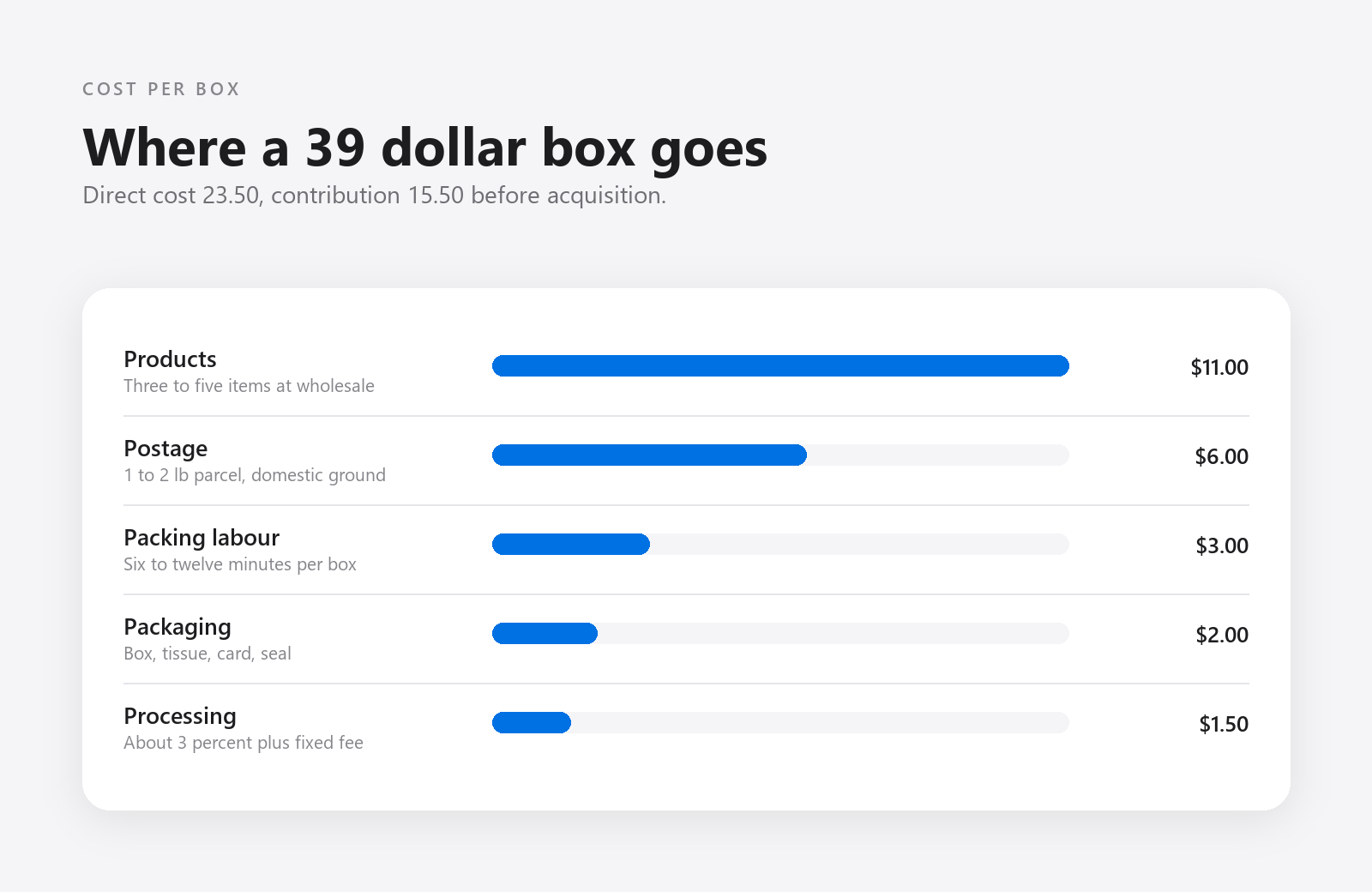
That line is not profit: it absorbs acquisition, the platform fee, replacements and your own hours. If it costs $35 to win a subscriber, that subscriber has to survive three cycles before the relationship turns positive.
Two mistakes show up in almost every first model. The first is treating postage as the customer's problem because they paid for shipping: on a two-pound box, the gap between a right-sized carton and an oversized one is a couple of dollars, which is 13% of your contribution gone on every order. The second is booking packaging as a one-time purchase. It is a variable cost, so it belongs in the per-box sheet and gets re-checked every time the box changes.
Step 3 — Run the first hundred yourself
Do not outsource batch one. Not to save money — to learn where the minutes go.
Labour is where most cost sheets are fiction. "Picking and packing, $3" hides the real question: how many boxes per hour, at what wage, with what error rate?
A useful comparison comes from Chinese e-commerce warehouses, which have run this experiment at scale. On fixed monthly salaries, a team of twenty-plus people shipped around 2,000 parcels a day. After switching to piece rate — about ¥0.10 per parcel — twelve people shipped more than 20,000 a day. Three times the output with fewer hands, and take-home pay rose from roughly ¥4,000–5,000 to ¥8,000–10,000.
The lesson is not "pay piece rate". Output came from splitting the job: one pulls stock, one builds, one seals, one labels. Done by one person, most of the time goes to walking.
At 100 boxes, two people and a long table with four bins is enough. Time it properly — clock the first box, stop at the last label — and write down minutes per box. That number decides step eight.
Step 4 — Set the cutoff, then work backward
A subscription is not an order queue. It is a monthly production run with a fixed promise date. Everything hangs off the date the box should arrive, counted backwards.
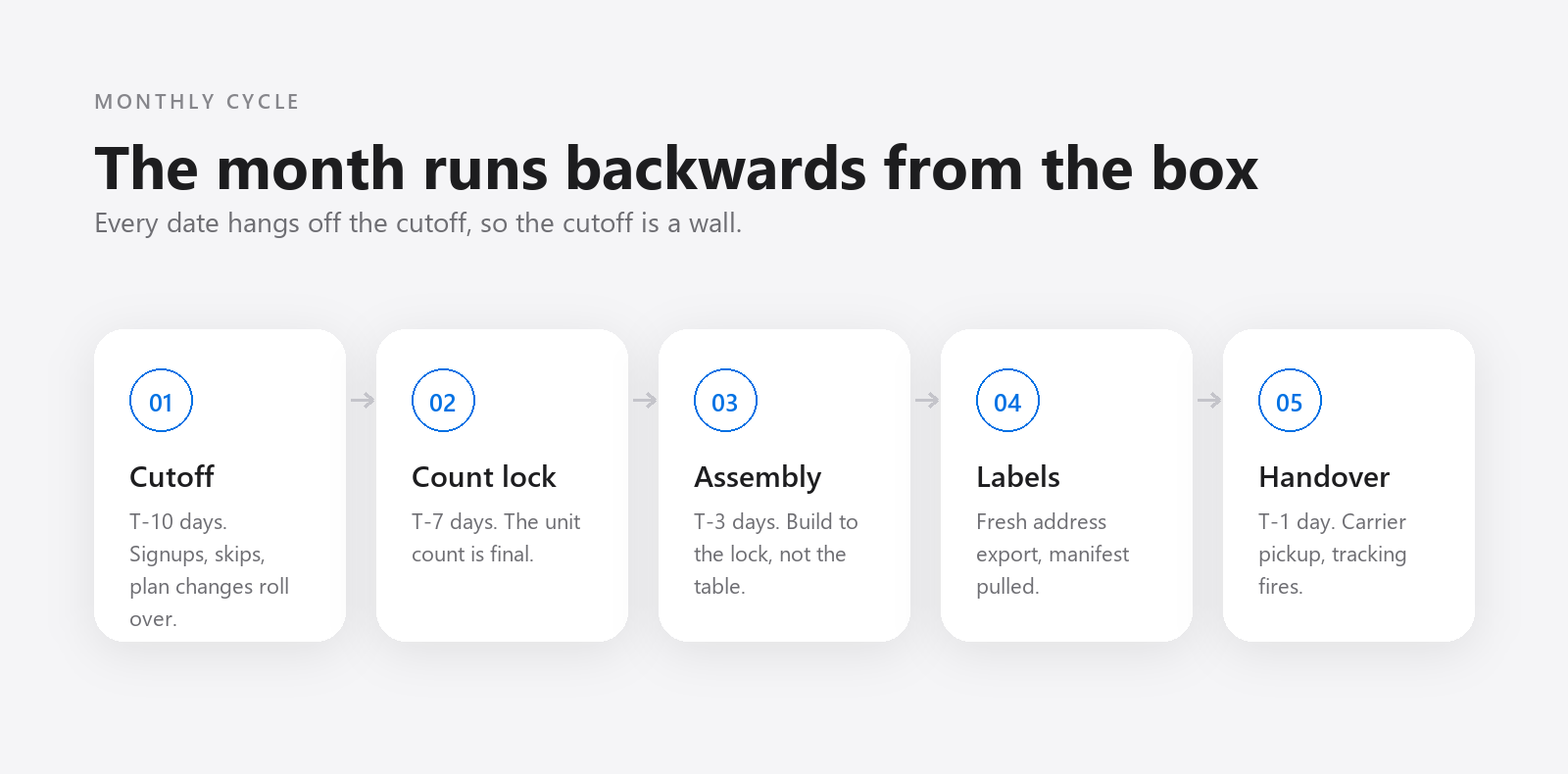
- T-10 days: cutoff. New subscriptions, plan changes and skips all roll to the next cycle.
- T-7 days: count locked. The unit count is final. Any component shortfall discovered now cannot be fixed this month.
- T-3 days: assembly done. Build to the locked count, not to whatever is on the table.
- T-1 day: labels and handover. Fresh address export, manifest, pickup.
Call it a cutoff rather than a target. Targets slip a day. Cutoffs cannot, because six other dates are chained to them.
The damage usually happens after the cutoff, in three familiar shapes. A skip arrives two days after the count locked, so you either ship a box that gets refunded or eat the build. An address changes after labels were generated from an older export, so the parcel goes to the old flat. A failed card recovers on day nine, and nobody decided in advance whether that subscriber gets this month or next.
You need a written answer to the third one, applied consistently, and repeated in the confirmation email.
Step 5 — Build the box the same way five hundred times
Assembly is where a subscription box fails at scale, because it replicates one mistake across the whole run.
Three controls do most of the work.
A build sheet with a photo. What goes in, in what order, which way the insert card faces, where the bonus item sits. Warehouses can get a new starter to senior-level accuracy in about three days when the steps are fixed and photographed; they cannot when the instruction is "pack it nicely".
A bill of materials the line can check against. Multi-item kits cannot be verified by eye, especially in a month where the insert changes. Version the insert, change the BOM, and have the line work from the BOM rather than memory.
A weight check on the closed box. Load the expected weight for every kit into the system and weigh each finished box. A tolerance of a few grams catches a missing sachet or a doubled card — cheaper and more reliable than spot checks.
Two habits pay for themselves in the ship window. Pre-assembly: fold boxes, add tissue, place cards before the count locks, so the only work left is putting product in and sealing. And when volume spikes, add a station rather than hours — Chinese warehouses set up an extra packing table and pull people from quieter roles; your living room works the same way.
Step 6 — Shipping is a design decision
Postage is set by the greater of actual weight and dimensional weight, which is calculated from the space the parcel occupies. In the US, parcels over 1,728 cubic inches are billed on cubic inches divided by 139, rounded up to the next pound.
Which means the box is a pricing decision before it is a design decision. Size the inside to the product plus the cushioning you will really use, not to what looks generous in a photo: cheaper to ship, less to damage.
Decide the replacement rule before the first parcel goes out — wrong item, damage, lost parcel — and whether returned stock can be resold. For food and cosmetics, it usually cannot.
One legal floor in the US: under the FTC's mail order rule, if you do not state a shipping time, you must ship within 30 days of a properly completed order. If you cannot, offer the customer the choice to wait or cancel, and refund within seven business days. "The boxes are running late this month" is a notice, not a defence.
Step 7 — Retention is an operations problem
Most cancellations are not a verdict on your curation. They are a forgotten renewal, a declined card, or a subscriber who could not find the skip button.
Three cheap fixes:
Let people skip, and put the cutoff date next to the skip button. A skipped month is better than a cancelled account. A skip that lands after the count locks is a box you built for nobody.
Send a renewal reminder three days before the charge, listing what is in the box and the amount. Most billing complaints are really "I forgot this renews".
Make cancelling easy. Subscription billing in the US falls under pre-notification negative option rules: renewal terms, price and cancellation method must be disclosed clearly before the charge, and cancellation cannot be obstructed. One-email cancellation looks like lost revenue; it mostly replaces chargebacks.
Step 8 — Know when to hand it over
Do not pick a subscriber number off a blog. Watch four signals instead:
- Packing eats more than two days of your week.
- Wrong-item and missing-item complaints appear, and you cannot trace which step caused them.
- Rent plus labour passes roughly 70% of what a fulfillment quote would cost.
- You cannot hire for the ship window, or the people you hire need a week of training.
In practice the switch tends to happen somewhere between 300 and 800 subscribers. The number is a symptom; the four signals are the cause.
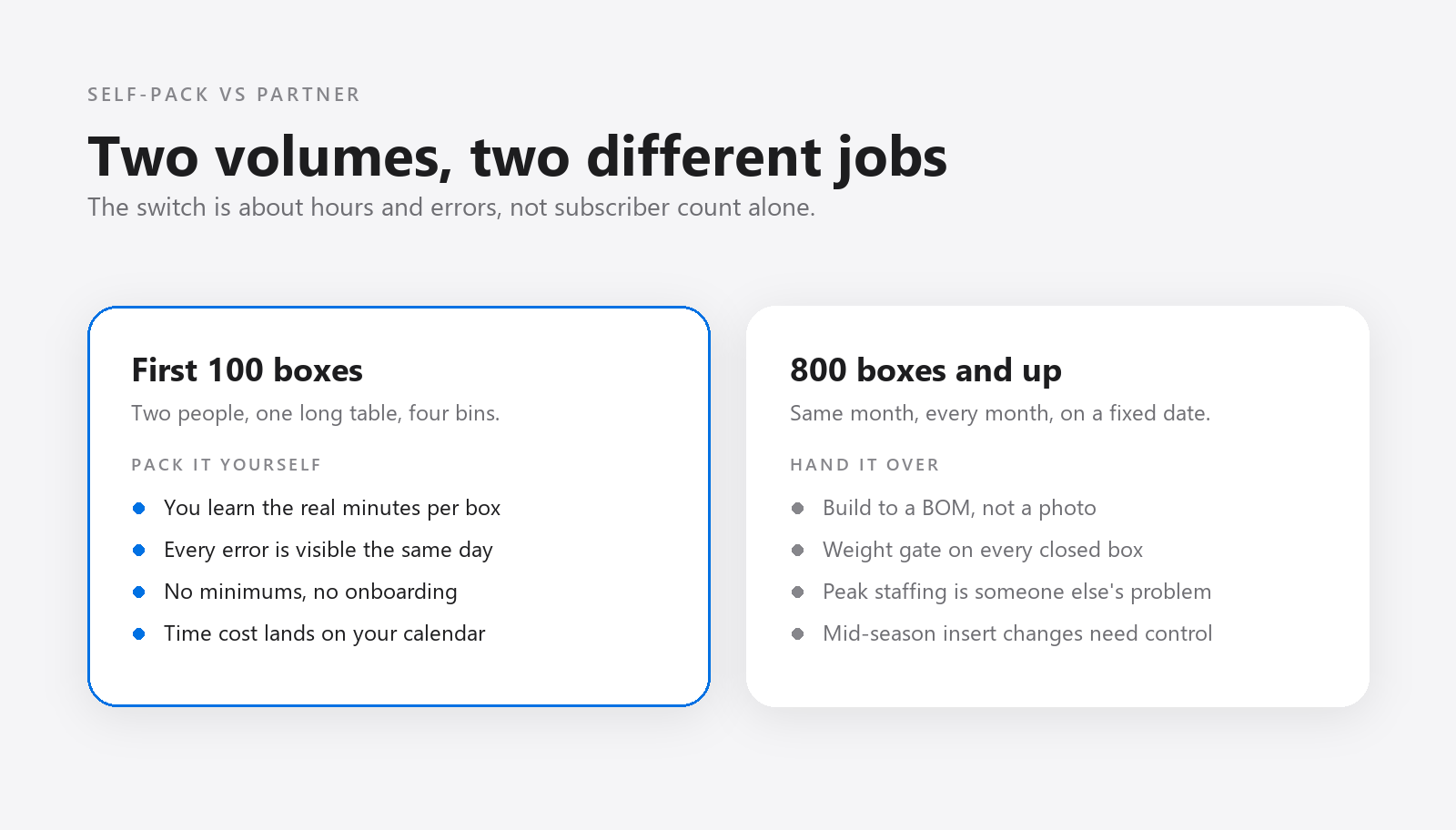
When you talk to a partner, ask five things: can you build to my cutoff date, can you assemble to a BOM rather than a photo, what is your weight-check tolerance, how are short-ships and damage settled, and how do you control a mid-season insert change. The last one is where most handovers break.
The first hundred boxes, costed
| Line | Basis | Amount |
|---|---|---|
| Products, with 10% buffer | 110 units × $11 | $1,210 |
| Outer boxes, with damage buffer | 130 × $1.20 | $156 |
| Insert cards, tissue, stickers | 120 sets × $0.55 | $66 |
| Packing tools (scale, taper, labels) | One time | $90 |
| Platform and subscription app, month one | $60 | |
| Samples and trial packs | Three rounds | $120 |
| Cash needed before the first shipment | $1,702 | |
| Postage float (customer-paid, you front it) | 100 × $6 | $600 |
First-cycle revenue at $39 is $3,900. Direct costs are about $2,350, leaving roughly $1,550 — enough to cover acquisition for the first cohort and part of next month's stock, not a profit. Cycle one funds cycle two, which is why the first cohort should be small enough that a bad box does not wipe you out.
The short version
Cost one box before you name the business. Price against contribution, not a competitor's sticker. Run the first hundred yourself so you know the minutes. Anchor the month on a cutoff date and treat it as a wall. Build every box against a BOM and a scale, not memory. Outsource when the signals say so, not when a blog says 500.
If you already have a box in mind, send the unit count, the item count and the destination countries. We will come back with a cycle plan and a per-box cost structure before we talk about price.
References (Neutral Third-Party Sources)
- Federal Trade Commission — Business Guide to the FTC's Mail, Internet, or Telephone Order Merchandise Rule: the 30-day dispatch rule, delay notices and the seven-day refund clock. https://www.ftc.gov/business-guidance/resources/business-guide-ftcs-mail-internet-or-telephone-order-merchandise-rule
- Federal Trade Commission — Negative Option Rule: the rule covering pre-notification subscription plans and what must be disclosed before a recurring charge. https://www.ftc.gov/legal-library/browse/rules/negative-option-rule
- USPS Postal Explorer — DMM 253: Prices and Eligibility: dimensional weight for parcels over 1,728 cubic inches, calculated as cubic inches divided by 139. https://pe.usps.com/text/dmm300/253.htm
- GS1 — EAN/UPC barcodes: the barcode standards required for retail listings and point-of-sale scanning. https://www.gs1.org/standards/barcodes/ean-upc
- U.S. Small Business Administration — Market research and competitive analysis: how to test demand and map competitors before committing inventory. https://www.sba.gov/business-guide/plan-your-business/market-research-competitive-analysis