
Best 3PL Companies: How to Choose the Right Partner
There is no best 3PL company. There is a 3PL that fits your order profile, and there is evidence that proves it. Every "top 10" list you have read ranks providers by size, funding or marketing budget — none of which tells you whether 1,800 orders a day will leave a building on time in the third week of November.
This guide does something different. It names no providers, because a name is not evidence. Instead it gives you six dimensions to score, the specific question that separates a real answer from a rehearsed one, and a 30-day trial with thresholds you can hold a partner to.
A third-party logistics provider, by the standard definition, is an outside firm you contract to perform specific logistics services for you. That definition covers a 40,000 sq ft pick-and-pack shop and a global contract logistics division equally — which is why "best" collapses on contact with your own numbers.
Why a ranking list cannot answer your question
Lists are built on proxies: square footage, number of facilities, revenue, headcount. Proxies travel well in a blog post and badly through a peak season.
The provider that is excellent for a 40-SKU direct-to-consumer brand shipping single-item parcels is often the wrong one for a 2,000-SKU catalogue with kitting, inserts, and a returns flow that requires inspection and repacking. Same company. Different grade.
There is a second reason to distrust the list format. The strongest predictor of a bad outsourcing experience is not capability — it is a mismatch that nobody measured before signing, and then discovered in week six when the invoice arrives with a line nobody quoted.
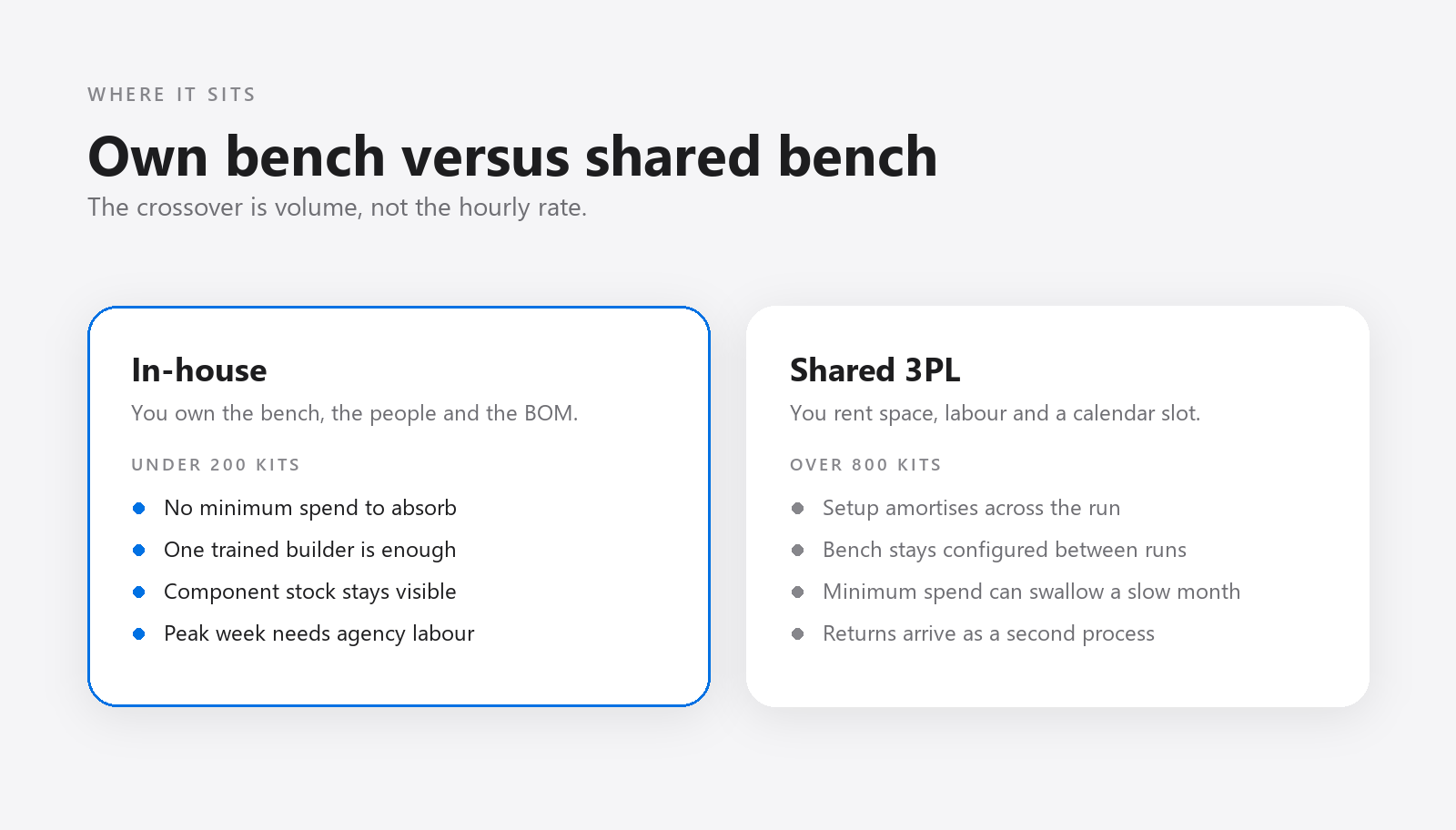
The right question is narrower and more useful: which provider can prove, with numbers I can audit, that it will hit my service level at my volume, in my worst month? Everything below serves that question.
Write your order profile before your shortlist
Most buyers start with names. Start with six numbers and two physical facts instead:
- Average orders per day, and the peak multiple you actually saw last year (2× is common; 4× happens)
- SKU count, and how many of them moved in the last 90 days
- Lines per order, and the share of orders with more than one item
- Return rate, and what fraction of returns can be resold as-is
- Inbound mode: pallet, carton, or container, and how often
- Your top ten destination ZIPs or postcodes
This is not paperwork. It decides which building can serve you. A warehouse running 20,000 parcels a day with 12 people on pack and pick is a genuinely different machine from one doing 2,000 with a fixed salaried crew of 20 — the first is built on piece work and prepacking, the second on hourly labor and low automation. Send a kitting-heavy, 3,000-SKU profile to the first and you will be the account that ruins its throughput numbers.
The cost logic behind the profile is blunt. Rent on a 40,000 m² building is the same whether the site ships 10,000 orders today or 100,000; it is a fixed cost. Packaging and piece-rate wages move with volume. If you cannot tell a provider which of your costs are fixed and which are variable, you cannot tell whether its quote is cheap or just incomplete.
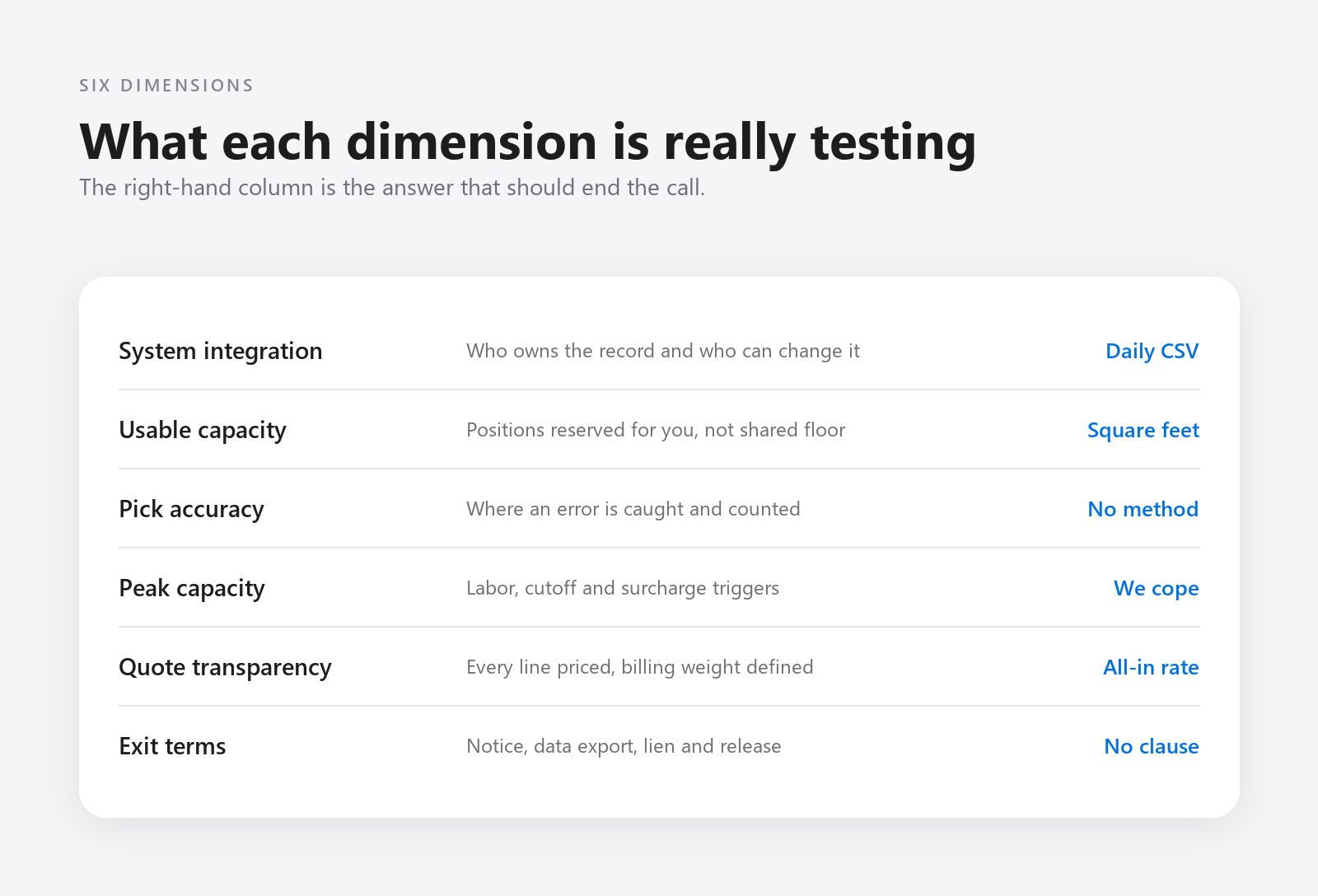
Dimension 1: System integration — who owns the record
Ask which warehouse management system runs the floor, whether your inventory sits in a dedicated instance or a shared one, and how many seconds pass between a scan and the number you see in your own dashboard.
Then ask the questions that reveal control: who is allowed to adjust stock by hand, does an adjustment require a second approval, and does the change leave an audit trail you can pull. Ask who generates the shipping label and the pallet identifier — a logistics unit should carry a unique SSCC so that one scan ties every carton on a pallet to one record.
The answer that ends the conversation: "We integrate with everything, and we can send you a daily spreadsheet." That sentence means standard connectors plus manual work for everything else. Integration is not a feature list; it is the guarantee that an order cannot be picked twice or missed because a file was re-uploaded.
Dimension 2: Capacity you can still use in week 50
Do not ask for square footage. Ask for the number of storage positions, the percentage of them contractually reserved for you, and what the site does when reserved capacity runs out.
Two more questions do most of the work. Is there a separate fast-pick area near the packing benches, and how often is it re-slotted? Mature operations treat that zone as a managed asset: high-velocity SKUs live within a few steps of the pack bench, dead stock gets pushed to a transit area, and the fast-pick positions are expected to turn several times a day. A site that says "we slot when we receive" is describing a warehouse, not a fulfillment operation.
The answer that ends the conversation: a very large number with no reservation language attached. Shared floor space is not capacity; it is an option the provider holds and you do not.
Dimension 3: Accuracy — ask for the method, not the percentage
Every provider quotes 99.9%. Almost none volunteer the denominator.
Ask where an error is counted. A wrong item caught at the pack bench by a weight check is not the same event as a wrong item that reaches a customer. The first is an internal catch; the second is a failure. Providers that report only the second number are usually reporting a good catching process, and the two get conflated in the sales deck.
Ask what the checkpoints are. A credible answer describes at least three: a scan that will not advance until the SKU matches, a weight gate that compares the packed parcel against a stored weight for that SKU or bundle (tolerances around 5 grams are common on small items), and a second label scan that refuses to print if the order and the carrier label disagree. Then ask how often stock is counted and who signs the count.
For calibration: well-run e-commerce warehouses describe pick error rates below 0.3%, and the best third-party operations aim an order-of-magnitude lower on mis-ships. Those are claims, not audits — which is why the trial in the last section exists.
Dimension 4: Peak capacity is a contract term, not a promise
"We handle Black Friday fine" is not an answer. Capacity at peak is a schedule, and schedules have inputs you can check.
How many temporary workers can the site add, from which agencies, with how many days' notice? Trained for how long before they touch a live order? Which dock doors are reserved for you in December? Does the order cutoff move earlier during peak, and by how much? What triggers a peak surcharge — a date range, a volume band, or the provider's discretion?
Ask for the forecast discipline too. Good sites refresh demand weekly and re-check sold units, remaining stock and carrier pickup capacity every couple of hours during a surge, so overflow moves before the aisles fill up. If your provider cannot describe that loop, it is planning with a monthly number.
The answer that ends the conversation: "We'll just add people." Adding untrained people is how a 0.3% error rate becomes 2% in the week you can least afford it.
Dimension 5: A quote you can reconcile line by line
The headline number is not the price. Ask for these lines separately, and refuse an all-in per-order figure until you have seen them:
| Cost line | What to pin down |
|---|---|
| Receiving | Per pallet, per carton, or per hour — and who unloads |
| Storage | Per pallet per day, per position per month, or per cubic foot |
| Pick | Per line, per unit, or per order; what counts as a line |
| Pack | Per order, plus materials at cost or at markup |
| Billing weight | Actual or dimensional, and who measures it |
| Surcharges | Residential, remote, oversize, second attempt, fuel |
| Minimums | Monthly spend, storage minimum, onboarding fee |
| Admin | Account management, reporting, project work |
Then hand over 500 of your real orders and ask for the invoice those orders would produce. Two providers quoting the same per-order rate can land 30% apart once dimensional weight, multi-item picks and returns processing are applied.
Billing weight deserves its own sentence. Carriers measure and round up, and a carton that grows half an inch on each side can cross into a higher band. Ask who bears that difference when the packaging changes — you or the provider.
Dimension 6: Exit terms and the inventory you cannot walk away from
This is the section most buyers skip and later wish they had not.
Ask for the notice period in days, the exact format of the inventory and order data export, and who runs the final reconciliation count. Ask who pays freight on stock leaving the building, and whether the provider holds any lien over goods for unpaid invoices.
Ask what happens to your stock if the provider's cash flow breaks. This is not hypothetical. In two widely reported cases in the Chinese cross-border market in 2021 and 2022, forwarders ran out of money with containers stuck at port; shippers were asked to prepay freight per kilogram to release cargo, and a deadline was set after which goods were treated as abandoned. A warehouse holding your inventory has the same leverage. The clause that protects you is boring and short: no lien without written notice, release within X days of a cleared final invoice, and a named contact for the handover.
The 30-day trial: what passing looks like
Run the trial on a slice, not the whole catalogue. Twenty SKUs, around 300 units, one destination mix that resembles your real orders.
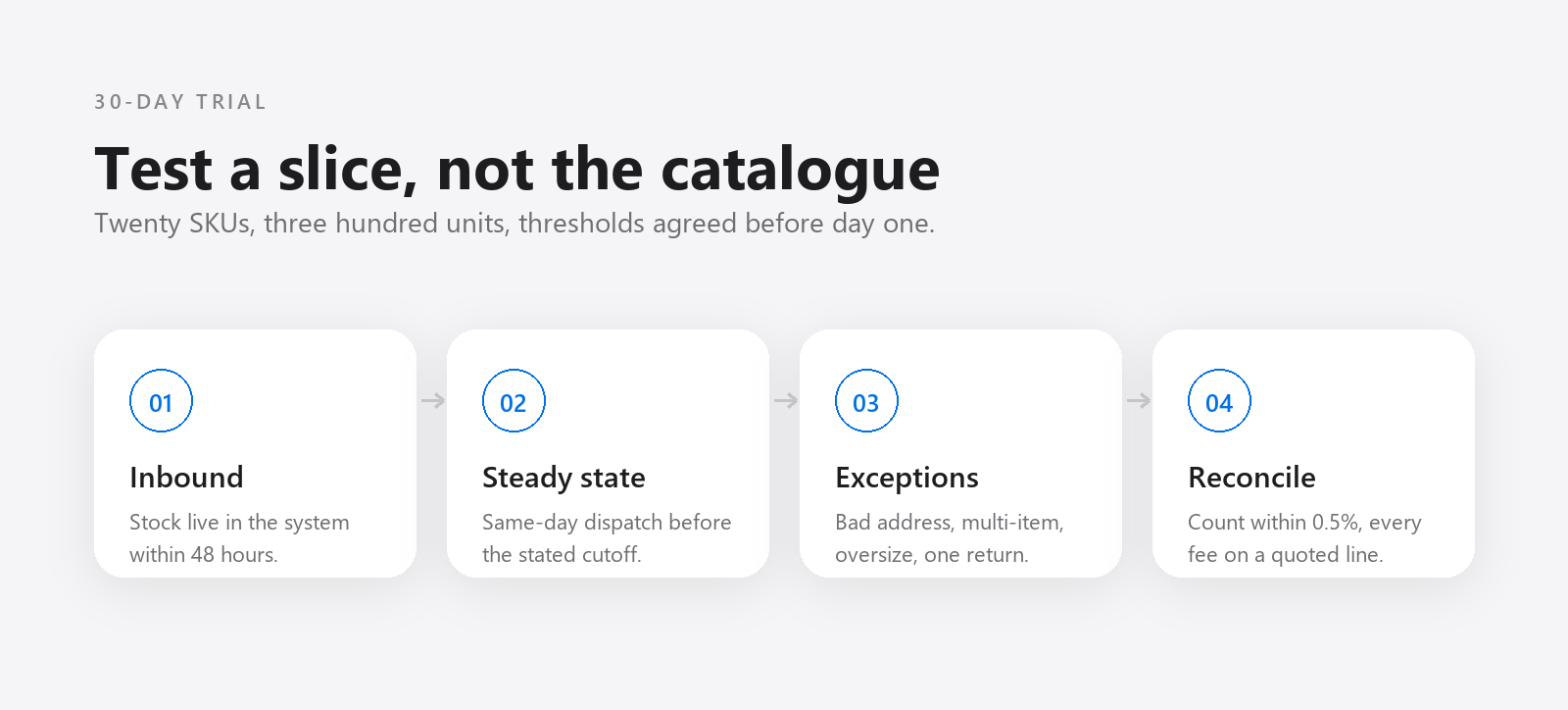
| Day | Test | Pass threshold |
|---|---|---|
| 1–3 | Inbound and put-away | Stock live in the system within 48 hours of arrival |
| 4–10 | Normal orders | 100% same-day dispatch before the stated cutoff |
| 11–17 | Injected exceptions | Wrong address, multi-item, oversize, one return — each resolved inside 48 hours |
| 18–24 | Volume step | Double the daily order count for three days with no missed cutoff |
| 25–30 | Reconciliation | Physical count matches system within 0.5%; every fee traceable to a quoted line |
Two rules make the trial honest. Pre-agree the thresholds in writing before day one, and let the provider see them. And keep a control sample of the same SKUs in your current operation, so a bad month is measured against something rather than felt.
Score it, then decide
Weight the six dimensions for your own model — a subscription brand weights kitting and pack quality higher, a marketplace seller weights cutoff reliability. Score each dimension on evidence, not on the meeting.
Three deal-breakers is a pattern, not bad luck. One weak dimension is a negotiation: price it, put it in the contract with a review date, and move on.
If you want a second opinion before you sign, send us your order profile — daily volume, SKU count, lines per order and destination split — and we will come back with an inbound and release plan you can hold against any quote, including ours.
References (Neutral Third-Party Sources)
- Encyclopaedia Britannica — Logistics: the business definition of third-party logistics as contracting an outside party to perform specific logistics services. https://www.britannica.com/money/logistics-business
- CSCMP — Supply Chain Management Definitions and Glossary of Terms: logistics management explicitly includes managing third-party logistics service providers. https://cscmp.org/CSCMP/Educate/SCM_Definitions_and_Glossary_of_Terms.aspx
- U.S. Bureau of Labor Statistics — Warehousing and Storage: NAICS 493: how the statistics agency defines warehousing establishments and the logistics services they may add. https://www.bls.gov/iag/tgs/iag493.htm
- GS1 — Serial Shipping Container Code (SSCC): the identifier for a logistic unit such as a pallet, case or parcel. https://www.gs1.org/standards/id-keys/sscc
- GS1 — Logistic Label Guideline v1.3: label placement rules, including barcode height on pallets and margins on cartons. https://www.gs1.org/standards/gs1-logistic-label-guideline/1-3
- UPS — Package Dimensions, Size Limits and Weight Guide: how package dimensions are measured, rounded up, and why billing weight differs from Gifting at Scale weight. https://www.ups.com/us/en/support/shipping-support/shipping-dimensions-weight.page
- Reddit — r/3PLproviders: practitioner discussion of provider selection, pricing structures and client churn. https://www.reddit.com/r/3PLproviders/