
Fulfillment Costs Explained: What You'll Really Pay
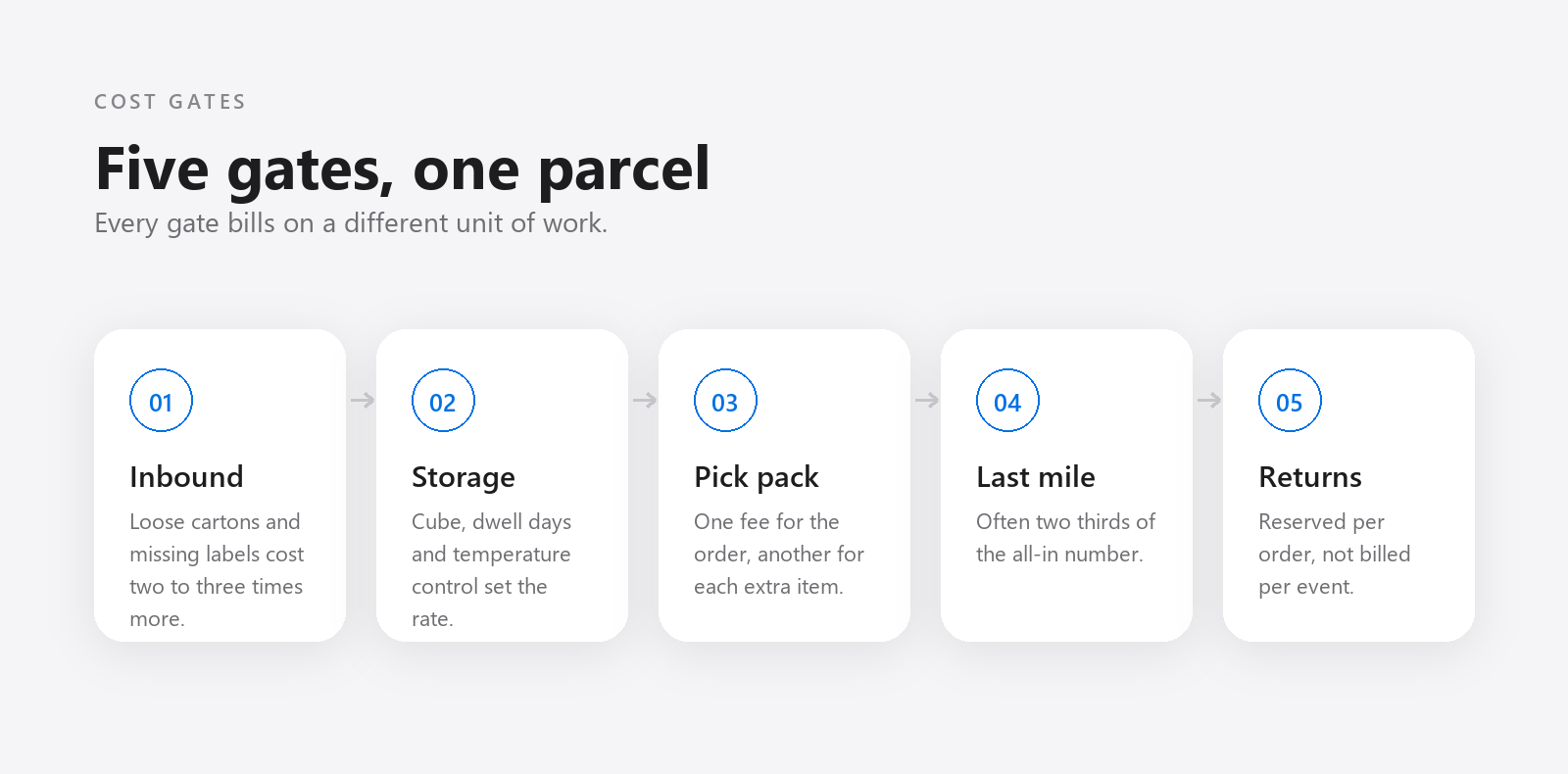
Fulfillment cost is nine lines on an invoice, and the one you negotiate is rarely the one that decides your margin. Pick and pack is usually the most visible fee and rarely the largest. Rent, receiving, packaging, returns, aged inventory, a peak surcharge and the occasional reship make up the rest, and most of them bill a month after the quote that promised you a number.
The pattern repeats across operators of every size. A brand prices a product using the pick fee plus postage, adds a healthy margin, launches, and then reads the first real invoice. Something between 20% and 35% of the total came from lines that never appeared in the proposal.
What follows is the arithmetic behind those lines: what each one is billed on, why the same order costs less at higher volume, one worked example per parcel, and the three charges that show up late.
The nine lines on a fulfillment invoice
Providers name these differently and split them differently. The underlying set is stable enough to use as a checklist.
| Cost line | Billed per | What pushes it up | Fixed or variable |
|---|---|---|---|
| Inbound receiving | Pallet, carton, or labour hour | Loose cartons, mixed SKUs, missing labels | Variable |
| Put-away and slotting | Pallet or bin position | SKU count, slot density | Semi-fixed |
| Storage | Pallet per month, cubic foot per month, or bin per month | Cube, dwell time, temperature control | Fixed |
| Pick and pack | Order, plus each additional item | Items per order, SKU spread | Variable |
| Packaging materials | Box, mailer, or kit | Right-sizing, branded print, inserts | Variable |
| Last mile | Parcel, by zone and billable weight | Weight, dimensional weight, zone, service | Variable |
| Returns processing | Per return | Return rate, inspection depth, resale or scrap | Variable |
| Account minimum | Month | Your slowest month | Fixed |
| Surcharges and exceptions | Parcel or event | Peak calendar, oversize, address correction, reship | Variable |
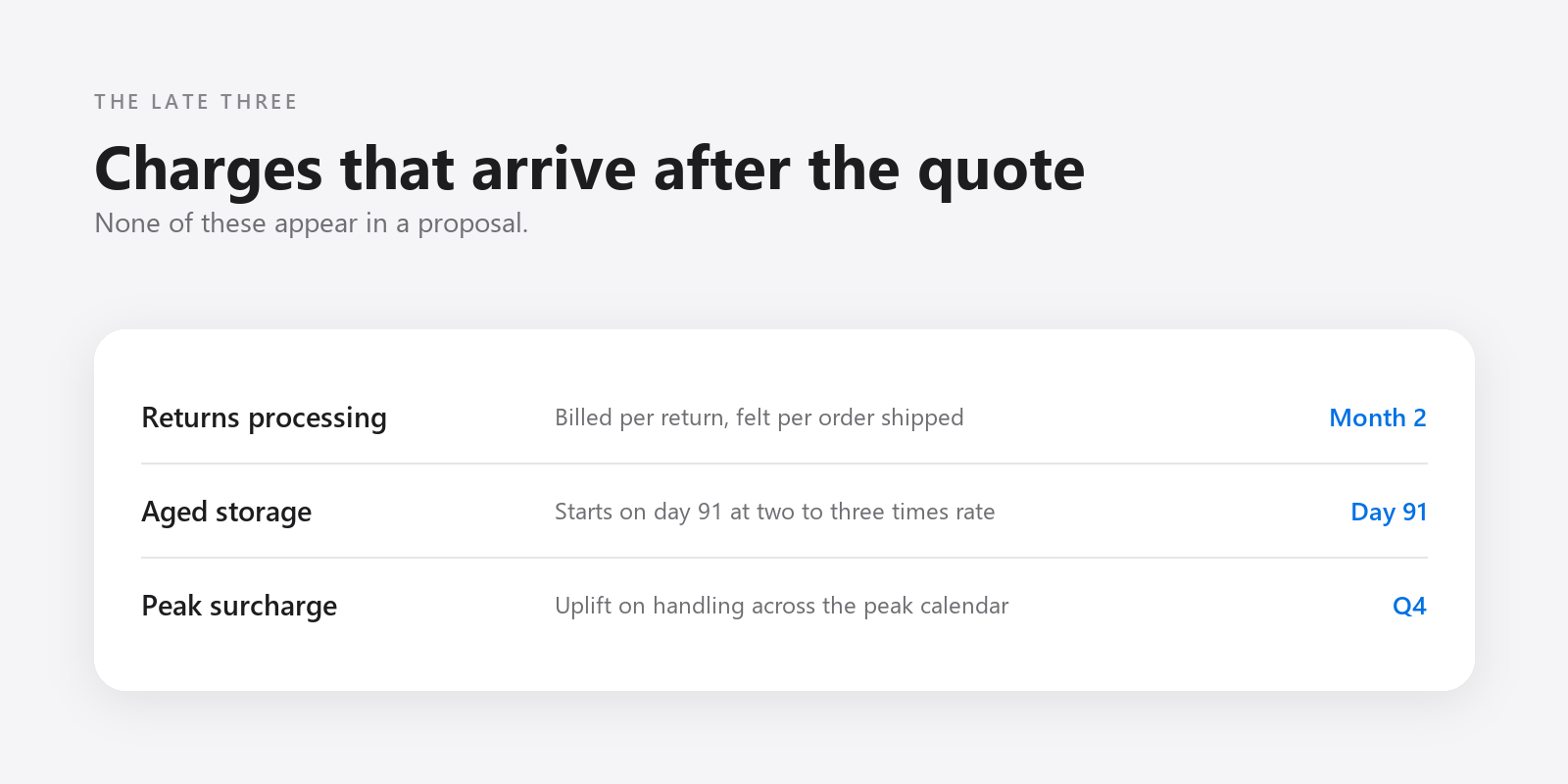
The first six pay for work. The last three pay for reserved space and for things going wrong. Those are the three that get left out of proposals, because a proposal is a sales document and a floor plan is not.
Why the same order gets cheaper as volume grows
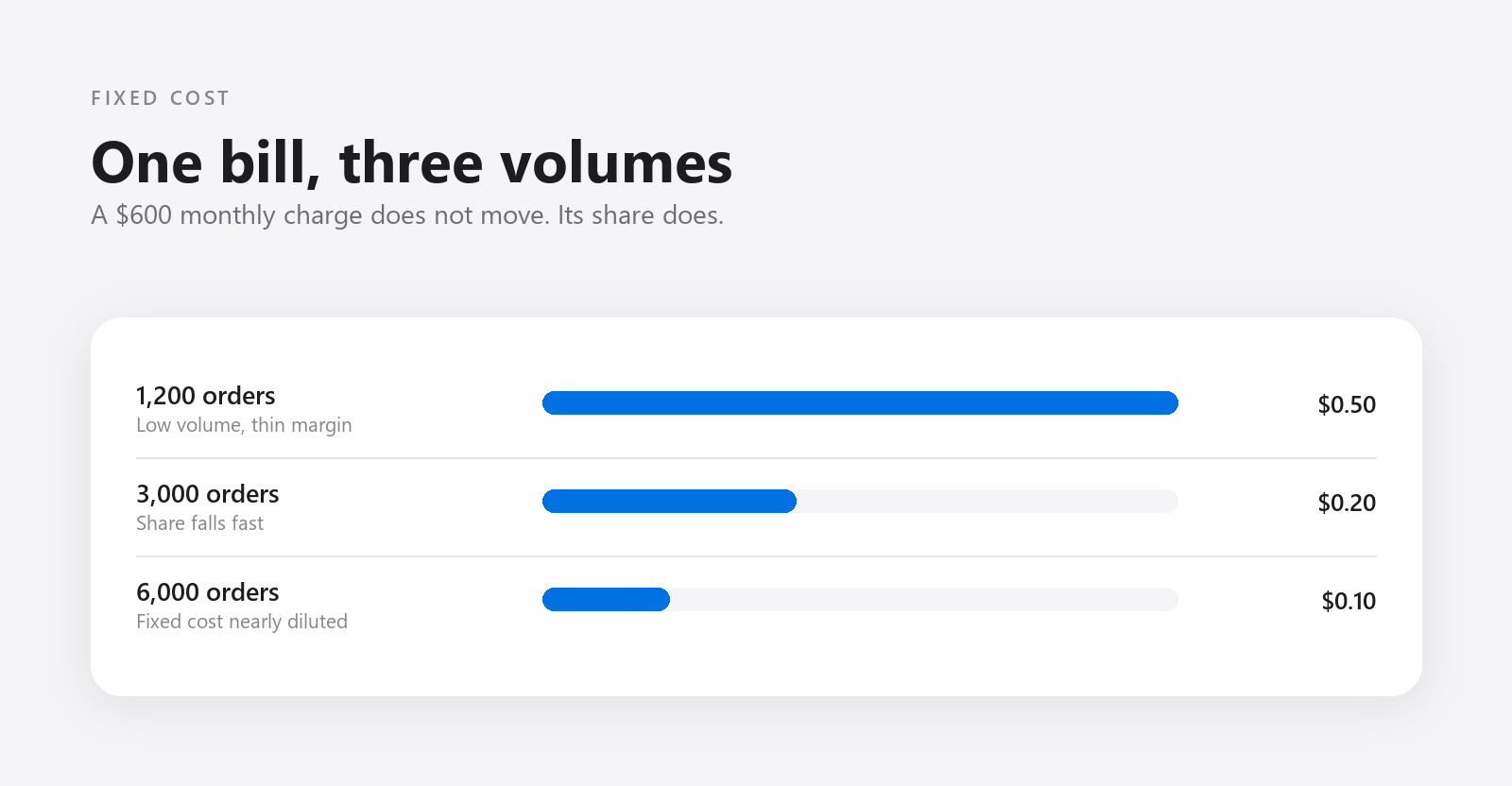
Part of the cost has nothing to do with your order count. A 40,000 square metre lease costs the same on a day with 100,000 orders as on a day with 10,000. Spread that rent over 10,000 orders and each one carries ten times the share it would at 100,000.
Warehouse cost is also not one line. Rent and property charges, maintenance accrual, equipment depreciation and amortisation, office costs, packaging, shrinkage, cycle counting and insurance all belong to storage. Only packaging and piece-rate labour actually move with volume; the rest sits there whether you ship or not.
That is the whole reason a monthly minimum exists later on this list. Space is bought in blocks and paid whether or not the pallet moves.
Small unit differences get multiplied by volume, which is why packaging is negotiated on annual spend and not on unit price. Taking a carton from 1.50 to 1.20 saves 0.30 a unit. At 100,000 orders a day, that is 30,000 a day, and it compounds into seven figures a year. Nobody argues that hard over three-tenths of a unit.
One ratio worth carrying into any negotiation: storage and delivery usually land near 1:1 in a retail operation. Teams spend weeks on the carrier rate and five minutes on the storage schedule, then wonder where the gap came from.
A worked example: one 2 lb order, all in
Ranges in pricing guides are useless until they are attached to a specific order. Here is one, with assumptions stated so you can swap in your own.
Monthly volume 1,200 orders. One unit per order. 240 units per pallet. Average dwell 45 days. US ground, zone 5, 1.4 lb billable.
| Line | Basis | This order |
|---|---|---|
| Receiving | $0.35 per unit, or $30 per pallet ÷ 240 | $0.35 |
| Storage | $22 per pallet-month × 1.5 months ÷ 240 units | $0.14 |
| Pick and pack | First item | $2.60 |
| Packaging | Mailer, label, dunnage | $0.85 |
| Last mile | Ground, zone 5, 1.4 lb | $7.90 |
| Returns reserve | 8% return rate × $4.20 per return | $0.34 |
| Peak, annualised | 12% uplift on handling for 3 months | $0.08 |
| Exceptions reserve | 1.5% of orders × $9 per incident | $0.14 |
| Total | $12.40 |
Two readings of that table matter more than the total. Last mile is about 64% of it, and it is also the only line you can check against a published rate card. The six smallest lines add up to $1.90, roughly 15%, and they are the least transparent segment of the whole bill.
Change one assumption and watch what moves. Push average dwell from 45 to 120 days and storage triples while pick and pack does not budge. Add a second item per order and the incremental pick fee lands before the second unit's packaging. This is why a quote built on "average order" hides the two SKUs that lose money.
Returns: the line that shows up three weeks later
Returns do not appear in the month you ship. They appear when you already believe the SKU runs at 42% gross margin.
Retail returns ran at 14.5% of sales in 2023, with online returns at 17.6% (NRF). At $3.50 to $5.00 to receive, inspect and restock a unit, an 8% return rate costs $0.28 to $0.40 per order shipped. At 15%, the reserve is $0.53 to $0.75 — per order, on every order, including the ones that never come back.
The mistake is booking returns as a per-event fee. Book them as a per-order reserve and put the number in the price. Otherwise the best-selling item is quietly the one funding the returns desk.
There is a second-order effect worth knowing. A returned unit that can be inspected, re-bagged and resold recovers most of its value; one that gets scrapped recovers the box. Whether your provider can do the first depends on whether inspection is in the rate card or billed as a project.
Long-term storage starts on day 91
Most warehouses add an aged-inventory charge once stock sits past 90 days, sometimes 180, commonly at two to three times the standard rate. It is not a penalty. It is a price for occupying a slot that produces nothing.
Waiting for the notice is the wrong control. The working version is a slot rule: fast-pick positions turn at least three times a day, and anything that has not moved in seven days gets pulled to a slower zone or cleared. That rule turns a finance surprise into a housekeeping task.
Which is also why storage pricing needs a unit you can audit. Per pallet is easy to count. Per cubic foot punishes bad carton design, and carton design is the one input you fully control — a small change in case dimensions can lift pallet load by around 20%, and that lands directly in the storage line.
Peak surcharge is a calendar event, not an accident
Peak pricing reflects real cost: agency labour, overtime, pre-packing, and moving stock out of the way so the pick face stays clear. A warehouse that handles peak well forecasts volume seven days out, refreshes sold units, stock on hand and carrier pickup capacity every two hours, and moves predicted bestsellers into the pick face nearest the packing bench before the wave arrives.
Carriers run the same logic. Demand surcharges, remote-area surcharges, additional-handling fees and weekly fuel adjustments are separate line items, published annually and revised as rates change. Budget peak as a calendar event with a percentage attached, not as last year's invoice plus a bit.
Annualising keeps the comparison honest. A 12% handling uplift across three months is roughly 3% of annual handling cost, or a little over $0.08 on this example order — small per parcel, but it arrives in the quarter when you can least afford to discover it.
Exception costs live outside the invoice
Mis-ships are the only cost that can eat a year in an afternoon. A well-run warehouse holds picking errors near 5 in 100,000 through three checks: scan-verified picks, a weigh station that flags a parcel more than 5 g off its expected weight, and a second label-to-order scan before the parcel leaves.
Skipping those checks has a price that is easy to estimate. A thousand wrong parcels in one peak week means return freight, refunds and rating damage, and the total tends to run more than ten times what the verification equipment would have cost.
For a buyer, the only durable protection is contractual: define what counts as a mis-ship, set a claim window, and require inbound weight records. Billable weight normally follows the provider's manifest, and arguing after the fact rarely moves it. Evidence moves it.
Build your own cost per order in five fields
- Monthly orders, and average items per order
- Pallets or cubic feet held, and average dwell in days
- Average billable weight, and the zone mix
- Return rate, and what happens to a returned unit
- Monthly minimum spend, in currency
Then add: fixed monthly charges ÷ orders, plus handling, plus packaging, plus postage, plus returns reserve, plus annualised peak, plus an exception reserve. If the answer does not match your bank statement within a few percent, one of the five fields is wrong — usually dwell or zone mix.
One sanity check on the handling input. A 12-person line — six packing, six picking — moving 20,000 parcels a day works out to roughly 1,700 parcels per person per day. That is what manual picking looks like at full stretch, so a quote implying double that is either automated or optimistic.
Six questions before you sign the next quote
- How is the monthly minimum calculated, and does a slow month carry forward?
- When does aged-inventory pricing start, at what multiple, and what is the clear-out rule?
- Are peak surcharge dates and percentages written into the agreement?
- How is loose or unlabelled inbound billed — per pallet or per hour?
- What does returns processing include, and is refurbishment extra?
- What is the claim window and the remedy for a mis-ship?
The negotiable money is rarely in the pick rate, which is the most visible number on the page. It sits in the minimum, the tier break and the surcharge cap.
The short version
Nine lines, one of which is postage and six of which are small enough to ignore until they are added up. Amortise fixed charges over real volume, convert returns into a per-order reserve, treat aged inventory as a slot-management problem, and annualise peak so November stops being a surprise.
If you already have two or three quotes in hand, send the monthly order count, items per order and pallet count. We will put them on the same basis before anyone argues about price.
References (Neutral Third-Party Sources)
- USPS — Postage Rates & Prices: the published domestic rate structure, and evidence that parcel rates are revised on a schedule rather than fixed. https://www.usps.com/business/prices.htm
- UPS — Shipping Zones and Rates: how zones, daily rates and retail rates differ, and how additional-handling and remote-area charges sit outside the base rate. https://www.ups.com/us/en/support/shipping-support/shipping-costs-rates.page
- UPS — Fuel Surcharges: the index-linked mechanism behind a floating surcharge, adjusted weekly. https://www.ups.com/us/en/support/shipping-support/shipping-costs-rates/fuel-surcharges
- National Retail Federation — 2023 Consumer Returns in the Retail Industry: total returns at 14.5% of sales and online returns at 17.6%. https://nrf.com/research/2023-consumer-returns-retail-industry
- Federal Trade Commission — Mail, Internet, or Telephone Order Merchandise Rule (16 CFR 435): the 30-day default shipping window and the consent-or-refund obligation when a shipment slips. https://www.ftc.gov/legal-library/browse/rules/mail-internet-or-telephone-order-merchandise-rule
- GS1 — Serial Shipping Container Code (SSCC): the pallet and carton identifier that makes inbound counting and weight records auditable. https://www.gs1.org/standards/id-keys/sscc