
Warehousing and Fulfillment: How They Work Together
A warehouse is where stock waits. Fulfillment is the work of making it leave. They share one roof, one labor pool and one finite set of storage slots — which is why they argue, and why the argument has a physical address.
Storage is priced in pallet-days and thinks in months. Fulfillment is priced in minutes and thinks in cutoffs. In one building, every decision about where a pallet sits becomes a decision about how fast an order can leave.
This article walks that seam: slotting and the pick path, storage form versus turnover, the gap between arrival and sellable stock, why counting stops dispatch, and three ways cheap rent turns into an expensive order.
One roof, two clocks
The statistical definition helps. Warehousing establishments, as the U.S. Bureau of Labor Statistics describes them, provide facilities to store goods and do not sell what they hold; they may add labeling, breaking bulk, inventory control, light assembly and pick and pack — but storage comes first.
That ordering explains the tension. Storage is judged on density: cost per position, how much floor is earning rent. Fulfillment is judged on flow: orders out by the cutoff, lines per hour, errors per thousand. Density wants aisles narrow and full; flow wants them clear and the pick faces close.
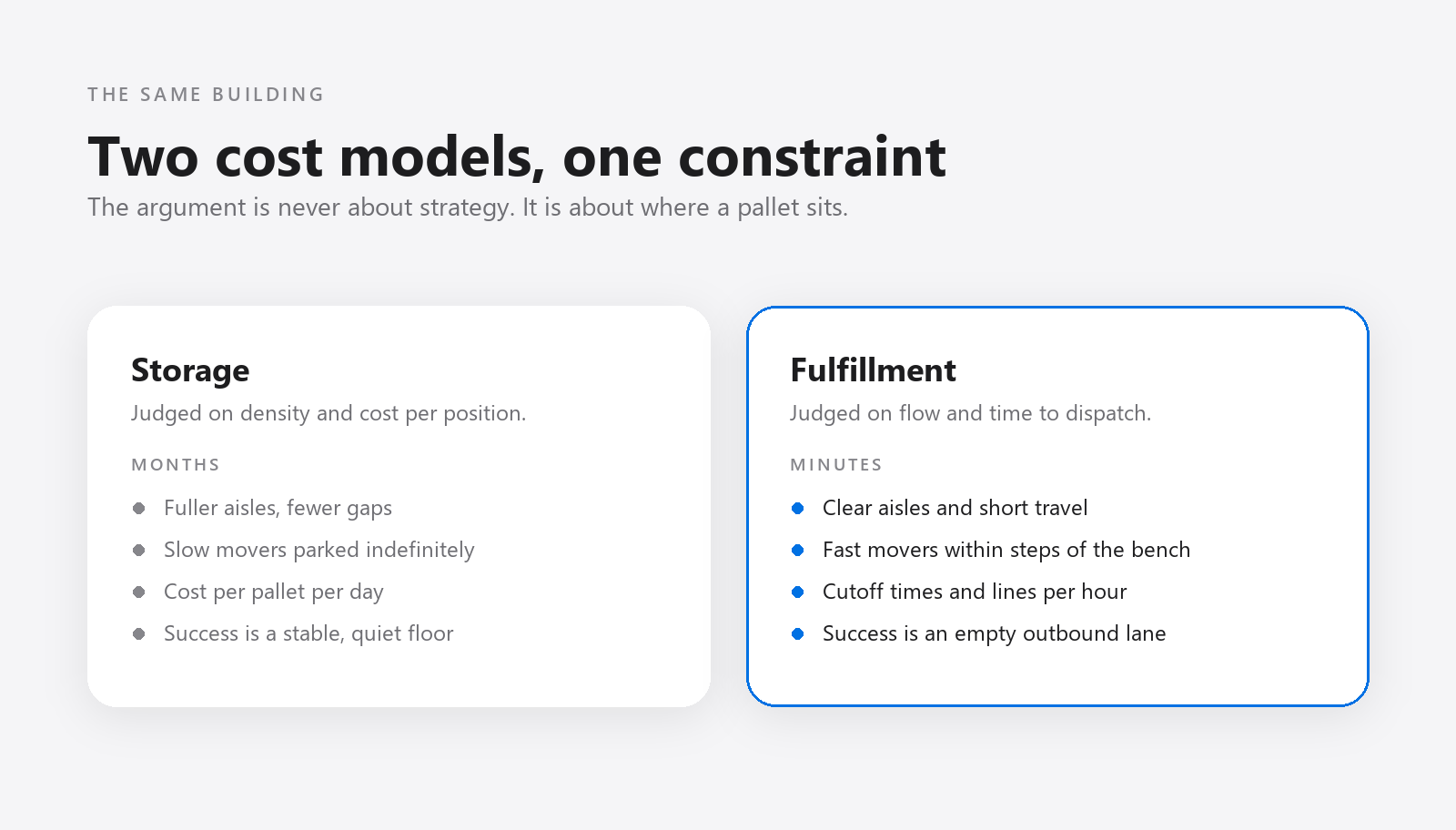
Neither side is wrong. The answer is not a compromise in the middle but a deliberate split of the floor: reserve stock at the back, pick faces at the front, and a rule for what may sit in each.
The conflict has an address: the slot
A slot — one labelled position — is the only resource both sides need. Storage wants it occupied for months. Fulfillment wants it to hold only what ships this week.
Treat slot count as a budget rather than a floor plan and the conversation changes. A site shipping 20,000 parcels a day with 12 people is not fast because the building is large; it is fast because prime positions turn over constantly and everything else is staged out of the way. Mature operations push predicted bestsellers to the positions closest to the pack benches, clear slow movers to a transit area, and expect fast-pick slots to turn several times a day. Stock sitting past a week in a prime position is a management failure, not an inventory fact.
Two rules follow, and both are uncomfortable:
- A slot occupied by a slow mover is a slot the peak cannot use. Re-slotting is not spring cleaning; it is capacity planning.
- Reserved positions need a number. Ask how many positions are yours in October and whether the site can absorb a 3× week without moving your stock into a corridor.
Slotting decides the pick path
Picking is walking with extra steps. The route a picker takes is fixed the moment the slot is assigned, long before anyone optimizes a pick list.
Put twenty SKUs in one bay and a batch pick is a short loop. Spread them across four zones and the same batch becomes a tour with three extra scans and a consolidation step. Software sequences stops; it cannot remove distance. Slotting decisions made in a quiet month show up as overtime in a busy one.
The test: print a heat map of pick travel for the last 30 days. If the hottest SKUs are not within a few bays of the pack bench, the picking problem is a layout problem, and staffing will not fix it.
Ergonomics belongs here too. Regulators note that the industry's most common injuries are musculoskeletal, from lifting and lowering, plus being struck by powered industrial trucks. A slot that needs a reach above the shoulder or a bend to the floor is slow and unsafe at once — which is why heavy, fast-moving items belong in the middle band.
Match the storage form to how often the SKU moves
Storage form is usually chosen by what the building already owns. It should be chosen by turnover, because each form trades density against access.
| Storage form | Fits turnover | What you give up |
|---|---|---|
| Flow rack / pick face | Daily or multiple times a day | Density; needs replenishment labor |
| Shelving, carton pick | Weekly | Pallet-level efficiency |
| Pallet rack, selective | Monthly | Floor space per unit stored |
| Floor block / bulk stack | Quarterly or slow | Access; you must dig to reach |
| Mezzanine or high bay | Slow, small, light | Travel time per pick |
The costliest mismatch is fast movers stored at pallet density. It looks efficient on a storage report — the same unit in a third of the space — and then a picker walks 90 seconds for one unit, twice an hour, all day. Slow movers in flow rack are the mirror image.
A pallet detail worth knowing before you design a bay: standard North American grocery pallets are 48 × 40 inches, and cartons that overhang by an inch waste more cubic space than most packaging reviews assume. Brands that resize a carton to the pallet footprint better have reported single-pallet loads rising by around a fifth.
Receiving: the appointment decides the week
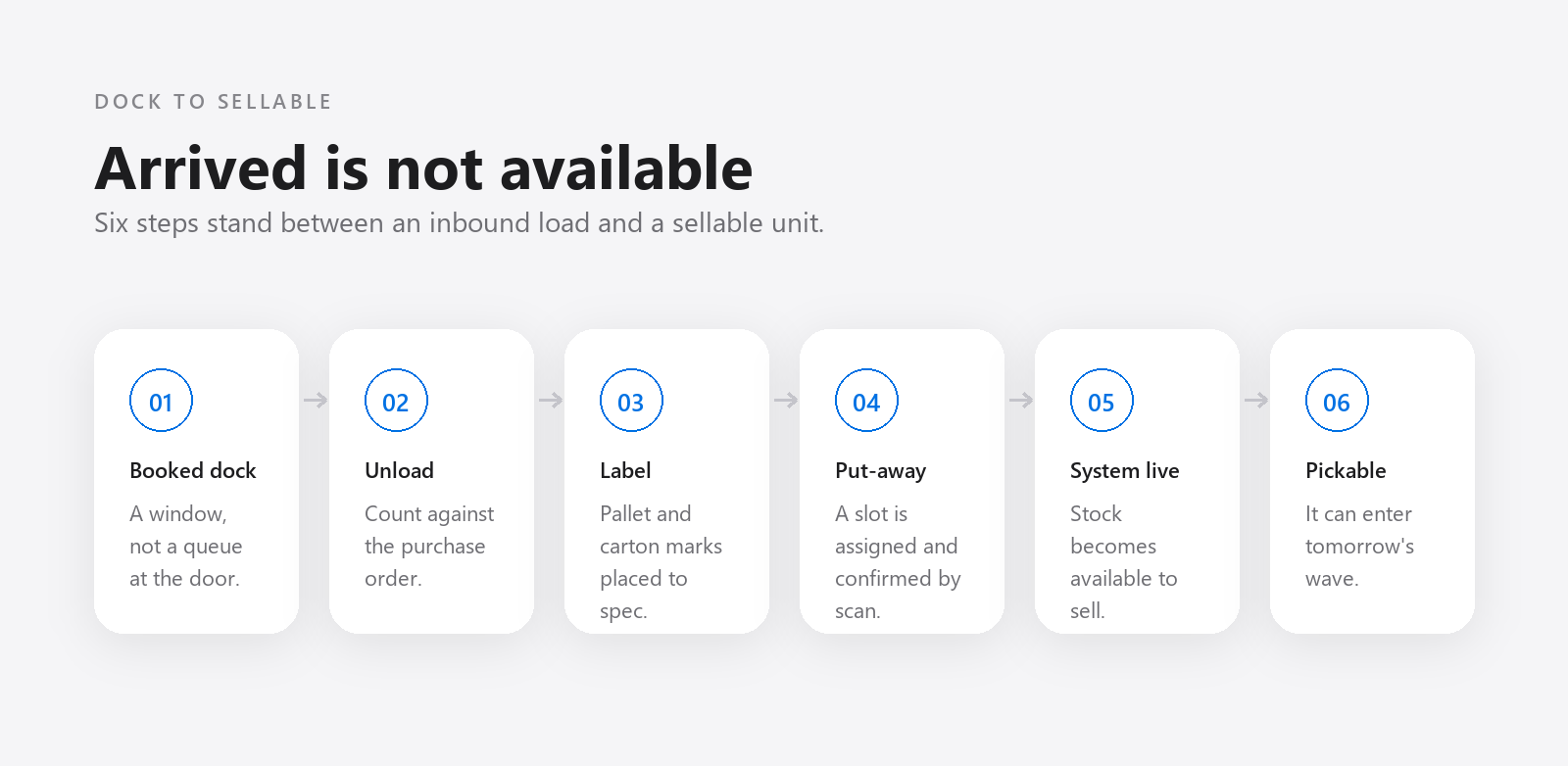
Stock that has arrived is not stock that can sell. Between the dock and the pick face sit unloading, counting, labelling, put-away and a system update. Until the last step the SKU reads as zero available, and the listing keeps selling into a hole.
This is where a receiving appointment becomes a service level. Three inbound loads landing on a Tuesday with no dock slot booked means unloading competes with dispatch for the same doors and the same people. Sites that run well book windows and publish the promise separately: stock live within 48 hours of arrival, which covers the whole chain, not the forklift.
Labels belong to this step, and they are specified more tightly than most sellers expect. Under the GS1 logistic label guideline, a pallet label's barcode sits 400–800 mm from the base and at least 50 mm from the vertical edge; a carton label sits about 32 mm from the natural bottom and 19 mm from the edge. Get this wrong and every scan becomes manual entry — receiving slows for a reason nobody can see on a dashboard.
One habit matters for peak. Booking capacity seven days ahead, then re-checking sold units, remaining stock and carrier pickup capacity every couple of hours during a surge, is how overflow moves before the aisles fill. Warehouses that plan monthly discover the problem on the day it becomes a photograph.
Counting stops dispatch
A cycle count — recounting a slice of the warehouse on a rolling schedule instead of shutting down for a full physical inventory — sounds like finance. Operationally it is dispatch, because counting freezes locations.
Freeze a bay and the orders needing those SKUs cannot enter a wave. Freeze the building on the last day of the quarter and you have stopped shipping on a day your customers are still buying.
The workable pattern counts by value and velocity: A-items weekly in small slices, B-items monthly, C-items quarterly, with a full reconciliation only when a variance keeps repeating. Pair it with the checks that catch errors before a customer does — a scan that will not advance on a wrong SKU, a weight check against a stored weight per SKU or bundle (tolerances around 5 grams on small items), and a second label scan at dispatch. Sites running all three describe mis-ship rates near 0.05%; a well-run third-party quotes pick accuracy around 99.7%, which is the same fact stated the other way round.
Three ways cheap rent gets expensive
Rent per square foot is the least useful number in the decision, because it is the one cost that does not move when you make a mistake.
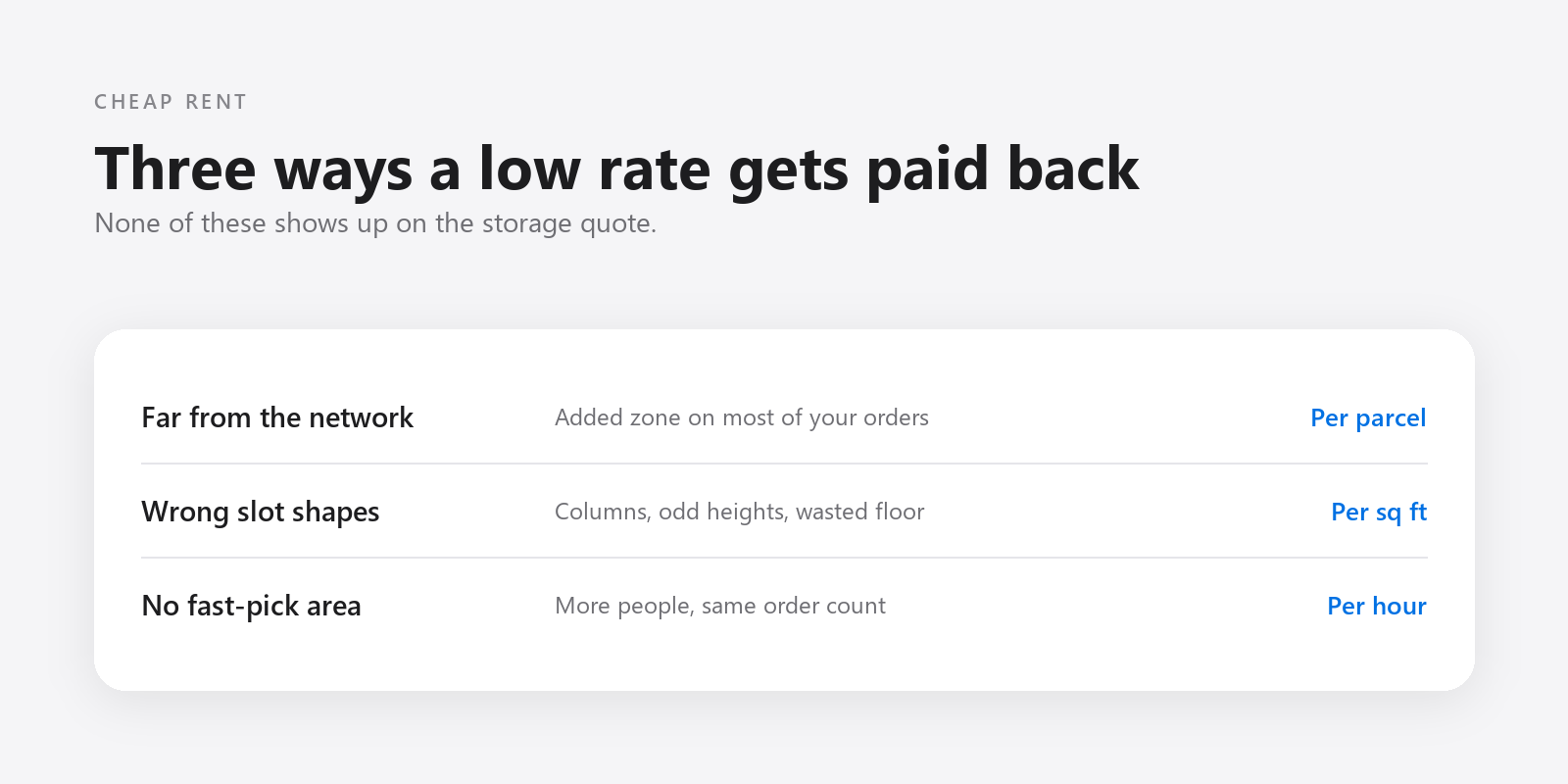
The warehouse is far from the parcel network. A building 70 miles further out saves on rent and adds a zone to much of your order book. On low-value parcels that zone can exceed the storage saving per order.
The slots are the wrong shape. Columns in the aisle, odd bay heights, no mezzanine. You rent 30% more floor than your SKU count needs, then pay again in travel time.
There is no fast-pick area. Labor is the largest controllable cost in a manual operation. Without velocity zoning you hire more people to ship the same orders, and the rent saving is spent on hours, permanently.
The fixed-cost logic is what makes this invisible. Rent on a 40,000 m² building is the same whether the site ships 10,000 orders today or 100,000; it does not flex. Packaging and piece-rate wages do. A cheap building with poor flow converts a fixed cost into a variable one — paid every month, then paid again per order.
Peak is a schedule, not a square footage
A peak plan has four numbers: how many temporary staff can be added and from where, how many days before they are productive, which dock doors are reserved, and when the cutoff moves. "We add people" is intent. "Forty temporaries from two agencies, booked 10 days out, two days of training, cutoff moves from 10 p.m. to 4 p.m. in the second week of November" is a plan.
Pre-packing is the other lever, and it is underused. Assembling the top-selling bundles ahead of the spike and staging them beside the pack bench turns a five-minute order into a label and a seal. Piece-rate operations — around a tenth of a currency unit per parcel in high-volume Chinese sheds — reach throughput by taking work off the critical path, not by hiring faster hands.
Six numbers on one dashboard
Storage and fulfillment stop fighting when they are measured together. Six metrics, reviewed weekly, cover most of the seam:
| Metric | What it exposes | Reference point |
|---|---|---|
| Fast-pick turns per day | Whether prime slots are earning | 2–3 or more |
| Dock-to-stock hours | The sellable gap after arrival | Under 48 hours |
| Pick lines per labor hour | Slotting and travel quality | Falling cost per line |
| Lines per order | Whether batching is possible | Stable or rising |
| Mis-ship rate | Whether checks are real | Near 0.05% in strong sites |
| Orders per person per day | Labor model and pre-pack depth | Rises with pre-packing |
Where it lands
Warehousing and fulfillment are not two departments needing better communication. They are two cost models sharing one constraint, and the constraint is a numbered slot on a rack.
Get the slot allocation right and the rest follows: shorter pick paths, fewer touches, a peak you can schedule instead of survive. Get it wrong and no amount of software, staffing or cheerful quarterly reviews closes the gap.
If you are sizing a move — a new SKU count, an uncertain peak multiple, or a warehouse that has quietly become the bottleneck — send us the SKU count and worst-month volume. We will come back with a slot and wave plan before we talk about rates.
References (Neutral Third-Party Sources)
- U.S. Bureau of Labor Statistics — Warehousing and Storage: NAICS 493: how the agency defines warehousing establishments and the logistics services they may add. https://www.bls.gov/iag/tgs/iag493.htm
- Occupational Safety and Health Administration — Warehousing: the industry's main hazard categories, including musculoskeletal injuries from lifting and struck-by incidents involving powered industrial trucks. https://www.osha.gov/warehousing
- GS1 — Logistic Label Guideline v1.3: label placement rules for pallets and cartons, and the SSCC segment that must appear on every logistics label. https://www.gs1.org/standards/gs1-logistic-label-guideline/1-3
- GS1 — Serial Shipping Container Code (SSCC): the identifier that ties a pallet, case or parcel to one record. https://www.gs1.org/standards/id-keys/sscc
- Encyclopaedia Britannica — Logistics: where warehouse and distribution centre management sits among business logistics activities. https://www.britannica.com/money/logistics-business
- UPS — Package Dimensions, Size Limits and Weight Guide: how dimensions are measured and rounded up for billing. https://www.ups.com/us/en/support/shipping-support/shipping-dimensions-weight.page
- Reddit — r/logistics: practitioner discussion of warehouse layout, slotting and picking practice. https://www.reddit.com/r/logistics/