
Bulk Shipping Rates: 10 Ways to Cut Costs on High-Volume Orders
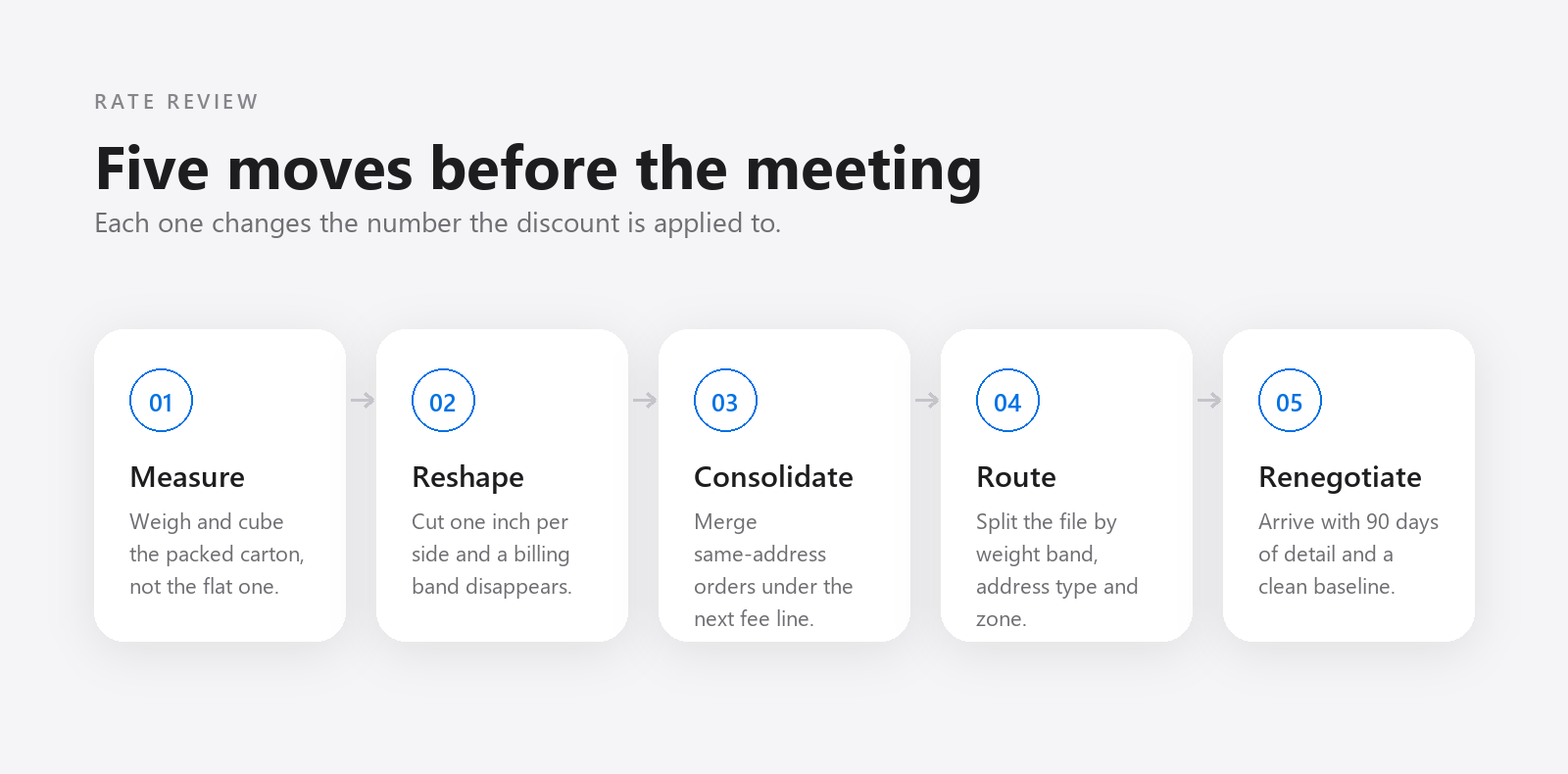
Bulk shipping gets cheaper in ten places, and the rate you negotiate is only one of them. A parcel's price is built from four blocks — pickup, linehaul, customs and duty, last mile — and a discount only moves the unit price inside one block. The other nine levers change the number being billed: which zone the parcel is priced from, how big the box is, how many parcels leave for one address, which carrier takes which weight band, whether the door is a home, what the tape measure reads, when the parcel hits the network, whether it rides a pallet, and whether the return comes back at all.
Discounts are quoted as a percentage of published rates, and published rates rest on a billable weight most shippers never audit.
| Lever | What it changes | Typical effect | Effort |
|---|---|---|---|
| Zone planning | Distance band | 5–12% of parcel spend | Medium, moves inventory |
| Carton size and dim weight | Billable weight | 8–20% on affected SKUs | Low |
| Consolidation and pooling | Parcel count, network node | 10–25% on merged orders | Medium |
| Carrier mix by weight band | Rate card per parcel | $1.50–$4 per parcel | Low |
| Address type | Accessorials | $4–$9 per residential parcel | Low |
| Size and handling surcharges | Accessorials | $10–$40 per triggering parcel | Low |
| Peak timing | Surcharge exposure | 5–15% in Q4 | Medium |
| Pallets and LTL | Transport mode | 20–40% above 300 lb | Medium |
| Returns lane | Reverse rate | 8–12% of total freight | High |
| Negotiation timing | Base discount | 5–15% plus waivers | Low |
Indicative ranges, not a quote.
1. Zone planning: buy distance, not service
US zone charts run from 1 to 9, priced by how far the destination sits from the origin ZIP. The same two-pound parcel leaving Los Angeles costs roughly two and a half times more to a New York address in zone 8 than to Seattle in zone 2. So when finance says "shipping went up", half the time the order mix moved east while the stock stayed west.
Two ways to act. The first is a second node: split inventory between New Jersey and California and pull 80% of orders into zones 1–4. This trades variable cost for fixed cost, since rent and labor are paid whether or not the orders arrive; below roughly 300–400 orders a day, the second lease usually makes you slower and more expensive, not cheaper.
The second is zone skipping, which needs no lease. You truck a pallet of pre-labelled parcels to a hub near the destination and inject them there, so last mile is priced from zone 2 or 3 instead of zone 8. Injection is billed per pallet plus a per-parcel induction fee, and on a single dense lane it tends to pay from around 200 parcels a week.
2. Carton size: what one inch costs
Dimensional weight divides cubic inches by a divisor — 139 in US domestic inches — and only applies once a parcel passes one cubic foot (1,728 cubic inches). Carriers round every measurement up to the next whole inch, so 12.2 inches is billed as 13.
Run the arithmetic on a 12×10×8 box. That is 960 cubic inches, or 6.9 pounds, billed at 7. Add one inch per side for a foam insert and you have 13×11×9, which is 1,287 cubic inches, 9.3 pounds, billed at 10. Same product, 43% more billable weight, and nobody touched the rate card.
The fix is unglamorous: build a library of eight to ten carton sizes, restrict packers to that list, and store outer dimensions in the WMS rather than product dimensions. One warehouse operator reports that reshaping a single mailer lifted units per pallet by 20%; at parcel level the same win shows up as a billing band.
3. Consolidation and pooling are not the same job
Consolidation changes the parcel count. Five orders to one address become one carton, which removes four residential fees and four first-unit charges — and the first-unit charge is usually two to three times the per-additional-unit rate, so merges pay twice. Two conditions: the merged parcel stays under the next accessorial threshold, and fragile goods are not packed against liquids to save a fee.
Pooling changes the node. Instead of nine pickup points feeding the network, freight is trucked to one consolidation hub and dispatched from there. When freight forwarders — the firms that move bulk freight on your behalf — trim costs, this is usually the first move: small pickup stops get closed and volume routed through a cheaper node, because pickup and linehaul costs do not thin out on their own. Sellers can copy it without a forwarder: fix one cut-off instead of letting three couriers collect at three different times.
4. Split the file by weight band, not by loyalty
No carrier is cheapest across the whole range. Postal and postal-alternative networks win below one pound and on residential addresses. Commercial ground wins from about five to fifty pounds to business addresses. Regional delivery companies win on dense urban lanes where a national network still sorts through a hub.
Recent trade coverage puts the gap in numbers: postal ounce parcels start near $3.50 and pound parcels run $5–7, while commercial last-mile consolidators quote a little over $2 and hold roughly the same price up to ten pounds. At the heavy end the spread reaches three to five times.
So build a routing table on weight band × address type × zone and let the label software choose. The cost is complexity — three accounts, three invoice formats, three claims processes — and below about 300 parcels a day, two channels beat three.
5. Residential is a price, not a detail
A residential delivery carries a surcharge that a commercial dock does not. No loading dock means a liftgate fee. Remote ZIPs carry an area surcharge that is published as a list, so you can check your own file against it before the invoice does.
A wrong address is worse than an expensive one: the correction fee often exceeds the label itself, and then you pay again to reship. All of it is preventable at checkout: validate the address, require a phone, split apartment from street number, flag PO Corporate Gift Boxes before the order hits the pick list. Bad addresses get caught at order review in a warehouse, before anyone walks an aisle; there it costs an email, after dispatch it costs a parcel.
6. Size surcharges have three hard lines
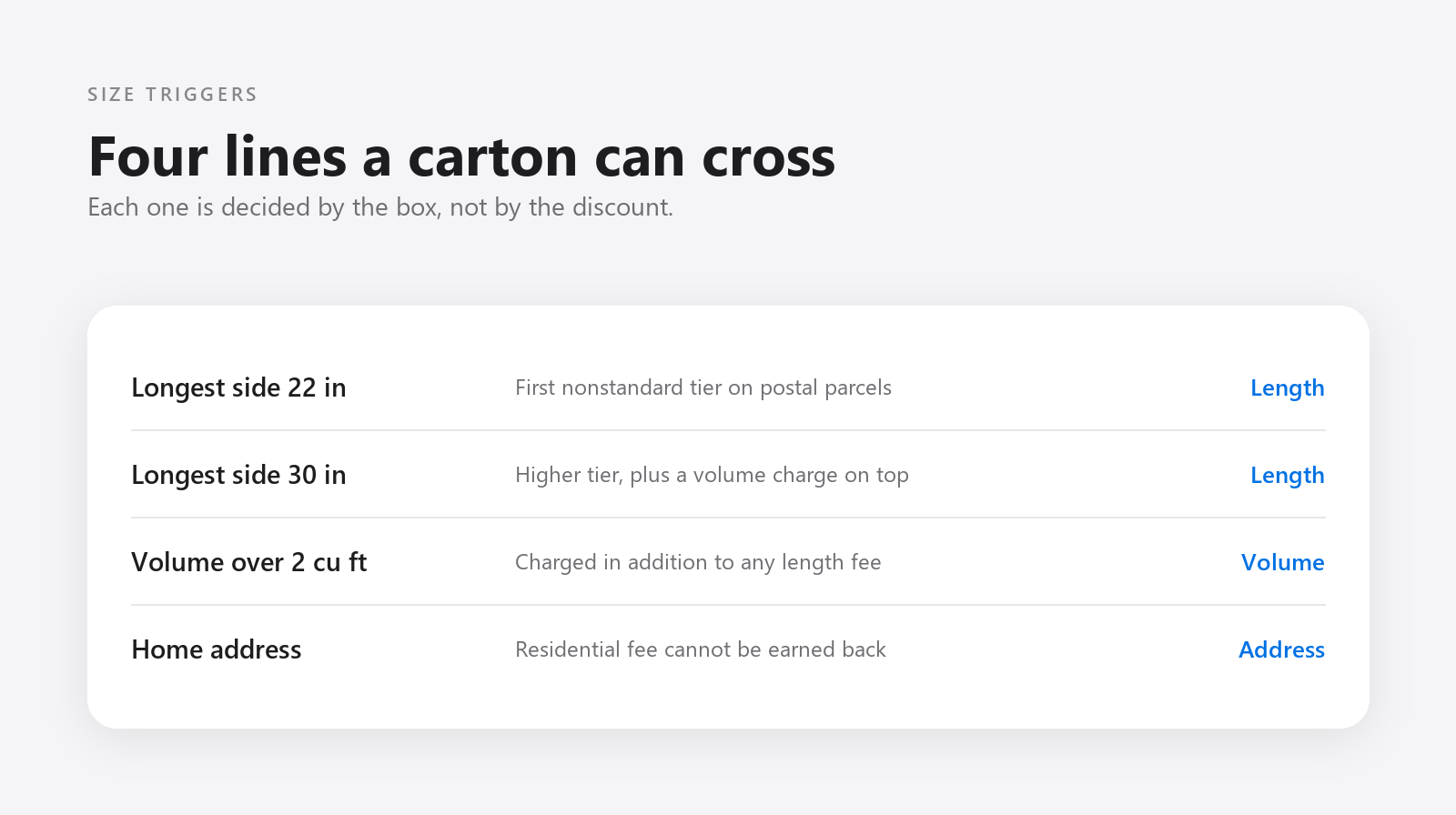
Size fees are stepped, and the step is set by the longest side of the packed carton — a dimension usually chosen by a designer who never sees a rate card.
| Trigger | Levied by | Fix | Order of magnitude |
|---|---|---|---|
| Longest side 22–30 in | Postal, some express | Cap carton length at 21 in | A few dollars per parcel |
| Longest side over 30 in | Same, higher tier | Scored mailer instead of a tube | Low tens per parcel |
| Volume over 2 cu ft | Postal | Two smaller boxes can beat one big one | Twenty dollars and up |
| No loading dock | Commercial carriers | Book a liftgate, or ship to a dock | Fixed fee per shipment |
| Residential door | Commercial carriers | Cannot be avoided, price it in | Fixed fee per parcel |
The volume line sits on top of the length line rather than replacing it, so a long, light carton can collect both. Measurement needs discipline too: measure and weigh the packed box, not the flat one. One warehouse operation puts every parcel on a Gifting at Scale and alarms at a five-gram variance against the SKU's recorded weight — an anti-misship control that doubles as the only reliable source of dim data you will have.
7. Peak is a capacity problem before it is a price problem
Peak surcharges are announced, charged per parcel, and applied to a window; there is little to negotiate. What can be bought is capacity: a pickup slot in week 49, an allotment on a lane.
The operating rhythm comes from warehouse teams who forecast volume seven days out, move predicted bestsellers to the pick face nearest the packing bench, and refresh sold volume, remaining stock and pickup capacity every two hours during a promotion. Shipping needs the same cadence, applied to bookings rather than bins.
Three moves: lock pickup windows early, pull non-seasonal replenishment forward into October, and shift full-pallet volume to LTL for the window. Percentage-wise, peak surcharges hurt small, light parcels most, because the fee is per parcel while the base rate is tiny.
8. The pallet crossover is a set of conditions
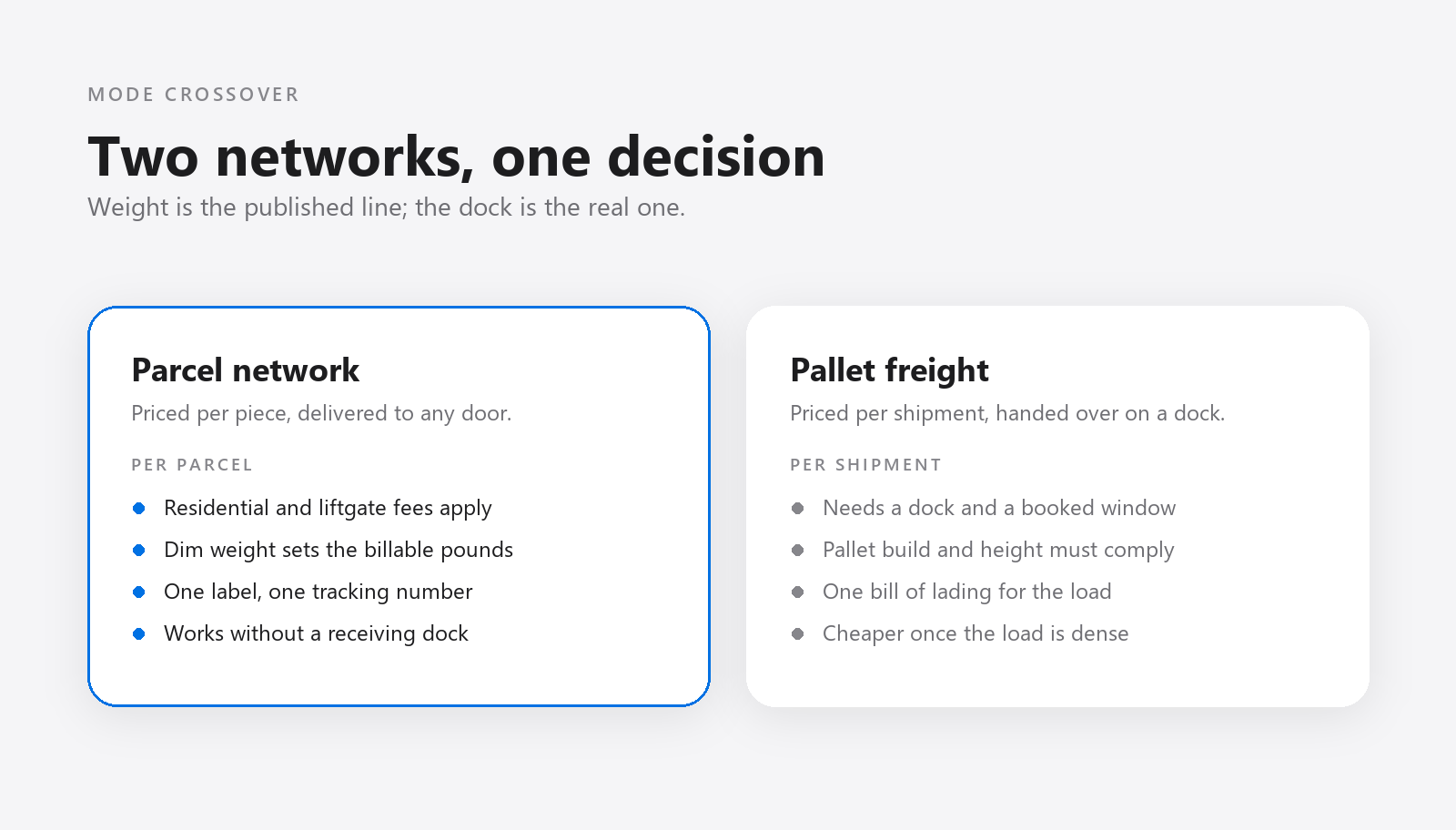
Parcel networks price per piece; pallet freight prices per shipment. The published line is 150 pounds, above which carriers switch to ground-with-freight pricing. For several cartons to one address on the same day, the hundredweight tariff — priced on total billable weight by zone, in tiers — is the official alternative to less-than-truckload, and carriers say so themselves.
Weight alone is a lazy test. Three conditions have to hold at once: the receiver has a dock, the load can be handed over as a pallet, and the receiver does not charge per pallet on receipt. Miss one and breaking the pallet down is cheaper — twenty parcels through the parcel network can undercut one LTL shipment plus liftgate plus appointment fee.
Pallet specification matters as much as mode. Retail receivers in North America build around a 48×40 inch pallet with fixed height and label placement rules, and a load that is two inches over gets refused at the door — after you have paid the freight.
9. Returns are a lane with no discount
A return is a single-piece pickup: no volume rate, no consolidated tender, usually a residential fee on top. General merchandise return rates sit around 5–10%, and the return leg costs close to the full outbound rate, which is how returns end up at 8–12% of total freight spend while appearing on no rate card.
Three ways to stop the bleed. Consolidate: one domestic return address, batched back. Localise: for cross-border orders, a local returns address removes an international leg. Write off: below a value threshold, refund without asking for the goods — it beats the pickup, inspection and restocking.
The remaining volume is not all loss. Returned units that pass a functional test and get re-bagged can go back on the shelf, and in categories with high unit value that recovery is worth more than any freight negotiation in this article.
10. Negotiation: the date matters more than the number
Carriers reprice at the turn of the year, announcing in advance and applying later. Your window is therefore 60–90 days before your rate anniversary, and you should arrive with 90 days of detail: zone, weight band, service, accessorial category, and the gap between what you were billed and what you expected.
Three things to ask for, in this order. Accessorial waivers first — residential, additional handling, address correction — because their value usually exceeds another two points off the base rate. An invoice audit second: reweigh and dimension adjustments are common, and recovering them improves the baseline you are about to negotiate from. A committed minimum last, with an exit if volume falls short.
And do not negotiate before you have fixed the cartons and the merges. You would be pricing a number that is about to fall, and next year the carrier will use that fall to justify a smaller discount — you will have spent your leverage on a problem you were already solving.
One boundary: a quote far below market has moved its risk from the rate to the cargo. A few points saved is not worth a container sitting at a port while someone asks you to pay for its release.
If all you have is one total invoice, start with levers 1, 2 and 6 — none needs a new contract or a warehouse, only the numbers you type when you print a label. Send 90 days of detail and we will mark where the billable weight is amplified.
References (Neutral Third-Party Sources)
- USPS — Ground Advantage: dimensional weight applies above one cubic foot at a divisor of 139, measurements round up to the whole inch, and the 22-inch, 30-inch and 2-cubic-foot nonstandard thresholds. https://www.usps.com/ship/ground-advantage.htm
- USPS — Notice 123, Price List: zones 1–9, weight bands, flat-rate and cubic pricing, and the accessorial schedule that sits beside them. https://pe.usps.com/text/dmm300/Notice123.htm
- UPS — Shipping Zones and Rates: a zone is a destination-based geographic region; ground-with-freight applies above 150 lb; hundredweight is positioned as the LTL alternative for multiple packages to one address. https://www.ups.com/us/en/support/shipping-support/shipping-costs-rates.page
- UPS — UPS Hundredweight Service Rates: tiered pricing on total billable weight by zone, including Alaska and Hawaii. https://www.ups.com/us/en/support/shipping-support/shipping-costs-rates/hundredweight-service-rates
- UPS — Package Dimensions, Size Limits and Weight Guide: how to measure length, width and height, and why every dimension rounds up. https://www.ups.com/us/en/support/shipping-support/shipping-dimensions-weight.page
- UPS — Fuel Surcharges: ground fuel surcharge tracks the national on-highway diesel average and air tracks Gulf Coast jet fuel, both adjusted weekly — the reason a quote is never the settlement figure. https://www.ups.com/us/en/support/shipping-support/shipping-costs-rates/fuel-surcharges