
Fulfilled vs Shipped: What Each Order Status Actually Means
No — fulfilled does not mean shipped, and shipped does not mean delivered. In most systems "fulfilled" records that the warehouse has finished with the items. "Shipped" records that someone says the parcel has left. "Delivered" is a scan by a carrier who has no stake in your dashboard.
Three words, three different owners, and usually one to three days of silence in between. That silence is where the angry emails come from.
Why one word maps to four different states
A status label does not answer "where is my parcel". It answers "who owns the next action". Read the eight common statuses that way and they split cleanly into two groups: the ones sitting with the warehouse, and the ones sitting with the carrier.
Nothing connects the two automatically. The warehouse says it is done with its part; the carrier says it has not received anything yet. Both statements are true. The customer is looking at a progress bar that has stopped and assumes someone lied.
Eight statuses, one question each
| Status | Who moves it forward | What it actually means | What customers assume |
|---|---|---|---|
| Pending | Buyer, bank or risk check | Order exists; payment or details not settled | "They are packing it" |
| Processing | Warehouse | Paid, waiting to be picked and packed | "It is on its way" |
| Awaiting fulfillment | Warehouse | Same state, different label | "It shipped yesterday" |
| Fulfilled | Warehouse | The items are done as far as the system knows | "It is in transit" |
| Partially fulfilled | Warehouse | Some items dispatched, the rest still open | "They short-shipped me" |
| Shipped | Seller or platform | Dispatch declared, tracking attached | "The carrier has it" |
| Delivered | Carrier | A delivery scan exists | "I have it in my hands" |
| Completed | Seller | Someone decided the order is closed | "It arrived" |
Four of these are warehouse states, three belong to the carrier or the platform, and one — completed — is a human judgement that can mean almost anything.
Shopify: fulfilled is a warehouse event
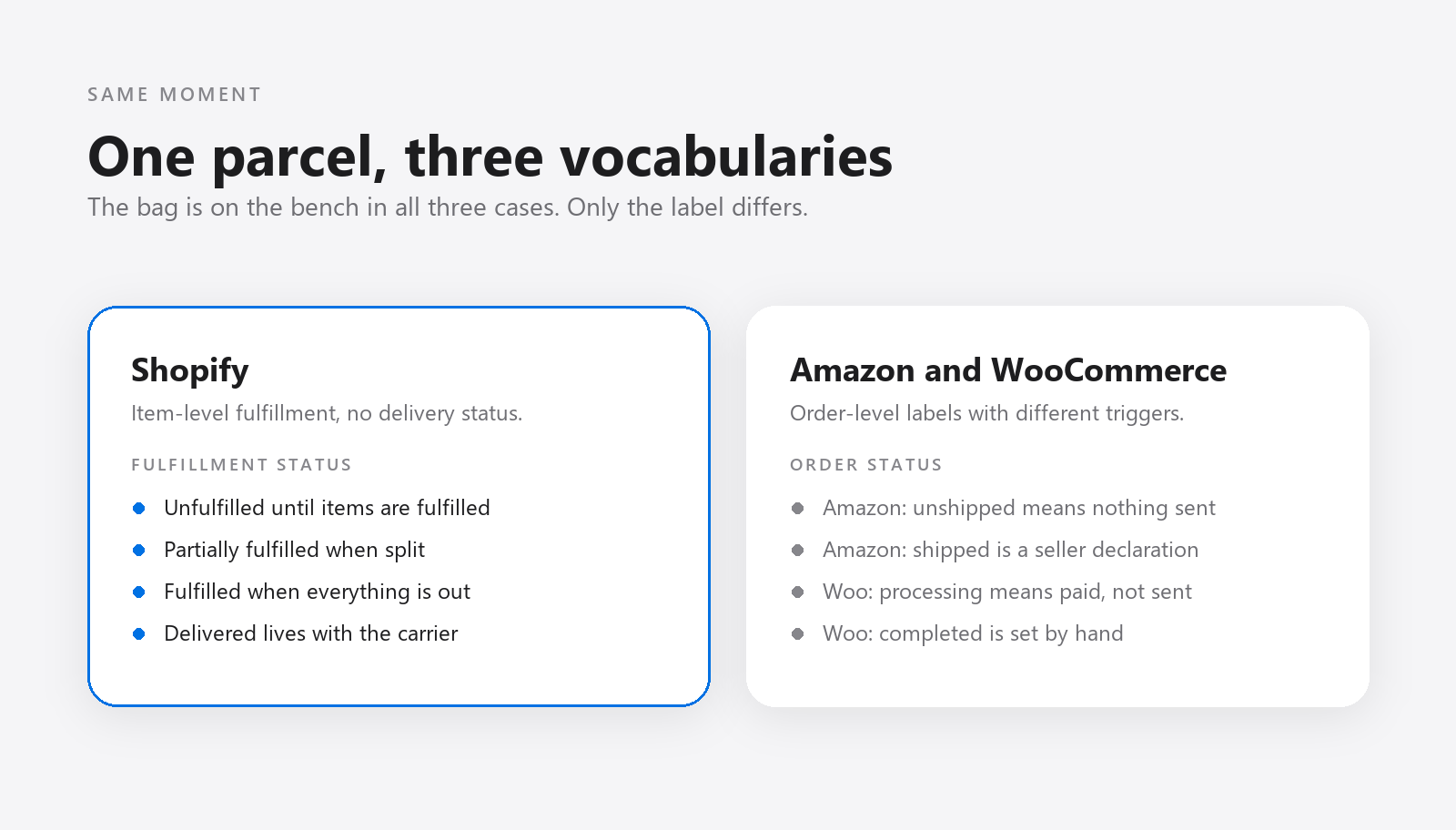
Shopify runs four status sets in parallel: order (open, archived, canceled), payment, fulfillment, and returns. Fulfillment is tracked at the item level — unfulfilled, partially fulfilled, fulfilled, and fulfillment not required for orders with nothing left to send.
Notice what is missing. Shopify's admin has no delivered status. Once the parcel is with a carrier, the platform can show a tracking number, but the status itself stops at fulfilled.
That single design choice explains a lot of support friction. "The dashboard says fulfilled" translates, at best, to "we have finished processing your items". It does not translate to "a truck is moving".
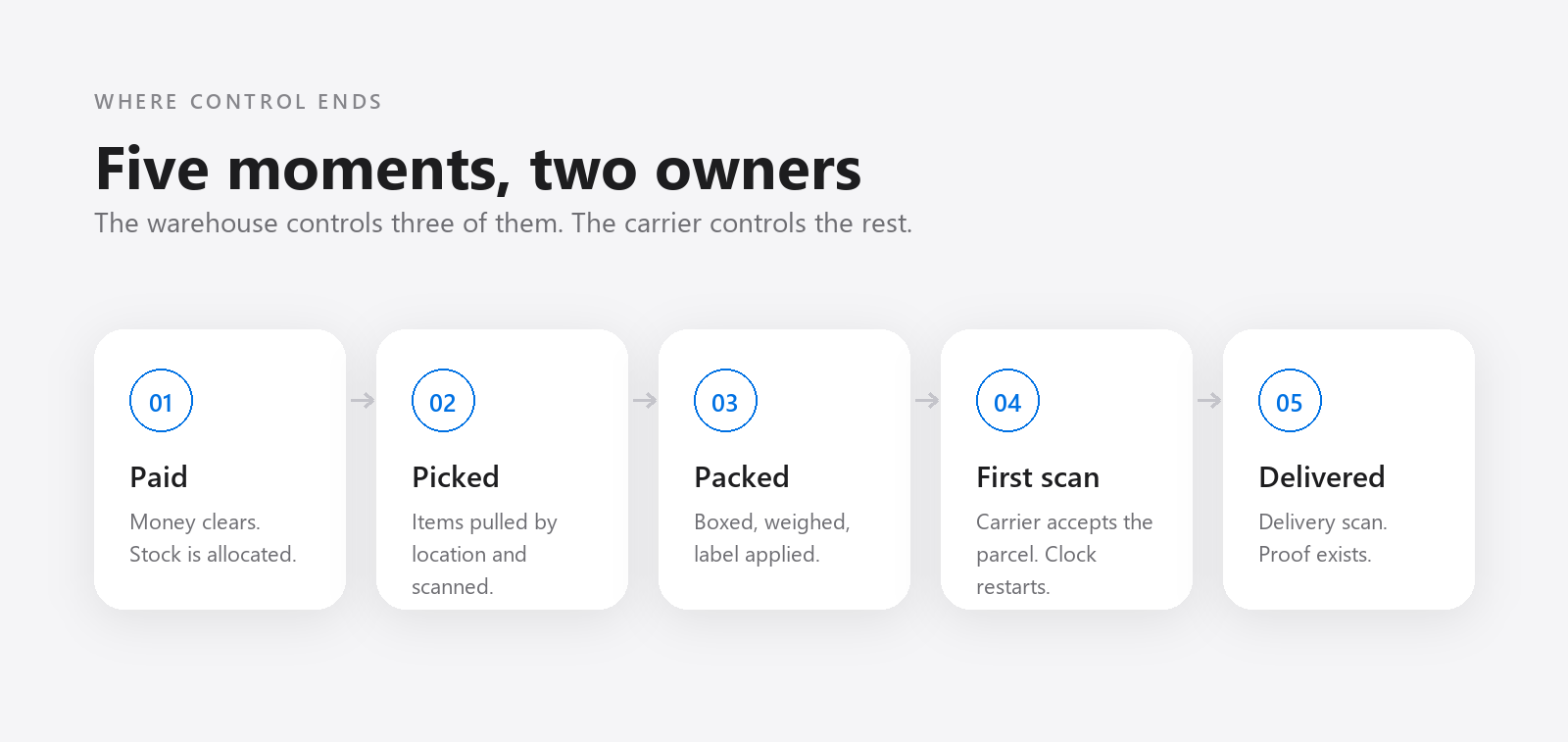
There is also a physical detail that platforms never show. Labels are usually printed and applied at the pack bench, and the order is marked fulfilled there — before the bag goes into the outbound cage and waits for the carrier. The record can therefore run ahead of the parcel by hours, or by a day if the pickup is early.
Item-level tracking has a second consequence. Sell the same SKU from two locations and one order can end up split without anyone deciding to split it. One line ships from the 3PL, the other waits on a transfer, and the order sits at partially fulfilled for reasons the customer will never see.
Amazon: shipped is a declaration, not a scan
Amazon's seller-side lifecycle reads pending, unshipped, partially shipped, shipped. The definitions are worth reading closely: pending means the order exists but is not ready to ship; unshipped means it is ready but nothing has gone out; shipped means every item has been dispatched.
There is no "carrier accepted the parcel" status in that list. On seller-fulfilled orders, the seller confirms dispatch and supplies a tracking number, and the order moves to shipped at that moment. For the buyer it is a promise. For the seller it is a record, and the record can be created slightly before reality.
Pending deserves its own note. It usually means payment is not authorised or something in the order is incomplete — not that the system is still thinking. A support agent who sees pending and tells the customer to wait is often waiting for nothing.
WooCommerce: completed is a human decision
WooCommerce's chain is blunt: pending payment, then processing once the money arrives and stock is reduced, then completed.
The documentation is explicit that processing is the cue to ship and that the store owner changes the status to completed manually. So completed measures housekeeping, not delivery. Some stores bulk-mark orders every morning; some never touch the button; some write a plugin to do it on tracking import.
This is why "completed orders" is a poor proxy for "delivered parcels" in any WooCommerce-based report. You are counting clicks.
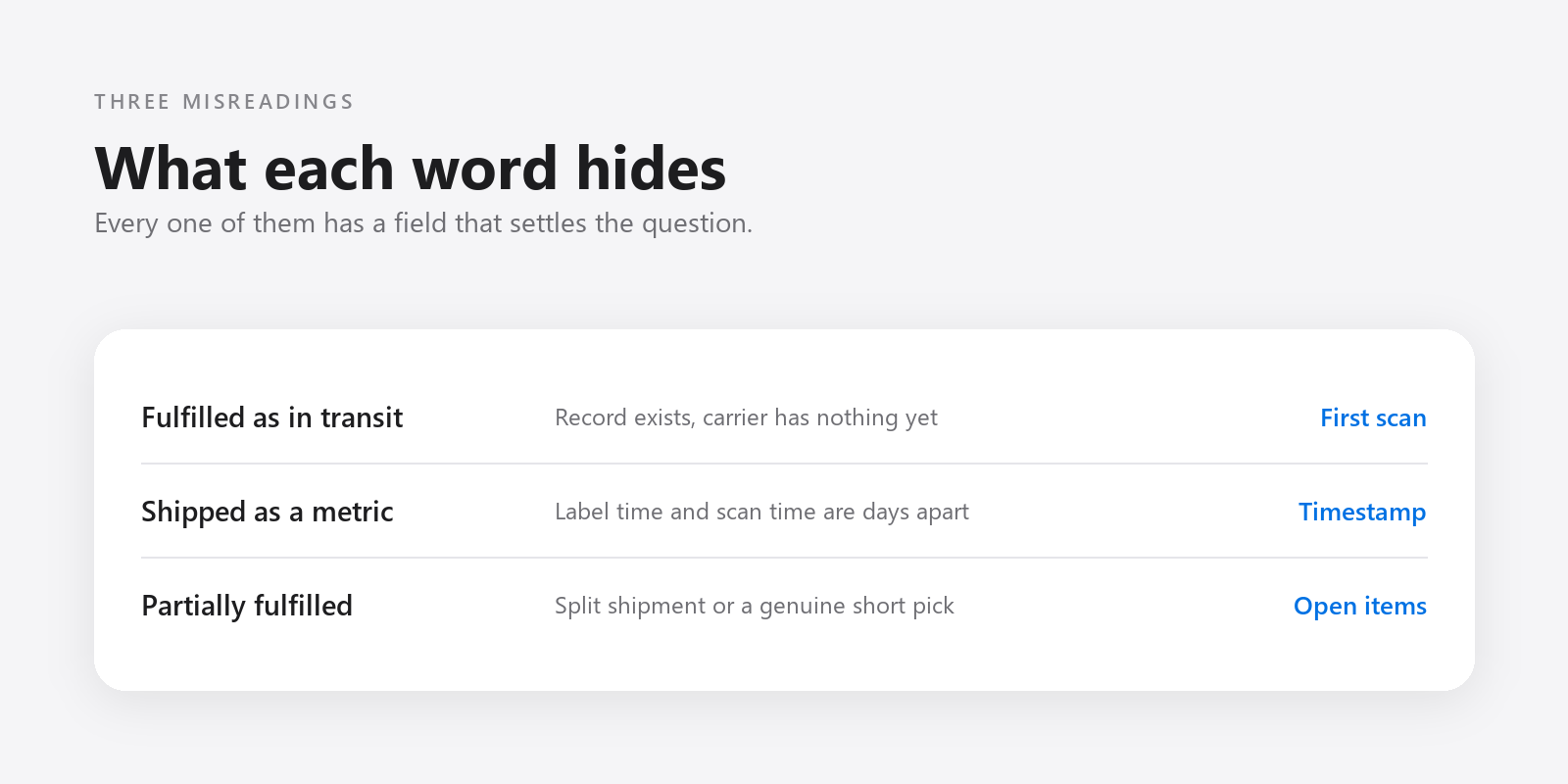
Misread one: fulfilled read as in transit
This is the most expensive misreading because it happens inside your own support team.
The order shows fulfilled, the agent replies "your order has shipped", and the customer spends two days refreshing a tracking page that has not updated. By day three the message is not a question anymore.
The physical sequence is: pick, pack, print the label, hand over, carrier's first scan. Fulfilled tends to land between the third and fourth step. The carrier's first scan is the fifth.
USPS names that gap precisely. Shipping Label Created, USPS Awaiting Item means a label exists and the package has not been given to USPS. Possession starts at USPS In Possession of Item. Until that scan appears, nobody outside your building can confirm the parcel exists.
The metric to watch is first-scan coverage: of the orders marked shipped in the last seven days, how many tracking numbers still have zero carrier events. When that number climbs past a few percent, the wording in your macros is wrong, not the warehouse.
Misread two: shipped used as a reporting metric
"On-time shipping rate" sounds objective. It is not, because three different timestamps can each be called the shipping moment: label printed, status changed, first carrier scan.
Late-shift packing with a morning pickup is normal in every warehouse. Measure by label time and that batch looks perfect. Measure by first scan and the same batch is a day late. One dataset, two conclusions, and a monthly argument between operations and finance.
Customer-facing promises have the same trap. Under the FTC's Mail, Internet, or Telephone Order Merchandise Rule, a seller that has not stated a shipping time must have a reasonable basis to ship within 30 days, and if it cannot, it has to notify the buyer and offer cancellation with a refund. Posting a note on an order-status page usually does not count as notice. In that rule, "ship" means handing the goods to a carrier — not printing a label.
So write the definition into the SLA: on-time is measured at first scan. Otherwise you and your carrier can both be right and still disagree every month.
The same gap shows up in disputes. When a customer claims non-delivery, what answers the claim is a delivery record with a date, not a label with a tracking number on it. A seller who treats "shipped" as proof will keep losing cases they should win, simply because they are submitting the wrong document.
Misread three: partially fulfilled read as missing item
Partially fulfilled means the order was split. Part of it went out, part is still open — different warehouse, backorder, or a pre-order line.
To the customer it means one thing: something is missing from the box. And two very different situations arrive wearing the same badge. Either the split was intentional and needs explaining, or an item was genuinely left out and needs reshipping.
The only field that separates them is the count of items still unfulfilled. Zero remaining but the badge persists means a data problem. Non-zero remaining past the promised date means a stock problem.
Warehouse-side short-ships have their own causes, and they are boring: near-identical SKUs picked from adjacent slots, a free gift left off the bench. Operations that catch these use a weight tolerance — deviations above five grams trigger an alert, because every SKU, bundle and gift has a pre-loaded weight — plus an outbound barcode match that refuses to print a label when the parcel barcode and the order do not agree. Warehouses running both report picking error rates under 0.3%. None of that reaches the customer, who only sees a badge.
What to fix first
You do not need a new system. Change four sentences and one definition.
| The system says | Do not tell the customer | Say instead |
|---|---|---|
| Fulfilled | "It has shipped" | "Packed and waiting for carrier pickup" |
| Shipped, no first scan | "In transit" | "Handed over; tracking updates within 24 hours" |
| Partially fulfilled | "Shipped" | "Part of your order is on the way; X items follow" |
| Completed | "Delivered" | "Order closed — tell us if it has not arrived" |
Then pull three timestamps for the same set of orders: label created, first carrier scan, delivery scan. The gap between the first two is your real handling time, and it is almost always larger than the number in the dashboard.
The short version
Fulfilled belongs to the warehouse, shipped belongs to the seller, delivered belongs to the carrier. Nobody is lying; they are answering different questions. Pick one timestamp — the first carrier scan — and use it for the customer promise, the SLA and the weekly report.
If your support macros and your order statuses keep contradicting each other, send us the macro you use today and we will rewrite it against the scan data.
References (Neutral Third-Party Sources)
- Shopify Help Center — Understanding your order statuses: order, payment, fulfillment and return statuses are separate; fulfilled means all items were fulfilled and shipped. https://help.shopify.com/en/manual/orders/manage-orders/order-status
- Shopify Help Center — Fulfilling orders: what the fulfillment action covers, from picking and packing to buying a label and handing parcels to a carrier. https://help.shopify.com/en/manual/fulfillment/fulfilling-orders
- WooCommerce — Order Statuses: processing means paid and awaiting fulfillment; completed is set manually after dispatch. https://woocommerce.com/document/managing-orders/order-statuses
- Amazon Selling Partner API — searchOrders: definitions for pending, unshipped, partially shipped and shipped on seller-fulfilled orders. https://developer-docs.amazon.com/sp-api/reference/searchorders
- USPS — Where is my package? Tracking Status Help: label creation, carrier possession and delivery scans, and what each status does and does not prove. https://faq.usps.com/articles/Knowledge/Where-is-my-package
- Federal Trade Commission — Mail, Internet, or Telephone Order Merchandise Rule: the 30-day shipping baseline, what counts as shipping, and the duty to notify buyers of delay. https://www.ftc.gov/business-guidance/resources/business-guide-ftcs-mail-internet-or-telephone-order-merchandise-rule