
What Is a 3PL? Third-Party Logistics Explained in Plain English
A third-party logistics provider (3PL) is a company that runs the physical side of your online store for you: receiving your stock, storing it, picking orders, packing them, handing them to a carrier, and processing returns. You are the first party, your customer is the second, and the company in the middle — the one with the warehouse, the scanners, and the people on the floor — is the third.
Two mistakes make people misjudge a 3PL before they've ever talked to one. The first is thinking of it as "a warehouse with a shipping discount." The second is thinking of it as "a courier." It is neither. What you are actually renting is a labour-and-accuracy system, and the difference decides whether it saves you money or just adds a layer of management you never wanted.
The six jobs a 3PL takes off your plate
Strip away the jargon and a 3PL does six concrete things, in order. Receive inbound cartons off the truck, count them against the packing list, and put each SKU away in a logged location. Store the stock and charge you for the space by the pallet or the cubic foot. Pick items off shelves when an order comes in. Pack them into a carton with the right dunnage. Generate the shipping label and hand the parcel to the carrier. Then take returns back in, inspect them, and either restock or flag them.
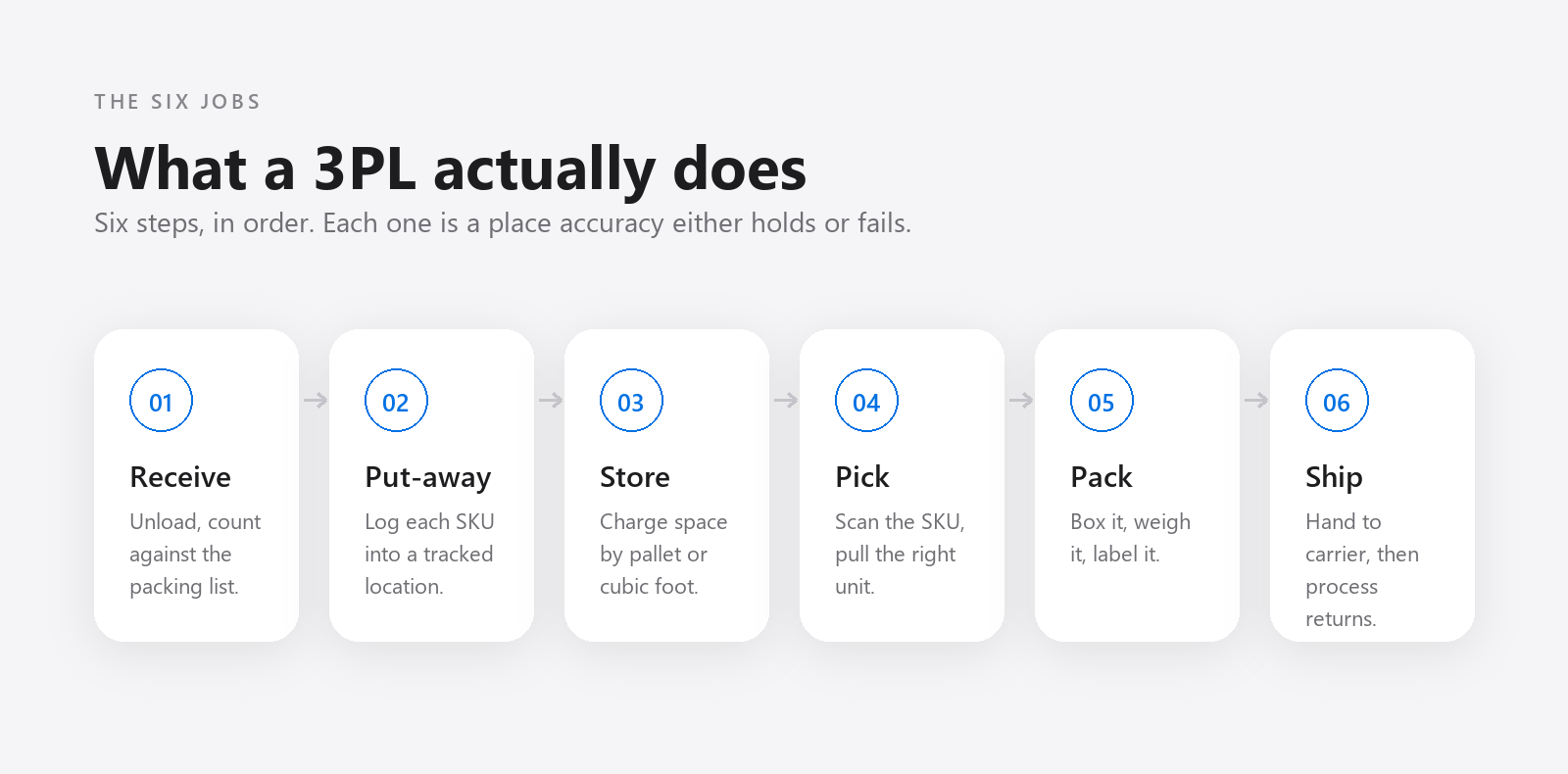
Every one of those steps is a place where accuracy either holds or quietly fails. A well-run floor doesn't rely on a picker remembering a SKU number. The picker scans a barcode with a hand-held PDA, the system confirms the SKU matches, and a wrong item physically cannot advance to the packing bench. At packing, the carton passes over a weight-check gate — in tight Chinese ecommerce warehouses the alarm triggers on a difference of just 5 grams, which is how a missing freebie or a wrong unit gets caught before it leaves the door. That machinery, not the person, is what you are paying for.
What a 3PL is not
The confusion usually sits in three places, so it's worth being blunt. A 3PL is not a carrier. UPS, USPS, FedEx and the regional players move a parcel from point A to point B and own the trucks or the linehaul; they don't hold your sellable stock for months or build your orders. A 3PL is not a freight forwarder either — a forwarder books the ocean or air leg, handles customs paperwork, and is the one you call when you're importing a container, not when a customer orders a single unit. And a 3PL is not a dropshipper: a dropshipper owns or sources the product and ships it on your behalf without you ever stocking it, whereas a 3PL only ever moves stock you already own.
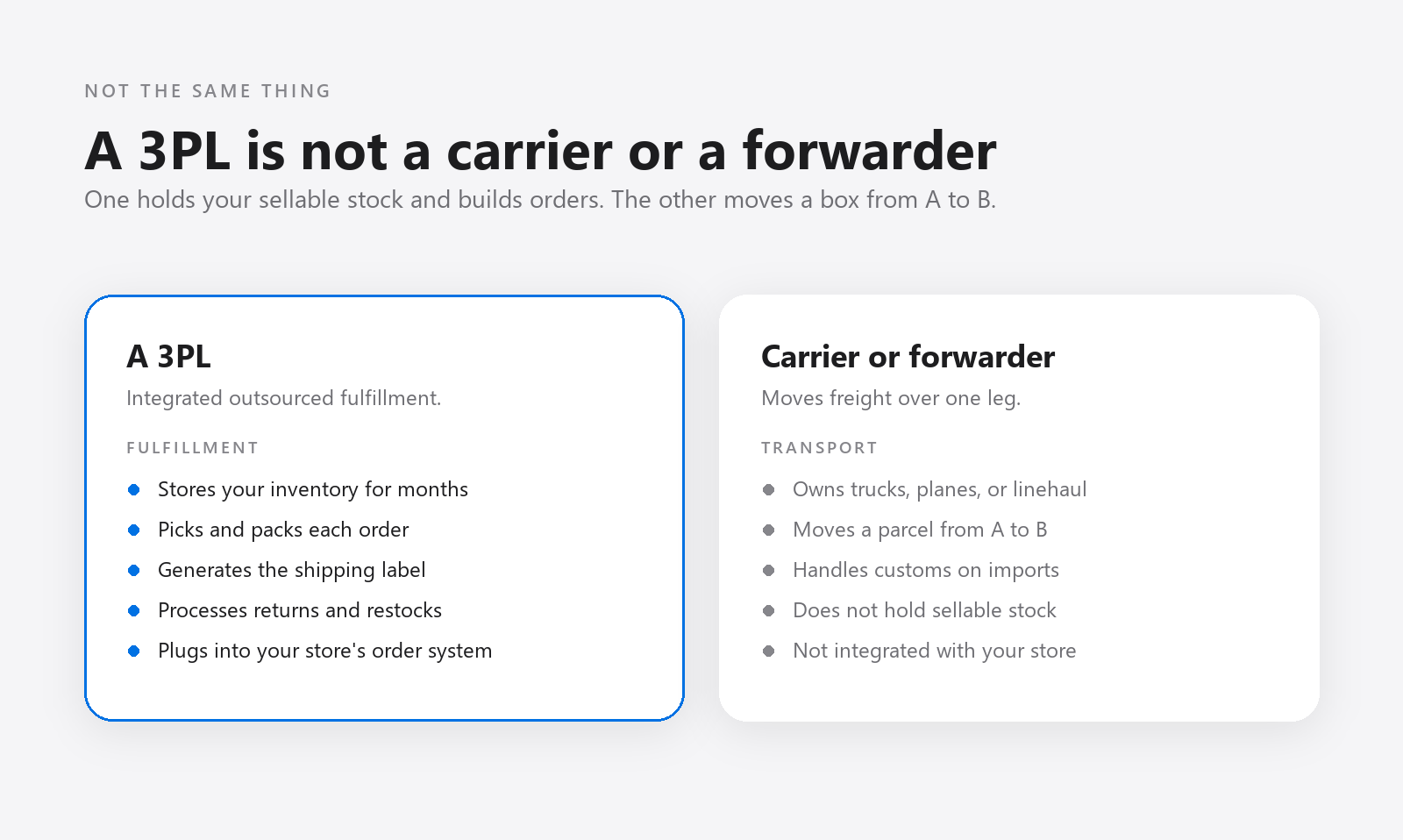
The practical test is simple. Ask one question: "Does this company make money by picking, packing, and shipping my orders?" If the answer is yes, you're looking at fulfillment. If it makes money moving freight or selling you the goods themselves, it's something else.
The 1PL through 5PL spectrum
The "party" numbering trips people up, but it's just a chain of who owns the work. 1PL is you doing your own logistics — your warehouse, your van. 2PL is an asset-based carrier or forwarder you hire for one leg. 3PL is an integrated outsourced operator that plugs into your order system. 4PL owns nothing and instead manages a roster of 3PLs, carriers and customs brokers on your behalf. 5PL layers supply-chain consulting and system design on top.
| Level | Who does the work | Owns assets? | Integrated with your systems? |
|---|---|---|---|
| 1PL | You, in-house | Yes | Fully |
| 2PL | A carrier or forwarder, one leg only | Yes | No |
| 3PL | An outsourced warehouse operator | Sometimes | Yes |
| 4PL | A manager over multiple 3PLs and carriers | No | Partly |
| 5PL | A supply-chain integrator and consultant | No | Partly |
The 3PL row is the one that matters for most online sellers: you hand over execution but keep ownership of the stock and the customer.
What it costs, line by line
3PLs don't charge a flat fee; they charge per activity, and the prices move with your volume and your SKU count. Knowing the buckets before you compare quotes is what stops a low headline rate from hiding a long list of add-ons.
| Cost line | What it covers | Typical range (industry figures, not a quote) |
|---|---|---|
| Inbound receiving | Unloading, counting, and put-away per unit | $0.25–$0.60 per unit |
| Storage | Space by pallet or cubic foot, billed monthly | $0.50–$1.50 per pallet per day |
| Pick and pack | The labour to grab, box, and label an order | $1.50–$3.50 per order |
| Additional item | Each extra unit in the same order | $0.25–$0.60 per unit |
| Packaging | Carton, tape, dunnage, label | $0.60–$2.50 per parcel |
| Last mile | The carrier leg to the customer | $6–$12 US domestic |
| Returns | Receiving, inspecting, restocking | $1.00–$3.00 per return |
Two things routinely get left out of that list. Storage is a fixed cost that keeps running whether you sell one unit or none, and last mile is the single biggest line — a cheap pick-and-pack rate means little if the carrier surcharge is being passed through at full price. "Last mile" is the final delivery leg from the local depot to the customer's door, and it is where most of the shipping money actually goes.
Where mis-shipments actually get stopped
The industry metric to care about is the mis-shipment rate — how often a customer receives the wrong item, a short count, or a parcel addressed to someone else. Good operators push this to fractions of a percent, and they don't do it by hiring more careful people. They do it with checkpoints that force the error to surface before it leaves.
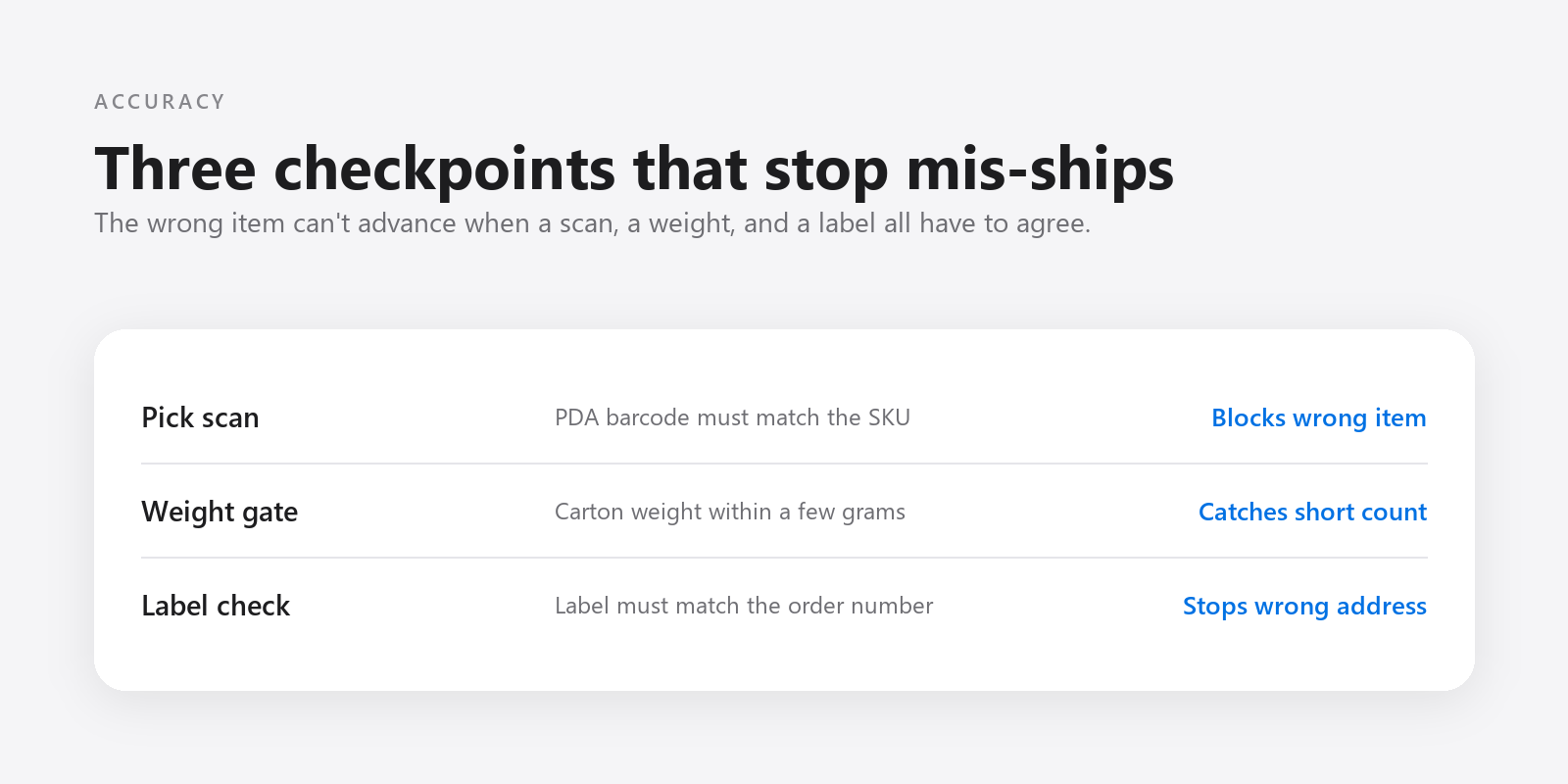
The three that matter are a barcode scan at picking, a weight check at packing, and a final cross-check that the shipping label matches the order before the carrier scans it in. A label that doesn't match the order number cannot print, which is the cheapest insurance against "A's parcel wearing B's address." If a warehouse tells you it "double-checks everything by eye," that's not a selling point — human eyes miss more after hour six of a peak shift, and that's exactly when the volume is highest.
When a 3PL makes sense — and when it doesn't
There is no magic order count, but there is a shape to it. Under roughly a few hundred orders a month, you can often pack from a spare room and a label printer is your whole tech stack. Once picking and packing starts eating your evenings and the mistake rate climbs with the volume, outsourcing starts to pay. The uncomfortable middle — say 300 to 800 orders a month — is where the math depends on your product's value and how much of your own time each parcel is stealing.
The real trigger is usually not the number of orders but the number of SKUs and the amount of your own labour the work consumes. A seller running 30 SKUs of small, low-value goods outgrows a spare room long before a seller with 3 high-ticket products does.
Questions to ask before you sign
- What is your mis-shipment rate, and how do you measure it?
- Is storage billed per pallet or per cubic foot, and what happens to slow-moving stock?
- Which charges are in the quote — receiving, packaging, label, returns, and any peak-season surcharge?
- Do you scan at picking and weigh at packing, or is it all visual?
- How do you Clothing Brands Handle a wrong-address or short-count claim, and what's the liability window?
The answers to the first two tell you more about a warehouse than any marketing page.
The short version
A 3PL is the company you rent to run receiving, storage, picking, packing, shipping, and returns so you don't hire a warehouse team yourself. It is not a carrier or a forwarder, it charges per activity rather than a flat fee, and its real value is in the checkpoints that keep the wrong item from leaving the building. Decide by watching your own labour and SKU count, not by a single order threshold — and make the mis-shipment rate the first thing you ask about.
If you're weighing a 3PL against doing it in-house and want a straight read on where your order volume actually sits, send us the order count, SKU count, and product size — we'll tell you whether outsourcing would pay before we ever talk pricing.
References (Neutral Third-Party Sources)
Facts and definitions in this article were checked against public, non-commercial sources. No fulfillment-provider pages are cited.
- Wikipedia — Third-party logistics: the definition of a 3PL, the distinction from 2PL (carriers and forwarders), asset-based versus non-asset operators, and the 4PL/5PL tiers. https://en.wikipedia.org/wiki/Third-party_logistics
- Wikipedia — Logistics: the origin of the 4PL concept (defined by Accenture as an integrator) and how a 4PL manages the whole process rather than a single function. https://en.wikipedia.org/wiki/Logistics
- GS1 — Global Trade Item Number (GTIN): the product-identification standard behind the barcodes scanned during receiving and picking. https://www.gs1.org/standards/id-keys/gtin
- U.S. Customs and Border Protection — De minimis shipments: the entry threshold that determines whether low-value cross-border parcels clear duty-free. https://www.cbp.gov/trade/programs-administration/entry-summary/de-minimis-shipments