
What Is a Fulfillment Center? How It Works & Benefits
A fulfillment center is three things stacked: a building, a system, and a labor model. The building stores and moves the stock; the system tells everyone where everything is and what to do next; the people turn that into a parcel by the cutoff. When one of the three is missing, you don't have a slower center — you have a warehouse pretending.
Most definitions stop at "a warehouse that also ships." That misses the point. The difference between a warehouse and a fulfillment center is not the racks — it is that a fulfillment center runs on a daily parcel cutoff and answers to individual consumers, and everything about how it is laid out, staffed and priced follows from that one fact.
A warehouse, a distribution center, and a fulfillment center are not the same thing
The three names get used interchangeably, and they describe different machines.
| Warehouse | Distribution center | Fulfillment center | |
|---|---|---|---|
| Primary job | Store goods long-term | Move bulk between businesses | Pick, pack and ship single orders |
| Typical order | Pallets in, pallets out | Cases to stores or hubs | One unit to one doorstep |
| Measured by | Storage density, cost per unit held | Throughput, dock doors | Orders shipped, cycle time, accuracy |
| Dwell time | Months | Days to weeks | Days or hours |
| Outbound rhythm | Scheduled loads | Delivery windows, OTIF | Daily carrier cutoff |
| Ships to | Other facilities | Retailers, distributors | Consumers |
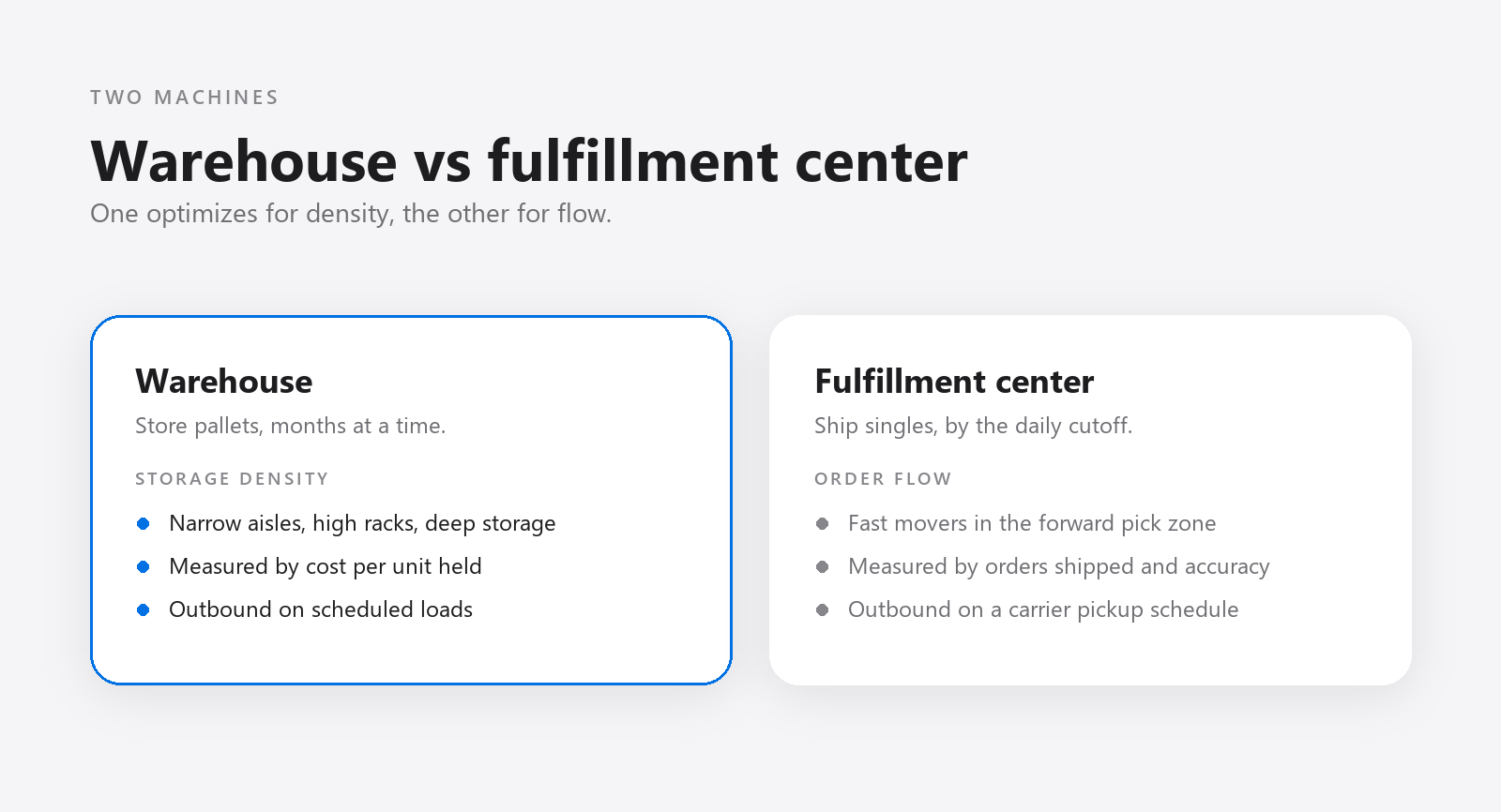
A warehouse optimizes for density: narrow aisles, high racks, deep storage. A fulfillment center optimizes for flow: fast movers in a forward pick zone near the pack benches, a layout that lets a picker grab one shirt and a packer box it in minutes. A distribution center sits between them, breaking a pallet into cases for stores rather than into singles for doorsteps.
The U.S. Bureau of Labor Statistics draws the line the same way: warehousing establishments store goods and may add labeling, breaking bulk, inventory control, light assembly and pick and pack — but storage comes first, and they do not sell what they hold.
The three layers: building, system, people
Strip a fulfillment center down and it is three layers that have to agree with each other. This is the part the facility-comparison articles skip.
The building is the floor plan — zones, aisles, dock doors, pack benches. The system is the WMS, the warehouse management system that assigns every SKU a location, sequences the pick list, and pushes stock counts back to your store. The people are the pickers, packers and receivers who execute against the system's instructions.
The three fail together. A great WMS pointing at a badly slotted floor still sends pickers on long walks. A well-laid-out floor with no system runs on memory and guesswork. Plenty of staff with neither a plan nor a system just means more people making the same mistakes faster.
Inside the building: five zones
Every fulfillment center, from a 20,000-square-foot shed to an Amazon-sized campus, is the same five zones strung together.
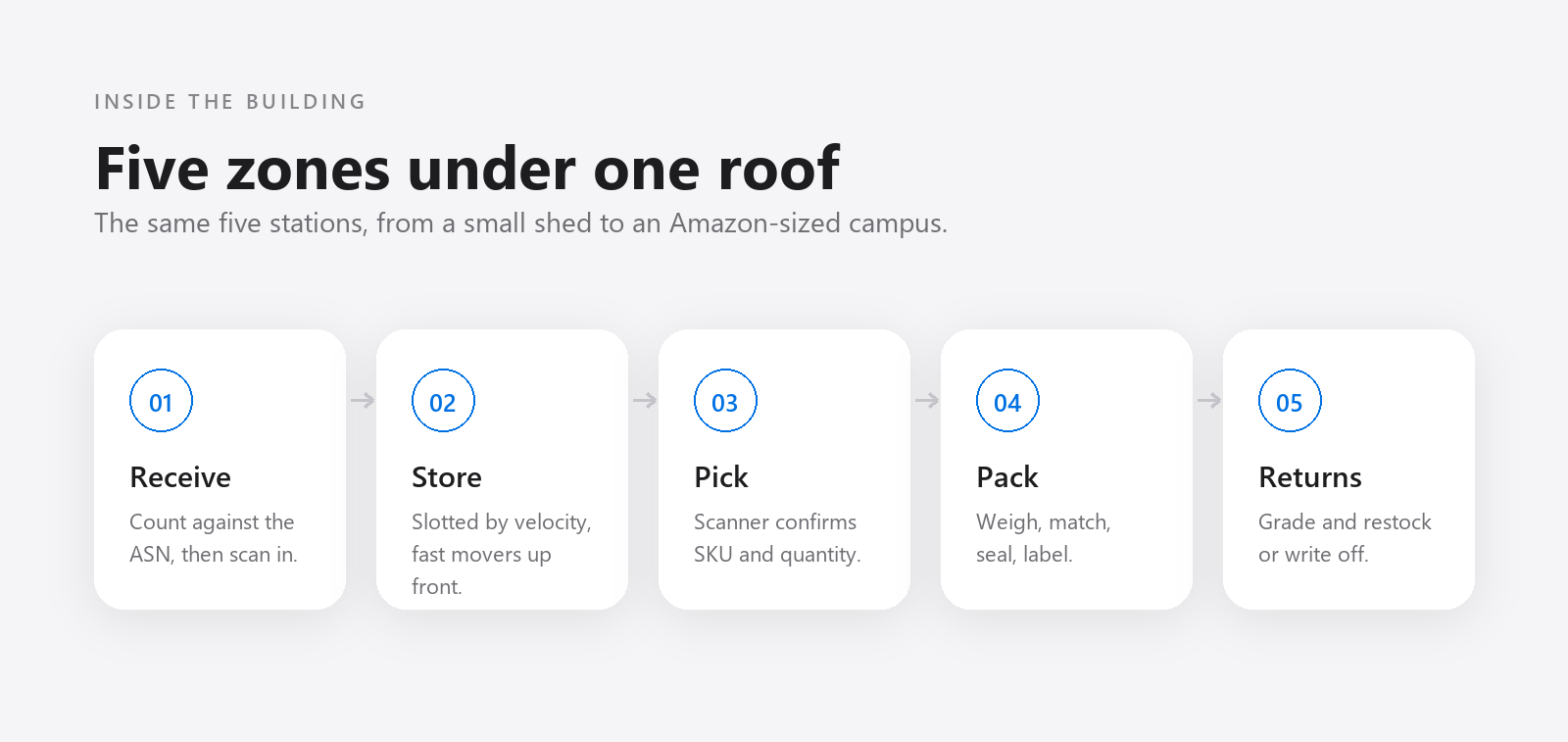
Receiving is where stock is counted against the advance shipping notice, checked for damage and scanned in. Storage is where it waits, slotted by velocity — fast movers near the pack benches, slow movers in the back. Picking is where orders are gathered, usually with a scanner that will not advance on a wrong SKU. Packing is where the order becomes a parcel, weighed and matched to a label. Returns is the reverse zone, where items come back and get graded as resaleable or not.
The speed of the whole line is set at the seam between two zones. Dock-to-stock — how fast arriving stock becomes sellable — is the standard inbound clock, and 24 to 48 business hours is the benchmark. Until the last scan, the SKU reads zero and the listing keeps selling into a hole.
The system: what a WMS actually does
The WMS is the reason a fulfillment center can ship twenty thousand parcels a day with a crew a warehouse would use to move pallets.
Its real job is not record-keeping. It is directing: assign every unit a location, decide which orders enter which wave, sort the pick list so a picker walks a route instead of hunting, and refuse to advance when a scan does not match. The one-to-one barcode check, the weight check, the second scan at dispatch — these are the checks that push a mis-ship rate down toward a few hundredths of a percent, and they are all system decisions, not human ones.
The other half of the system is the handoff to your store. A fulfillment center that syncs orders and stock back to Shopify, Amazon or TikTok through an API means no one is copying orders by hand. Without that sync, every order is a manual entry, and the error rate stops being a warehouse problem and becomes a data-entry problem.
The people: labor is the variable cost
The labor model is where the economics show up. Rent on a 40,000-square-meter building is the same whether the site ships ten thousand orders today or a hundred thousand — it does not flex. Packaging and piece-rate wages do.
That is why fulfillment centers pay pickers and packers by the piece or against a measured rate rather than a flat salary, and why they keep a fixed core on the accuracy-critical steps — picking, checking — and an elastic pool for packing and sorting during a peak. The measurement is not "how many hours" but "lines per labor hour," and the electronic board showing that number in real time is part of the same labor model.
Build it or rent it: the arithmetic
The build-versus-rent decision is a fixed-cost question, not a control question.
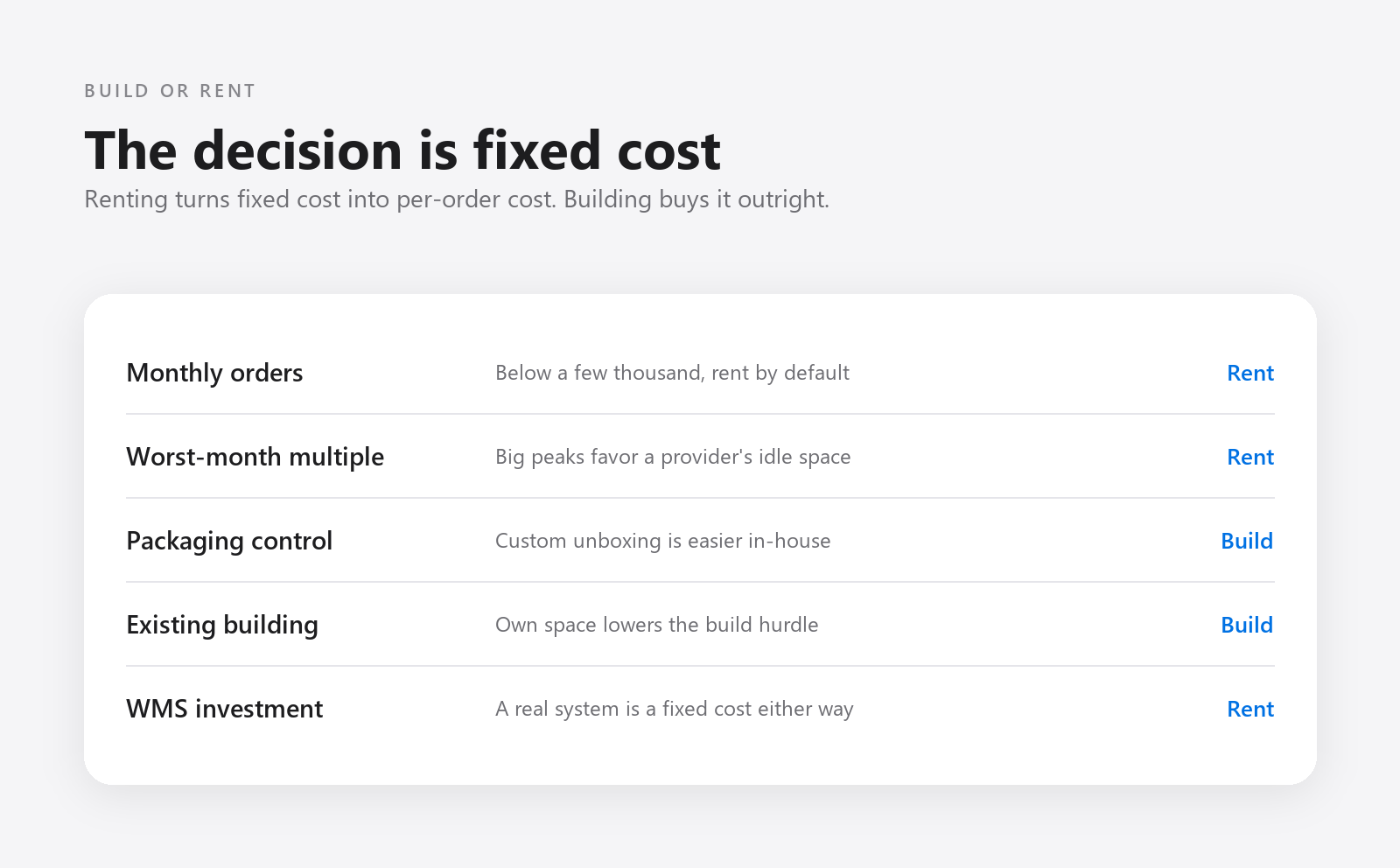
Renting a fulfillment center turns fixed cost into variable cost: you pay per order, per pallet, per month of storage, and the provider absorbs the idle space in a slow month. Building one means buying the fixed cost — rent, a WMS, a trained crew — whether it is full or not. The pattern across the industry is that outsourcing a logistics function typically cuts the function's cost by a noticeable margin in the first years, precisely because the provider spreads that fixed cost across many Gifts for Clients.
The honest criteria are four: monthly order volume, peak multiple, how much control your packaging and unboxing actually needs, and whether you already own a building. Below a few thousand orders a month, renting wins almost by default, because the fixed cost of even a small site outweighs the per-order savings. The middle is the hard part, and it usually comes down to how big your worst month is relative to your average one.
The Process 038 Benefits, stated honestly
A fulfillment center earns its fees in four places, and none of them is "someone else packs boxes."
The first is the cutoff. A center that lives by a 2 p.m. cutoff and a carrier pickup schedule converts "orders today" into "parcels today," which is what two-day and next-day promises are actually made of. The second is carrier rates — a center shipping for many brands negotiates rates you cannot reach alone. The third is accuracy — the scanner checks that live between pick and dispatch. The fourth is the data: real-time stock, order status and return reports that make the next forecast less of a guess.
What it does not give you is control. The packaging, the inserts, the tone of the packing slip — those are still your calls, and they only stay yours if you write them into the agreement.
The short version
A fulfillment center is not a warehouse with a packing bench bolted on. It is a building, a WMS and a labor model built to hit a daily cutoff, and the three either work together or fail together. Whether you build or rent is a fixed-cost question, and the answer usually flips on how much your worst month is larger than your average one.
If you are deciding whether to build, rent, or move, send us your monthly order count, SKU count and your worst-month multiple — we will map the zones and the numbers before we talk about pricing.
References (Neutral Third-Party Sources)
- U.S. Bureau of Labor Statistics — Warehousing and Storage: NAICS 493: how warehousing establishments are defined, and the logistics services they may add on top of storage. https://www.bls.gov/iag/tgs/iag493.htm
- Occupational Safety and Health Administration — Warehousing: the industry's main hazard categories, a reminder that the people layer carries real safety risk. https://www.osha.gov/warehousing
- Encyclopaedia Britannica — Logistics: where warehousing, distribution center and fulfillment management sit among business logistics activities. https://www.britannica.com/money/logistics-business
- GS1 — Global Location Number (GLN): the identifier that gives a physical site like a fulfillment center a machine-readable identity. https://www.gs1.org/standards/id-keys/gln
- Shopify Help Center — Fulfilling orders: what the fulfillment action covers, from picking and packing to handing parcels to a carrier. https://help.shopify.com/en/manual/fulfillment/fulfilling-orders