
Global Fulfillment: Shipping Rewards to Backers in 50+ Countries
Global fulfillment is one warehouse, one set of customs knowledge, and one tax table. You do not open six warehouses in six countries. You collect the run in a single facility, decide DDP or DDU once per region, and use "consolidate by region, then split" to cut the freight cost. The difference between shipping to five countries and fifty is not more warehouses — it is a longer tax table.
Crowdfunding is the clearest case, because the order shape is extreme: one large batch, a fixed window, and Rewards to Backers spread across seventy, sometimes two hundred, countries. A single parcel that crosses a border is a customs problem. Fifty thousand of them, to fifty borders at once, is a planning problem. The tool that solves it is not a map of warehouses. It is a table of who pays what at each door.
Why one warehouse beats six
A campaign shipment is not everyday e-commerce. It is lumpy, one-time, and time-boxed, so the job is to run one set of rules fifty times, not to maintain six sets of rules in six facilities. Receiving, counting and checking everything in one place removes the decision load that kills teams — every extra warehouse is another inbound spec, another carrier contract and another place a rule can drift.
The warehouse has to match where the goods flow, not just exist somewhere convenient. A brand shipping a ten-kilogram kitchen set from an Italian warehouse to Singapore, Australia and Hong Kong once paid over a hundred dollars per delivery. Moving to origin-direct shipping with consolidated freight cut transport cost by roughly forty percent. The problem was never "not enough warehouses." It was that the warehouse sat where the stock was, not where the backers were.
Decide DDP or DDU once per region
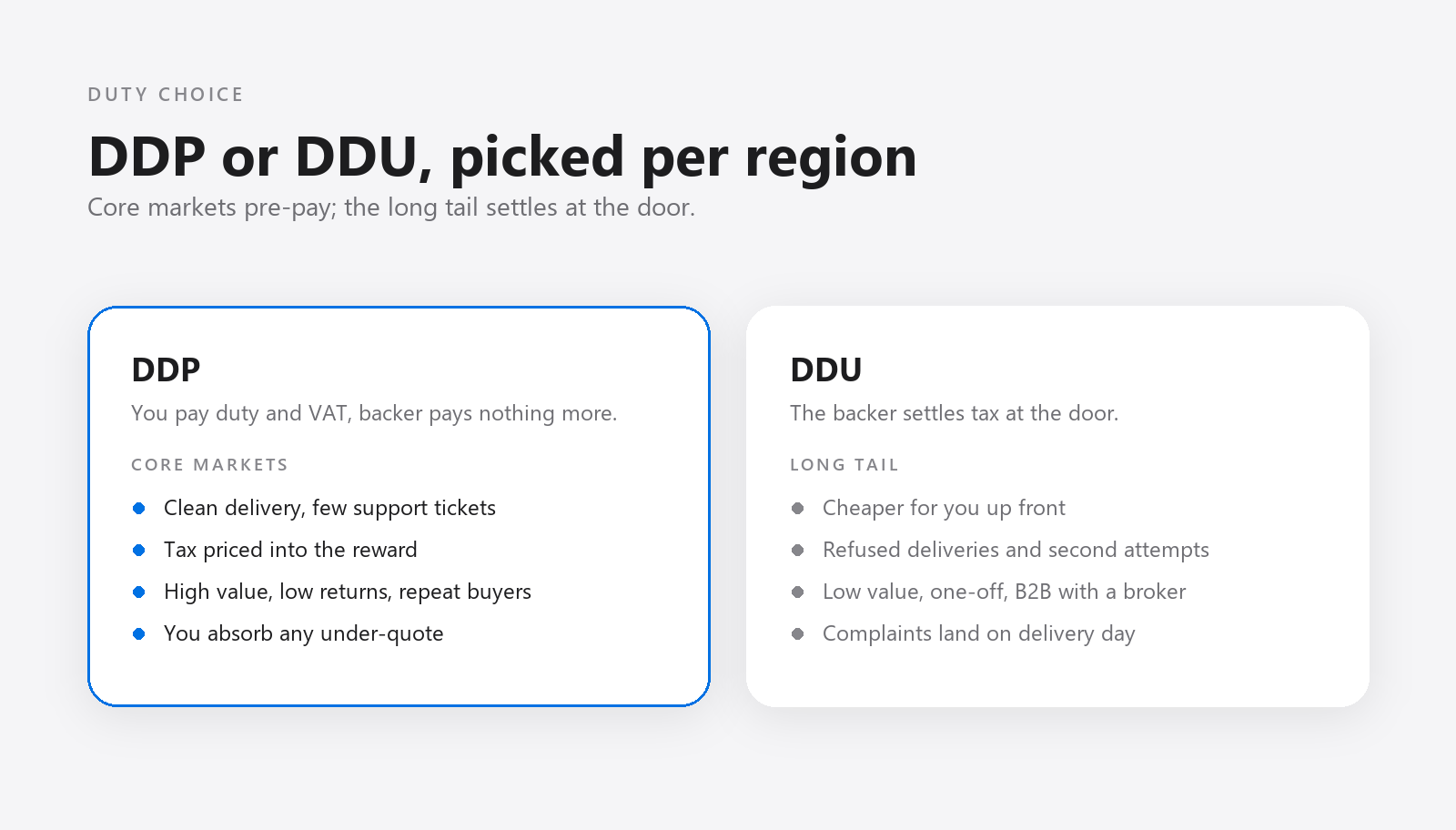
DDP means you pre-pay the duty and import VAT; the backer receives the parcel and pays nothing more. DDU means the backer settles it at the door. DDP is cleaner and generates far fewer support tickets; DDU is cheaper up front and reliably produces refused deliveries.
At campaign scale you do not pick one for the whole world. You batch the decision by region: high-value, low-return, repeat-buyer markets go DDP, because you can price the tax in. Low-value, long-tail destinations — or buyers who already have a broker — go DDU, because the margin cannot absorb the tax and the recipient expects to handle it.
Whatever you choose, print it on the product page and the checkout page. A bill discovered on the doorstep generates more complaints than a late parcel, and it is entirely preventable.
The tax table you ship against
This table is the scarce asset, not the number of warehouses. It is a handful of rows, and every row moves.
| Region | Threshold, as of writing | Below the line | Above the line |
|---|---|---|---|
| EU | IOSS up to €150 per consignment | VAT charged at checkout, one monthly return | Standard import: VAT plus duty |
| UK | £135 | Seller accounts for VAT in the price | Recipient pays import VAT and duty |
| US | de minimis around $800 | Usually enters duty-free | Formal or simplified entry |
| Rest of world | Varies by country | Check per market | Check per market |
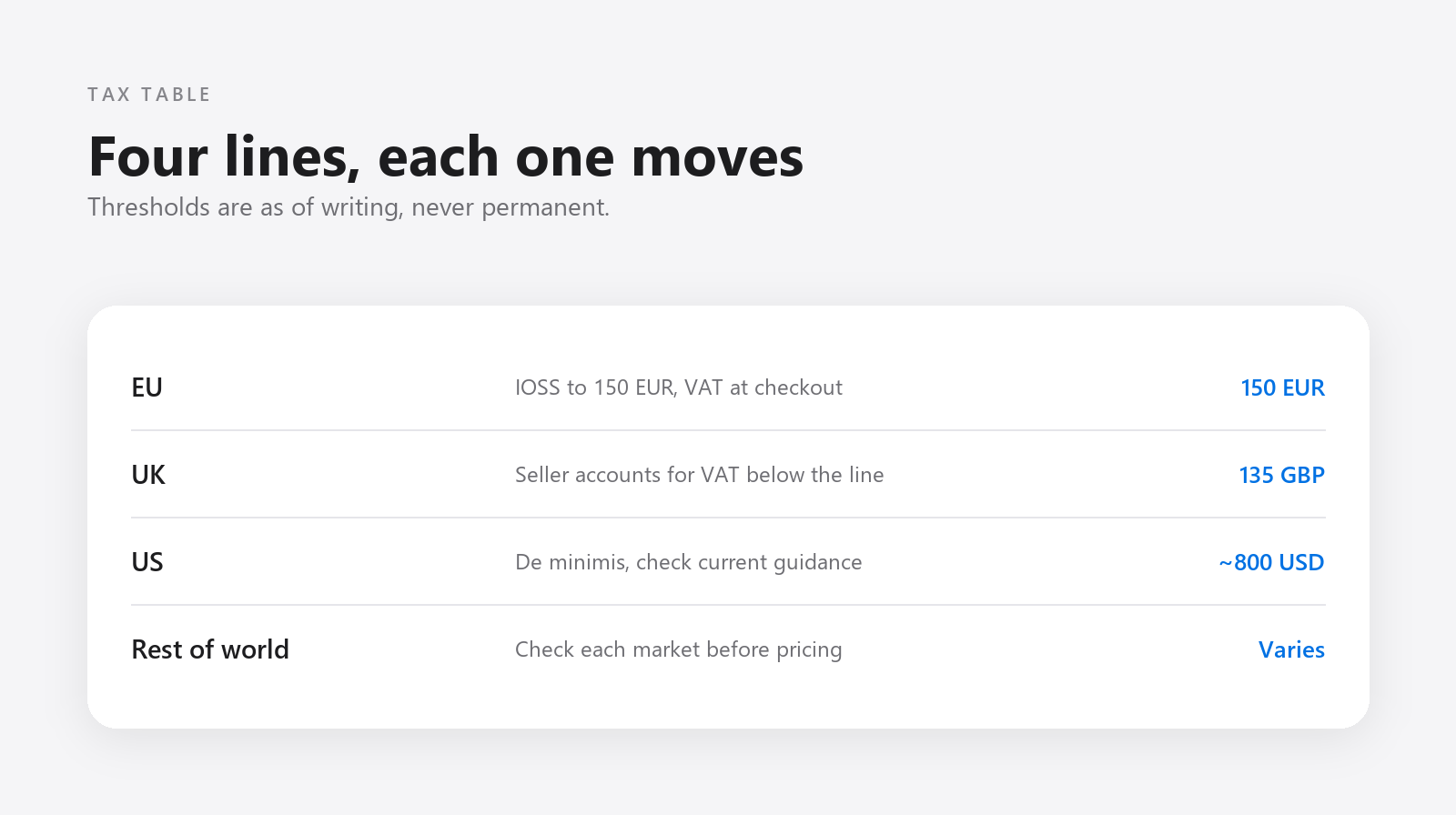
Two things to hold onto. The EU removed its €22 VAT exemption in July 2021, so low value now needs a declaration anyway. And the US line is a variable, not a strategy — treat "around $800" as indicative and check CBP's current guidance before you build a price on it. Write thresholds as "as of writing," never as a permanent number.
Declare once, clear everywhere
Customs reads the data, not your intent. Three fields must agree on every parcel: the HS code, the description, and the declared value. The description has to say what the item is, what it is made of, and what it is for — "gifts" gets a parcel returned, while "one scented candle" gets it through. The HS code is a six-digit global standard, and individual countries add digits of their own beneath it.
Get these three right once and the run clears fifty borders. Get them wrong and every border stops to ask you the same question, one parcel at a time.
What is banned changes at every border
The same product gets stopped in different countries for different reasons. Lithium batteries travel by air depending on their configuration and watt-hour rating, not on the fact that a battery exists. Perfume with alcohol cannot fly. Wooden components may need fumigation. Electronics need certification. All of that paperwork has to be ready before the first leg, not assembled while a parcel sits at a frontier.
Batteries are the usual crowdfunding trap, because smart hardware almost always contains one. Battery-enabled lanes cost more than general cargo — commonly twenty to forty percent more — and the declaration has to precede the shipment, not follow it.
A carrier mix per region
No single carrier is cheap everywhere across fifty countries, so you assemble a mix by region. The US runs a postal option plus a commercial carrier plus a local last-mile provider — the local players can undercut USPS on pound-rate parcels by a wide margin. The EU runs IOSS-registered tracked mail plus a commercial carrier. The long tail rides the international postal network.
The constraint is coverage, not price. A warehouse that can only print labels for some carriers simply cannot deliver to the countries those carriers do not serve. A region with no reachable lane is not a pricing problem; it is an unreachable backer.
Consolidate by region, then split
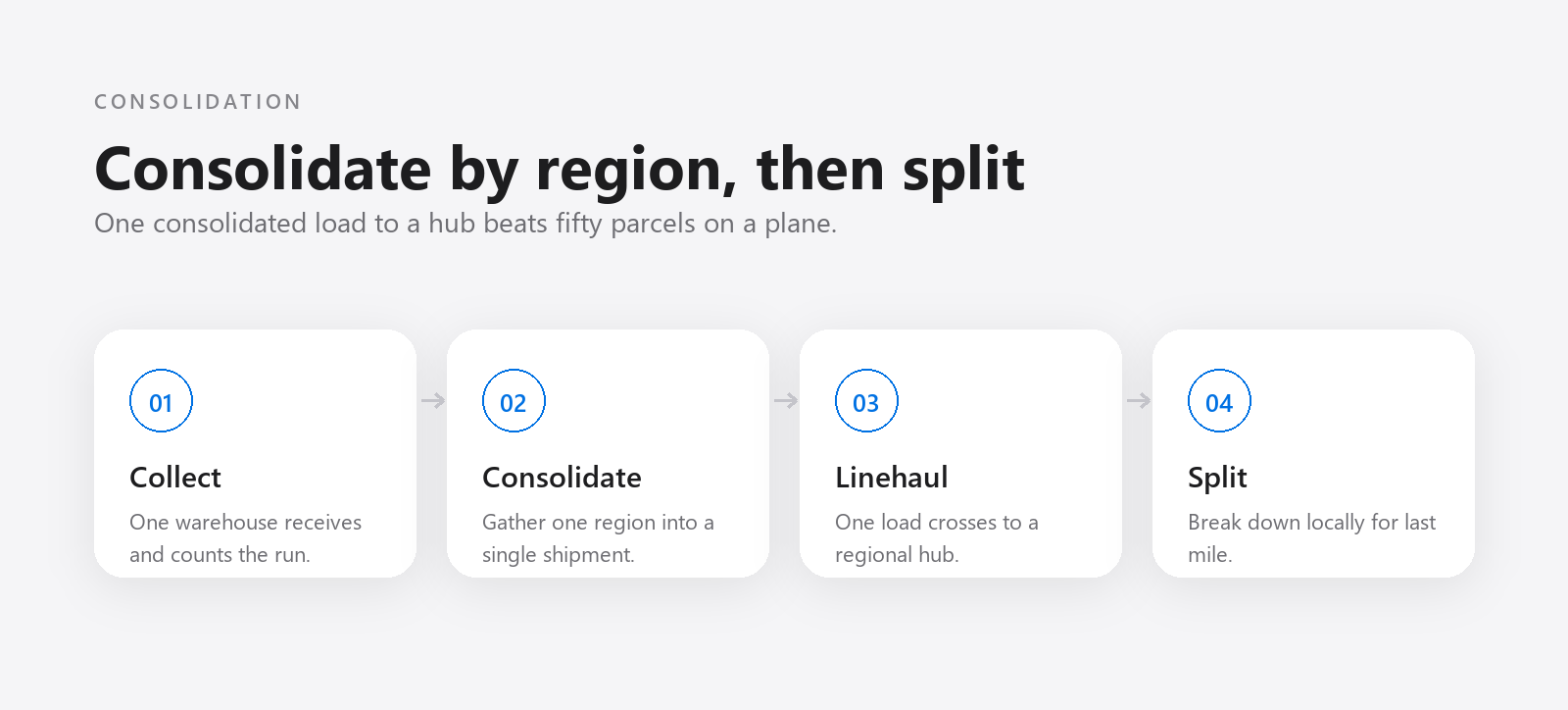
This is where the freight cost actually comes down. Direct shipping sends every parcel from the origin warehouse over an international line. Consolidation instead gathers one region's parcels into a single shipment, moves it to a regional hub, then breaks it down for local last mile.
| Model | Linehaul | Last mile | Fits |
|---|---|---|---|
| Direct | Every parcel crosses | Local postal or courier | Few units per region, high value |
| Consolidate then split | One consolidated load to a regional hub | Local breakdown and delivery | Many units per region, time-insensitive |
The break-even is volume. Consolidation only pays once the freight saving on the linehaul outweighs the extra handling and wait at the regional hub — and that number depends on the country, the carton and whether a local partner will actually do the split. Get it in writing before you sign, because billing for mixed pallets differs between warehouses.
The cross-border leg is where contracts matter more than prices. A forwarder that runs out of cash leaves containers sitting at the port while storage fees accrue daily, and the cargo owner is the one asked to pay to release them. Fix liability before anything sails, and insure high-value loads.
The short version
Global fulfillment fails in the tax table, not in the warehouse count. One facility, one set of customs rules, a DDP/DDU split decided per region, and a consolidation plan for the markets where volume justifies it — that is the whole discipline.
If you are holding a crowdfunding order file heading to fifty-plus countries, send the country split, unit count, order value and whether the product contains batteries. We will come back with a region-by-region DDP/DDU map, a tax table and a consolidation plan before we talk about rates.
References (Neutral Third-Party Sources)
- ICC — Incoterms® rules: eleven three-letter trade terms, first published in 1936, current edition in force since 1 January 2020, defining tasks, costs and risk between seller and buyer. https://iccwbo.org/business-solutions/incoterms-rules/
- European Commission — VAT One Stop Shop, VAT e-Commerce: the July 2021 changes, the removal of the €22 import VAT exemption, the IOSS ceiling of €150, and the €10,000 distance-sales threshold. https://vat-one-stop-shop.ec.europa.eu/index_en
- World Customs Organization — What is the Harmonized System: more than 5,000 commodity groups, six-digit codes, over 200 economies, 98% of world trade, revised every five to six years. https://www.wcoomd.org/en/topics/nomenclature/overview/what-is-the-harmonized-system.aspx
- IATA — Batteries: lithium batteries are carried by air according to configuration and watt-hour rating or lithium content, with matching classification, packing and marking requirements. https://www.iata.org/en/programs/cargo/dgr/lithium-batteries/
- USPS — U.S. Customs Forms: every item needs a specific, detailed description, "gifts" is listed as unacceptable, and HS codes run six to ten digits. https://www.usps.com/international/customs-forms.htm