
PR Boxes: How to Build & Ship a Press Kit That Gets Coverage
A PR box is a media file you can hold. The product is the least of it. What decides coverage is whether a journalist on deadline can write the story from what is inside — the facts, the permission to use the images, and one clear next step — without emailing you first.
Most Send PR Boxes fail in reverse. They are built as gifts: nice to open, nothing to do with after the lid goes back on. The recipient posts a flat-lay and forgets the brand. A box built as a media file gets opened, read, and used, because it was assembled to answer a working editor's questions at 9 pm on deadline.
Here is what goes in, in what order, and how many days the printing really takes.
The box is a media file, not a gift
A gift is received and set aside. A media file is opened and consulted. The difference is not the box — it is whether the contents carry three things a gift never has: facts the reporter can print without checking, images they are allowed to use, and a next step that is obvious.
This is not a metaphor for how you feel about the product. It is a checklist. Every layer below exists to remove one reason a busy person would stop: no time to ask, no way to verify, no idea what to do next.
What goes in: four layers, one job
Assemble the box the way you would assemble a press release — edited, not stuffed. Four layers, each with one job, and each fails in a specific way.
| Layer | What it is | Fails when |
|---|---|---|
| The sample | The thing you want written or filmed | It never arrives, or the wrong variant goes out |
| The one-pager | Name, benefit, key points, price, where to buy | The recipient forgets what the product is |
| The QR code | A link to a digital media kit of hi-res images and facts | They have nothing publishable to attach |
| The contact | A real name and direct address, not a form | They cannot reach you before the deadline |
Assembling a set is a system job, not a shopping job. A physical bundle has to be picked, packed and settled correctly on the back end — the same reason book sets require changes to sortation, storage and billing before they can ship. Each sheet and code in the box needs one person who owns it.
The one-pager does the heavy lifting
One sheet of paper carries more of the outcome than the product does. A recipient forms their first impression in about sixty seconds, and the one-pager is where that impression turns into a decision to cover or skip.
Keep it front and back, and make it scannable:
- Product name and a one-line benefit
- Three to five key points (material, feature, what it does)
- How to use it, in two or three sentences
- Price and where to buy
- Your Clothing Brands Handle and a suggested hashtag
- A named contact with a direct address
The test is simple. If a journalist can write an accurate piece from this one sheet without emailing you, the sheet is finished. If not, keep editing it before you print a single box.
Box shape and the unboxing order
The box is part of the message. A rigid box with a magnetic close says this is a serious How to Launch; a flimsy mailer says the opposite. But shape matters less than sequence, because people open a box in a fixed order: lift the lid, see the top layer, then dig down.
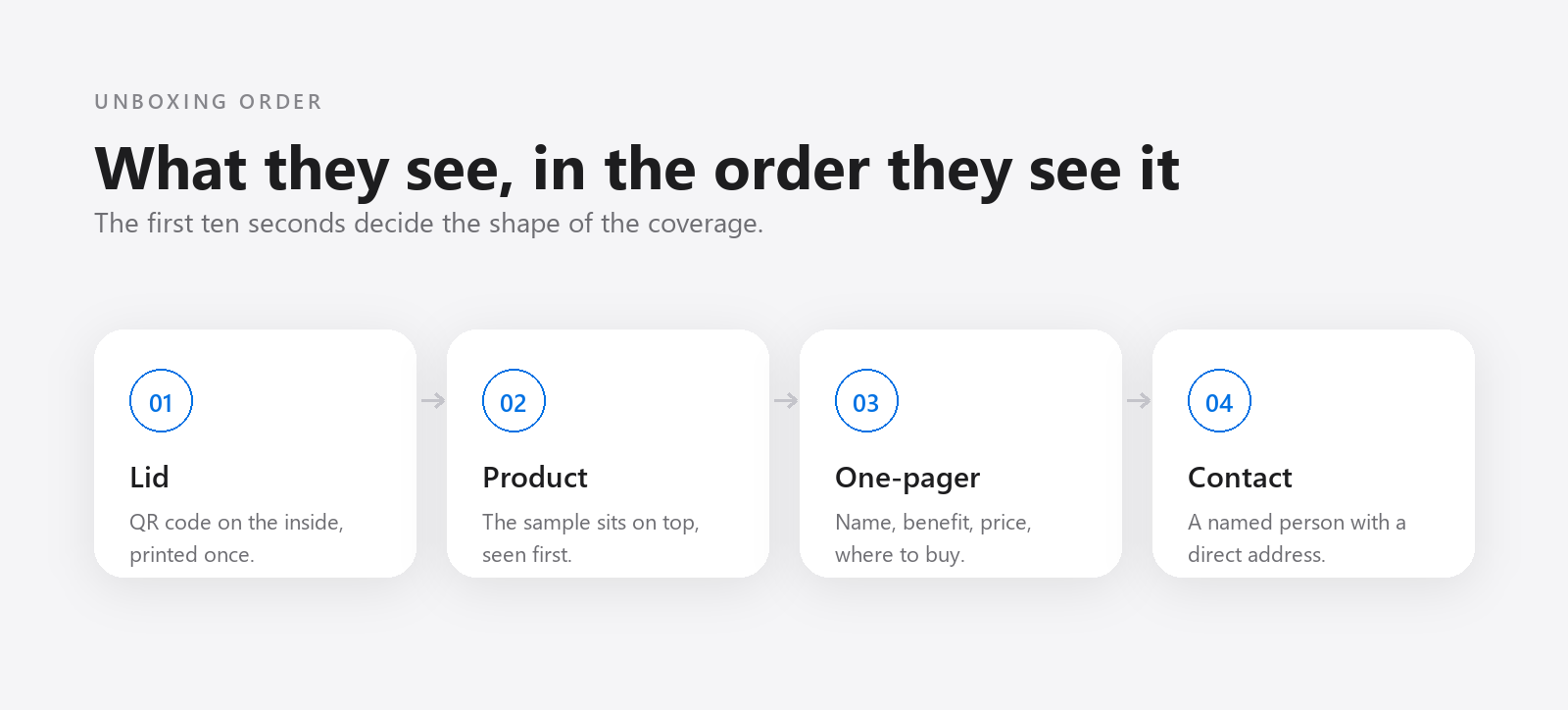
Design for that order. Put the product on top where it is seen first, the one-pager and contact in the second position, and the QR code on the inside of the lid or on the card itself. What a person sees in the first ten seconds decides the shape of the post or the piece they make from it.
Proofing and print: count the days
Printing is not "send the file and wait". Tooling, a sample proof, and machine setup are fixed costs that do not shrink with the run — so the difference between printing 100 boxes and 500 is mostly materials, not labour.
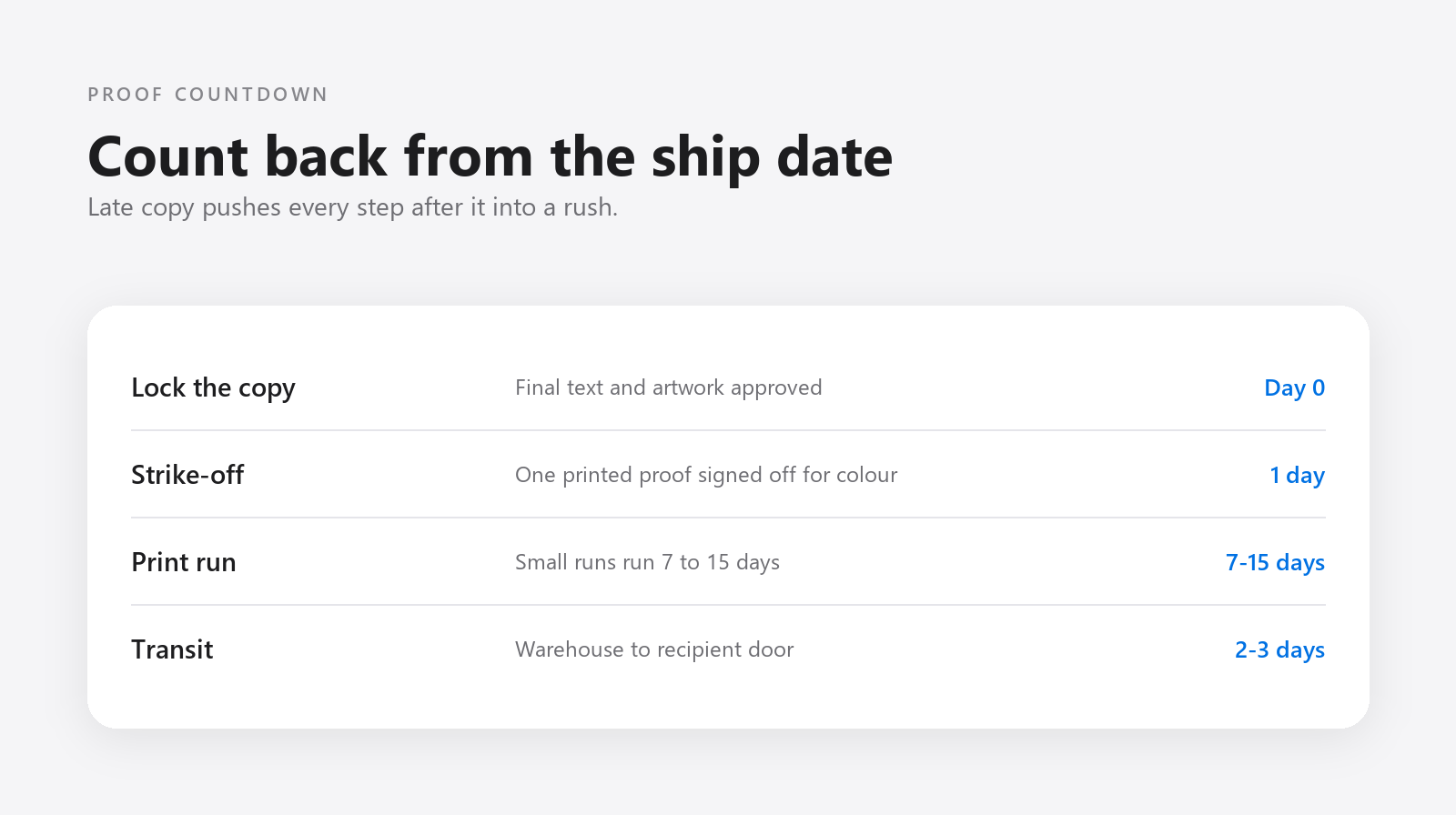
The calendar is what trips people up. A small run takes roughly 7–15 days; a large one starts at 30 days. The strike-off — a single printed proof you sign off for colour — eats its own day, so do not stack it on top of the print run. Work backward: ship date minus two to three days in transit, minus seven to fifteen days of print, minus one day for the proof, minus the day you lock the copy. Late copy pushes every step after it into a rush.
The deadline rhythm, and holidays
The timeline runs backward from the coverage date, not forward from whenever you feel ready. Publishers start prepping for a November push in August — three months out, not three weeks.
Two calendars can stall a box. Print shops close around major holidays, and the media you are pitching also close — December into January, and August across much of Europe. When both calendars shut down at once, the box sits in the gap. A realistic rule: count four to six weeks back from the target publication date, and that is the latest honest ship date.
Three kinds of recipient, three boxes
"Media list" is not one thing. Three different people open the box, and they are looking for three different sets of material.
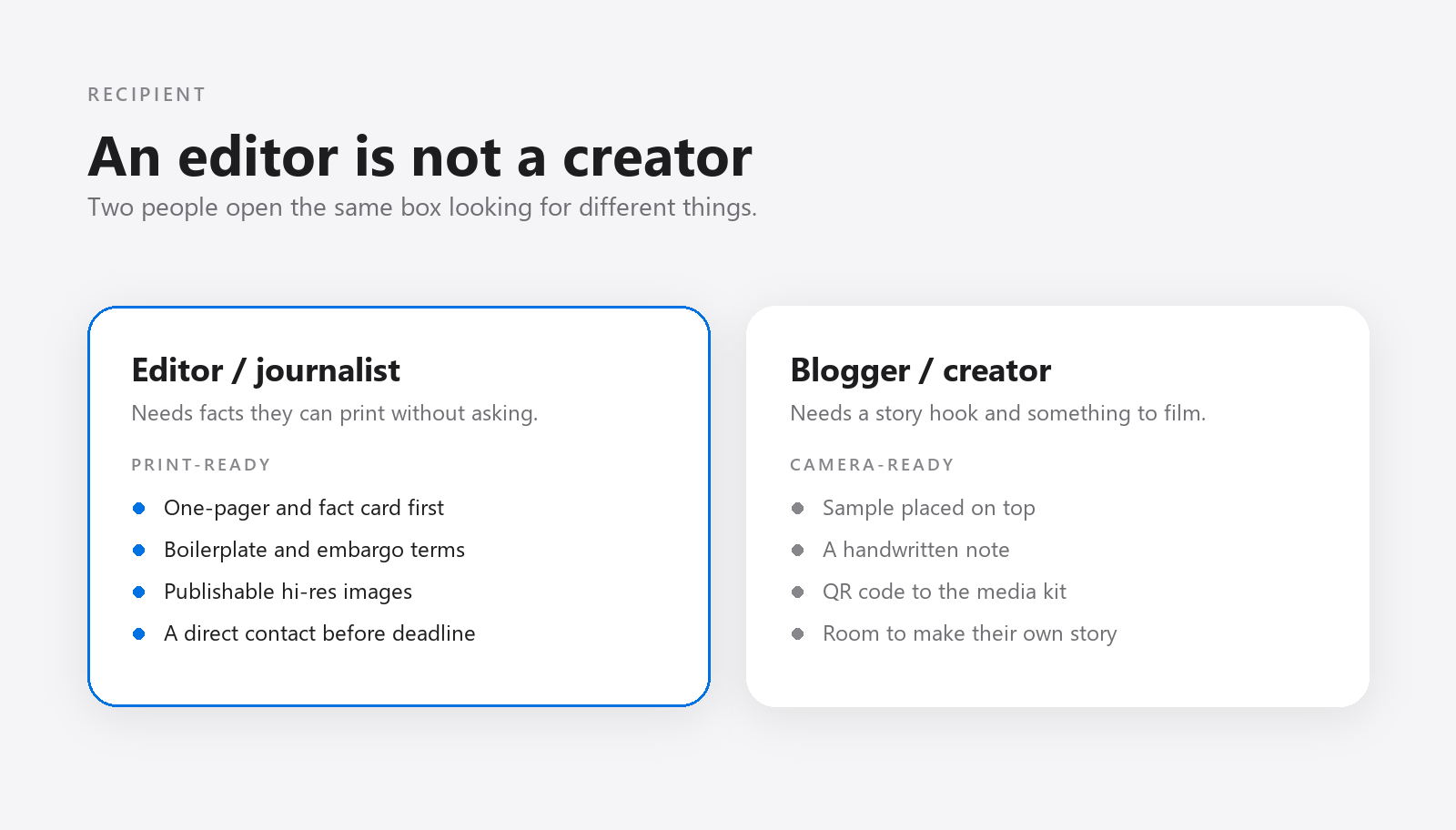
| Recipient | They need | The box should carry |
|---|---|---|
| Editor / journalist | Facts, boilerplate, publishable images, embargo terms | One-pager, fact card, contact — sample secondary |
| Blogger / creator | A story hook, the sample, something to film | Sample on top, handwritten note, QR code |
| Podcast host | Talking points, quotable lines, a guest contact | Outline, one-pager, media contact |
Send one box to everyone and each person uses a third of it and bins the rest. Split the list and each box gets read the whole way through. Publishers already do the channel version of this — a custom edition for one retailer, a commemorative edition for another.
QR codes that don't expire
A normal QR code points at a fixed URL and is frozen the moment you print. That is fine for a link, and useless for a media kit that changes every week — new images, a corrected fact sheet, an updated contact.
Use a standard that decouples the code from the content. With GS1 Digital Link, one QR code carries an identifier and resolves to information the brand owner can redirect and update online, so the pack artwork never has to be reprinted when the digital kit changes. The code on the box stays current for the life of the After Your Campaign.
The short version
Coverage is decided by the contents, not the ribbon. Four layers with one job each, an unboxing order that puts the product first, a proofing calendar that starts from the ship date, and a list split by who is opening the box.
If you have a product and a target coverage date but are not sure how to cut the list or sequence the box, send the product, the audience and the date. We will come back with a content plan and a print schedule before anyone talks about rates.
References (Neutral Third-Party Sources)
- Federal Trade Commission — Disclosures 101 for Social Media Influencers: free or discounted products create a material connection that must be disclosed clearly and placed where it is hard to miss. https://www.ftc.gov/business-guidance/resources/disclosures-101-social-media-influencers
- Federal Trade Commission — FTC's Endorsement Guides: What People Are Asking: why a stand-alone "gifted" is too vague and a platform's own tool is not a substitute. https://www.ftc.gov/business-guidance/resources/ftcs-endorsement-guides-what-people-are-asking
- USPS — U.S. Customs Forms: every item needs a specific, detailed description, and "gifts" is listed as an unacceptable description on the customs form. https://www.usps.com/international/customs-forms.htm
- GS1 — GS1 Digital Link: one code carries a GTIN and resolves to information the brand can update without changing the printed code. https://www.gs1.org/standards/gs1-digital-link