
West Coast Fulfillment: Cut Shipping Costs on the Pacific
West Coast fulfillment is freight arithmetic, not a coastal preference. Your warehouse ZIP is the origin on every shipping-zone lookup for every order you ship, so a building in Southern California versus the Pacific Northwest changes the bill on your whole order book. Put the node where your customers and your containers actually are, and you cut the zone on the orders that matter; put it there because "California sounds good" and you pay a distance tax on everyone else.
This article works through that arithmetic: when a West Coast node earns its keep, what the Pacific ports do for importers, how to pick among the anchor regions, and when a single West Coast warehouse stops being enough. No rankings, no named providers — just criteria you can score yourself.
Zones are distance, and distance is money
Ground carriers price a parcel by zone, and zones are bands of distance, not a per-mile rate. The USPS Domestic Mail Manual lays them out by radius from the origin: Zone 1 runs to about 50 miles, Zone 2 to about 150, and so on out to Zone 8 at roughly 1,800 miles and beyond. A package that travels one or two zones costs a fraction of one that crosses eight.
The origin on that lookup is your warehouse's ZIP code. That is the whole mechanism behind West Coast fulfillment: move the building closer to a customer and the zone drops; drop the zone and the per-parcel rate falls on the same billable weight. Everything else in this article is what happens once you act on it.
A warehouse in Los Angeles or the Inland Empire keeps the West in low zones, but it pushes a New York or Florida order out to Zone 7 or 8 — the expensive end of the chart.
Why a West Coast node pays off for Western and Mountain customers
The West is not as dense as the Northeast corridor, but the customers who live there are concentrated enough to make a local node decisive. California is the largest state economy and, for many catalogs, the single biggest destination; a Southern California building reaches most of the West Coast in one to two days by ground, and the Mountain states in two to three.
The rule of thumb is blunt and useful: if a meaningful share of orders ship to California and the Mountain West, one West Coast warehouse covers most of that volume fast and cheap. If demand sits east of the Rockies instead, a West Coast node is a cost center, not an asset. Match the node to your own order map.
Here is where the term blurs: some buyers mean a California warehouse for their West Coast orders, others a 3PL for their whole national book. The first is a location decision; the second is a network decision. Score the building on the right one.
The Pacific ports are the importer's shortcut
If you import, the West Coast is not a preference — it is where your freight already lands. The San Pedro Bay complex, the Port of Los Angeles and the Port of Long Beach side by side, is the largest container gateway in the Western Hemisphere and the default landing point for transpacific cargo.
A warehouse near one of these ports shortens the inbound leg twice over. First, drayage — the short truck move from the terminal to the warehouse, the step Chinese shippers call "卡派" — turns "arrived at port" into "in the building" within a day instead of a week of inland rail or trucking. Second, customs entry and warehousing can sit next to each other: goods clear, get received, and become sellable in one pass instead of two stops. The time from a container hitting the dock to the goods being scanned into sellable inventory is dock-to-stock, and near-port warehouses win it by days.
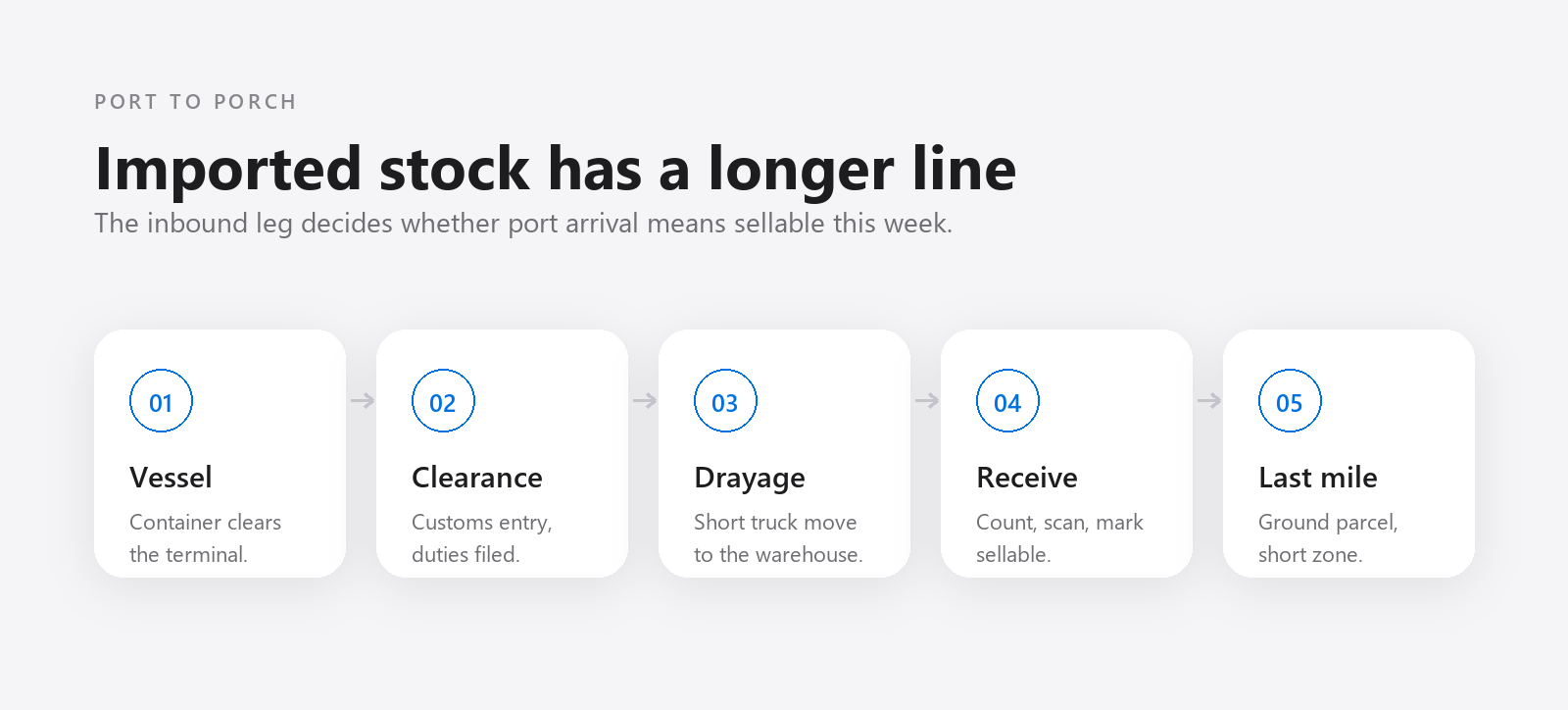
If you ship only domestic goods and never touch a container, the port is a distraction. Score it a zero and move on.
Choosing a West Coast fulfillment center: three anchor regions
Most West Coast decisions come down to three anchor regions, and each is a straight trade-off between rent, inbound access, and customer reach.
| Region | Speed to the West | Warehouse cost | Port / inbound access | Best fit |
|---|---|---|---|---|
| Southern California / Inland Empire | Fastest to SoCal and the Southwest | High, climbing near the harbor | LA / Long Beach, the largest Western Hemisphere gateway | Import-heavy, speed-first brands |
| Bay Area / Oakland | One to two days up the coast | Highest of the three | Oakland, a top Northern California gateway | Tech and NorCal-demand brands |
| Pacific Northwest / Seattle-Tacoma | One to two days in the PNW | Meaningfully lower than California | Seattle-Tacoma (NWSA), a major gateway | PNW and cost-conscious West Coast shippers |
The Inland Empire deserves a note of its own: the warehouse market an hour east of the ports, where containers transload into domestic trailers and most large operators actually build. A Los Angeles-area warehouse 60 miles inland still clears a container into the building within a day or two, at rent the harbor itself cannot match.
A single West Coast warehouse cannot reach the East cheaply
Here is the honest limitation of a Pacific node: roughly three-fifths of the U.S. population lives east of the Mississippi, and every one of those orders shipped from California crosses most of the zone chart. That is not a failure of the warehouse — it is the arithmetic of one building on one coast.
The cost shows up as a per-parcel zone premium on your best eastern customers, and as the air freight you buy to hold a two-day promise that ground can no longer meet.
West Coast + East Coast: the two-node arithmetic
Adding a second node — a West Coast warehouse plus an East Coast warehouse — is the standard fix, and it is where the location question stops being theoretical. A second building drops the zone on the customers it serves, but only for the SKUs actually stocked in both places.
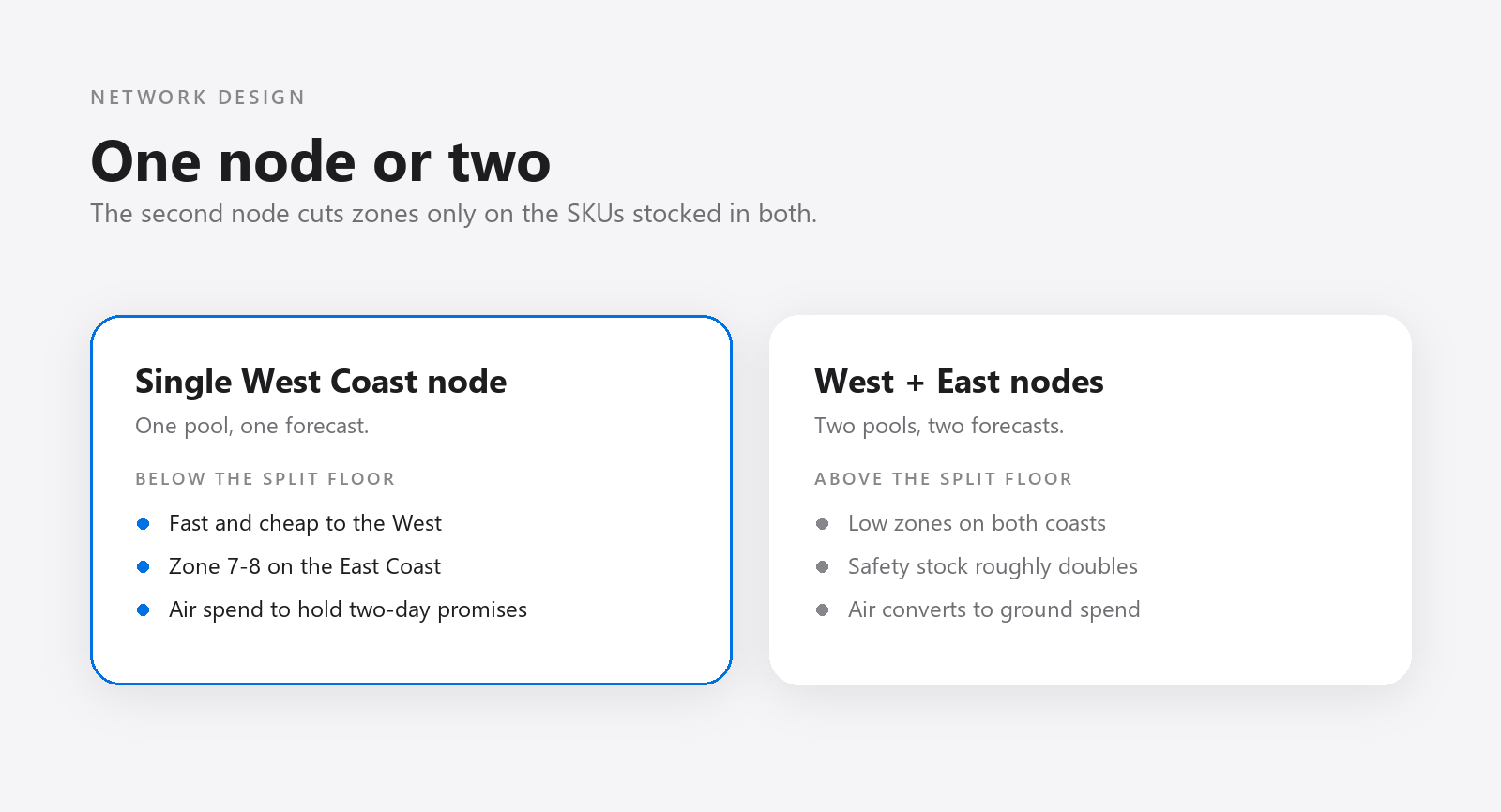
The savings are real but easy to overstate. Industry data across fulfillment operators points to roughly a tenth off parcel cost from a second center — but that saving only lands on units that exist in the closer building when the order comes in. A SKU stocked at only one coast ships long zones to everyone else no matter how good the map looks.
The other side of the trade is safety stock. Splitting inventory roughly doubles it: you hold a buffer in two places and forecast per node rather than for the whole book. Below a certain volume, the extra inventory costs more than the zone savings return. The economics generally favor a second node only once you are shipping a meaningful, predictable daily volume — commonly cited as fifty to a hundred orders a day.
That floor matters more than the map. A thin node with a third of your catalog in it cancels most of its own orders for lack of stock, and you pay two rents for the privilege.
West Coast fulfillment services: what you are actually buying
Once the location is settled, the service layer is what separates a warehouse from a fulfillment partner. A West Coast fulfillment service that actually ships orders — as opposed to a landlord that only stores pallets — runs a handful of stations: receiving, putaway, pick and pack, a weight check at pack-out, and the handoff to a carrier for last mile, the industry term for the final delivery leg to the customer's door.
The details are where the quality lives. A good receiving dock scans a container into sellable inventory in 24 to 48 hours; a slow one lets Send PR Boxes sit for days and quietly cancels the location advantage you paid for. Picking accuracy under a strong process runs below a fraction of a percent — the operators that get there scan at every touch and weigh every parcel at pack-out, flagging a five-gram error so a wrong item cannot leave the building.
A scorecard for any West Coast location
Before you sign anything, score the location on six lines, in writing. The right answer on paper is the one you can defend in the invoice later.
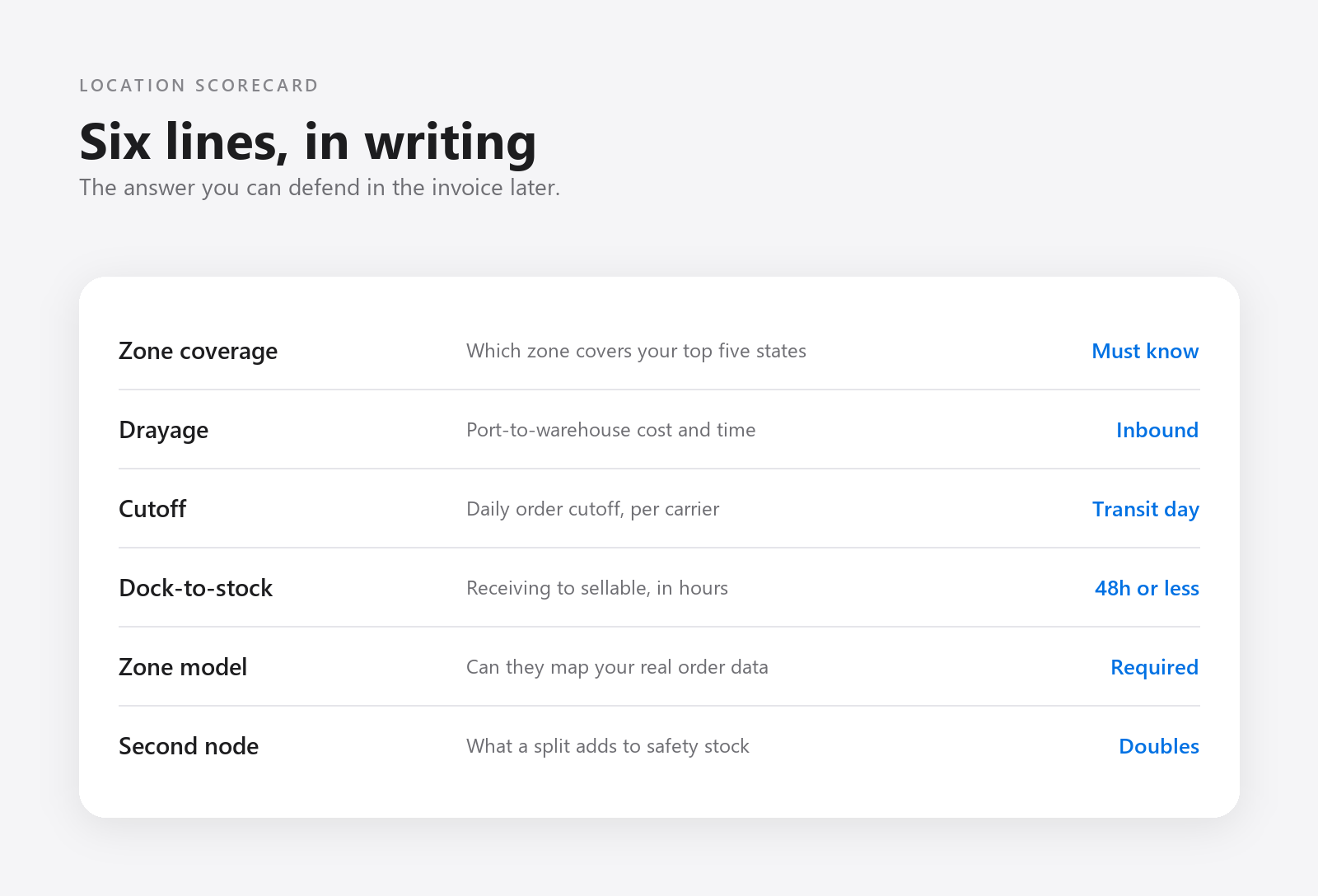
| Question | Why it matters | A bad answer sounds like |
|---|---|---|
| What zone covers your top five states? | That number sets most of your freight | "We don't have a zone map" |
| How far is drayage, and at what cost? | Port-to-warehouse is a hidden inbound line | "The port is close enough" |
| What is the daily cutoff, per carrier? | A late cutoff is worth a full transit day | "Standard times" |
| How fast is dock-to-stock? | Slow receiving cancels the location advantage | "Within a few days" |
| Can you model the zone math on real orders? | A partner should map your data, not a map | "Trust us" |
| What does a second node add to stock? | Splitting roughly doubles safety stock | "It just works" |
Three "right-column" answers and you are buying a building, not a freight decision.
The short version
A West Coast fulfillment node earns its place the moment your customers live west of the Rockies and your freight bill proves it — or the moment your containers land at a Pacific port and every mile inland is a cost you can avoid. Match the node to your order map, decide whether port or customer proximity wins, and only split into a two-node network when the volume can support a second safety stock. The location is a number you can calculate before you ever talk to a provider.
If you want the arithmetic done on your data, send us your last ninety days of orders by destination ZIP and your SKU count — we will map the zones and the split point before we talk about pricing.
References (Neutral Third-Party Sources)
- USPS — Domestic Mail Manual, Section 608: the official definition of postal zones 1–8 by radial distance from the origin, the basis for zone-based parcel pricing. https://pe.usps.com/text/DMM300/608.htm
- Port of Los Angeles — Business / Your Trade Gateway: the port's own statement that it moves more containers than any other port in the Western Hemisphere and its warehouse and drayage infrastructure. https://www.portoflosangeles.org/busi
- Port of Los Angeles — Warehousing and Distribution / Foreign-Trade Zone 202: how near-port warehousing and a foreign-trade zone support the inbound and customs-adjacent picture. https://portoflosangeles.org/business/supply-chain/warehousing-and-distribution
- Port of Long Beach — About the Port: the port's description of itself as the premier U.S. trans-Pacific gateway and its 2024 record container year. https://polb.com/port-info/
- U.S. Bureau of Labor Statistics — Warehousing and Storage: NAICS 493: what warehousing and storage establishments do, including the logistics services that overlap with fulfillment. https://www.bls.gov/iag/tgs/iag493.htm
- GS1 — Global Location Number (GLN): the identifier that gives each physical node in a split network a machine-readable identity. https://www.gs1.org/standards/id-keys/gln