
3PL in Georgia: Fulfillment Near Atlanta's Ports and Highways
A Georgia 3PL earns its place when your customers and your containers both live in the Southeast. Savannah is the port, Atlanta is the hub, and the 259 miles between them is where the freight math happens. Put a building at the wrong end of that line and you pay a drayage bill or a zone bill you never needed to.
This article works through the arithmetic: what shipping zones cost you, why Savannah matters to importers, why Atlanta matters to everyone, and the criteria for deciding whether a Georgia building is worth it. No rankings, no named providers — just the numbers to score a location yourself.
Zones are distance, and Georgia sits mid-map
Ground carriers price a parcel by zone, and zones are bands of distance from the origin, not a per-mile rate. The USPS Domestic Mail Manual lays them out by radius: Zone 1 runs to about 50 miles, Zone 2 to about 150, on out to Zone 8 at roughly 1,800 miles and beyond. A parcel that crosses one or two zones costs a fraction of one that crosses eight.
The origin on that lookup is your warehouse's ZIP code. That is the entire mechanism behind a Georgia node: the state sits near the midpoint of the East Coast, so an Atlanta building reaches the whole Southeast in low zones, and a Savannah building reaches both the Southeast and, by rail, most of the eastern half of the country. Move the building toward your customers and the zone drops; drop the zone and the per-parcel rate falls on the same billable weight.
Why Georgia wins for Southeast customers
The Southeast is the advantage a lot of West Coast and Northeast shippers never price. A single Atlanta-area warehouse reaches Georgia, Florida, Tennessee, the Carolinas and Alabama in one to two days by ground — a block of buyers you cannot touch that fast from Los Angeles or northern New Jersey at parcel rates.
The rule of thumb is blunt and useful: if a meaningful share of your orders ship to the Southeast, one Georgia building covers most of that volume fast and cheap. The state's highway grid is why. I-75, I-85, I-20 and I-16 all cross through Atlanta, and the metro sits at the intersection where east-west and north-south freight meet. Match the node to your own order map, not to the nearest port or the biggest city.
The Savannah port is the importer's on-ramp
If you import, Savannah is not a preference — it may be where your freight already lands. The Georgia Ports Authority runs the Garden City Terminal, which it calls the single largest container terminal in the country, with two Class I railroads on-terminal and overnight rail reach into a five-state region.
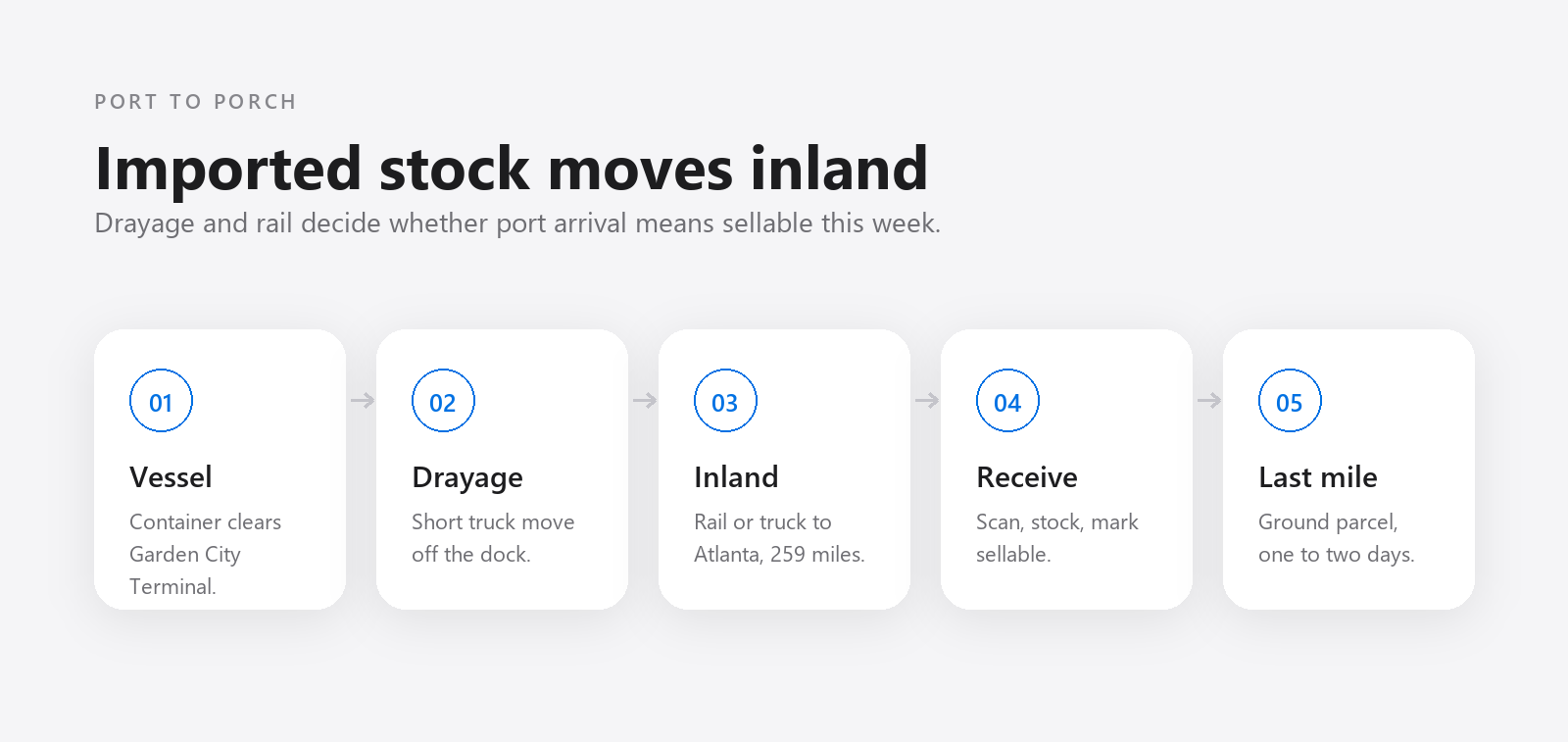
The inbound advantage is drayage, the short truck move from the terminal to the warehouse — the step Chinese shippers call "卡派" (kǎ pài). A warehouse minutes from the dock turns "arrived at port" into "in the building" the same day. Inland, Savannah is also the closest major port to Atlanta by rail, so a container can be off the vessel and rolling toward an Atlanta warehouse overnight instead of sitting in a yard.
The caution is a practice Chinese sellers call "远仓近送" — roughly "far warehouse, near delivery" — where a forwarder books freight for a distant building but drops it at a closer, busier one to save their own trucking. Amazon and other marketplaces have cracked down, and the penalty is a re-routing fee or a load that cannot be received. When your freight is container volume, the port named on the bill of lading has to match the building you actually stock.
Atlanta is the air and highway hub
Atlanta's value is not the port — it is the node where freight changes direction. Hartsfield-Jackson Atlanta International Airport, the world's busiest passenger airport, runs a large air cargo operation for expedited replenishment, and the metro's highways fan out in every direction.
That hub position is what makes a Georgia 3PL a national play rather than a regional one. Containers land at Savannah, ride rail or truck inland to Atlanta, and the inventory then ships one to two days by ground across the Southeast and into the Midwest. The Georgia Ports Authority states Savannah is the closest and fastest port by rail to Atlanta, Birmingham, Charlotte, Memphis and Orlando — so an Atlanta building sits one rail leg from a deep inland market without paying a coastal rent.
Savannah or Atlanta: two anchors, two jobs
Most Georgia decisions come down to two anchors, and each is a straight trade-off.
| Anchor | Best for | Inbound advantage | Outbound reach | Cost |
|---|---|---|---|---|
| Savannah (port-adjacent) | Import-heavy brands landing containers | Drayage measured in minutes | Southeast, then inland by rail | Higher near the dock |
| Atlanta (metro hub) | DTC brands selling to the Southeast | Containers arrive by rail or truck | One to two days across the Southeast and Midwest | Lower inland rent |
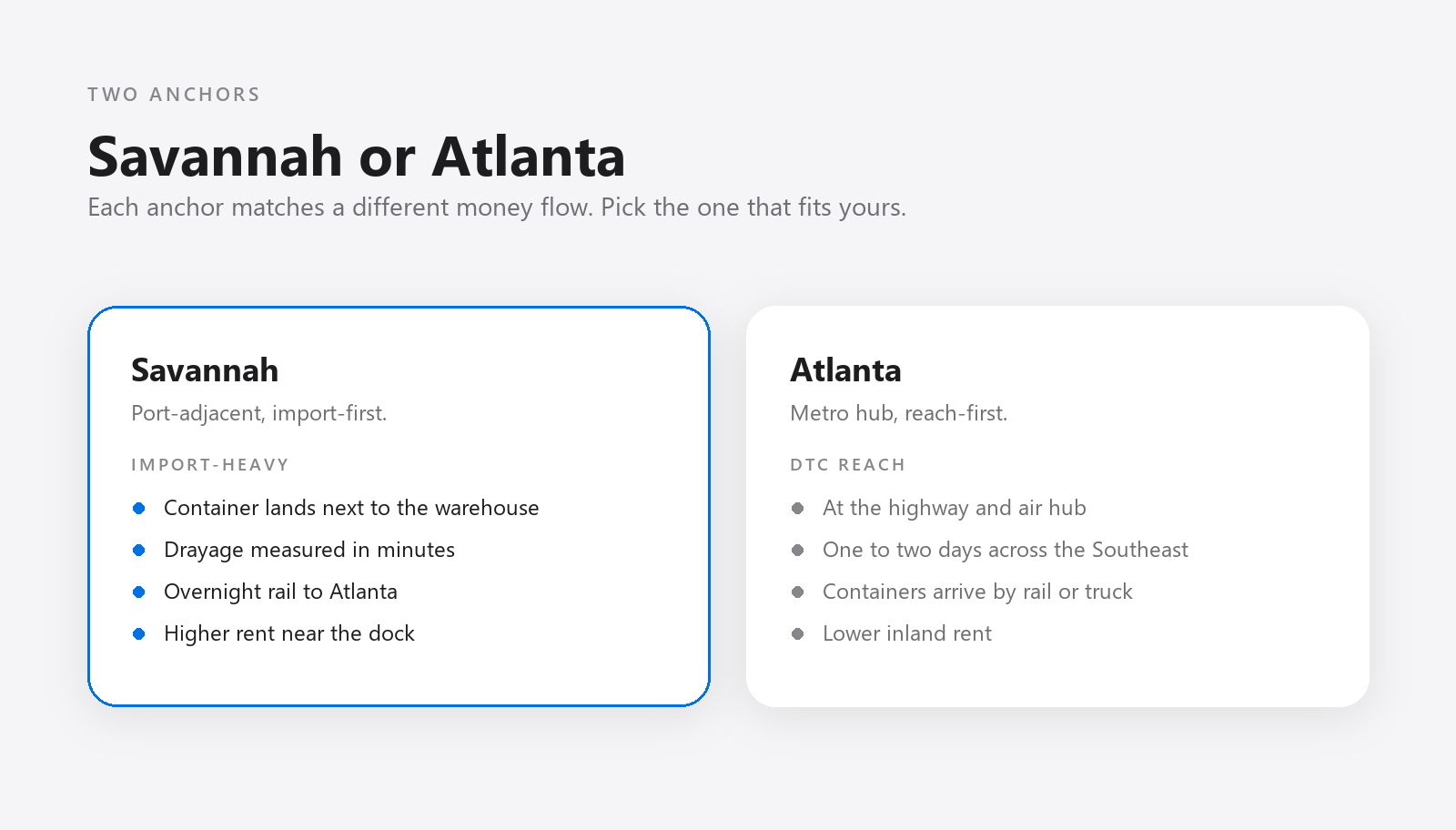
The split is the same one importers face on every coast: inbound port access pulls toward one ZIP, outbound customer proximity toward another. A brand landing a dozen containers a month and selling mostly to Florida belongs near Savannah. A brand selling to the whole Southeast on a thin import mix belongs in Atlanta. There is no single "correct" Georgia location — only the one that matches where your money is.
Does your freight already land here?
Start the Georgia decision from your inbound bill, not a map. If your containers already discharge at Savannah and then ride rail or truck to some other region, a Georgia warehouse deletes that inland leg entirely. One Chinese freight write-up put the cost of dragging a container from the West Coast to the East by rail in the thousands of dollars per box — on top of the port congestion that periodically stalls the West Coast gateways.
If your freight lands on the West Coast, or you ship only domestic goods and never touch a container, the port argument scores a zero. Score it and move on; the only thing that matters after that is where your customers live.
When Georgia is the wrong answer
Georgia is not automatic. If your order map is heavy on California, the Pacific Northwest or the Mountain West, a Georgia building pushes those orders out to Zones 7 and 8 — the expensive end of the chart — and a West Coast or Midwest node serves you better. If your Southeast volume is thin, the node costs more in duplicated inventory than it returns in zone savings.
The middle case is the trap: enough Southeast volume to justify a building, not enough to fill one. That is when Georgia makes sense only as a second building in a two-node network, never as your only building.
A scorecard for any Georgia location
Before you sign anything, score the location on six lines, in writing. The answer you can defend in the invoice later is the one that matters.
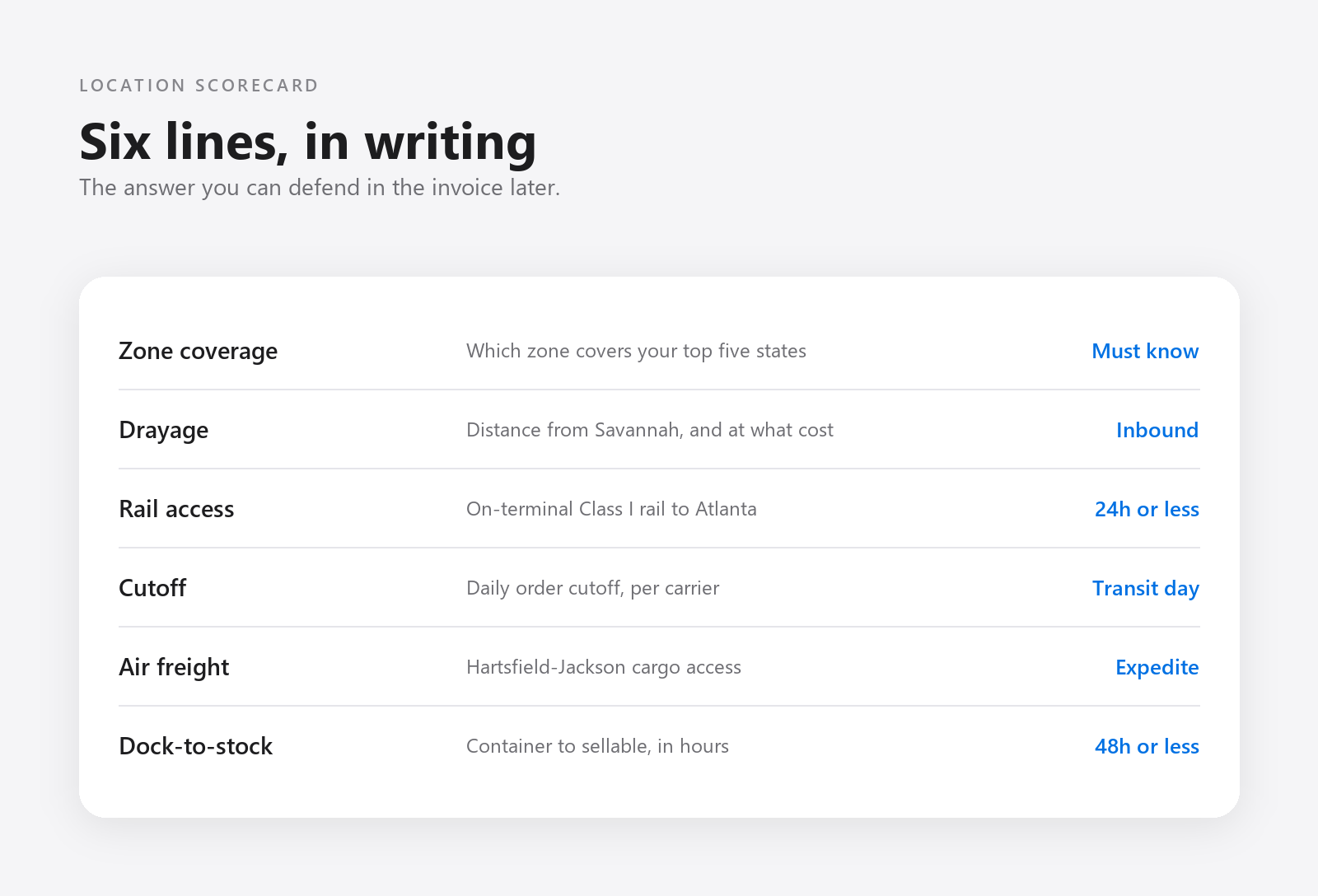
| Question | Why it matters | A bad answer sounds like |
|---|---|---|
| What zone covers your top five states? | That number sets most of your freight | "We don't have a zone map" |
| How far is drayage from Savannah, at what cost? | Port-to-warehouse is a hidden inbound line | "The port is close enough" |
| Is there on-terminal rail to Atlanta? | Inland moves are cheaper and faster by rail | "We truck everything" |
| What is the daily cutoff, per carrier? | A late cutoff is worth a full transit day | "Standard times" |
| How fast is dock-to-stock? | Slow receiving cancels the location advantage | "Within a few days" |
| Can they map the zone math on real orders? | A partner should map your data, not a map | "Trust us" |
Three "right-column" answers and you are buying a building, not a freight decision.
The short version
A Georgia 3PL earns its place the moment your customers live in the Southeast and your freight bill proves it — or the moment your containers land at Savannah and every inland mile is a cost you can avoid. Pick the anchor that matches your money: port-adjacent for importers, metro for DTC reach. Match the node to your order map, and only add Georgia as a second building when the volume can support a second safety stock.
If you want the arithmetic done on your data, send us your last ninety days of orders by destination ZIP and your SKU count — we will map the zones and the split point before we talk about pricing.
References (Neutral Third-Party Sources)
- USPS — Domestic Mail Manual, Section 608: the official definition of postal zones 1–8 by radial distance from the origin, the basis for zone-based parcel pricing. https://pe.usps.com/text/DMM300/608.htm
- Georgia Ports Authority — Port of Savannah: the port authority's own statement that Savannah is the single largest container terminal in America, with two Class I railroads on-terminal, overnight service to a five-state region, and the fastest rail reach to Atlanta and other inland cities. https://gaports.com/facilities/port-of-savannah/
- Hartsfield-Jackson Atlanta International Airport — Official site: the airport's status as the world's busiest airport and its air cargo and passenger operations that anchor Atlanta as a logistics hub. https://www.atl.com/
- U.S. Bureau of Labor Statistics — Warehousing and Storage: NAICS 493: how warehousing and storage establishments are defined, including the pick and pack and Uniform Order Fulfillment work a Georgia node performs. https://www.bls.gov/iag/tgs/iag493.htm
- U.S. Bureau of Labor Statistics — Couriers and Messengers: NAICS 492: the parcel and local delivery work that carries the last mile out of a warehouse. https://www.bls.gov/iag/tgs/iag492.htm
- GS1 — Global Location Number (GLN): the identifier that gives each physical node in a multi-warehouse network a machine-readable identity. https://www.gs1.org/standards/id-keys/gln
- Federal Trade Commission — Mail, Internet, or Telephone Order Merchandise Rule: the shipping baseline and the duty to notify buyers of delay, part of the outbound promise. https://www.ftc.gov/business-guidance/resources/business-guide-ftcs-mail-internet-or-telephone-order-merchandise-rule