
B2C Fulfillment: How It Differs from B2B (And Why It Costs More Per Order)
B2C fulfillment sells a different promise: one unit, fast, and easy to send back. A B2B order promises a pallet, a dock window and a label on every carton; a B2C order promises a single parcel at a front door, with a return that has to be just as easy as the purchase. Same word "fulfillment," opposite economics — which is why a consumer order costs more per unit even though the item is smaller.
This article lays out the split: the order unit, the delivery, the returns, the packaging, and the per-order cost. If you ship pallets instead of parcels, our B2B fulfillment guide covers the other half of the same table.
The order unit is one
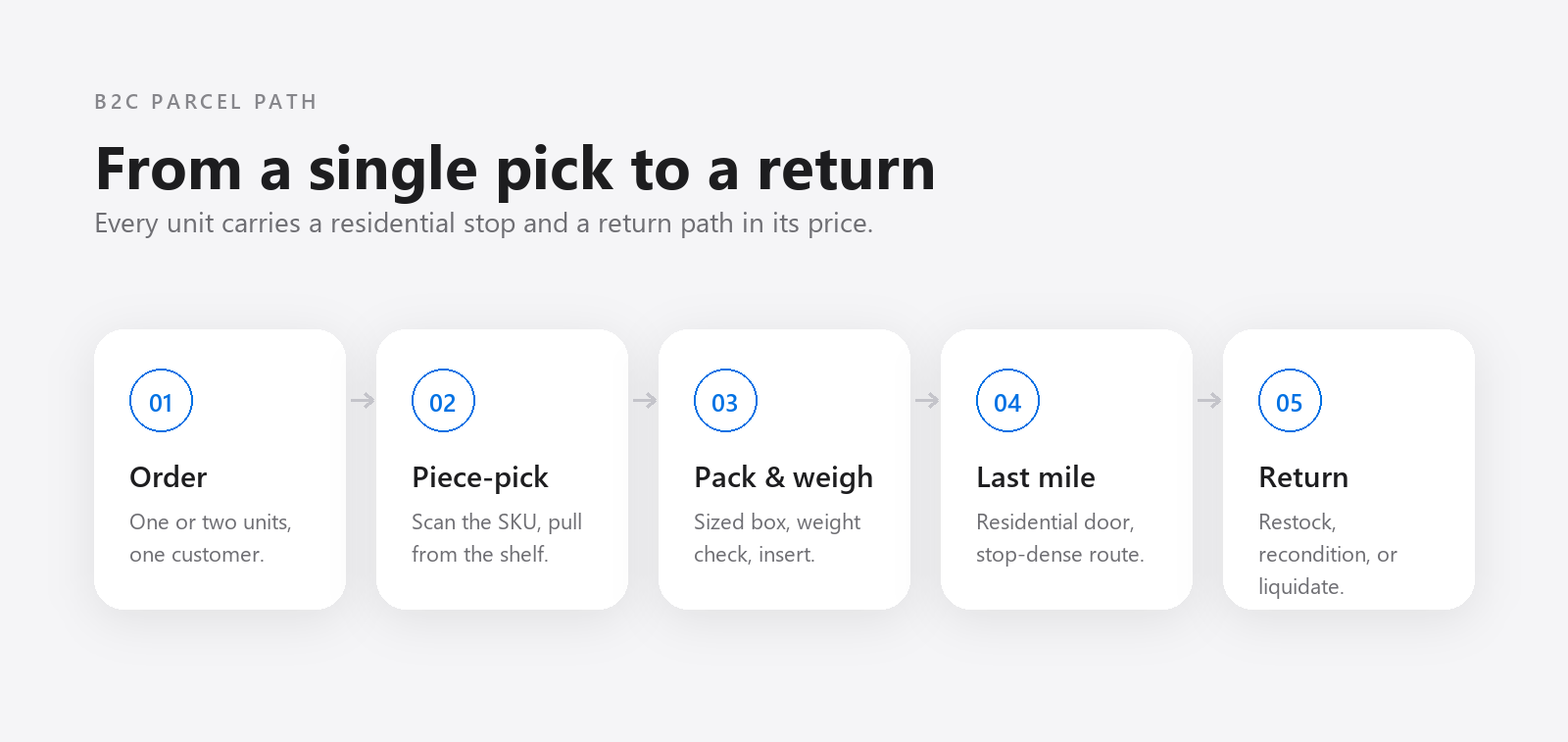
The first difference is the unit. B2C fulfillment is piece-picking — a warehouse worker pulls one unit, or a couple of units, per order, from a broken case or an open shelf slot. A typical consumer order is one or two units; the pick density per order is low, and every order gets its own carton and its own label.
B2B runs the opposite shape: cases and pallets picked by the layer, verified against a shipping document, not a retail price. The same building that runs a parcel line well rarely runs a pallet line well, because the aisle is built for different work — shelving and pack benches for single units, versus forklifts and floor loading for pallets.
Residential delivery changes the last mile
The costliest difference is the last mile, the final delivery leg to the customer's door — the step Chinese shippers call "尾程" (wěi chéng). A B2B shipment lands at a commercial dock with a receiving function and a forklift; a B2C shipment lands at a house with stairs, a porch, and sometimes nobody home.
That is why last mile dominates the B2C bill. Couriers run stop-dense routes to residential addresses, deal with failed first attempts, and need a return path for every parcel. BLS data counts couriers and messengers as a subsector of their own (NAICS 492) precisely because local parcel delivery is a different business from freight — one person, a van, and a door, not a truck and a dock.
Returns are the cost you cannot skip
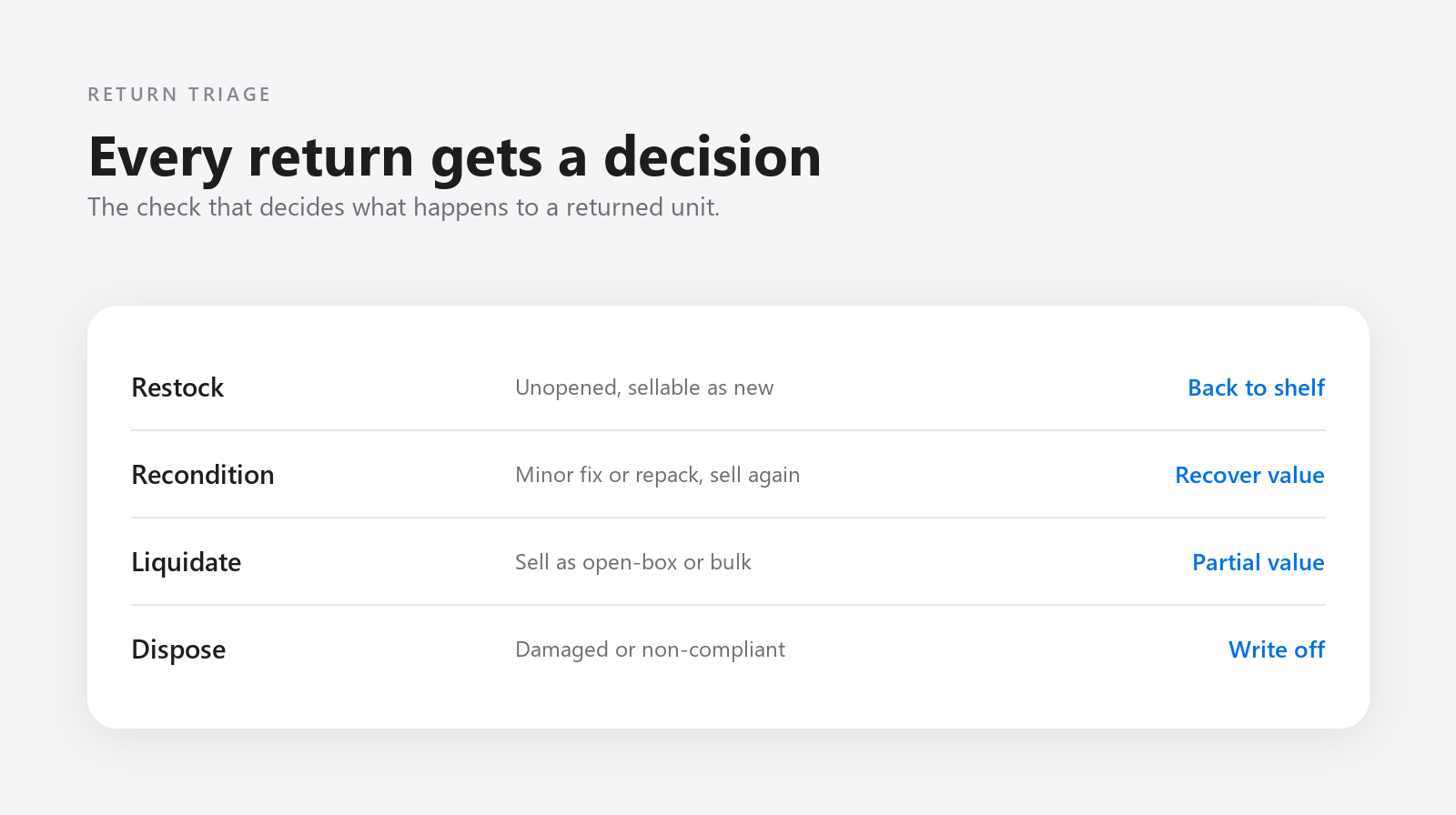
Returns are where B2C and B2B diverge hardest. Consumer returns are frequent and single-unit; they arrive as loose parcels, each needing a condition check and a decision — restock, recondition, liquidate, or dispose. Apparel and footwear, the highest-return categories in e-commerce, push this flow constantly, and every returned unit is a second handling that was never in the original price.
B2B returns are rarer but heavier: a pallet under an RTV (return to vendor) agreement, with a credit memo and a dock appointment. The B2C problem is volume of small decisions; the B2B problem is a few large ones. Neither is free, but only the B2C one scales with your order count.
Speed is a promise with a clock
B2C speed is a cutoff, not a slogan. A good consumer operation prints labels by a fixed afternoon time — one Chinese warehouse runs a 10 p.m. cutoff so every order paid before that leaves the same day — because a parcel that misses the truck loses a full transit day for free. The legal floor sits beneath it: the FTC's Mail Order Rule says if you promise no date you still have to ship within 30 days, and if you cannot, you have to tell the buyer and give them a refund path.
That clock is what turns "as fast as possible" into something you can measure. Dock-to-stock in 48 hours, out the door in 24, delivered in two to five days — those are the numbers a B2C operation is actually promising, and they all hinge on the daily cutoff more than on any piece of automation.
Packaging sells the unboxing
In B2C, the carton is part of the product. The box, the insert and the tape are the brand's only physical moment with the customer, so a consumer order gets branded or at least clean packaging sized to the item — and that sizing matters, because carriers bill dimensional weight, so an oversized box costs you twice.
The packaging line also carries the error-proofing. A good B2C operation weighs every packed order against an expected weight, tight enough to catch a missing insert — one Chinese warehouse describes a 5-gram trigger. Get under that bar and a wrong item leaves the building; get over it and the same scanner that matched the label stops the parcel.
B2C versus B2B, side by side
| Area | B2C order | B2B order |
|---|---|---|
| Order unit | One or two units per order | Cases, pallets, mixed pallets |
| Picking | Broken-case, piece-pick | Full-case or pallet pick |
| Delivery | Residential door, stop-dense route | Commercial dock, booked window |
| Paperwork | Carrier label, optional slip | BOL, ASN, packing list, invoice |
| Returns | Frequent, single-unit, restock/recondition | Rarer, palletized, RTV with credit memo |
| Cost driver | Last mile, returns, piece labor | Pallet positions, dock time, compliance |
| Speed target | As fast as possible | Inside the window; early is late |
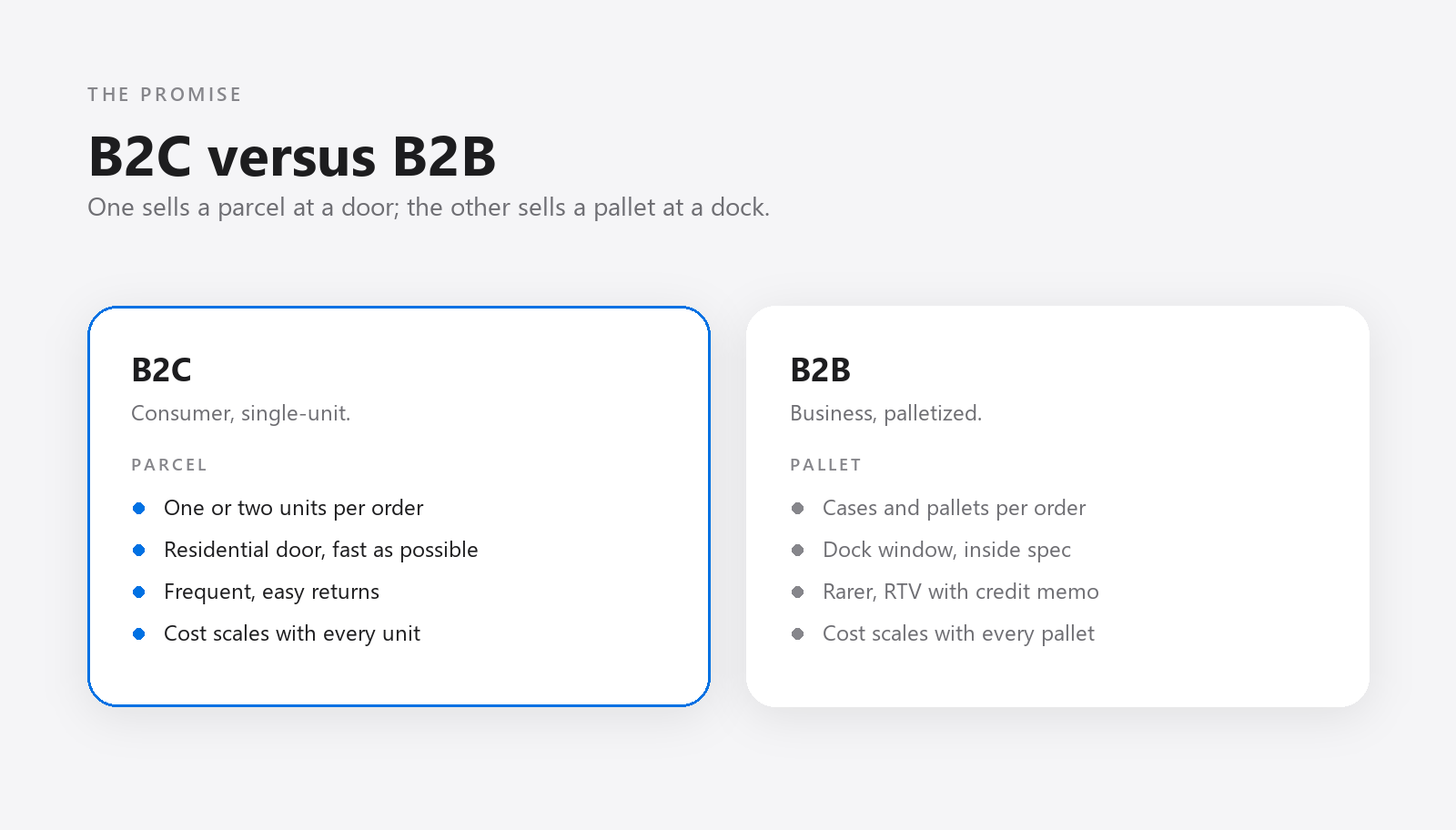
The table invites the lazy conclusion that B2C is simply "smaller." The real line is where the cost lands: B2C cost scales with every unit you touch, B2B cost scales with every pallet you move. A parcel operation that scans and weighs every order is cheap per unit; a pallet operation that misses a label pays a chargeback.
Why B2C costs more per order
The higher per-order cost is arithmetic, not inefficiency. A consumer order pays for a piece-pick, a residential stop, and a return path; a B2B order amortizes one pick across a pallet and delivers to a dock that accepts it in bulk. The fixed costs are the same building, but the variable costs — the touch labor and the last mile — attach to every single parcel.
The labor model shows it clearly. Chinese warehouse operators moved packers from a fixed monthly wage to piecework at about ¥0.10 per parcel: where twenty-odd people once shipped around 2,000 orders a day, six packers and six pickers shipped more than 20,000. Same twelve people, tenfold output — because the unit of B2C work is small, countable, and pays by the piece.
Six things to confirm before you switch
| Item | Get in writing | What goes wrong without it |
|---|---|---|
| Returns handling | Restock vs recondition vs dispose rules | A pile of units nobody can resell |
| Weight check | Tolerance per SKU, in grams | Missing inserts leave the building |
| Last-mile carriers | Which residential carriers, which cutoffs | Late cutoffs cost a full transit day |
| Pack-out spec | Box sizes, DIM weight, insert rules | Oversized Send PR Boxes inflate the bill |
| Cutoff time | Same-day cutoff per carrier | Orders miss the truck by minutes |
| Error rate | Pick accuracy target, measured | A wrong item costs a refund and a review |
If a row is vague, ship one test order and watch it end to end.
The short version
B2C fulfillment is one unit, a residential stop, and a return path, paid three times on every order. That is why it costs more per unit than B2B even though the parcel is smaller — and why the work is built around piece-picking, a weight gate, a daily cutoff and a returns decision. Price all four together, and the higher per-order cost becomes a number you can forecast instead of a surprise.
If you are moving into DTC and want the per-order math run on your own SKUs, send us your unit mix and your return rate for a quote.
References (Neutral Third-Party Sources)
- U.S. Bureau of Labor Statistics — Warehousing and Storage: NAICS 493: defines the pick, pack and order fulfillment work a B2C warehouse performs, including order fillers and packers. https://www.bls.gov/iag/tgs/iag493.htm
- U.S. Bureau of Labor Statistics — Couriers and Messengers: NAICS 492: the residential parcel and local delivery work that carries the B2C last mile. https://www.bls.gov/iag/tgs/iag492.htm
- USPS — Domestic Mail Manual, Section 608: postal zones 1–8 by radial distance, the basis for the residential parcel rates B2C pays. https://pe.usps.com/text/DMM300/608.htm
- Federal Trade Commission — Mail, Internet, or Telephone Order Merchandise Rule: the shipping timeline and the duty to notify buyers of delay, the baseline for a consumer's delivery expectation. https://www.ftc.gov/business-guidance/resources/business-guide-ftcs-mail-internet-or-telephone-order-merchandise-rule
- GS1 — Global Trade Item Number (GTIN): how a consumer unit is identified at the item level, versus the logistic-unit SSCC used on B2B shipments. https://www.gs1.org/standards/id-keys/gtin
- GS1 — Serial Shipping Container Code (SSCC): the identifier on a logistic unit such as a case or pallet, the B2B counterpart to the B2C parcel label. https://www.gs1.org/standards/id-keys/sscc