
Nationwide Fulfillment: Shipping to All 50 States Without a Coast Tax
"Nationwide fulfillment" is a promise, not an address. A single building on one coast can technically ship to all fifty states — but it pays a zone penalty on roughly half the country, and it converts a two-day promise into an air-freight bill. Real nationwide fulfillment is a network decision: where to put nodes so most of your customers stop being far away.
This article works through that arithmetic: what a single warehouse costs you in zones, how two or three nodes cut it, what two-day delivery actually requires, and the Gifts That Scale at which a second building stops being an expensive theory.
A single warehouse pays the coast tax
Ground carriers price a parcel by zone, and zones are bands of distance from the origin, not a per-mile rate. The USPS Domestic Mail Manual defines them by radius: Zone 1 to about 50 miles, Zone 2 to about 150, on out to Zone 8 at roughly 1,800 miles and beyond. A parcel that crosses one or two zones costs a fraction of one that crosses eight.
A single warehouse is the origin for every order, so it cannot avoid the wide zones. Ship from one East Coast building and your California and Pacific Northwest customers sit in Zones 7 and 8 — the expensive end of the chart — while your Northeast customers enjoy Zones 2 and 3. That asymmetry is the coast tax, and it is paid on your best far-coast customers, not your worst ones.
Two-day delivery is a distance problem, not a speed problem
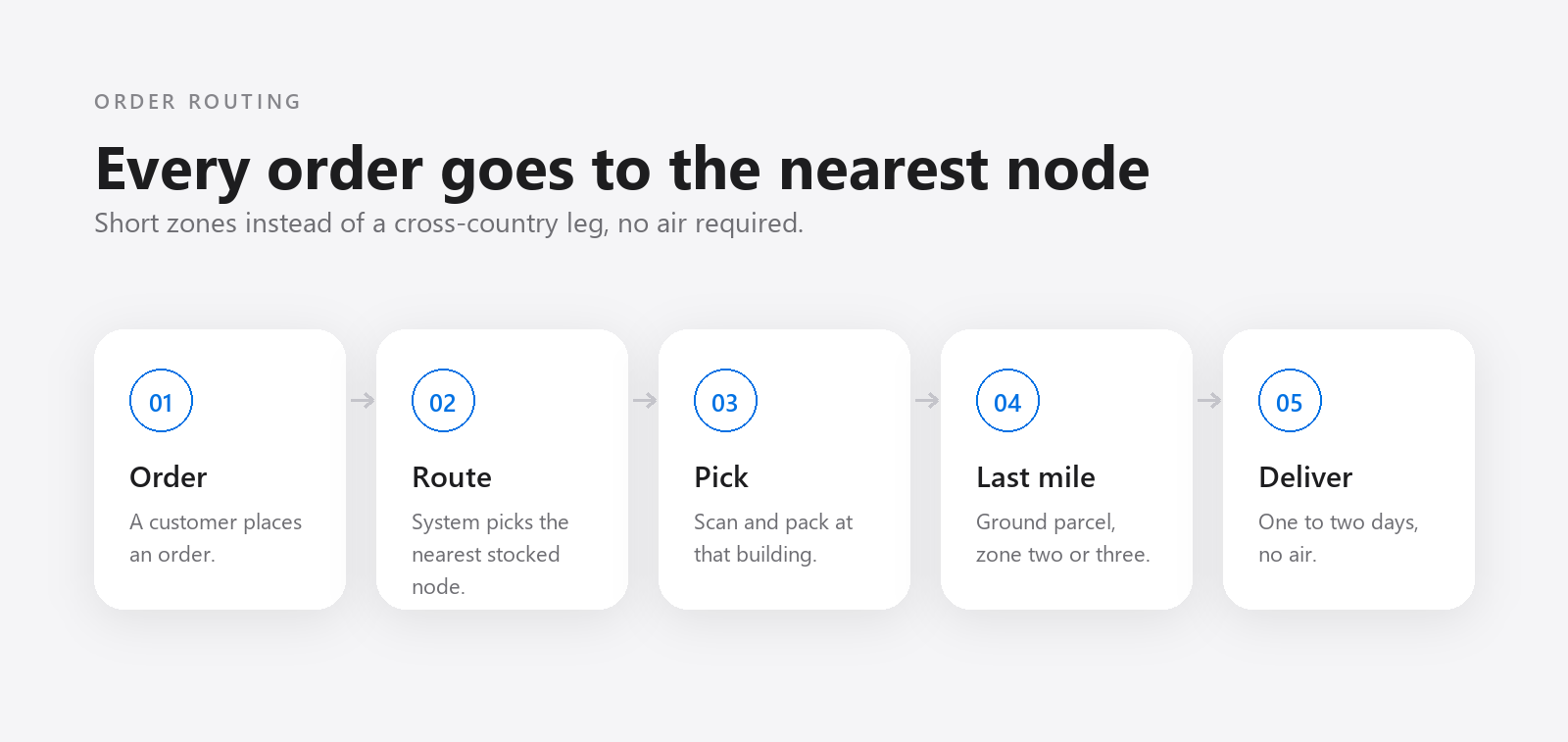
Brands chase two-day delivery by buying air, but the real lever is distance. A parcel that travels Zones 2–3 arrives in one to two days by ground; the same parcel shipped to Zone 8 takes five to seven days unless you pay for air. You do not need a faster carrier — you need a closer building.
The last mile, the final delivery leg to the customer's door — the step Chinese shippers call "尾程" (wěi chéng) — does not get faster with better software. It gets faster when the origin moves. Nationwide fulfillment is the practice of moving that origin close to your customers, node by node.
The two-node baseline
The first split is one West Coast node plus one East Coast node, and it is the classic starting point because it moves roughly four out of five American consumers into two-day ground reach. The savings are real but easy to overstate: industry data across fulfillment operators points to roughly a tenth off parcel cost from a second center — but that saving only lands on the SKUs actually stocked in both places.
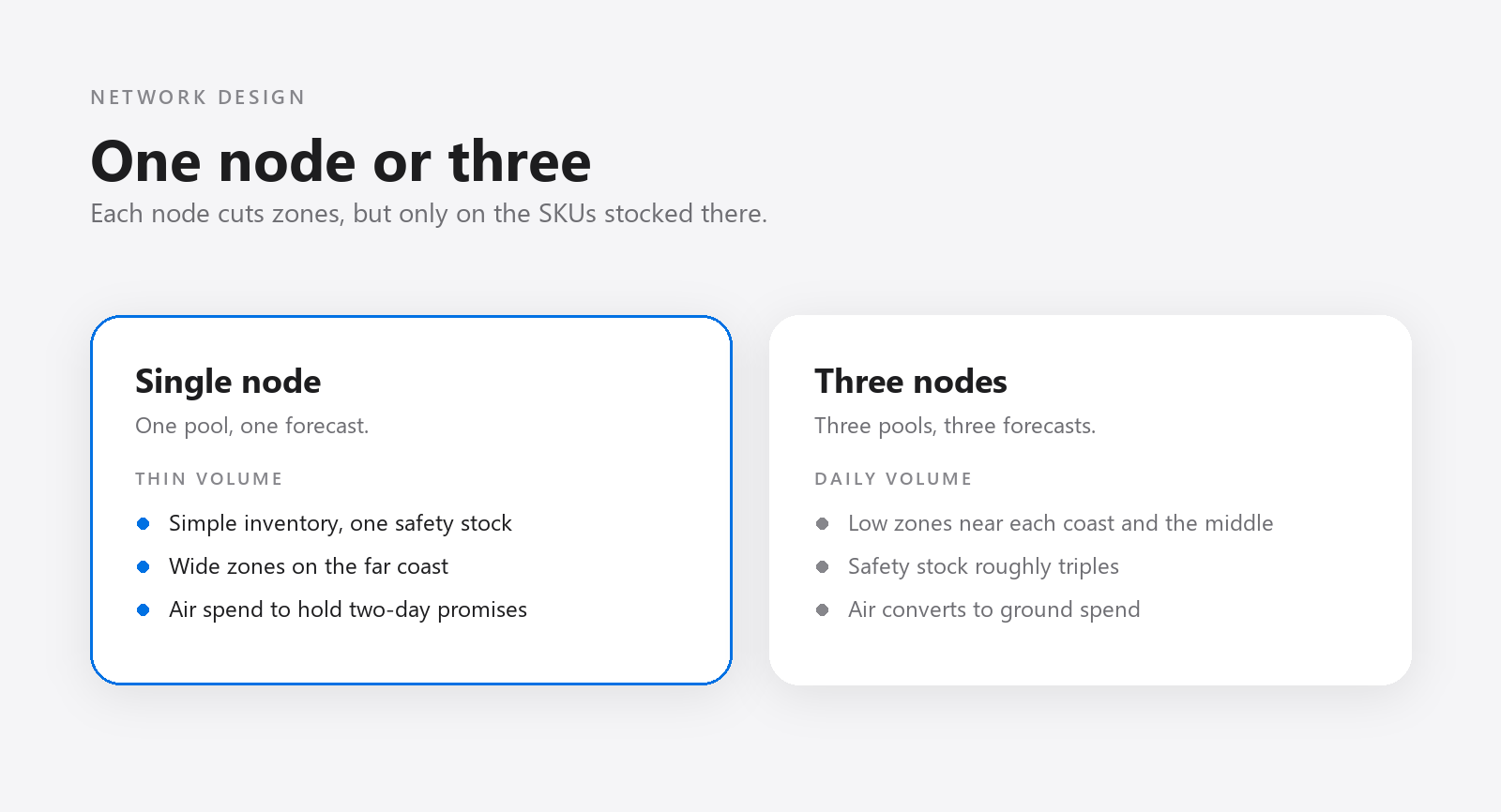
The other side is safety stock, the buffer inventory you hold against stockouts. Splitting roughly doubles it: you hold a buffer in two buildings and forecast per node instead of for the whole book. A SKU stocked at only one coast ships long zones to everyone else no matter how good the map looks.
Three nodes is the sweet spot for most brands
Two nodes cover the coasts but leave a hole in the middle. A third node in the Midwest or the South closes it, and for most mid-size catalogs that is the point of diminishing returns. Four or more nodes buy you marginal coverage at a real cost in duplicated inventory and management complexity.
The pattern is not more buildings, it is better placement. A well-chosen three-node network — West, Midwest, East — reaches the large majority of U.S. consumers in two days by ground, without air. The table below is the directional version.
| Nodes | Two-day ground reach | What it costs you | Best for |
|---|---|---|---|
| 1 | Strong on one coast, weak on the other | Lowest inventory, highest zones | Startups, thin volume |
| 2 (E + W) | Most of the population | Safety stock roughly doubles | Established brands on both coasts |
| 3 (E + C + W) | The large majority | More stock and forecasting per node | Mid-size catalogs shipping daily |
| 4+ | Marginal extra coverage | Real complexity and tied-up cash | High volume or oversized goods |
The split arithmetic: inventory is the hidden cost
The zone savings are visible on the freight bill; the inventory cost is not. Splitting stock means you duplicate every buffer, and a catalog with thousands of slow-moving SKUs spread across four buildings ties up cash and risks stranded stock — units sitting in a warehouse where no local demand exists.
The workable compromise is to split only your fast movers. Distribute the top fifth of your SKUs, which usually drive the large majority of orders, and keep the long tail in a single hub. That gets most of the zone savings without multiplying your whole catalog by the number of nodes. This is the "分仓" (fēn cāng) decision — splitting inventory across warehouses — and it is a judgment call, not a setting.
What scale justifies a second node
The economics favor a second node only once volume is meaningful and predictable. Below a commonly cited floor of fifty to a hundred orders a day, the extra inventory and the second set of receiving and forecasting costs more than the zone savings return. A few hundred orders a month does not pay for a second building; a few hundred a day does.
The same logic runs underneath the outsourcing decision. A warehouse's rent is a fixed cost that stays the same whether you ship a thousand orders a month or ten thousand; a distributed network converts some of that fixed cost into variable, per-node cost. Chinese retail operators report cutting 3PL Third-Party Logistics costs by roughly 10–20% a year by splitting transport and warehousing out by region and function — a directional range, not a guarantee, and one that only lands when the volume is there to amortize the extra nodes.
The other precondition is order geography. If your last ninety days of orders show a heavy cluster on the far coast, or a large share of labels already sitting in Zone 5 and above, a split pays for itself. If your demand is one coast, one building — the wrong node only adds inventory without adding reach.
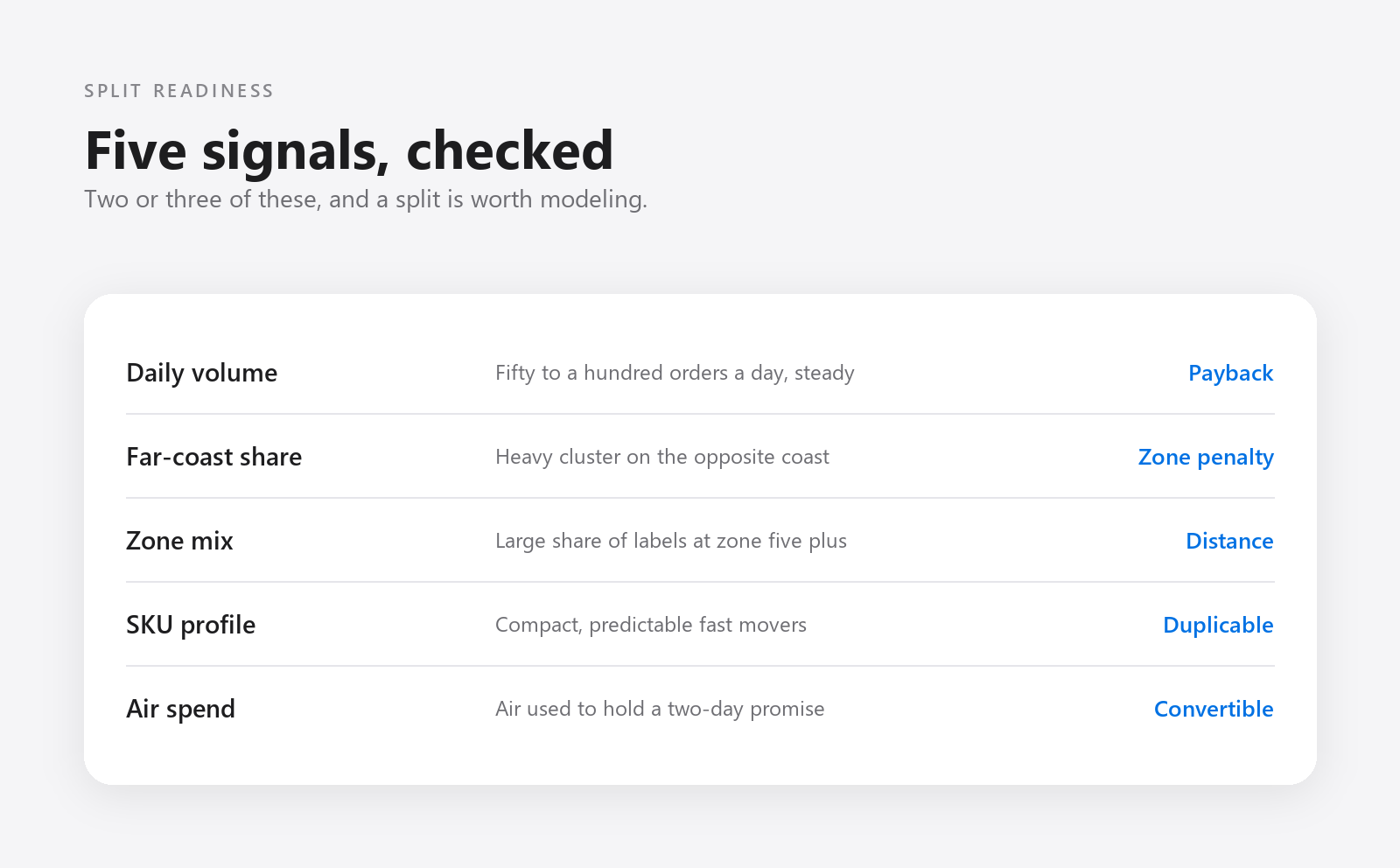
A readiness checklist
| Signal | Look for | What it tells you |
|---|---|---|
| Daily volume | 50–100+ orders a day, steady | A second node starts to pay back |
| Far-coast share | A heavy cluster on the opposite coast | You are paying a zone penalty today |
| Zone mix | A large share of labels at Zone 5+ | Distance, not the carrier, is the cost |
| SKU profile | Compact, predictable fast movers | Safe to duplicate across nodes |
| Air spend | Air used to hold a two-day promise | A closer node converts air to ground |
Two or three of these, and a split is worth modeling. Zero or one, and you are better off with a single well-placed building.
The short version
Nationwide fulfillment is not a single warehouse that ships everywhere — it is a network that stops making your customers far away. Start with one node, split to two when both coasts show volume, add a third when the middle matters, and stop before the inventory cost eats the zone savings. Split only your fast movers, and model the split on real order data, not a map.
If you want the split point calculated on your own orders, send us your last ninety days by destination ZIP and your SKU count — we will map the zones and the node count before we talk about pricing.
References (Neutral Third-Party Sources)
- USPS — Domestic Mail Manual, Section 608: the official definition of postal zones 1–8 by radial distance, the basis for the coast tax a single warehouse pays. https://pe.usps.com/text/DMM300/608.htm
- U.S. Bureau of Labor Statistics — Warehousing and Storage: NAICS 493: how warehousing and storage establishments are defined, including the multi-node distribution work behind nationwide fulfillment. https://www.bls.gov/iag/tgs/iag493.htm
- U.S. Bureau of Labor Statistics — Couriers and Messengers: NAICS 492: the parcel and local delivery work that carries the last mile from each node. https://www.bls.gov/iag/tgs/iag492.htm
- GS1 — Global Location Number (GLN): the identifier that gives each physical node in a multi-warehouse network a machine-readable identity. https://www.gs1.org/standards/id-keys/gln
- Federal Trade Commission — Mail, Internet, or Telephone Order Merchandise Rule: the shipping baseline and the duty to notify buyers of delay, the legal floor under a two-day promise. https://www.ftc.gov/business-guidance/resources/business-guide-ftcs-mail-internet-or-telephone-order-merchandise-rule