
What Does "Pending Fulfillment" Mean? (And When to Worry)
"Pending fulfillment" means the money is taken and the box is not. The payment has cleared, the order is sitting in the system, and the warehouse knows it exists — but no hands have touched it yet. Nothing is lost, and nothing is broken. The order is in a queue waiting for a picker.
The trouble is that "pending" is a word that changes meaning from one system to the next. On some platforms it means the payment has not actually landed. On others it means the order has not been formally accepted by the warehouse. This article untangles those meanings, explains what the customer can and cannot see, and walks through the three reasons the Each Order Status overstays its welcome.
Where "pending" lives in the journey
Every order moves through the same rough stations even when the labels differ.
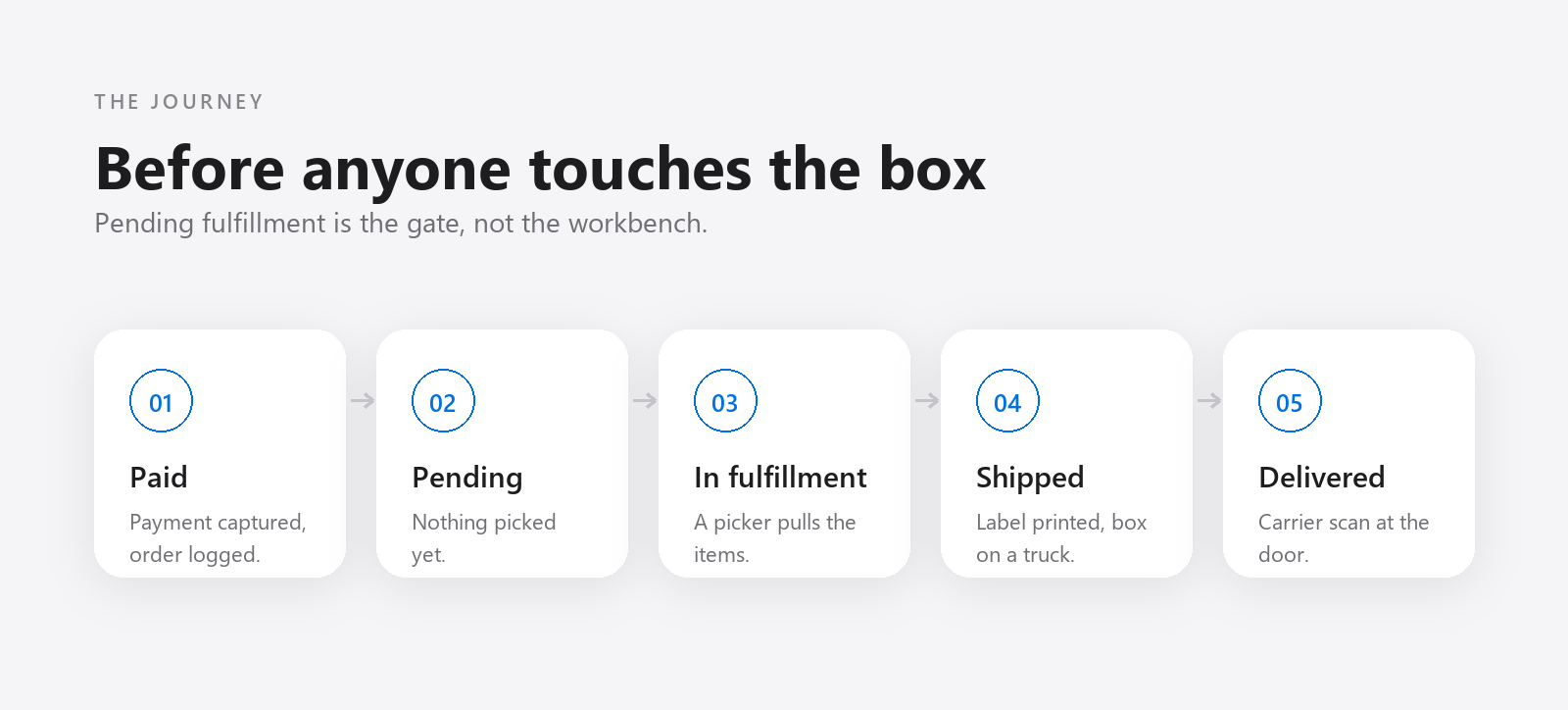
Submitted, then payment captured, then pending fulfillment — the order is real, and the warehouse system knows about it. Next is in fulfillment, when a picker is actually pulling items off the shelf. Then shipped, once a label exists and the box is on a truck. Then delivered.
"Pending fulfillment" is the gate before the hands. It is the inbox, not the workbench. The key difference from the steps after it: at this point there is still a chance the order needs something from someone before it moves — a payment that has not settled, or a human who has to approve it.
Pending, awaiting, and processing are not synonyms
These three words show up next to each other in a customer dashboard and quietly mean different things. The confusion costs support hours, because a customer who reads the wrong one assumes the wrong thing.
| Status | What it actually means | Who owns the next action |
|---|---|---|
| Pending | Payment not confirmed, or the order not yet accepted | Buyer, bank, or a risk check |
| Awaiting fulfillment | Paid and logged; nothing picked or packed | Warehouse |
| Processing | Paid and being worked, a broader pre-ship step | Warehouse |
| On hold | Something flagged — address, payment or inventory | The merchant, to release it |
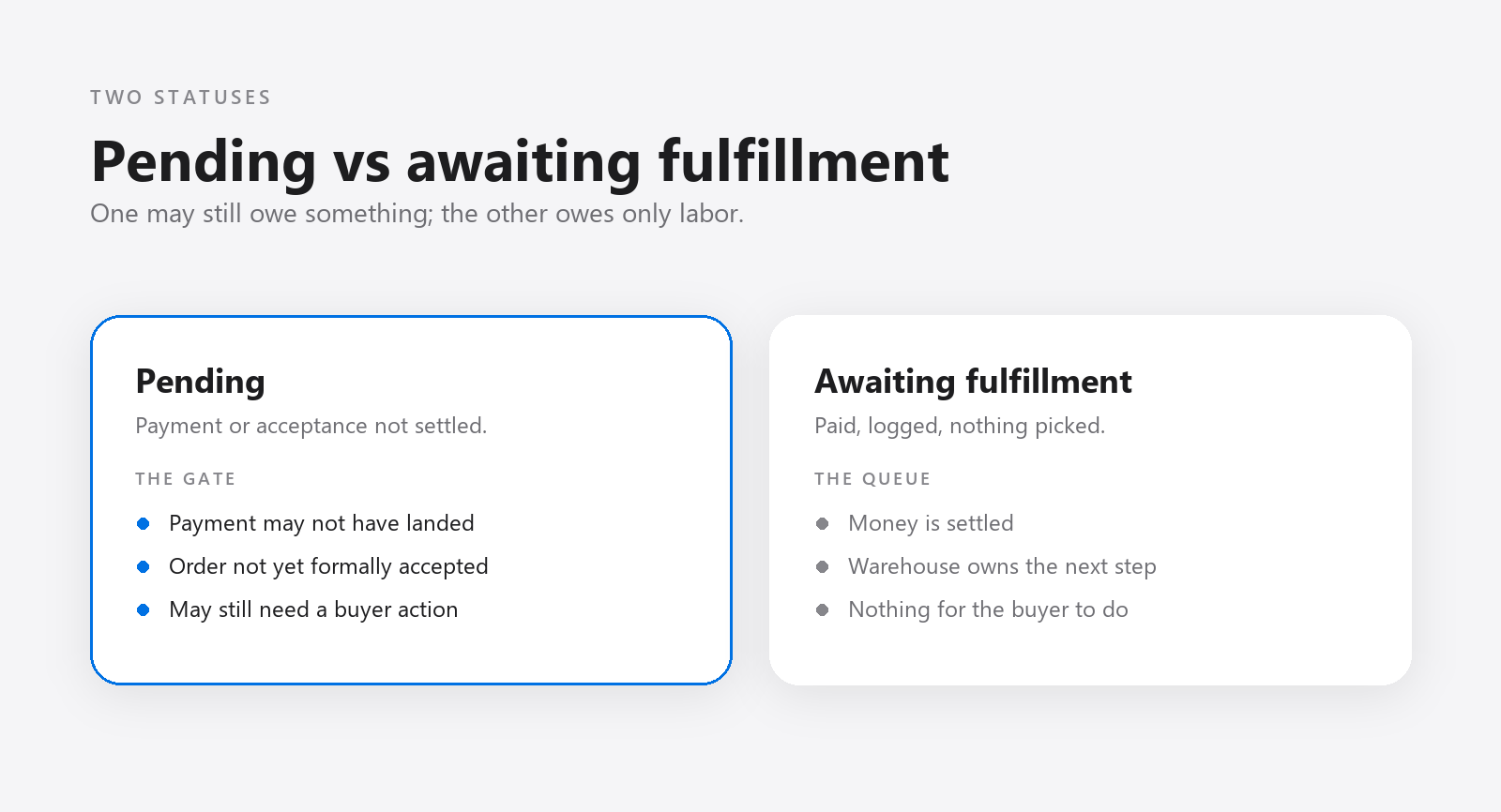
The one that needs the customer's attention is on hold, not pending. Pending in the literal sense often resolves itself when the payment settles; awaiting fulfillment needs nothing from the buyer at all.
What "pending" means platform by platform
The platforms do not share a vocabulary, and "pending" is where the drift is worst.
Shopify splits order status into four tracks — order, payment, fulfillment, and return — and its word "pending" lives on the payment track. Payment pending means the payment provider has started processing but has not finished, and the funds are not guaranteed. The inventory is reserved, but the money has not landed. On the fulfillment track, Shopify says unfulfilled, not "pending fulfillment."
Amazon's seller-side lifecycle reads pending, unshipped, partially shipped, shipped — and there, PENDING means the order has been placed but is not ready to ship. It is the default first status for a standard order, before payment authorization completes. UNSHIPPED is the one that means "ready to go, nothing has left." For pre-orders there is a separate PENDING_AVAILABILITY that resolves into PENDING once payment authorization begins.
WooCommerce keeps it blunt: pending payment, then processing once money arrives and stock is reduced, then completed, which the store owner sets by hand. In WooCommerce, the pending-fulfillment moment is called processing.
The takeaway is not to memorise every name. It is that the names drift, so always read them against the current help docs of the platform in question. A support agent answering with one platform's vocabulary while the customer looks at another's is the most common reason a simple question becomes a three-message exchange.
What the customer sees — and does not see
The customer sees a status, an order number, and no tracking number. That last part is worth knowing, because it is what makes the page feel frozen.
A tracking number is only generated when the shipping label — the 面单 (waybill) printed at the pack bench — is created, and that happens after fulfillment begins. So pending fulfillment always comes before any tracking number exists. The customer who refreshes the page during pending fulfillment is refreshing nothing that can move. USPS names the next gap precisely: a label can exist with "USPS Awaiting Item" while the package has not been handed over, and the scan that matters only appears when the carrier actually takes possession.
This is also where pending parts ways with its Georgia Fulfillment Near-twin, awaiting fulfillment. Pending leaves room for something still owed — a payment, an approval. Awaiting fulfillment means the money is settled and the only thing owed is warehouse labor. One is about money and acceptance; the other is about hands.
The three ways it gets stuck
Most orders clear pending fulfillment in hours, or within a business day. When one sits for two, three, five business days, the cause is almost always one of three things.
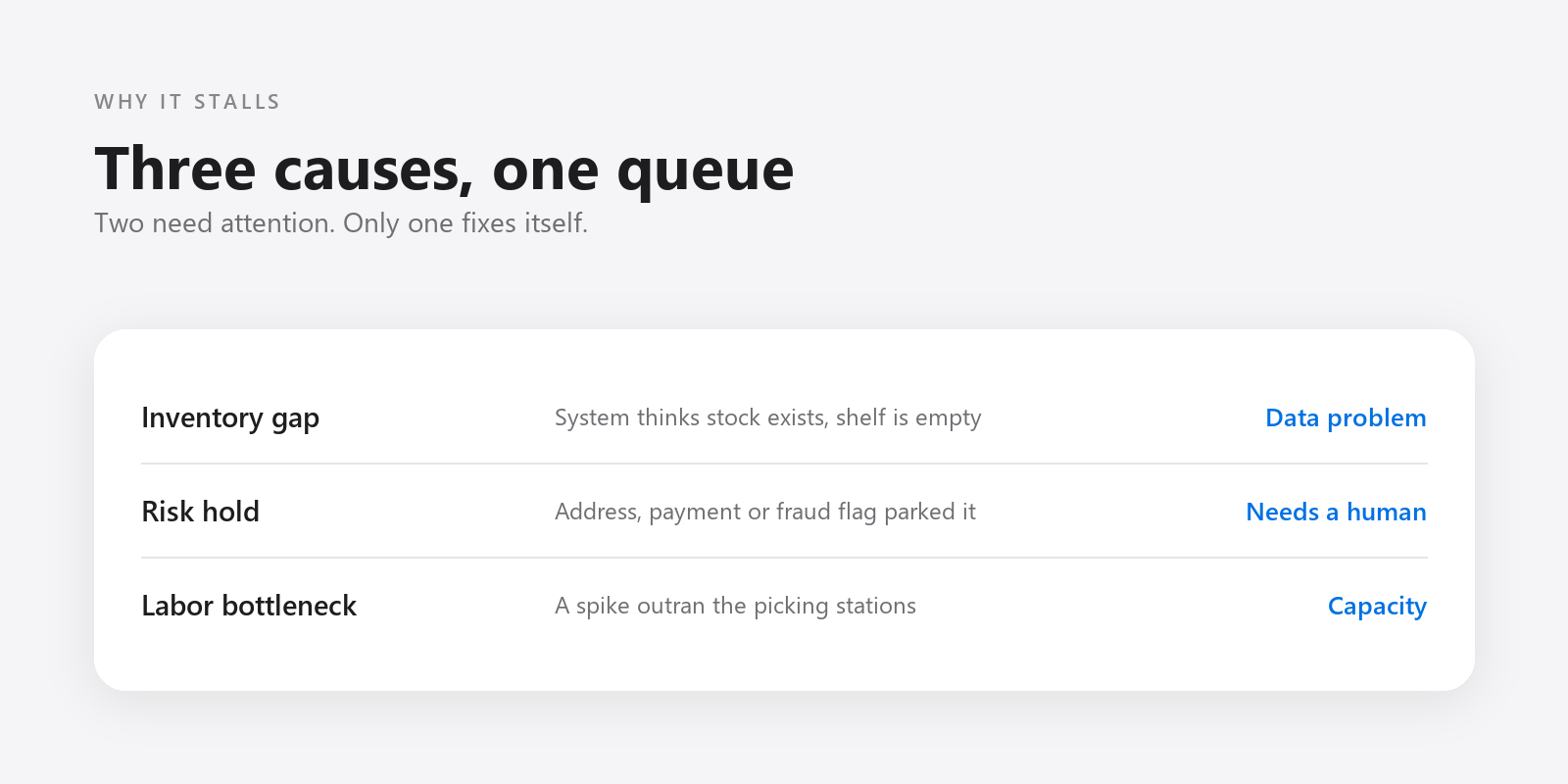
An inventory gap. The system believes stock exists and it does not — a miscount, a unit sold on another channel that never synced, or stock still sitting in receiving counted as zero available. The order cannot be picked, so it waits.
A risk hold. A high-value order, a mismatched address, or an unusual payment pattern trips a fraud or verification review, and the order is 拦截 — intercepted and parked until a human clears it. This one does not resolve itself.
A labor bottleneck. A launch or a sale puts a week of volume into two days, the picking stations fill up, and the queue stretches past same-day. This is capacity, not a bug.
The three need different responses, and confusing them is how a fixable day becomes a lost customer. An inventory gap is a data problem: reconcile the count and the order moves. A risk hold is a decision problem: a person has to release it. A labor bottleneck is a capacity problem: no amount of checking resolves it — only staff or batching does.
The early signals that tell them apart
Each of the three leaves a different fingerprint, and reading it early is cheaper than reading it late.
An inventory gap shows up as a mismatch: the dashboard says in stock, the shelf is empty, and the number on one sales channel disagrees with another. A risk hold shows up as a pattern — high order value, a shipping address that does not match the billing address, or a payment method used for the first time. A labor bottleneck shows up as a queue that is growing on a normal day, not just during a spike. The first two are specific orders behaving oddly; the third is the whole queue moving slower.
The cheapest fix is the inventory gap, because it is a counting error — run a cycle count and the order releases. The risk hold needs a decision, and the labor bottleneck needs capacity, and neither of those gets fixed by refreshing the page.
A four-check diagnostic for merchants
When your own pending queue is growing faster than the team drains it, run four checks in order and stop at the first one that is wrong.
| Check | What you are looking for | If it fails |
|---|---|---|
| Payment captured | Money settled, not just authorised | The order is pending payment, not pending fulfillment |
| SKU in the active location | Stock physically in the pickable bay | You have an inventory gap, not a queue |
| Sync logs | Store, system and warehouse agree | A missing field freezes the whole batch |
| Holds | Anything flagged for review | A person has to release it |
The last check is where most merchants stall, because a hold does not announce itself. The order simply sits. Before you write the customer an "it's processing" message, confirm whether the order is held — and if it is, why and when it releases.
How long is too long
For the customer, two full business days is the line. Most orders move to shipped within one business day; two days of stillness usually means a backlog or a flag. Past that, a direct question is reasonable — and the question to ask is specific: is the order pending, awaiting fulfillment, or held? If held, why, and when does it release? "It's processing" is not an answer.
One thing is worth doing before you write that message: check the estimated shipping window the store gave you at checkout. That window, not the status label, is the promise. If you are still inside it, the order is behaving exactly as sold.
The short version
Pending fulfillment is a normal, brief state: paid, logged, not yet touched. The word "pending" drifts between systems — sometimes it means the payment has not settled, sometimes that the warehouse has not accepted the order — so always read it against the platform's own help docs. If it drags past two business days, the cause is usually an inventory gap, a risk hold, or a labor bottleneck, and only one of those fixes itself.
If your own pending queue keeps outrunning your team, send us your order volume, your SKU count and your current cutoff — we will tell you which of the three causes you are hitting before we talk about pricing.
References (Neutral Third-Party Sources)
- Shopify Help Center — Understanding your order statuses: payment
Pendingmeans the provider has not finished and funds are not guaranteed; fulfillment status is tracked separately at item level. https://help.shopify.com/en/manual/orders/order-status - Amazon Selling Partner API — searchOrders: definitions for
PENDING("placed but not ready for shipment"),PENDING_AVAILABILITYandUNSHIPPED. https://developer-docs.amazon.com/sp-api/reference/searchorders - WooCommerce — Order Statuses:
pending payment→processingonce paid →completedset manually after dispatch. https://woocommerce.com/document/managing-orders/order-statuses - USPS — Where is my package? Tracking Status Help: "Shipping Label Created, USPS Awaiting Item" means the package has not been handed to USPS. https://faq.usps.com/articles/Knowledge/Where-is-my-package
- Federal Trade Commission — Mail, Internet, or Telephone Order Merchandise Rule: the 30-day shipping baseline and the duty to notify buyers of delay. https://www.ftc.gov/business-guidance/resources/business-guide-ftcs-mail-internet-or-telephone-order-merchandise-rule