
Fulfillment Throughput: Why It Matters More Than Order Volume
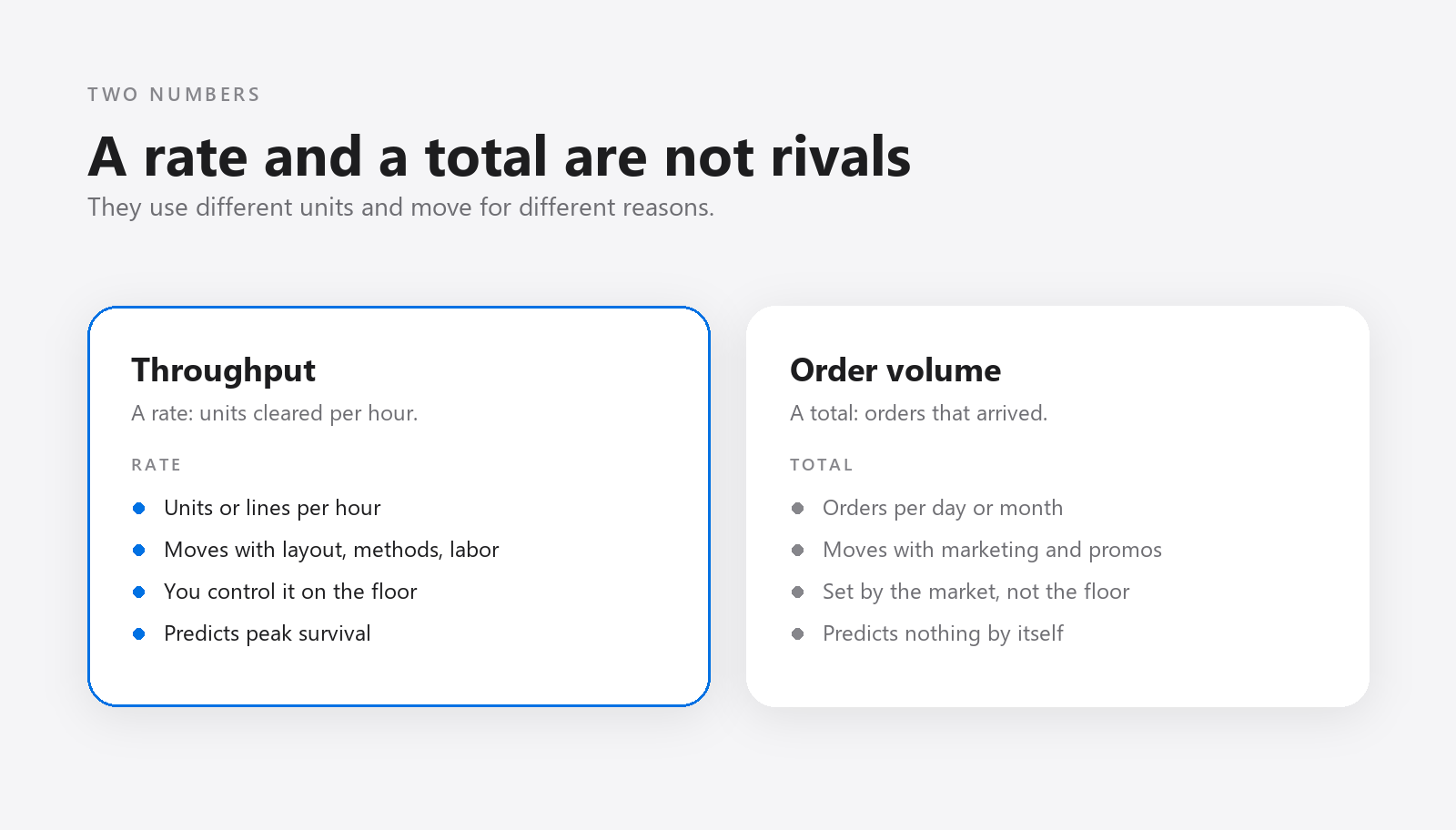
Throughput is a rate — units moved per hour — while order volume is a total — orders per day. A warehouse doing 50,000 orders a day can be slower than one doing 5,000. The number on your dashboard that predicts whether you'll survive peak season is not how many orders you got, but how many you can clear per hour before the queue backs up.
I've seen the same crew described in a Chinese ecommerce interview go from shipping about 2,000 orders a day to shipping over 20,000 a day with no extra headcount. The order volume changed because pricing changed; the throughput changed because they switched from fixed salaries to a piece rate. That single switch is the cleanest example I know of why the rate, not the total, is the lever.
Throughput and order volume measure different things
Order volume answers "how much work arrived." Throughput answers "how fast can we clear it." They use different units, and they move for different reasons.
Volume moves when marketing moves — a flash sale, a launch, a platform promo. Throughput moves when the floor moves — layout, methods, labor, whether the fast sellers sit next to the packing bench or on the far wall. You can have a record volume month and a warehouse that is still slow, and a flat month that finally surfaces the bottleneck that was always there.
A working example. Before switching to piece-rate pay, the Yiwu accessories seller in that interview ran fixed salaries of about 4,000–5,000 yuan a month and had twenty-plus people shipping roughly 2,000 orders a day — call it 100 orders per person per day. After switching to a piece rate of one mao (a tenth of a yuan) per parcel, pay jumped to 8,000–10,000 yuan, efficiency roughly tripled, and twelve people — six picking, six packing — moved 20,000-plus orders a day. Same walls, wildly different rate.
The three throughput KPIs that actually matter
You don't need fifteen dashboards. You need three numbers, each a division problem.
| Metric | Formula | What it flags |
|---|---|---|
| Lines picked per hour (LPH) | Lines picked / picking hours | Pick-path and slotting problems |
| Units per labor hour (UPH) | Units processed / total labor hours | Overstaffing and idle time |
| Dock-to-carrier time | Carrier handoff − order release | Queue buildup and cutoff misses |
LPH tells you whether picking is slow. UPH tells you whether the whole floor is slow, including the walking and the waiting. Dock-to-carrier time tells you whether work is leaving on schedule — and it's the number your customer actually feels.
What "good" looks like
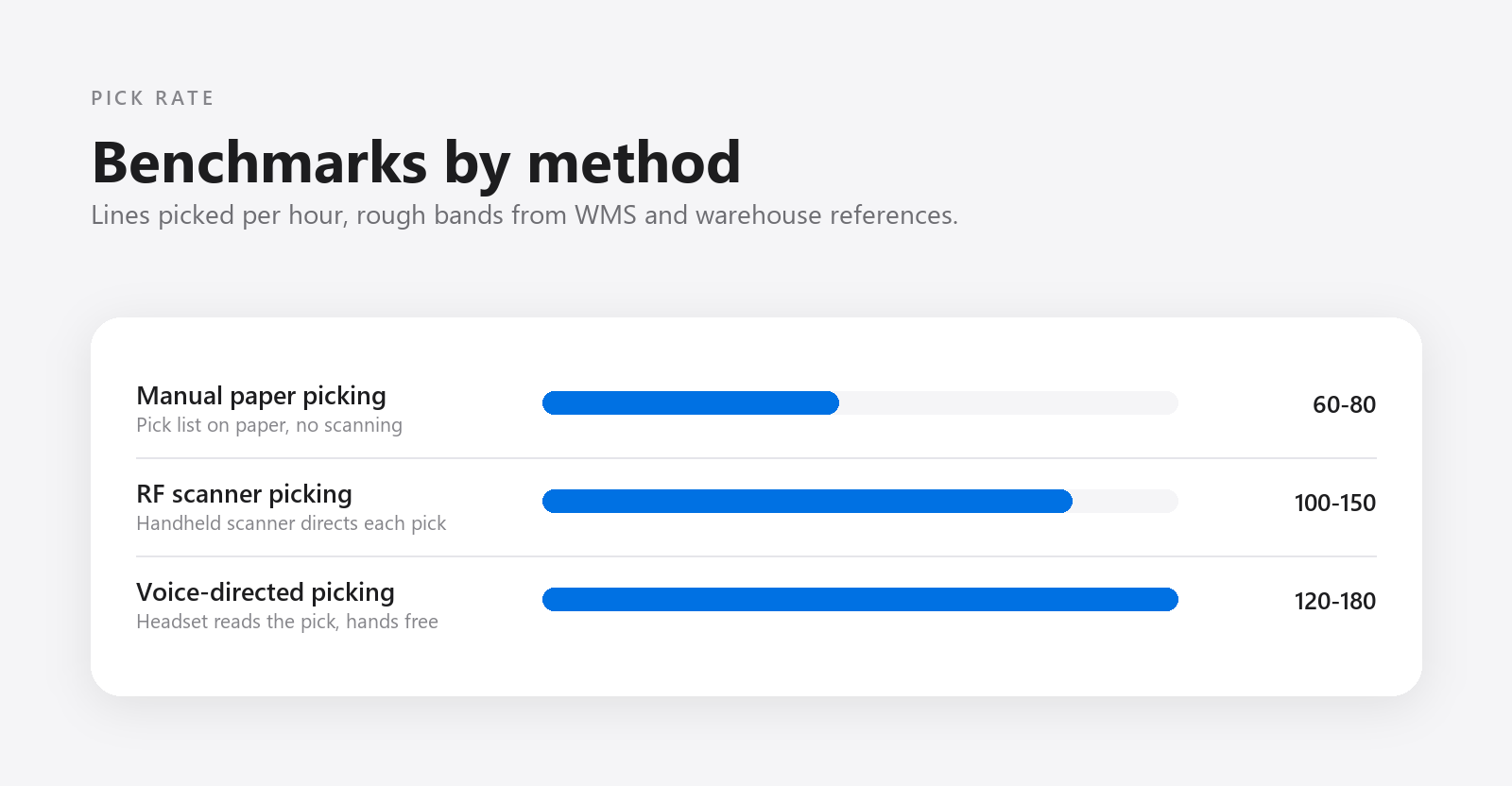
Benchmarks from warehouse-engineering and WMS references cluster like this: manual paper picking runs 60–80 lines an hour, RF-scanner-directed picking 100–150, and voice-directed picking 120–180. Piece-level targets land around 120–175 units an hour for an average operation, with best-in-class floors above 250.
The context caveat matters more than the number: picking small electronics is not picking furniture. Segment your targets by order profile or the average hides everything.
One ratio is worth internalizing before you touch a target: picking typically eats 50–60% of warehouse labor cost. That means a 20% improvement in pick rate is a real margin event, not a nice-to-have.
Find the bottleneck before it finds you
A bottleneck is a single step whose rate is lower than everything feeding it. Diagnose it in four passes, and only change one thing at a time.
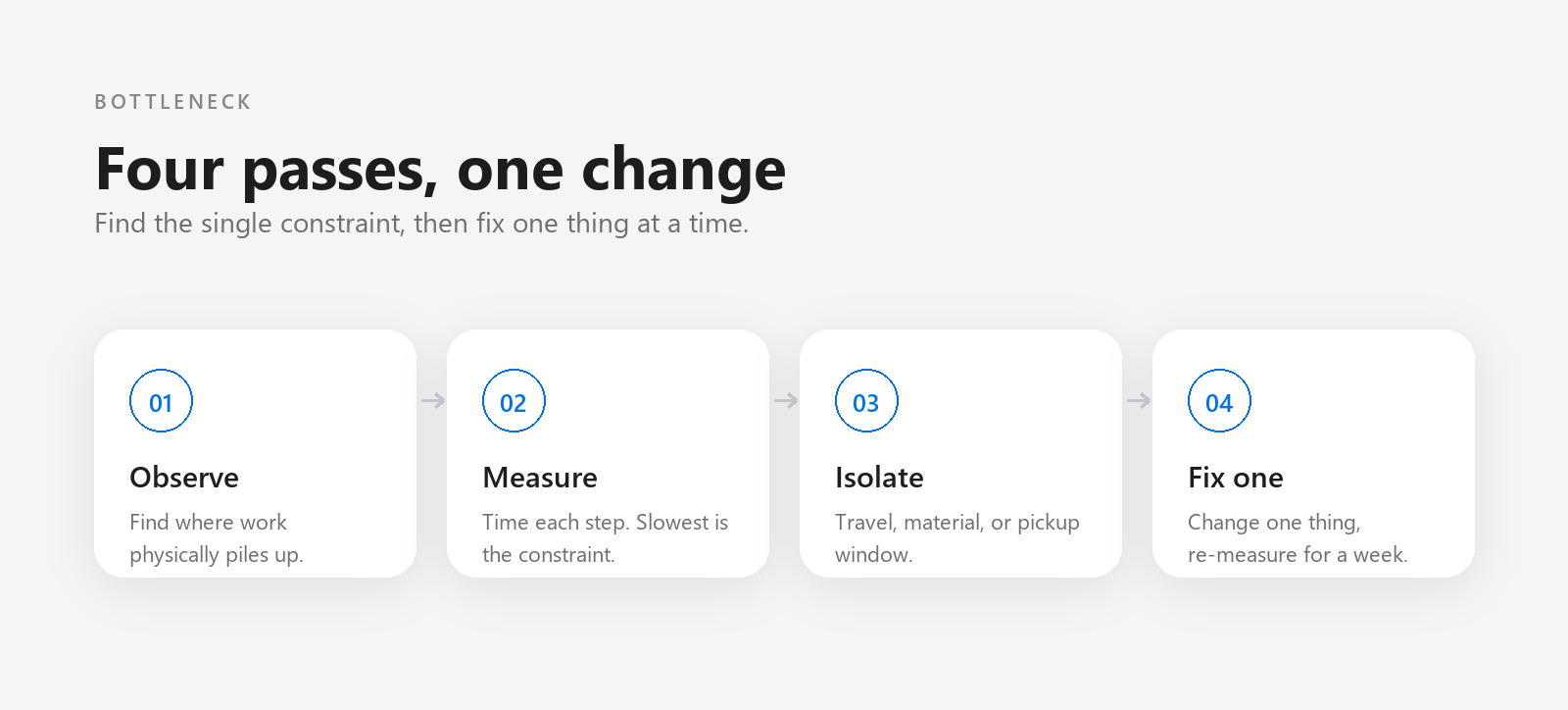
- Observe the queue, not the people. Walk the floor and find where work physically piles up: carts waiting at packing, boxes waiting at the dock, pickers waiting at a dead slot.
- Measure each step's rate. Time the pick, the pack, the label, the handoff separately. The slowest one is your constraint; everything upstream of it will look "busy" while being throttled by it.
- Isolate the cause. A slow pick is usually travel distance (bad slotting), a slow pack is usually material movement (box, tape, void fill out of reach), a slow dock is usually a carrier pickup window that doesn't match your cutoff.
- Fix one thing and re-measure. Change slotting or the cutoff, then watch the single number for a week. Changing three things at once tells you nothing.
Why adding people doesn't fix throughput
The instinct under a spike is to hire. It usually makes unit cost worse, not better.
Split your costs the way warehouse finance people do: fixed versus variable. Fixed costs — rent, equipment depreciation, salaried core staff — don't move with order volume. Variable costs — packaging, piece-rate labor — move one-for-one with volume. When you add a body to a floor that's already bottlenecked, you add fixed cost while the constraint stays put, so cost per order rises and nothing ships faster.
The better move is to convert fixed into variable. The piece-rate switch above is exactly that: the same labor cost stops being a monthly salary you pay regardless and becomes a per-parcel cost that only grows when orders do. When a warehouse does 10,000 orders a day, shaving packaging from 1.5 yuan to 1.2 yuan per box is 3,000 yuan a day, every day — a variable-cost win that needs no extra square footage.
Peak throughput is your real ceiling
Average throughput is a comfort metric. What actually breaks you is peak-hour capacity, because the queue doesn't care about your daily average — it cares about your rate at 2 p.m. on a promo day. That's why warehousing and fulfillment planning has to be done against the peak, not the month.
The warehouses that survive peaks plan against them seven days out: they flag which SKUs the next marketing push will spike, move predicted fast-movers into the fast-pick zone — the slots nearest the packing bench — and evict slow movers to a mid-term area. During the peak they refresh sold counts, remaining stock, and the carrier's pickup capacity every two hours, and open a temporary overflow space the moment any zone crosses its warning line.
The fast-pick zone deserves its own mention. "Fast-pick zone" is the industry term for the highest-turnover slots placed closest to packing; the whole point of slotting is to put the SKUs that ship most often within the fewest steps. If a fast-pick slot is turning over less than a few times a day, it's not a fast-pick slot anymore — it's storage that happens to be near the bench.
Piece rate is not a universal fix
The Yiwu story makes piece rate look like magic, and for packing it mostly is. Packing is a standardized, repeatable motion with a countable output, which is exactly what piece rates reward.
It fails where accuracy is the product. Picking and the final check need senior staff paid on a piece-rate-plus-accuracy basis, not raw count, because a picker paid only for speed will trade mispicks for pace and the error rate shows up later as returns, reships, and support tickets. The standard warehouse pattern is: piece rate for the repeatable base tasks (packing, sorting), fixed-plus-accuracy for the skilled core (picking, verification). Rate alone optimizes the wrong thing.
A throughput checklist you can run this week
- [ ] Write down LPH, UPH, and dock-to-carrier time for last week. If you can't compute them, that's the first problem.
- [ ] Walk the floor and name the single physical pile-up point.
- [ ] List your top 20 SKUs and confirm they sit in the nearest slots.
- [ ] Check whether your daily cutoff and your carrier's pickup window actually line up.
- [ ] Separate fixed labor from variable labor on your P&L and see which one is growing with volume.
- [ ] Confirm the picking/packing split is roughly 50–60% of labor, and set one target against it.
- [ ] Before the next spike, pre-flag the SKUs the promo will move and stage extra pack stations.
- [ ] Change exactly one thing this week, then re-measure the same three numbers.
The short version
Order volume tells you what arrived. Throughput tells you whether you can clear it. They're different numbers with different levers, and confusing them is how a warehouse gets buried by a queue it claims it "didn't expect." Measure the three rates, find the one constraint, and fix it in single steps — starting with the fast-pick zone and the cutoff. That's the whole discipline, and it's why the rate matters more than the total.
If your numbers are pointing at a layout or systems problem rather than a people problem, our fulfillment center guide and fulfillment costs breakdown walk through the trade-offs.
References (Neutral Third-Party Sources)
Facts and concepts in this article were verified against public references. No fulfillment-provider pages are cited.
- Wikipedia — Order picking: picking strategies (piece, zone, batch, wave) and how they cap throughput. https://en.wikipedia.org/wiki/Order_picking
- U.S. Bureau of Labor Statistics — Occupational Employment and Wage Statistics (OEWS) Tables: wage context for warehouse labor, the largest controllable fulfillment cost. https://www.bls.gov/oes/current/oes_nat.htm
- Omneelab (WMS vendor) — Warehouse KPIs Dashboard: 15 Essential Metrics to Track: pick-rate benchmark bands and the 50–60% of labor held by picking. https://omneelab.com/?p=4442/