
What Is 3PL Logistics? (And How It Differs From 4PL)
3PL logistics is the outsourcing of the physical work of getting goods to customers — transportation, warehousing, and distribution — to a company that never owns the goods. That last clause is the whole definition. A third-party logistics provider is neither the seller nor the buyer; it is the party in the middle that moves and stores products on contract, so the brand can focus on making and selling them.
The term gets tangled because "logistics" covers a lot and "3PL" gets used loosely for everything from a single courier to a full supply-chain manager. This article unpacks what 3PL logistics actually includes, how it differs from a 4PL, and the volume point where it stops being a nice-to-have and starts being the cheaper option.
What "logistics" actually covers
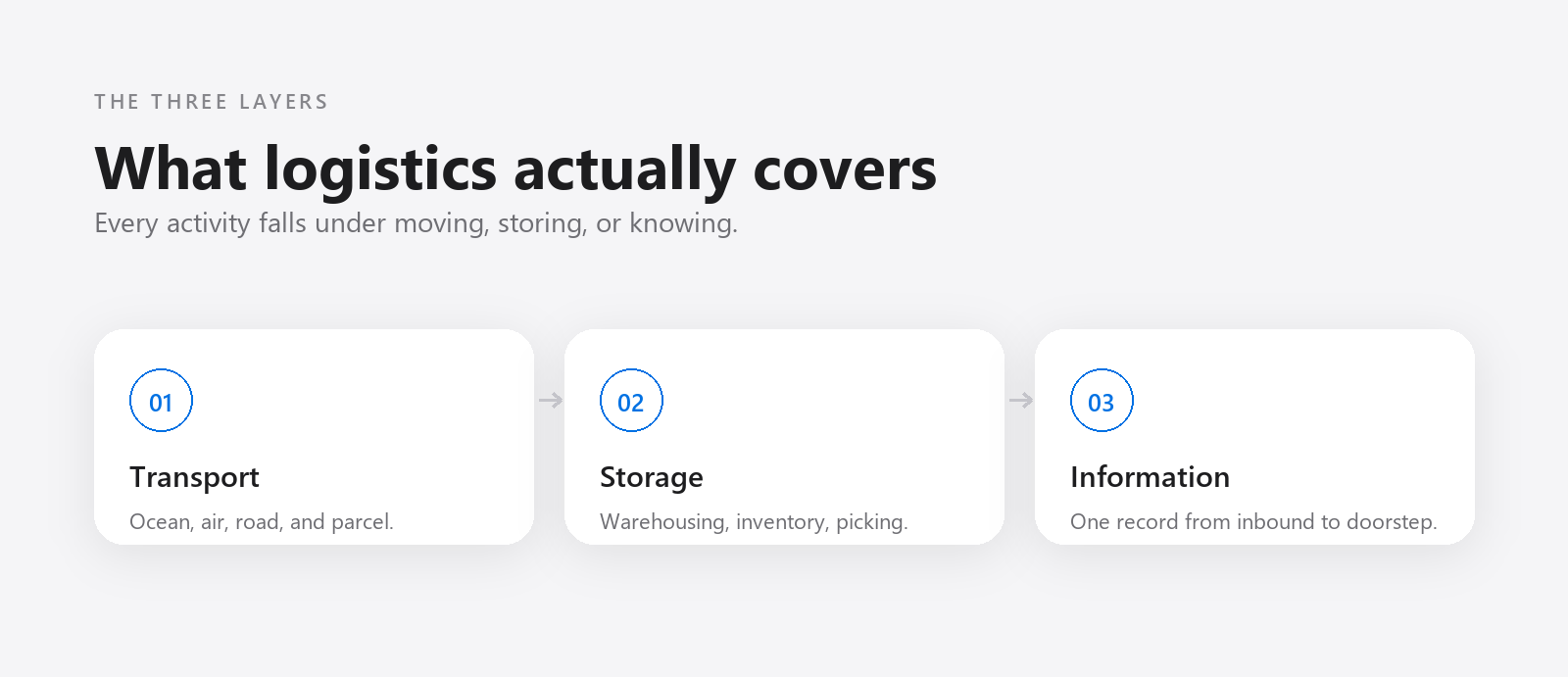
Strip the jargon away and logistics is three things: moving goods, storing goods, and knowing where they are. Every logistics activity you will ever pay for falls under one of those three — transportation (ocean, air, road, or parcel), warehousing and inventory, and the information layer that ties them together, from a pick list to a tracking number.
A 3PL bundles these into one contract. Instead of signing with a freight forwarder for the container, a warehouse for the stock, and a carrier for the parcel separately, you sign with one provider that runs all three and, critically, owns the handoffs between them. The value is not that each activity is cheaper — it is that the boxes stop falling between systems, because there is one record from inbound to doorstep.
The 1PL to 4PL naming, in plain terms
The "PL" scale counts how many parties sit between the factory and the customer. It is easier than it looks once you ignore the marketing.
A 1PL is the shipper itself — a manufacturer or retailer that owns its own trucks and warehouses and moves its own goods. A 2PL is an asset-based carrier: a shipping line, an airline, a trucking company that owns the physical means of transport but does one leg, not the whole journey. A 3PL is the integrator in between: it does not own the ship, but it arranges the freight, stores the stock, and dispatches the orders. A 4PL is the layer above the 3PL — an "eye in the sky," as one Chinese logistics write-up puts it, that coordinates several 3PLs on the customer's behalf but owns almost nothing itself.
The naming matters less than one question it forces you to answer: am I hiring someone to do the logistics, or someone to manage the people who do it?
3PL vs 4PL: assets and coordination
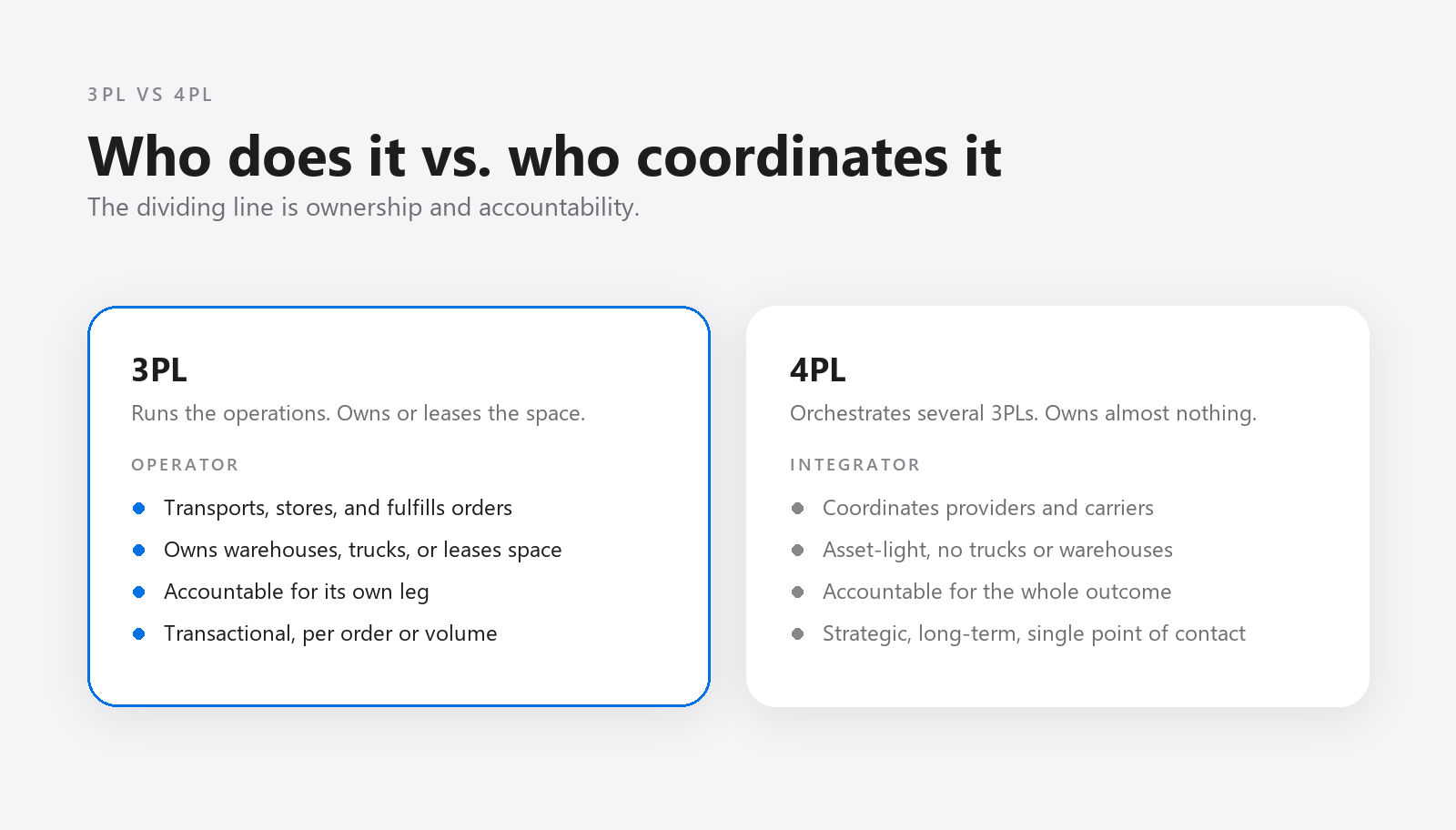
The cleanest dividing line is ownership, not capability.
| Question | 3PL | 4PL |
|---|---|---|
| What it does | Operates transport, warehousing, fulfillment | Coordinates several providers and carriers |
| What it owns | Warehouses, trucks, or leased space | Usually almost nothing (asset-light) |
| What you buy | Execution of a specific task | Management of the whole supply chain |
| Relationship | Transactional, per order or per volume | Strategic, long-term |
| Typical customer | Small to mid-market | Large, multi-region, multi-mode |
| Who is accountable | The operator, for its own leg | The integrator, for the whole outcome |
The term "4PL" was registered as a trademark by the consultancy Accenture in 1996, and its definition — an integrator that assembles its own resources with those of other providers to run a complete supply chain — has stuck even as the trademark itself went generic. That is the useful mental model: a 4PL manages the chain; a 3PL runs the operations inside it.
For most ecommerce brands the distinction is academic. If you ship a parcel-and-a-half per order to consumers, you want a 3PL. You reach for a 4PL when your supply chain spans several regions, several modes of transport, and several warehouses that someone has to orchestrate — and that is a much bigger company's problem.
3PL logistics vs. single-function logistics
A common mistake is treating a 3PL as "a trucking company with extra steps." The difference shows up in what you are buying.
| Dimension | 3PL logistics | Single-function provider |
|---|---|---|
| Scope | Integrated transport, storage, fulfillment | One leg, e.g. trucking or warehousing only |
| Value-add | Order processing, inventory management, repacking | Little beyond the single service |
| Cost model | Scale-driven, usually lower per unit | Higher per unit, fixed resources |
| Relationship | Long-term contract, a partner | Transactional, one shipment at a time |
| Information | Shared across every leg | Siloed to that provider's leg |
The practical consequence is the handoff. A single-function provider hands your goods to the next party and its responsibility ends at the dock. A 3PL keeps the record intact through the handoff, which is where inventory accuracy actually gets decided.
What 3PL logistics does not do
Defining by exclusion clears up most of the confusion. A 3PL does not own your goods — it never takes title, so your inventory stays an asset on your books and the liability for a slow-moving SKU stays with you. It does not design your supply chain — that is a 4PL's job. And it does not replace your customer relationship: when the 3PL's driver hands the parcel to your buyer, the delivery experience reflects on your brand, not the warehouse's.
That last point is why the cheap provider problem from our comparison guide matters. A 3PL employee is the face of your fulfillment. If they ship late or throw the box, the review is written about you.
When the volume math tips toward a 3PL
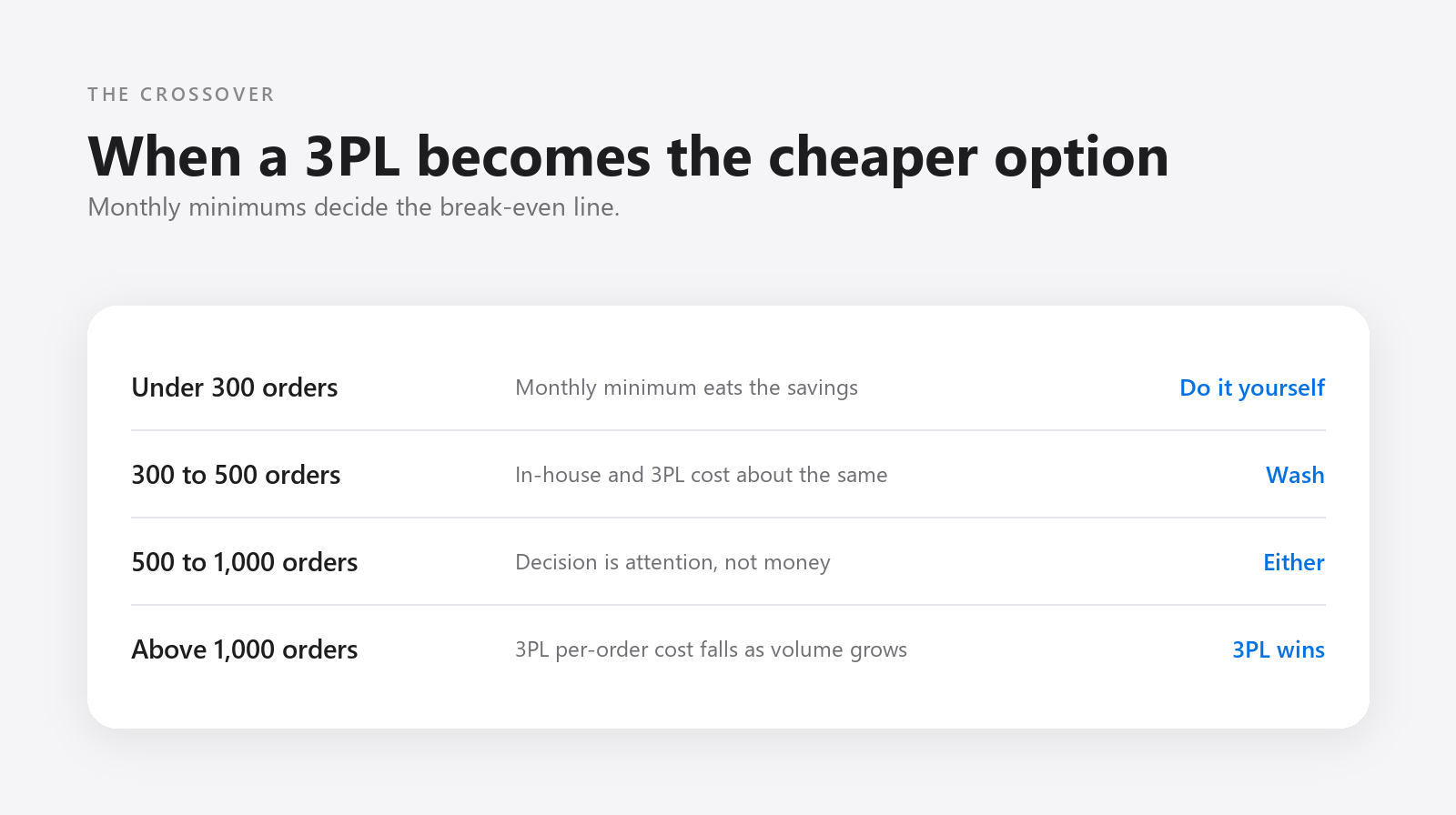
The crossover point is mostly a question of monthly minimums versus in-house labor. A 3PL charges a monthly floor — often a few hundred to a couple thousand dollars — that recovers its fixed costs regardless of how much you ship. Below roughly 300 to 500 orders a month, that floor eats the savings: you are paying warehouse overhead for volume you are not moving, and packing from your own garage or spare room is genuinely cheaper.
Above that line the math flips. Once you are paying for rent, packing staff, packaging materials, and the software to run it all, a 3PL's shared space and negotiated carrier rates beat the do-it-yourself number — and the gap widens as you scale, because the 3PL's per-order cost falls with volume and your in-house cost does not.
There is a middle band, though, and honest buyers admit it is uncomfortable. From roughly 500 to 1,000 orders a month, a well-run in-house operation and a 3PL cost about the same. In that band the decision is not money; it is attention. If fulfillment is eating the hours you should spend on product and marketing, a 3PL is the right call even when the spreadsheet says "wash."
The short version
3PL logistics is buying the physical movement, storage, and delivery of goods from a company that never owns them. It differs from a 4PL by what it owns and what it is accountable for: the 3PL runs the operations, the 4PL orchestrates the people who run them. And it differs from a single-function carrier by holding one record through every handoff. For most brands, the real question is not "3PL or 4PL" but "is my volume past the point where doing it myself still makes sense" — and that point sits somewhere around 500 orders a month.
References (Neutral Third-Party Sources)
- Wikipedia — Third-party logistics: the definition of a 3PL as a provider that moves and stores goods without taking ownership, and the range of activities it covers. https://en.wikipedia.org/wiki/Third-party_logistics
- Wikipedia — Fourth-party logistics: the 1996 Accenture origin of the 4PL as an asset-light supply-chain integrator, used for the 3PL-vs-4PL distinction. https://en.wikipedia.org/wiki/Fourth-party_logistics
- Wikipedia — Logistics: the scope of logistics as the management of the flow of goods, including transportation, warehousing, and information. https://en.wikipedia.org/wiki/Logistics
- USPS — Mail & Shipping Services: how parcel carriers price by weight, zone, and dimensional weight, referenced in the cost crossover discussion. https://www.usps.com/ship/mail-shipping-services.htm