
Subscription Box Fulfillment Cost: What to Budget
Without Breaking Budget $9 to $23 per box for fulfillment before you count what's inside it. At 1,000 Send PR Boxes a month, a mid-complexity box usually lands near $17–$18 of non-product cost. On a $35 box, that gap decides whether you have a business or a very popular hobby.
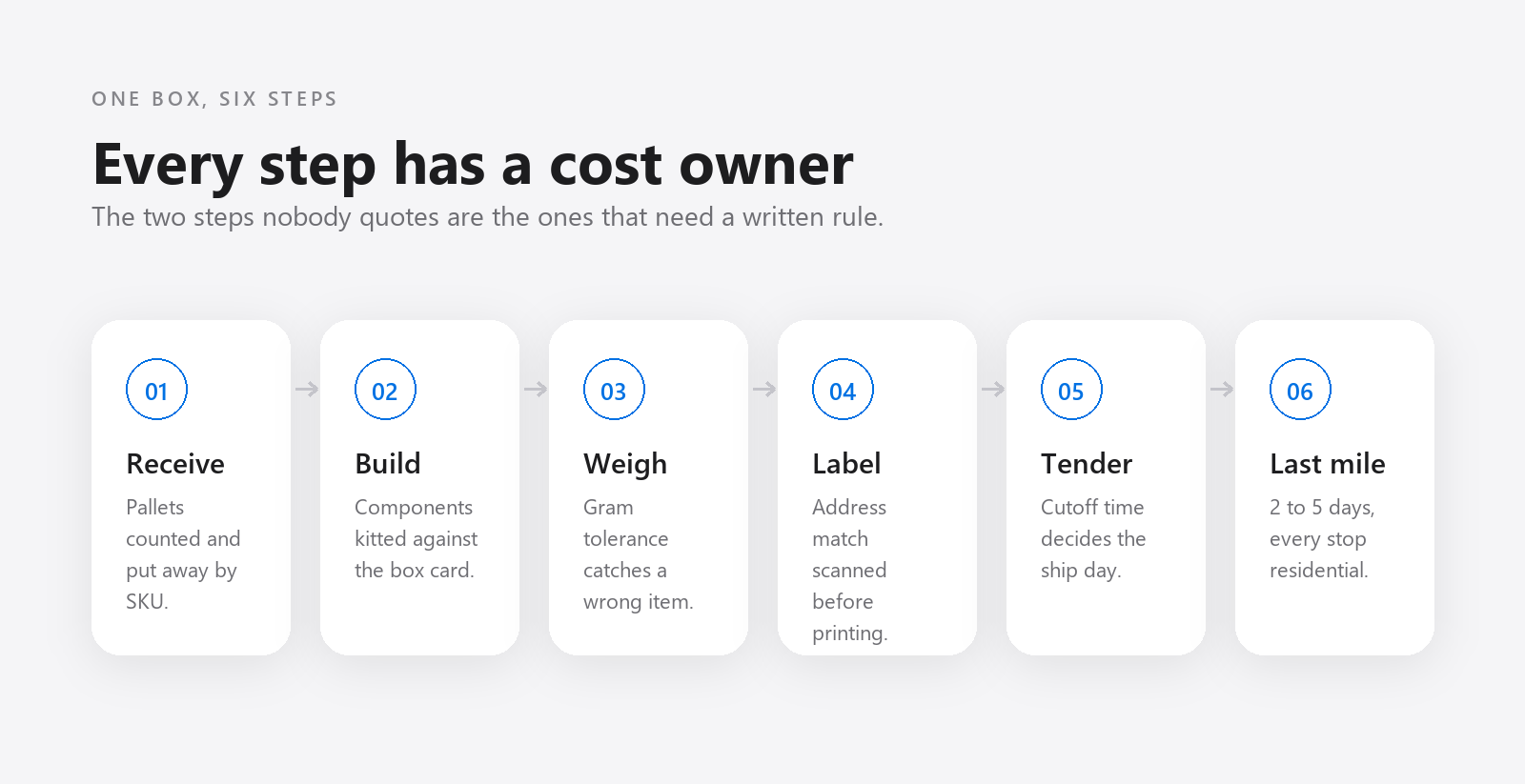
Most founders build the number from a quote. The quote covers storage, handling, postage and assembly. The bill covers eight lines, and the four the quote leaves out are what make month three a surprise.
Eight lines, and the two nobody quotes
| Line | What it pays for | Typical range per box |
|---|---|---|
| Content | Everything inside the box | 30–40% of retail price |
| Packaging | Outer box, tissue, insert card, sticker, void fill | $1.00–$4.00 |
| Assembly | Building the box (kitting), per unit | $1.50–$5.00 |
| Handling | Pick, verify, label, hand to carrier | $0.90–$2.50 |
| Postage and surcharges | Last mile, plus anything the carrier adds | $6.00–$14.00 |
| Storage | Pallet or cubic-foot space, month by month | $0.20–$2.00 |
| Payment and platform | Card processing, subscription software, marketplace cut | $1.50–$2.20 |
| Returns and reships | Reverse 3PL Third-Party Logistics plus replacement stock | $0.40–$0.90 |
The first four are cost to make; the last four are cost to deliver. The making costs get quoted line by line. The delivering costs get vague, and that is where the two invisible charges live — a monthly minimum, and a return nobody priced.
Content sets the ceiling, packaging sets the freight band
Content is the one line you should not squeeze. At 30–40% of retail, it is also the reason people stay subscribed. If content is 40% and fulfillment is 50%, you have 10% for acquisition and everything else. That math fails at the pricing table, not in the warehouse.
Packaging looks like a design decision. It is a freight decision, and it locks on the day the dieline is approved.
USPS prices anything over one cubic foot on dimensional weight: length × width × height ÷ 139, every fraction of an inch rounded up. A box that grows half an inch in each direction can cross a billing tier, and every box you ship for the next two years pays that tier. Size to the packed shape, not the empty one — a quarter inch of slack is plenty, an inch is buying air. When money is tight, cut print before you cut structure: print changes the Business Big-Brand Unboxing, structure changes the rate. The per-unit lever is slow but real — thirty cents off a carton is $18,000 across 5,000 subscribers and twelve sends.
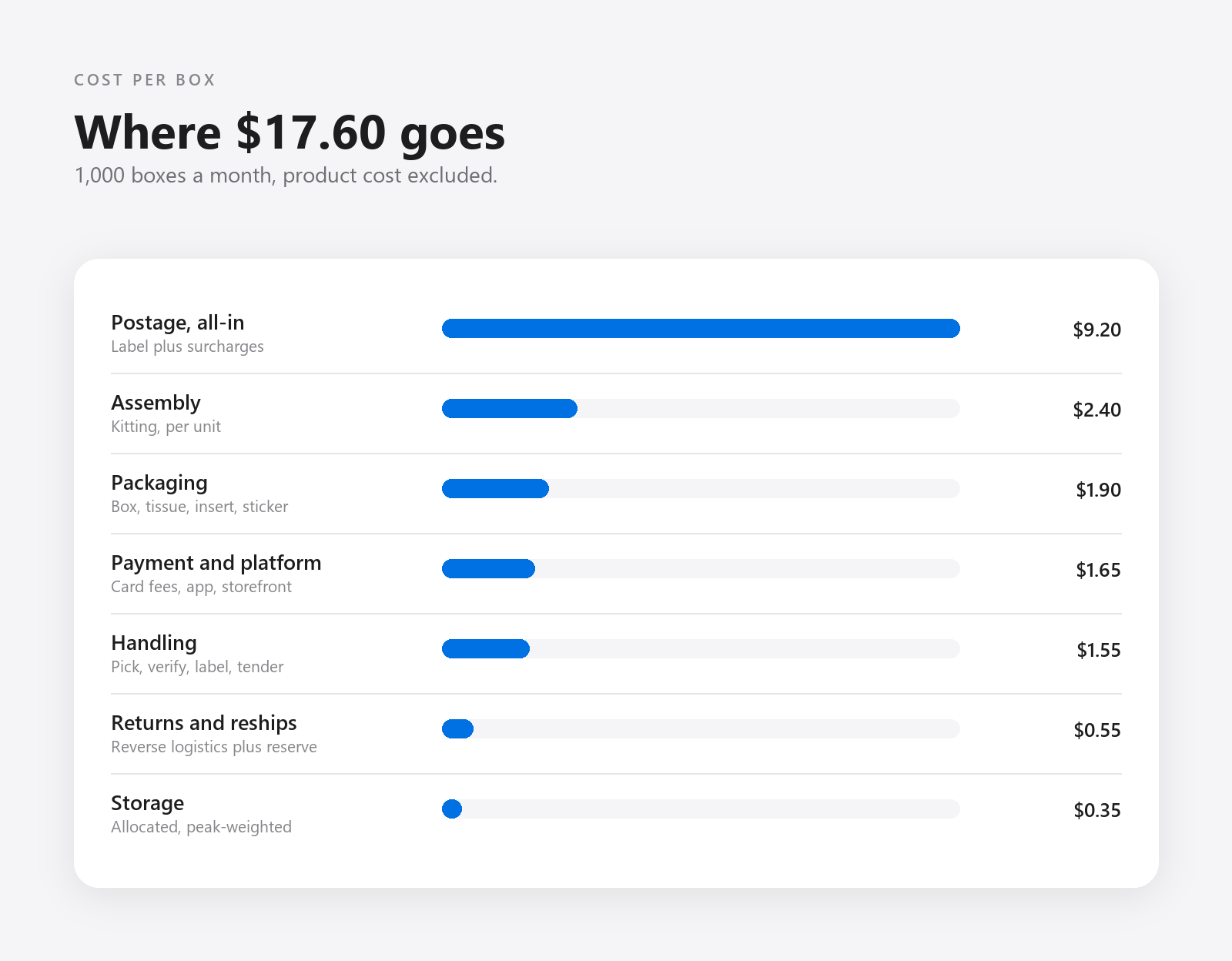
Assembly labor is priced two ways, and they are not comparable
In-house, assembly is a fixed cost. Eight hundred boxes and 1,200 boxes cost the same payroll, so cost per box falls as volume rises and spikes in a thin month.
One warehouse operator described the before and after plainly: twenty-odd people on fixed monthly salaries shipped about 2,000 orders a day; after packing moved to a piece rate of 0.1 yuan per parcel, six packers and six pickers shipped more than 20,000. Wages rose from roughly 4,000–5,000 yuan to 8,000–10,000, and throughput tripled. The lesson is not "pay less". A salary does not reward speed, so the slow hours get paid like the fast ones.
Outsourced, assembly becomes a variable cost. Now the unit price matters less than the assumption behind it: a rate built on a five-component box is void the moment your box has nine.
Anchor the math with public wage data. BLS puts the median hourly wage for hand packers and packagers at $15.83 (May 2022). Nine minutes of assembly is $2.37; twelve minutes is $3.17. When someone quotes $1.20 a box, either the build is a standardized four-piece job or the productivity assumption is under five minutes.
The handling fee is not the labor cost
Handling — pick, verify, label, bag, hand off — is quoted separately from assembly, and the two get conflated in every comparison spreadsheet.
Fee structures that are published usually list four charges: storage, handling, dispatch and last mile. Kitting sits outside all four. So a $0.95 handling fee is not the warehouse's labor; it is the pick-and-pack motion, and assembly arrives on a second invoice.
One question separates a real number from a marketing number: does the handling fee include assembly, insert cards and a weight check? Usually not, and for a subscription box those are the three steps that eat the time.
Postage: every one of your addresses is residential
This is the structural difference between a subscription box and almost any other parcel business. Your entire ship list is homes.
Commercial carriers price that with a residential surcharge, a delivery-area surcharge for outlying ZIPs, a fuel percentage that moves monthly, and a peak surcharge in the fourth quarter. In other categories those are exceptions. In yours they are the base case, and a label quoted at $8 can settle near $13 once they stack.
USPS prices it differently. The business rate card for Ground Advantage carries no fuel, delivery-area or residential surcharge — the rate is the rate, 2–5 days, $100 of insurance included, 70 lb ceiling. For a two-to-four pound box going to homes that structure is usually the cheapest route.
Two caveats. USPS still charges for nonstandard parcels: $4.50 for 22–30 inches, $10.00 beyond 30 inches, $21.00 over two cubic feet, $4.00 for shapes that won't run on the belt. A tall, narrow gift box can quietly become a nonstandard parcel. And if the box is heavy or the promise is tight, a commercial carrier may still win on service — just Which Logistics Model the surcharges before assuming it.
Storage: the monthly minimum is the real number
Storage is quoted per pallet per month or per cubic foot, and the headline rate is rarely the problem. Components turn over fast, so the space looks cheap.
Two things break that. The first is the peak: components arrive over weeks and get assembled in the ten days before the ship date, so occupancy runs near 30% most of the month and 100% for two weeks. You pay for the peak.
The second is the floor. Most warehouses carry a monthly minimum, commonly $150–$500. At 100 boxes a $200 floor adds $2.00 per box; at 1,000 it is $0.20; at 10,000 it disappears. That charge never appears in a per-unit rate card, but it appears on every invoice.
Slot discipline compounds it. Warehouses that run tight expect fast-pick locations to turn three times a day, so a bloated SKU list shows up as storage before it shows up anywhere else.
Payment and platform fees take a cut of the shipping money
Card processing runs about 2.8–2.9% plus $0.30, subscription software runs $19–$99 a month, some apps add 1–1.25% of subscription revenue, and a marketplace storefront can add a referral fee near 15%.
The detail founders miss: the shipping charge sits inside the transaction. Price shipping at cost and you have lost 3% of it before the carrier sees the parcel — $270 a month on 1,000 boxes at $9 postage.
Returns: the second missing line
Subscription returns are low. Reships are not. Damage, a missing item, the wrong variant, a bad address — four failures, four costs, and they all land in the month you are assembling the next box.
Price them separately. Return processing — receive, open, inspect, decide restock or scrap — runs $1.50–$4.00. A reship is a second trip through the last mile, $7–$12. Restocking a sellable return runs $0.50–$1.50. Scrap is the product cost, gone.
At a 1.5% reship rate and $10 an event, that is $0.15 per box. If damage means sending a whole new box at $22 landed cost, the same 1.5% is $0.33. Neither number is scary alone. Both are permanent.
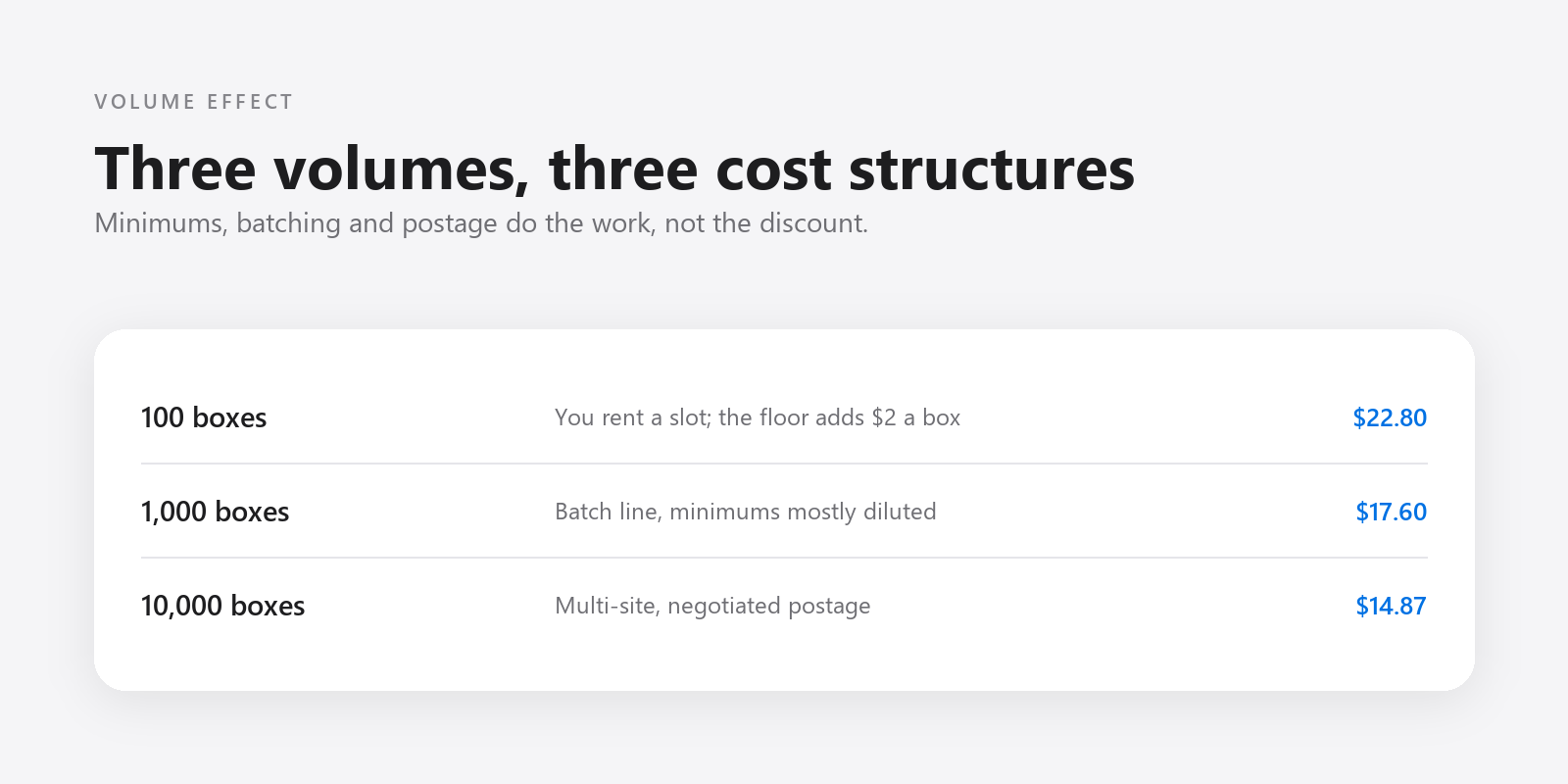
What changes at 100, 1,000 and 10,000 boxes
The three volumes are not one business at different sizes. They are three cost structures.
| Line | 100 boxes/mo | 1,000 boxes/mo | 10,000 boxes/mo |
|---|---|---|---|
| Packaging | $2.30 | $1.90 | $1.45 |
| Assembly | $3.20 | $2.40 | $1.95 |
| Handling | $2.40 | $1.55 | $1.10 |
| Postage, all-in | $10.80 | $9.20 | $8.10 |
| Storage, allocated | $1.80 | $0.35 | $0.22 |
| Payment and platform | $1.70 | $1.65 | $1.55 |
| Returns and reships | $0.60 | $0.55 | $0.50 |
| Total, excluding product | $22.80 | $17.60 | $14.87 |
Four forces produce the spread: minimums get diluted, packaging gets bought in bulk, assembly gets batched into a line, postage falls as you add locations and negotiate.
Note what does not drive it — the provider's discount. At 100 boxes you are not buying a better rate; you are buying a slot in someone's schedule and paying for it by the unit. Which is why, below roughly 800 boxes a month, doing it yourself is often cheaper. Not because your kitchen is efficient, but because you are paying the fixed cost with your own evenings, and that subsidy never shows up in the comparison.
Six fields to lock before you sign
A quote is a price. A contract is a cost.
- Minimum order quantity and monthly minimum, stated separately, and whether one offsets the other.
- The component count the assembly rate assumes, the surcharge above it, and how insert cards are billed.
- How postage is re-rated when dimensions or packed weight change — quote-date rate or ship-date rate.
- Who pays return freight, the restocking fee, and how many days before an unclaimed return is abandoned.
- The liability cap for wrong item, short ship and damage, stated per event rather than per year.
- Peak surcharges and the pallet ceiling, including how much notice a volume spike needs.
If a provider cannot answer the third question in writing, the rest of the number is decoration. Box dimensions change once or twice in the first two years of most subscription products, and that clause decides whether the change costs a redesign or a renegotiation.
If you have the box weight, the dimensions, the subscriber count and the country split, send them over — we will build the eight-line sheet at your current volume before anyone talks about price.
References (Neutral Third-Party Sources)
- USPS — USPS Ground Advantage: transit time, 70 lb ceiling, included insurance, the dimensional-weight divisor of 139, and the nonstandard-parcel fees. https://www.usps.com/ship/ground-advantage.htm
- USPS — USPS Ground Advantage for Business: commercial pricing, and the statement that the service carries no fuel, delivery or residential surcharges, plus the return service for customer returns. https://www.usps.com/business/ground-advantage.htm
- U.S. Bureau of Labor Statistics — Occupational Employment and Wage Statistics, 53-7064 Packers and Packagers, Hand (May 2022): median hourly wage used for the per-box labor estimates. https://www.bls.gov/oes/2022/may/oes537064.htm
- Federal Trade Commission — Mail, Internet, or Telephone Order Merchandise Rule: a seller must have a reasonable basis for a shipping promise, or ship within 30 days and offer a delay-or-refund choice. https://www.ftc.gov/legal-library/browse/rules/mail-internet-or-telephone-order-merchandise-rule
- Federal Trade Commission — Negative Option Rule: disclosure obligations for prenotification subscription plans. https://www.ftc.gov/legal-library/browse/rules/negative-option-rule
- GS1 — EAN/UPC barcodes: the item-level identifier that makes scan verification and slot control possible. https://www.gs1.org/standards/barcodes/ean-upc