
Holiday Gifts for Clients: What to Send (And What to Skip)
Holiday gifting is a scheduling problem that people keep trying to solve by shopping. What you can send on December 8 was decided in September; whether you can put a logo on it was decided a month before that.
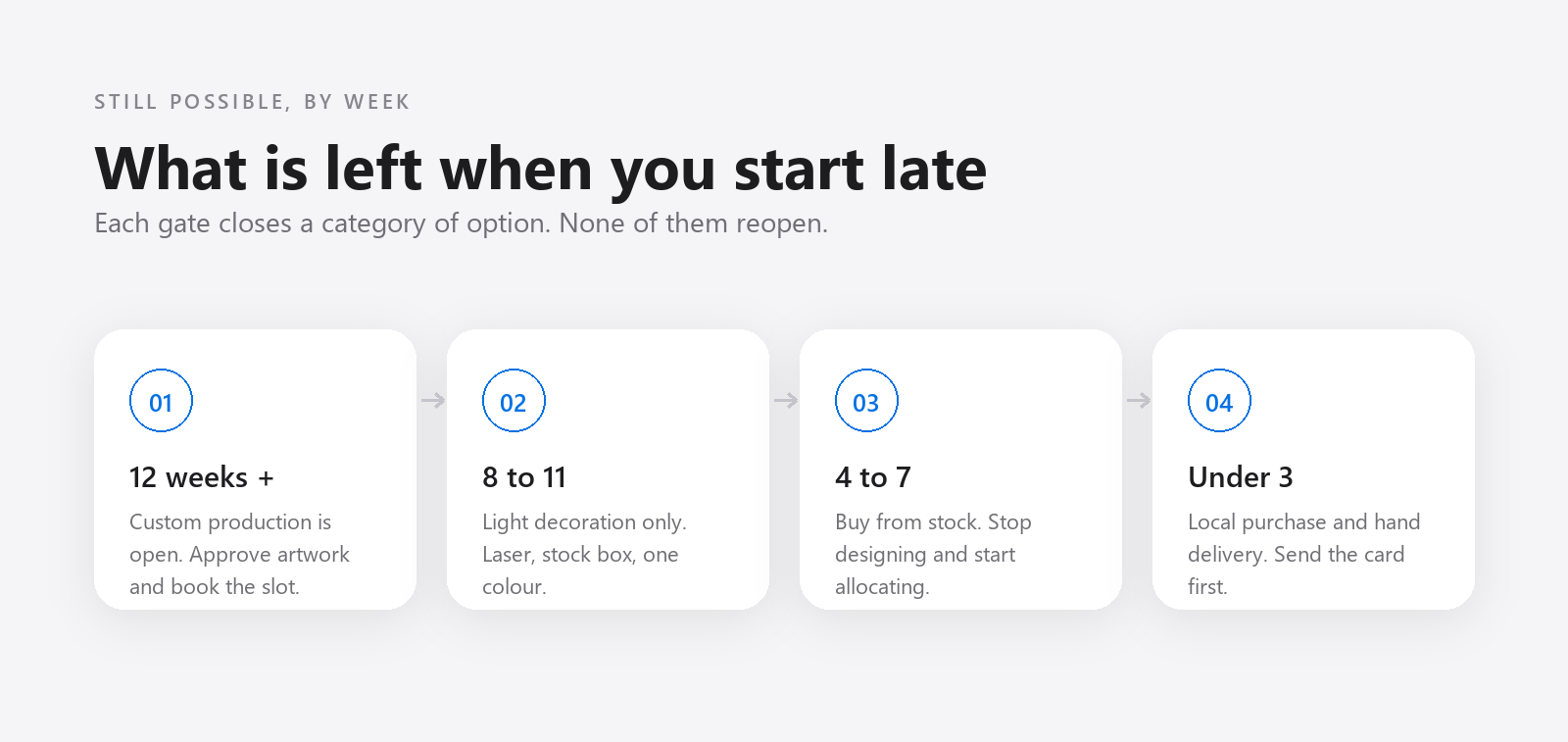
The list gets approved late, the Without Breaking Budget later, and by then the only open question is which express service still has capacity. That is the last of three walls: production first (artwork approval, a proof round, tooling, a factory slot), transit second, the carrier's calendar last — and it closes before yours does. Work it backwards and the shopping gets simpler: fewer options survive, but the ones left actually arrive.
Work the calendar backwards
Start from the day the box has to be in someone's hands — not the day it ships — and count backwards.
| Weeks out | What has to be finished | Why it slips |
|---|---|---|
| 16 | List, budget band, yes/no on customization | Approval cycles; quotes that come back with two MOQ options and no recommendation |
| 12 | Artwork approved, PO issued, deposit paid | Two proof rounds is normal; three is common when a logo sits near a fold |
| 9 | Production complete, inspection passed | Q4 factory slots fill early; a re-run costs three weeks |
| 7 | Container loaded and sailing | Ocean door-to-door runs 5–6 weeks on most lanes |
| 4 | Cleared customs, goods in a local warehouse | Clearance plus haulage; one bad line item holds the shipment |
| 2 | Kitted, labeled, handed to the carrier | Carrier cut-offs land here |
| 1 | Local delivery or hand delivery | Building access, reception hours, someone working from home |
The nine-week row is where inspection lives — the last point where a defect costs a re-run instead of a reship. A reship from a factory in November arrives in January.
The two-week row is where kitting lives. Kitting means assembling components into one giftable unit: box, insert, card, product, sometimes a second product. Warehouses quote it per unit, and the quotes are not comparable — some count the assembly step, some count every item placed, some fold the carton into the price. Get the unit definition in writing; across 400 units the difference is a four-figure line.
December is a capacity problem, not a price problem
Every year the same word appears in freight conversations: baocang, the overflow that happens when parcels arrive faster than a facility can push them out. It sounds like "the warehouse is full." It isn't. It is a structural mismatch — goods parked in the wrong zone, forecasts that missed, a dispatch door with a queue behind it.
Good warehouses forecast volume seven days ahead and refresh sold units, remaining stock and carrier pickup capacity every two hours during peak. Those two numbers — how far ahead, how often — are worth asking a supplier directly.
Carriers hit the same wall on their own schedule. For 2022, USPS set these domestic send-by dates for arrival before December 25:
- December 17 — Retail Ground, First-Class Mail, First-Class packages up to 15.99 oz
- December 19 — Priority Mail
- December 23 — Priority Mail Express
USPS also applied a temporary price adjustment from October 2 through late January on Priority Mail Express, Priority Mail, First-Class Package Service, Parcel Select Ground and Retail Ground. International products were excluded. That is the domestic version of a peak surcharge — a per-parcel add-on that prices December capacity as a different product.
One rule catches 15 Thoughtful Gifts boxes specifically: since June 6, 2022, parcels containing lithium batteries must move by surface transportation — Parcel Select Ground, Retail Ground, Parcel Return Service or Ground Return Service. A branded power bank in a gift box is no longer a gift box; it is a regulated shipment on a slower lane.
Eight weeks out, customization still works
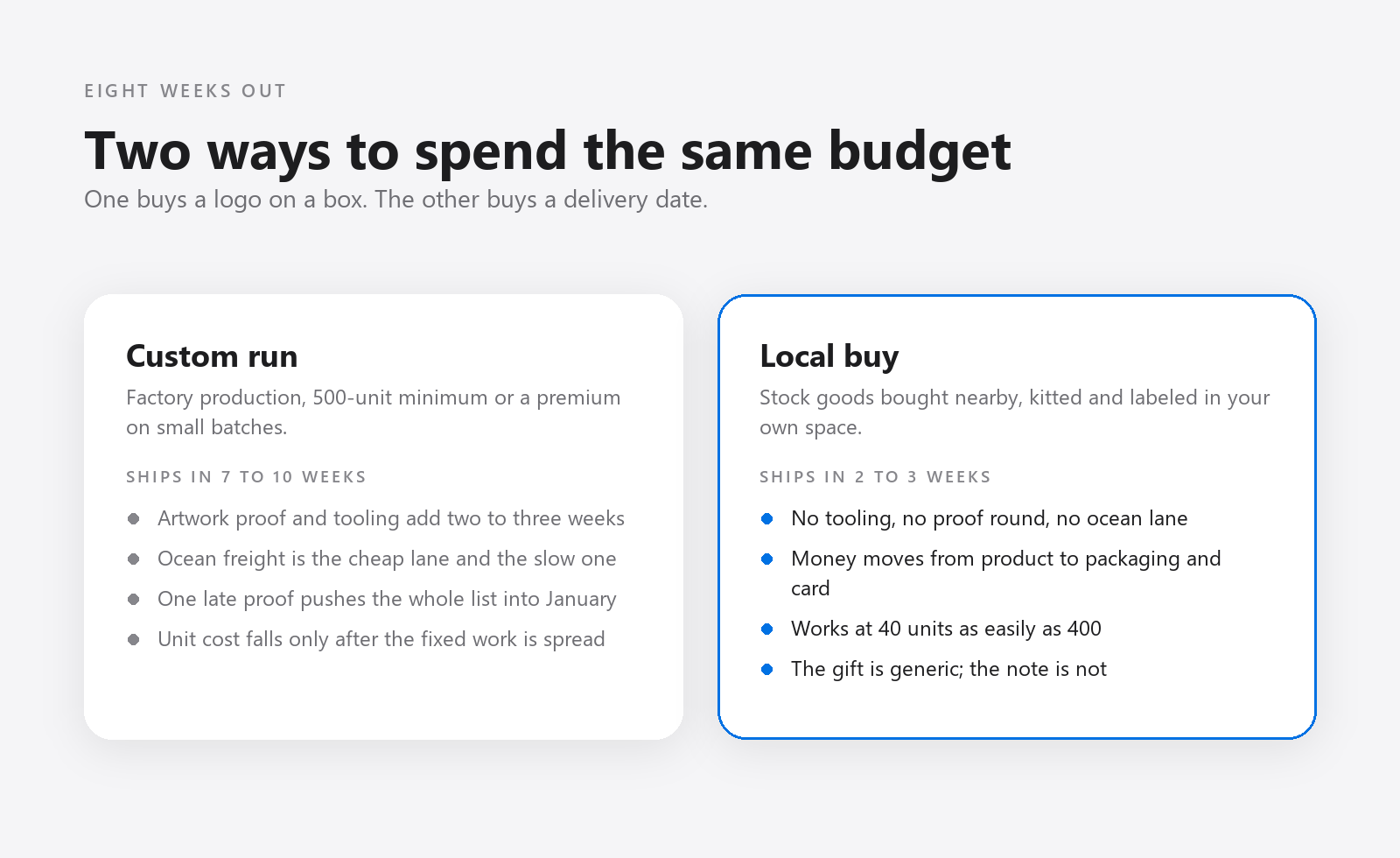
Eight weeks is enough for light customization and not enough for anything needing a new mould.
The cost structure is counter-intuitive. Batch size drives unit price far more than material does, because the fixed work does not shrink: one tooling setup, one sample run, one production slot squeezed between larger jobs. Suppliers typically answer with two options — a 500-unit minimum, or 30 units at roughly a 50% per-unit premium. Both are honest. Neither is a discount.
So "make fewer" does not save money. It moves the same fixed cost onto fewer pieces. What saves money is changing the process: laser engraving instead of foil stamping, a stock box with a printed label instead of a custom-printed box, one colour instead of four.
Production time follows the same logic. A full run needs about 30 days from scheduling through production, inspection and dispatch; a small batch often lands in 7–15 days because it can be slotted into gaps. When the delivery date is fixed, lead time is the first constraint on decoration, not price.
Two weeks out, buy locally and kit it yourself
At two weeks, three things remain under your control: what goes in the box, the order it comes out, and what the card says.
The recipient forms an opinion in roughly the first minute — how the box feels, whether the print is clean, whether the lid closes. A generic object in a well-built box beats a good object in a poly mailer, and both beat a great object that arrives in January.
Kitting is also where mistakes get caught cheaply. Mature operations pre-load the weight of every SKU and bundle, weigh each finished parcel, and flag anything outside a five-gram tolerance. A missing card, a doubled item, the wrong colourway — all of it shows on a scale.
If your list runs to hundreds of people across offices, the last mile is not a courier problem. It is a receiving-dock problem. Cartons need palletizing to the standard the building expects — a 48 × 40 inch pallet with labels in fixed positions, in most North American mailrooms — and someone at the destination has to know the pallet is coming and who signs.
Four things that should never go in the box
Compliance failures are quiet, because they happen after the invoice is paid.
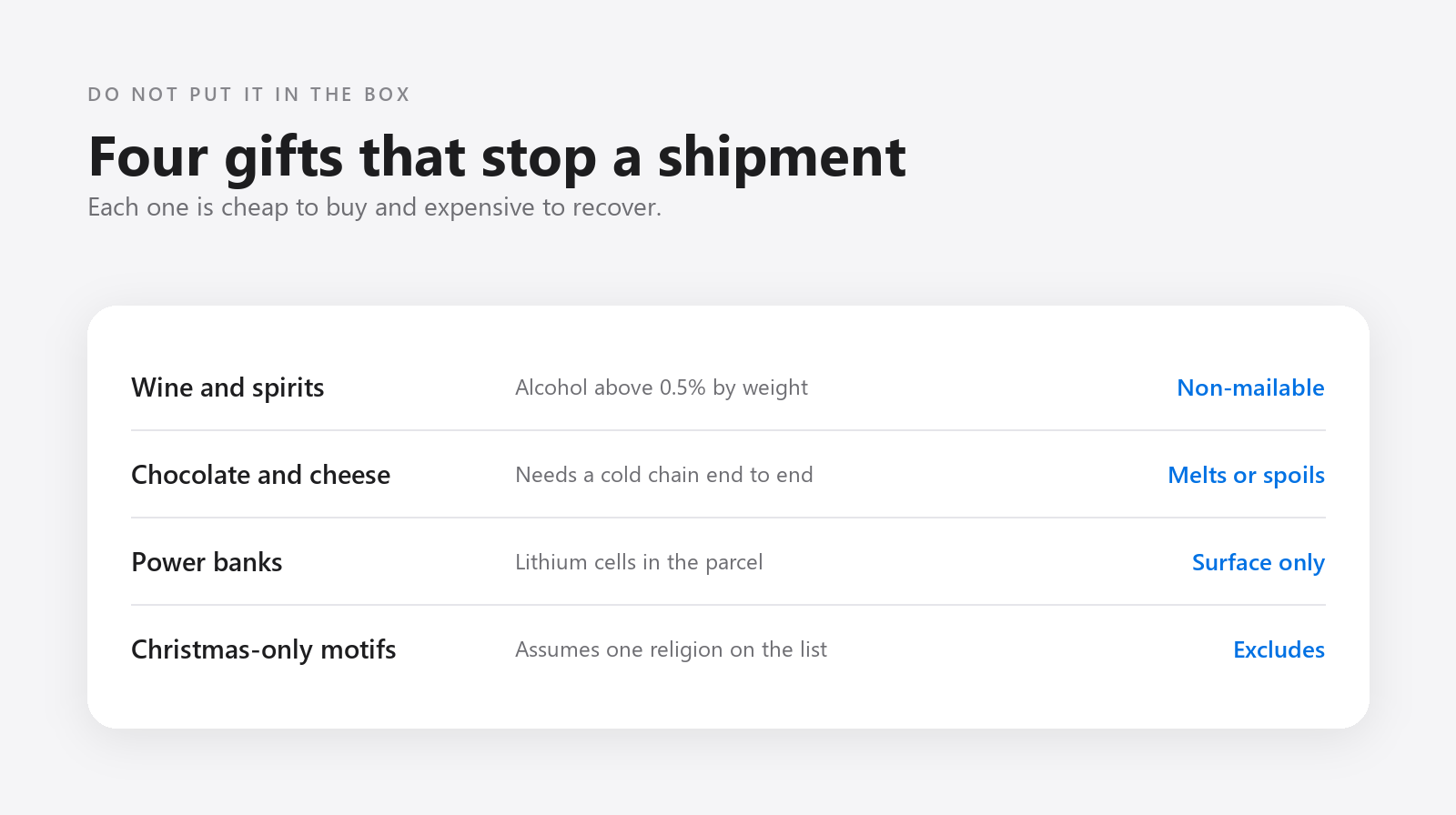
Alcohol. USPS treats any beverage at 0.5% alcohol by weight or more as an intoxicating liquor, and intoxicating liquor is generally non-mailable, with narrow exemptions that do not cover a client gift. Commercial carriers will move it, but only under licence, contract and state rules. A bottle is the most common last-minute addition and the most likely to stop a shipment.
Perishables. Chocolate in a December trailer, cheese crossing a border, anything needing a cold chain. A gift that melts is worse than a gift that is boring.
Anything with a lithium battery. Surface transport only since June 2022, which changes both transit time and the cost you quoted in September.
Anything that assumes the recipient celebrates Christmas. Your list includes people who don't. Pick an object with no holiday content, or write the card for the end of the year rather than the 25th.
Cross-border adds a layer: bundled sets often have to be filed as a set, and every item needs its own description and value. "Gifts" is not one.
The $25 line is a deduction ceiling, not a spending cap
Every December someone says the limit is $25 and everyone nods. The rule is narrower. Under US federal tax rules, you can deduct no more than $25 of the cost of business gifts given to any one person during your tax year. Incidental costs — engraving, packing, shipping — are not counted toward that $25 if they don't add substantial value. Items costing $4 or less with your name permanently imprinted, distributed regularly, are treated separately.
That is a rule about what you can deduct, not about what you may spend. Two other ceilings usually matter more: your own procurement policy, which often sets a lower declaration threshold, and the recipient organisation's gift policy, which for public bodies, hospitals and regulated financial firms can be strict. Ask before you ship rather than explain after.
There is also a perception line no policy captures. A $400 gift against a $30,000 contract does not read as generosity; it reads as a misunderstanding of what closed the deal. A $60 object with a note naming a specific conversation reads as attention.
Late is worse than never: the December 18 playbook
After the cut-offs, customization is off the table. Three options remain, in ascending order of cost.
Send the card now, the gift later. A handwritten card by Priority Mail costs a few dollars and arrives on time; the gift follows in January with a line explaining it. This turns a late gift into an expected one, which is a different event.
Buy local, ship local. Trade uniqueness for timing. It works when the relationship matters more than the object, and fails when the object was the point.
Hand-deliver. For anyone within driving distance, one meeting beats ten parcels.
The worst option is silence. A box that arrives in January with no warning does not read as busy. It reads as an afterthought.
The short version
Count backwards from the delivery date, not forwards from the budget approval. Sixteen weeks for the list, twelve for the PO, nine for inspection, seven for the ship, two for kitting, one for the last mile. Inside eight weeks, change the process rather than the quantity. Keep alcohol, perishables and battery products out of the box. Treat the $25 line as a tax rule, not a spending rule. And if it is already the third week of December, send the card first.
If you have a list, a delivery date and a country split, send them over — we will come back with a countdown before we talk about price.
References (Neutral Third-Party Sources)
Facts in this article were checked against carrier and government publications. No gift supplier, promotional agency or fulfillment provider is cited.
- USPS — Prepping for the Holidays With Important Dates (newsroom release, October 4, 2022): the 2022 domestic send-by dates, the October 2–January 22 temporary price adjustment, and the June 6, 2022 rule requiring lithium-battery parcels to move by surface transportation. https://about.usps.com/newsroom/national-releases/2022/1004-prepping-for-the-holidays-with-important-dates.pdf
- USPS Postal Explorer — Publication 52, §42 Intoxicating Liquors: the 0.5% alcohol-by-weight definition and the narrow mailability exemptions that do not cover ordinary client gifts. https://pe.usps.com/text/pub52/pub52c4_005.htm
- USPS — Priority Mail: tracking and up to $100 insurance, no fuel/residential/Saturday surcharges, dimensional weight at a 139 divisor, and the nonstandard-length fees that apply to long gift boxes. https://www.usps.com/ship/priority-mail.htm
- IRS — Are business gifts deductible? (small business and self-employed FAQ): the $25 per-recipient deduction limit, the incidental-cost exclusion for engraving, packing and shipping, and the $4 promotional-item exception. https://www.irs.gov/faqs/small-business-self-employed-other-business/income-expenses/income-expenses-8