
Client Gift Ideas: 15 Thoughtful Gifts That Close Deals
Most client Gifting Send Gifts are forgotten before the tracking page stops updating. The recipient opens the box at their desk, decides in under a minute whether it earns a place in their life, and either keeps it, hands it to a colleague, or leaves it in the mailroom. None of that is driven by your logo.
The gifts that survive are boring to plan: they fit the stage of the relationship, cost what it can justify, and let the packaging persuade before anyone reads the card.
Why the gift you sent in December is already gone
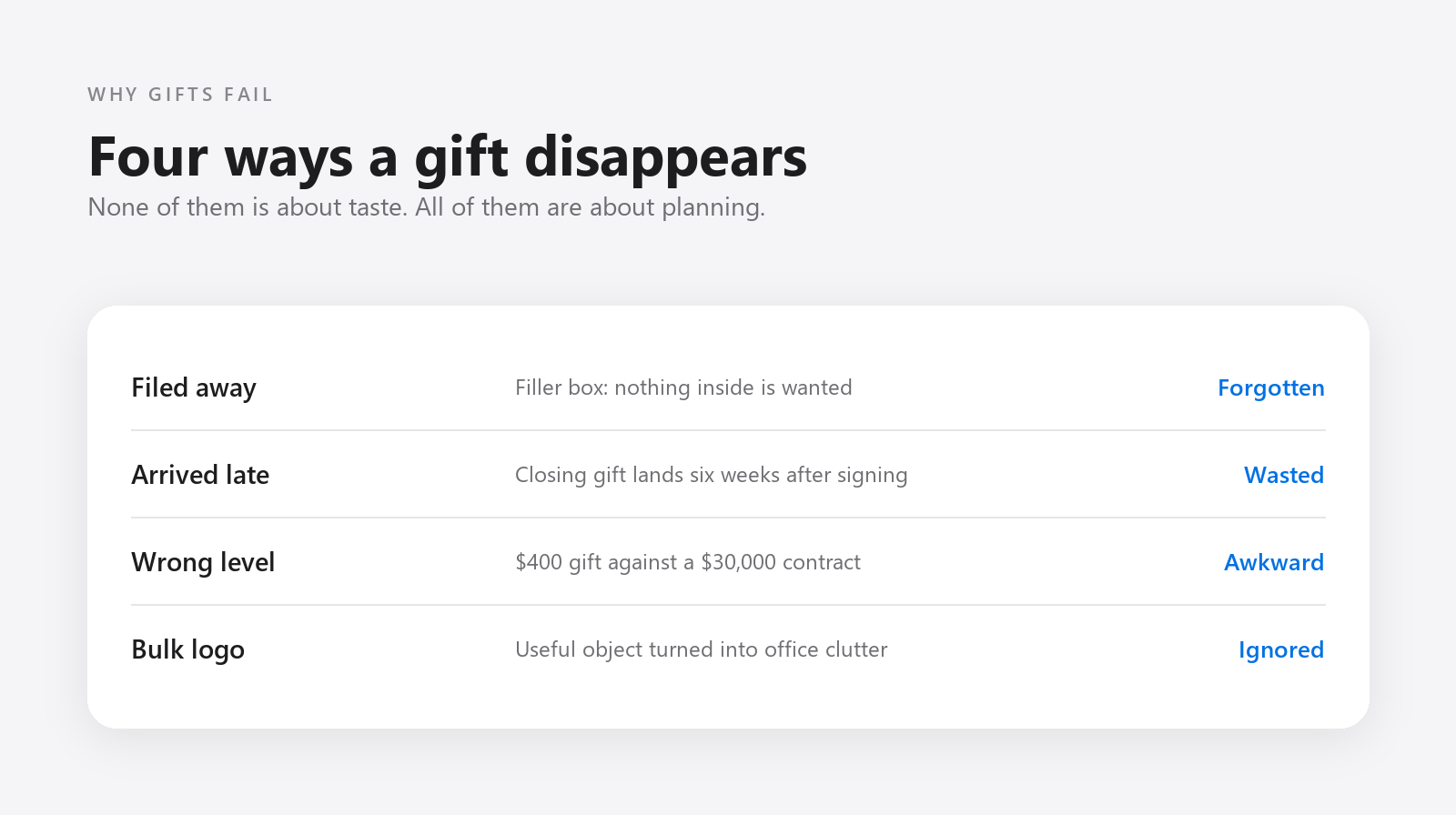
Gift suppliers describe the same first minute: the box is opened, judged on weight and print quality, then sorted into "keep" or "not mine." A gift that fails is not disliked; it is not thought about again.
Two failures explain most waste. The first is the filler box — a dozen items the recipient would never buy, bundled so the total looks generous. Buyers call it neither useful nor disposable: it sits in a cupboard for two years.
The second arrives months after the moment it was meant to mark. A closing gift that lands in week six is a delivery, not a closing gift.
Set the budget by relationship stage, not by the calendar
The usual pattern is a year-end scramble: whoever is left gets something, the amounts follow seniority rather than relationship, and accounts mid-deal get the same treatment as ones that renewed in March.
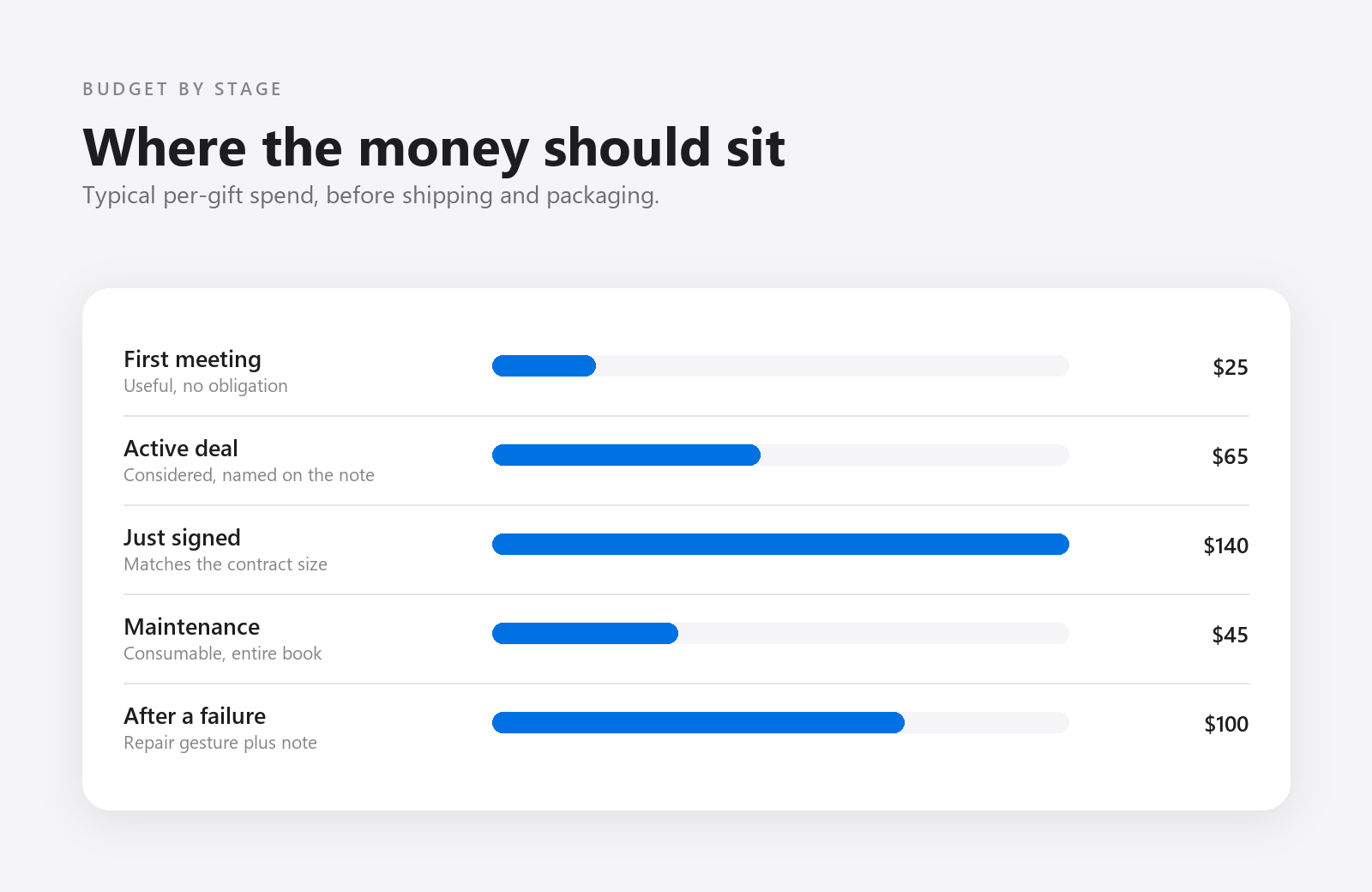
Buyers frame this as one number — a budget of 500 or 5,000 — when what matters is the split per account. Spending works better when it follows the relationship, with roughly 60% of the annual total going to the two middle stages.
| Stage | Accounts per year | Per-gift band | What the money buys | Avoid |
|---|---|---|---|---|
| First meeting / prospecting | 20–40 | $15–30 | Something useful enough to keep on a desk | Gifts that imply obligation |
| Active deal | 5–15 | $40–90 | A considered object with their name on the note | Anything sent mid-negotiation |
| Just signed | 1–5 | $75–200 | A welcome that matches the contract size | Over-gifting relative to the deal |
| Annual maintenance | Entire book | $25–60 | A consumable they will use | Three big gifts, forty nothing |
| After a failure | 1–3 | $50–150 | Repair gesture plus a handwritten note | Anything that reads as a bribe |
Two rows cause the arguments. "Just signed" is where people overreach: $400 against a $30,000 contract signals the deal was won by the gift. Maintenance is where they underreach — three accounts gifted heavily, forty who got nothing.
The MOQ trap: why thirty units can cost more than five hundred
Custom gifts are made in batches, and batch size sets the unit price more than material does. A standard run starts at 500 units. Suppliers will take 30, but the unit price carries a 50% premium, because the fixed work does not shrink: a tooling setup, a sample run, a production slot squeezed between larger jobs. Identical at 30 pieces or 500.
Three terms before you ask for a quote:
- MOQ (minimum order quantity) — the smallest batch before the unit price jumps.
- Tooling cost — the one-time charge for the mould or die your logo needs. Paid once, not per unit.
- Pre-production sample — the piece you approve before the run; approving a photo instead is how colour goes wrong.
Lead time splits the same way: a large run needs scheduling, production, inspection and freight, so 30 days is a floor; small batches compress to 7–15 days, which is why the premium pays when a meeting is already booked.
There is no clean rule in the middle. Under about 300 units, the premium usually costs less than storing 500 pieces you cannot give away; above 800, volume pricing wins. Between 300 and 800 the tiebreaker is whether sales, HR or next year's event can absorb the surplus.
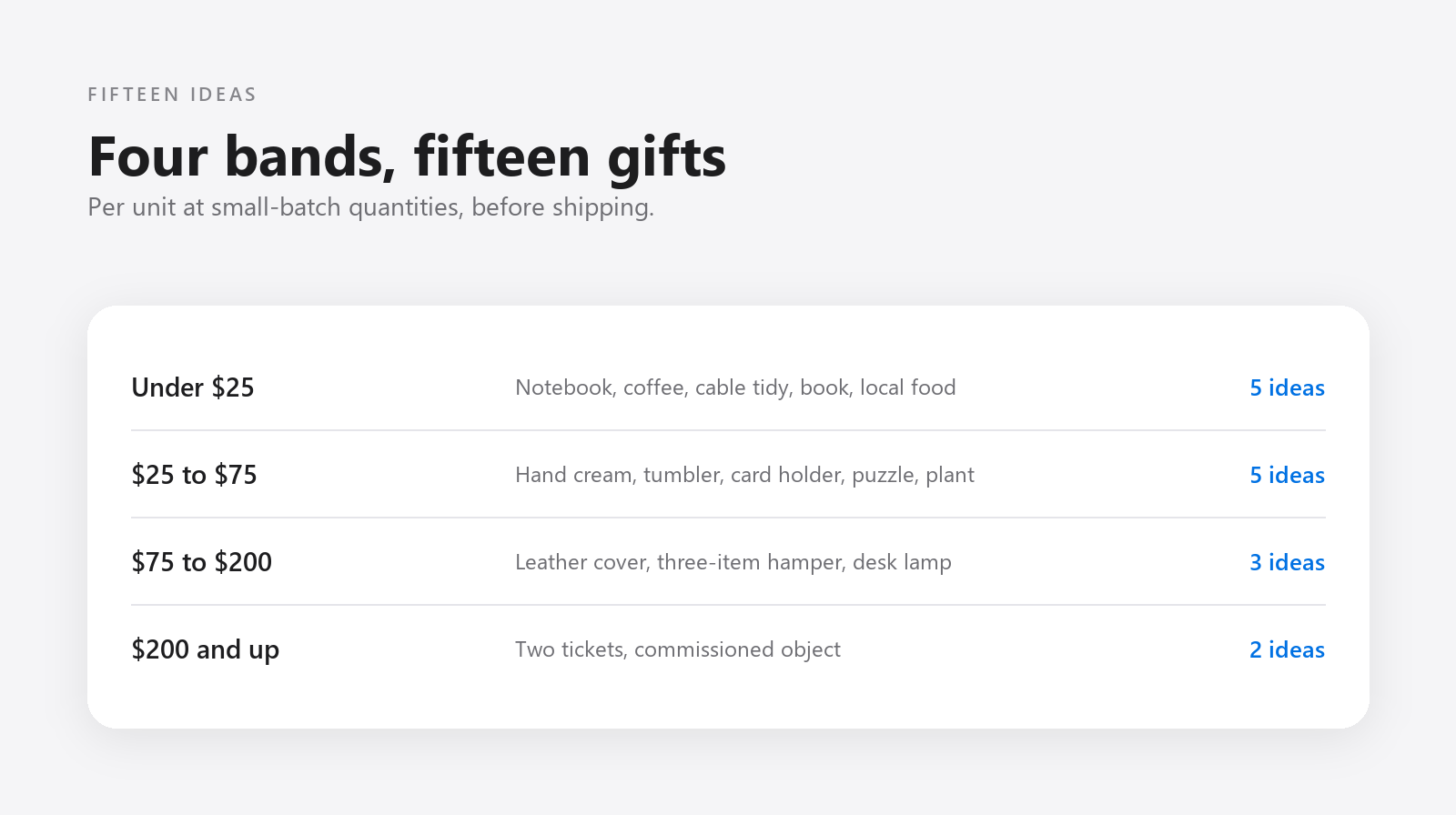
Fifteen gift categories, grouped by what they cost
Prices are per unit at small-batch quantities: ranges, not quotes.
Under $25 — kept on the desk
- A notebook and pen set that looks considered, not promotional.
- Single-origin coffee or tea with brewing notes, in a tin that survives the office kitchen.
- A cable organiser. Nobody has enough; everybody notices a tidy desk.
- A hardcover book tied to their industry, with one line on why this one.
- A consumable from your region, from a producer you can name.
$25–75 — this was chosen
- One hand cream in a proper box. A small tube reads as a sample; an 80g jar with a ribbon reads as a gift at the same cost of goods.
- A tumbler, laser-engraved rather than printed, so the mark survives the dishwasher.
- A leather card holder with initials stamped inside, not across the front.
- A desk puzzle or two-player game, for people who take calls at their desk.
- A plant in a ceramic pot with a care card, sent to the office.
$75–200 — made for you
- A leather A5 cover with an interior stamp, ordered once you know whether they carry a laptop or a notebook.
- A hamper with three good items instead of twelve average ones.
- A desk lamp, for clients who present or film from home.
$200+ — relationship, not campaign
- Two tickets to something they would have bought themselves, date agreed in advance.
- A commissioned object — a board, a knife, ceramics — from a maker you can describe in one sentence.
What a gift actually changes in a decision
A gift never closes a deal. It changes what the recipient remembers at renewal, and how much benefit of the doubt you get when something breaks.
| Gift type | First month | Effect on the relationship | Where it backfires |
|---|---|---|---|
| Desk object (tumbler, lamp) | Used daily, seen by colleagues | Steady, low-intensity recall | Bulk logo turns it into clutter |
| Consumable (coffee, chocolate) | Gone in 2–8 weeks, often shared | Warm but short-lived; good for repeat touches | Arrives melted, broken or out of season |
| Personal item (leather, initials) | Kept for years, rarely discussed | High perceived thought, low frequency | Wrong initials cannot be fixed |
| Experience (tickets, dinner) | Anticipated, then talked about | Strongest memory per dollar above $150 | Date clashes; feels like a sales meeting |
| Donation in their name | Acknowledged once | Signals shared values, or cynicism if generic | They did not choose the cause |
| Gift card | Spent within days | Convenient, almost no recall | Bank-issued cards read as cash |
Buyers describe the same thing from the other side: the gift people keep is the one they would pass on to someone else. The pattern is not "expensive wins." A $30 consumable shared in a meeting room beats a $200 object left in its box.
Packaging and the note do the persuading
The same product reads as a sample or as a gift depending on the box. A small tube of hand cream feels like a freebie; the 80g version in a rigid box with a ribbon reads as something bought for the person. Box, printed liner, one ribbon, a card that fits without folding: $3–8 per unit at small volumes, the cheapest leverage in the budget.
Two logistics details follow. Volume, not weight, sets the price on light gifts: carriers bill dimensional weight, length × width × height ÷ a divisor, charged at whichever is greater. A box that grows half an inch each way can cross into the next band, and across a 200-piece mailing that is real money. Heavy gifts flip it: a set over 10kg can cost more than $100 per delivery, more than most of the gifts inside it.
Personalisation is the other half, and the least forgiving. Engraving is permanent: a misspelled name, a title that changed between order and delivery, a logo in the wrong weight — each turns a $90 gift into scrap, because a personalised item cannot be returned, resold or passed to another client. Budget 3–5% for rework, and get the proof signed off by whoever checks spelling.
The cheaper personalisation is the one most buyers skip: a handwritten note about the actual project. One product, forty notes, each from a template with one sentence edited by hand. The note is remembered; the object is a reminder of the note.
Run it as a program, and know each client's limit
A program is a list with five fields per row and one owner who can say no.
- Recipient and stage — sets the band, and stops the loudest account from setting everyone's budget.
- Per-gift cap — approved before anyone shops, not after the invoice arrives.
- Ship-to address and phone — office reception with a number beats a home address.
- Send week — one ship week is cheaper than twenty single parcels and easier to track.
- Owner — one name per row. Rows without a name do not ship.
Caps are not always yours to set. U.S. federal employees may accept $20 per occasion and $50 per year from one source; cash is barred, and bank-issued gift cards count as cash. Contractors add declaration thresholds, often $50–100. The rule: small, non-cash, on an occasion unrelated to a pending decision.
Two habits keep it running. Order 10% more units than the list requires: breakage and failed addresses cost less than a second run at 30 units. And price it landed — unit price plus packaging plus freight plus duty plus replacements is the budget number.
The short version
Pick the stage first, then the object. Put the middle of the budget on accounts mid-deal or newly signed, not on the three names everyone knows. Pay the small-batch premium when the date is fixed, buy volume when leftovers have somewhere to go, and move personalisation into the note, where a mistake costs a card instead of a unit.
If you are assembling a list of 50 or 500 clients and the quantities are still moving, send the stage breakdown and the ship week. We will come back with a kitting and delivery plan before we talk about unit prices.
References (Neutral Third-Party Sources)
Facts were checked against public regulations, carrier documentation and standards bodies. No gift platform or fulfillment provider is cited.
- eCFR — 5 CFR § 2635.204, Exceptions to the prohibition on solicitation or acceptance of gifts: the $20 per occasion and $50 per year limits, the bar on cash and investment interests, and how gift cards are treated. https://www.ecfr.gov/current/title-5/chapter-I/subchapter-B/part-2635/subpart-B/section-2635.204
- USPS — Priority Mail: 2–3 day service, the dimensional weight divisor, and nonstandard and oversize fees on long or bulky parcels. https://www.usps.com/ship/priority-mail.htm
- FTC — Mail, Internet, or Telephone Order Merchandise Rule: the 30-day shipping baseline when no date is promised, and the consent-or-refund requirement when a shipment slips. https://www.ftc.gov/legal-library/browse/rules/mail-internet-or-telephone-order-merchandise-rule
- International Trade Administration — Harmonized System (HS) Codes: how goods are classified for duty, including sets and composite goods. https://www.trade.gov/harmonized-system-hs-codes
- Cornell Legal Information Institute — 19 U.S.C. § 1321: the statutory low-value import exemption, including the lower allowance for bona fide gifts. https://www.law.cornell.edu/uscode/text/19/1321