
Realtor Gifts for Clients: Ideas That Get Referrals
The closing gift does not earn the referral. The four weeks after it do. A candle handed across the signing table gets admired for ninety seconds, then packed into a box with the good scissors and not seen again until the kitchen is finished.
Most gift guides for agents stop at the shopping list, which is the easy half. The hard half is that your client is mid-move: the old address is dying, the gate needs a code, nobody is home to sign.
So treat this as a sequence.
The referral is decided in the first month
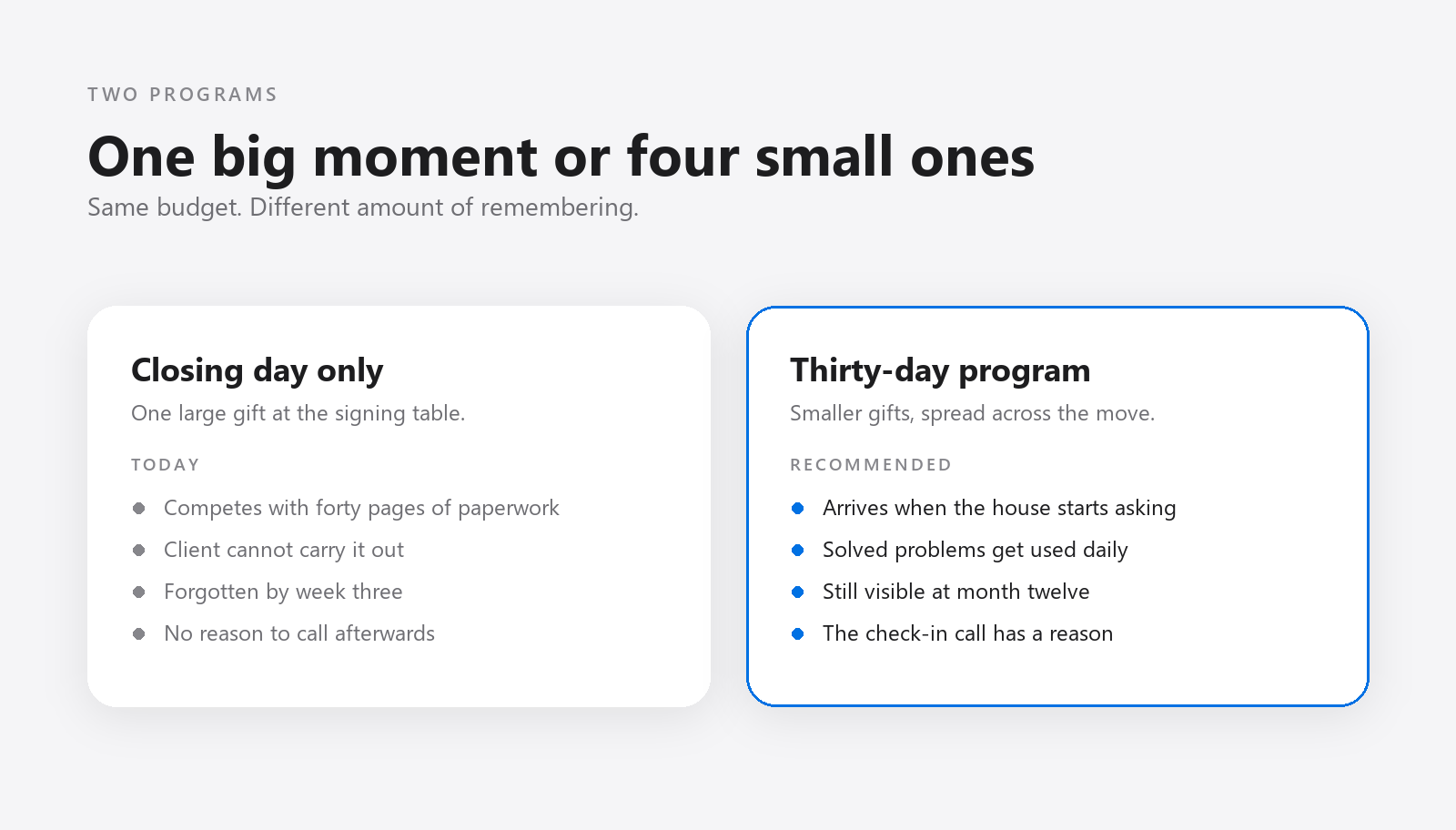
At closing your client is signing forty pages and thinking about the water bill. Attention is at its lowest exactly when the gift on a Budget is at its highest.
Four weeks later the paperwork is old news and the house starts asking questions. Which day is trash pickup. Which breaker runs the garage. Why the water heater knocks at six in the morning. Whoever answers those questions is who they call again, and who they name when a colleague mentions they are thinking of buying.
That is the argument for spending less at the table and more across the first thirty days. A forty-dollar item that solves a Tuesday problem outlives a hundred-and-fifty-dollar item that lives in a cupboard.
Give by stage, not by occasion
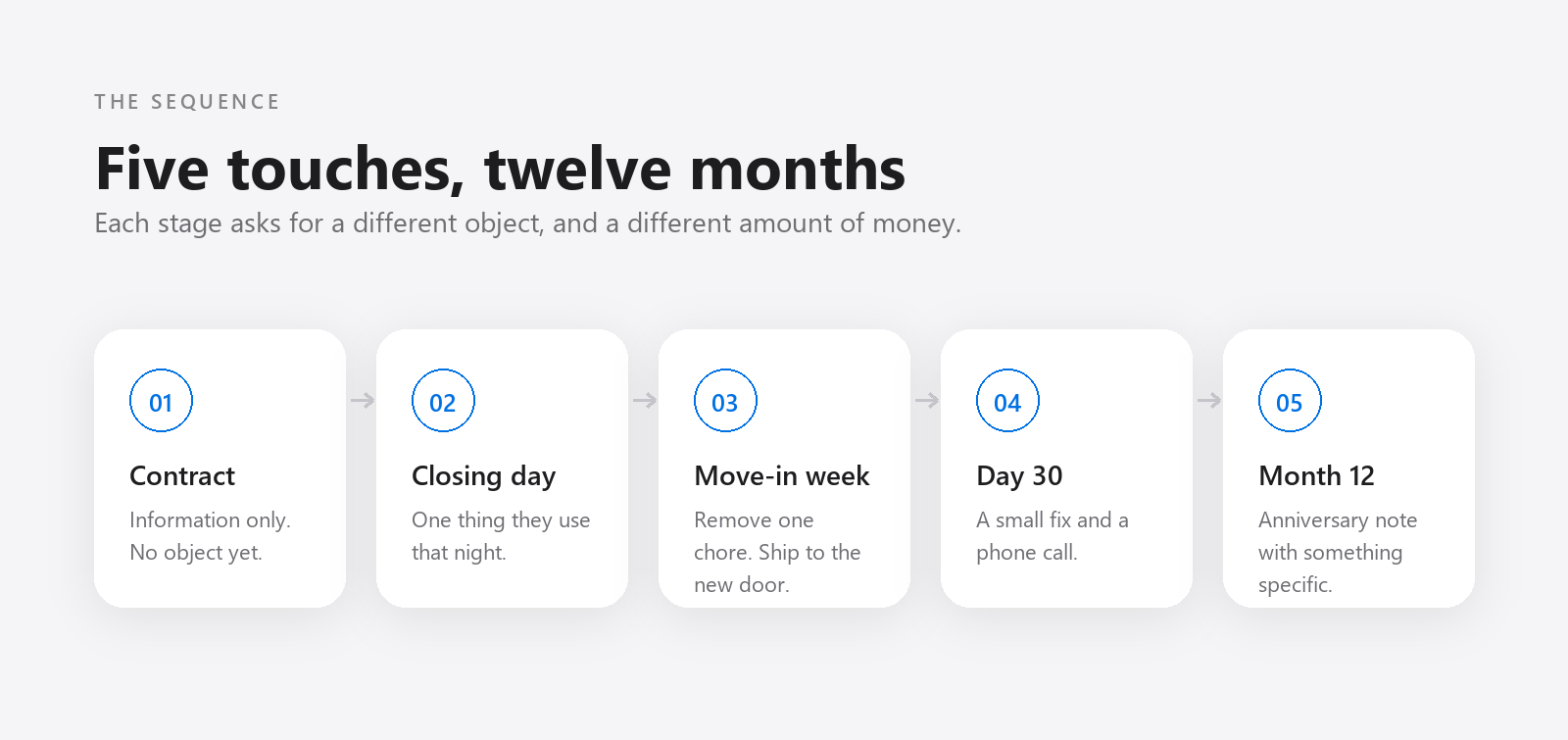
A deal has five moods, and the same object is worth different amounts in each one.
| Stage | What the client is doing | What the gift is for | Spend | How it arrives |
|---|---|---|---|---|
| Under contract | Inspections, loan paperwork, packing quotes | Information, not objects | $0–25 | Email or in person |
| Contract to closing | Boxing up twenty years of stuff | Consumables that get used up | $25–40 | Handed over |
| Closing day | Signing, keys, lunch that never happens | One thing they use that night | $50–80 | In person |
| Move-in week | Unpacking, no groceries, no toilet paper | One problem removed | $60–120 | Shipped to the new address |
| Day 30 | Settled, finding faults | A small fix and a phone call | $25–60 | Mail or drop-off |
| Month 12 | Anniversary of the purchase | Memory plus a service | $30–75 |
Two rows deserve comment.
Between contract and closing, the useful gift is not a gift. Tape, bubble wrap, marker pens and label stickers cost under thirty dollars and get used within a week, because the client is about to label every box in the house.
Closing day is where agents overspend. The client cannot carry anything. They are holding keys, a folder, and a phone that will not stop ringing. One object they will use within four hours beats a basket they have to put down somewhere.
What survives the first month: the $50–$150 shortlist
Six items earn their price in this window.
A doormat sized to the actual door. Measure the opening, not the mat you like. A 30×18 mat in front of a 36-inch door looks like a sample. No logo on the top.
A first-night box. Paper towels, toilet paper, trash bags, paper plates, a box cutter, a phone charger, dish soap, packed in a lidded tote so the container stays useful. Highest retention on the list, and the only one that has to be assembled before the move rather than improvised from a grocery run.
A small hardware kit. Tape measure, level, picture hooks, a bit set. People hang curtains in week two and discover they own nothing but a butter knife.
A printed house manual. Trash day, water shutoff, breaker panel, Wi-Fi router spot, HOA phone number, the plumber the previous owner used. One laminated page on the fridge. It costs almost nothing and gets read for years, because that information exists nowhere else in one place.
A local consumable with a schedule. Three months of coffee from a roaster two miles away, or bagels for the first four Sundays. Consumables get used, which means they get noticed.
A grocery card with a note that sets a date. Sixty dollars at the store nearest the new house, plus one line: "First dinner is on me — text me when the kitchen works." That turns a gift into a scheduled conversation.
The overused option is the insulated tumbler. Not a bad object — just the one every brokerage already handed out, so it reads as inventory. Skip wine for the same reason: some clients do not drink and none will say so at the table.
The address problem: parcels do not follow a change of address
This is where gift budgets quietly disappear.
A USPS change of address takes effect seven to ten business days after the request is approved, and mail is then forwarded piece by piece. Standard forwarding runs twelve months; after that, mail is returned to the sender with the new address attached for another six. None of it helps a parcel sent to the old house in week one.
Four rules follow.
Once the deed records, stop sending anything to the old address — not the card, not the anniversary gift. Forwarding is built for letters, and forwarded parcels often arrive with postage due, a small awkwardness you are handing to your client.
Take the new address from the settlement statement, not a text thread. Unit numbers are where this fails: 4B, Apt 4-B and #4b are three different strings, and one of them will fail address validation.
For new construction, confirm the address exists in the carrier's system before you ship. New builds routinely take weeks to appear, and the driver will not guess.
One detail that only shows up in practice: a change of address submitted after the Friday cut-off tends to start on the next weekly cycle. Closing on Thursday and mailing on Friday means planning for the following week.
Gated, blocked, and not home
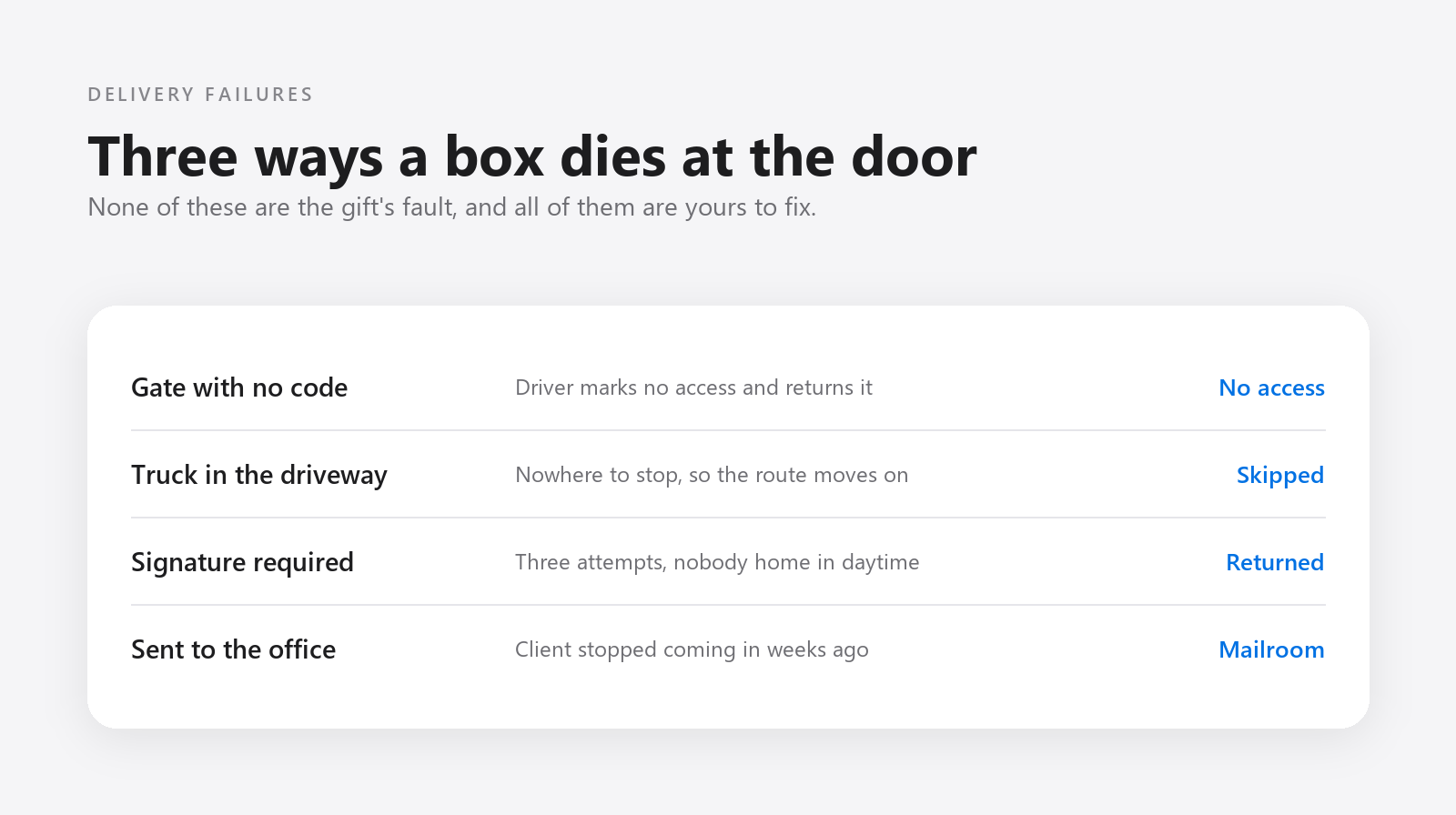
Three failures account for most of the losses.
A gated building with no code gets marked "no access" and comes back to you. A moving truck in the driveway means no place to stop, so the driver continues the route. A signature requirement on a gift means three attempts and a return, because nobody is home in the middle of a weekday.
A fourth is specific to this trade: a box sent to the office after the client stopped coming in sits in a mailroom.
One workaround is legitimate. USPS Hold Mail keeps mail at the local post office for three to thirty days, and a parcel can be held for pickup. For a client moving across town over a weekend, handing the box over at the walkthrough beats any tracking number.
Pack it for a house full of Corporate Gift Boxes
Your gift arrives where every horizontal surface is cardboard, and gets opened with a box cutter by someone on their fortieth box of the day.
No loose glass without a box inside a box. No liquid over 750ml. No chocolate or candles on a summer move — six hours in a hot delivery van does not recover. One desiccant pack prevents the smell that ruins the box.
Write "open this one first" on the lid in marker. Put the card inside, never taped outside — a card on the outside tells the whole building what is in the box. The judgment happens in about the first minute, and a poly mailer reads as a promotional drop.
Ask for the referral on a different calendar
Employee Appreciation Gifts and referral requests fail together, because one is a thank-you and the other is a request for work.
Separate them by at least a week, and separate the review from the referral too. A review is a small public favor; a name and a phone number is a bigger private one. Asking for both in one text gets neither.
The day-30 call is the natural moment, because you have a reason to call that is not the ask. "How is the house treating you? Did trash turn out to be Tuesday or Wednesday?" Once that is answered, one sentence is enough: "If anyone on your street is thinking about selling this fall, I would be glad to talk to them — no pressure either way."
At month 12, send the anniversary note with something specific attached: a $15 bakery card, furnace filters sized to the unit. By then you are competing with silence, not with another agent.
What a 40-deal year actually costs
Forty closings at $95 a gift is $3,800. The number is fine. How custom gifts are sold is the problem.
Minimum order quantities in promotional manufacturing sit around 500 pieces. Suppliers who take 30 usually add roughly 50% to the unit price, and the reason is structural: tooling, a pre-production sample and a line setup are fixed costs that do not halve because the order is small. Bulk runs start at about 30 days; a 30-piece run can come back in 7 to 15.
That is an awkward middle: two or three closings a month will not support 500 engraved boards, and a 50% premium on every closing is worse.
The workable version is three tiers. Two stock items with no personalization, bought twice a year. One personalized item that earns its setup cost, ordered in batches of 50 to 100. Everything else bought locally the same week, which is also the only tier with no lead time.
Order engraved items when the contract is signed, not when closing is scheduled. Two weeks out is already inside a bulk lead time. And if you quote a client a delivery date on a custom order, you need a reasonable basis for it — without a stated date, the FTC default is thirty days.
The short version
Pick the stage, then the object, then the budget. Spend the money between closing and day 30, when the house is asking questions and your name can be the answer. Confirm the new address in the carrier's system, drop the signature requirement, put the card inside the box. Ask for the referral a week after the thank-you, in one sentence, with an easy exit.
If you are running this across dozens of closings, the constraint is not taste. It is lead time and minimums. Send us your deal count and the two or three items you want to standardize on, and we will come back with a stocking plan before we talk about price.
References (Neutral Third-Party Sources)
- USPS — Standard Forward Mail & Change of Address: how long a change of address takes to start, the twelve-month forwarding window, and which mail classes are not forwarded. https://www.usps.com/manage/forward.htm
- USPS — Domestic Mail Manual 507.2, Forwarding: forwarding periods by mail class, postage due on forwarded parcels, and the retention window for undeliverable Express mail. https://pe.usps.com/text/dmm300/507.htm
- USPS — Hold Mail: holding delivery for three to thirty days, the basis for the hold-for-pickup suggestion. https://www.usps.com/manage/hold-mail.htm
- FTC — Business Guide to the Mail, Internet, or Telephone Order Merchandise Rule: the requirement to have a reasonable basis for a stated ship date, and the thirty-day default when no date is given. https://www.ftc.gov/business-guidance/resources/business-guide-ftcs-mail-internet-or-telephone-order-merchandise-rule