
Crowdfunding Fulfillment: Ship Rewards to Backers Worldwide
Short answer: crowdfunding fulfillment is the one-time job of turning a finished production run into thousands of separate parcels — collecting backer addresses, mapping every pledge tier to a packing list, and releasing the shipments in waves to a dozen or more countries. Campaigns that land on time lock five things before Orders After Launch: final carton size, final weight, a hard address-freeze date, a tier-to-packlist map, and a shipping budget that includes replacements. Campaigns that lose money usually get one of three things wrong: they quote shipping on a prototype, they treat duties as the backer's problem, or they let address data go stale for six months.
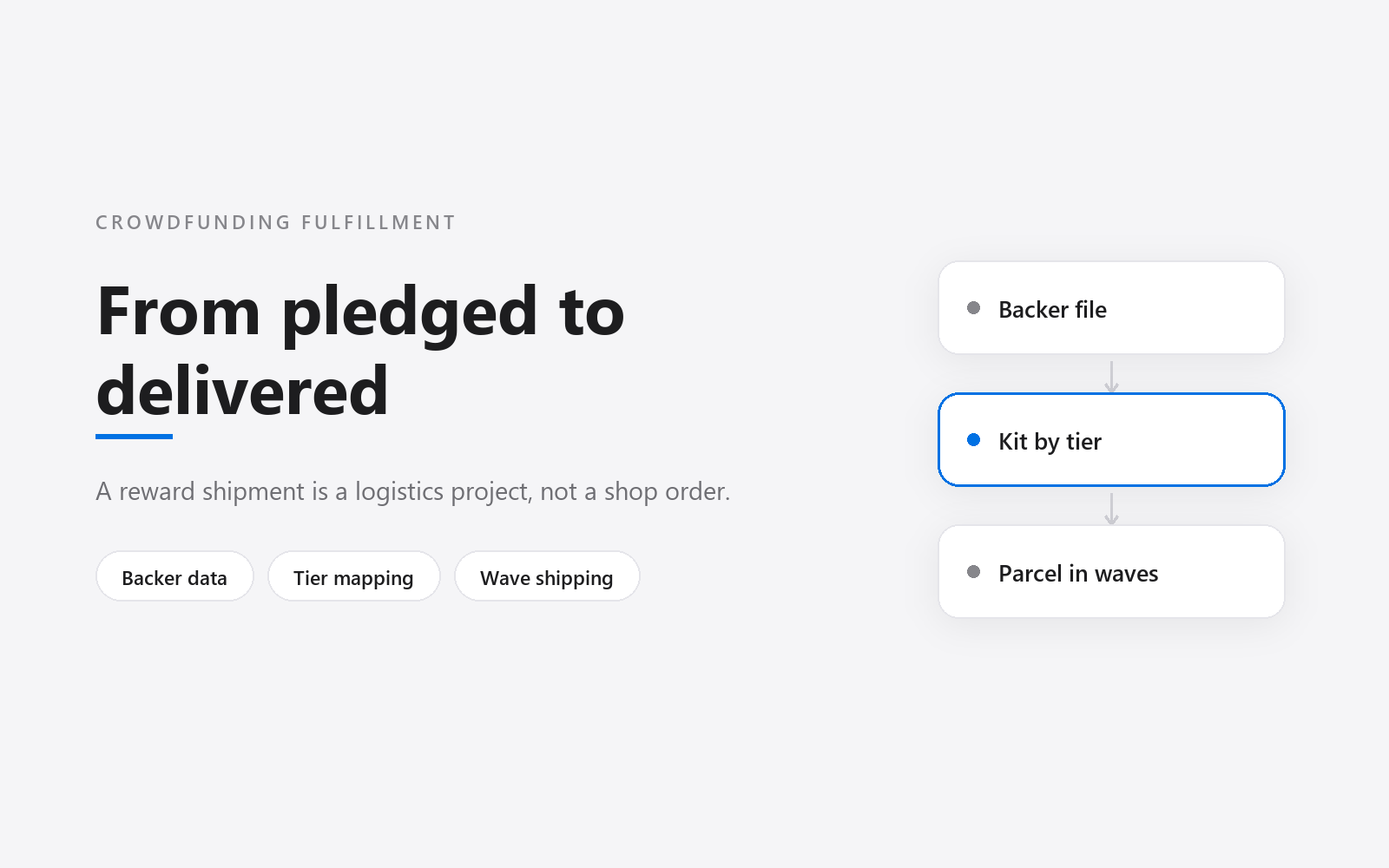
Why crowdfunding shipping is not ecommerce shipping
Ecommerce fulfillment is a steady daily flow. Crowdfunding is a single surge followed by a long tail of exceptions.
- Orders arrive in hours, but the goods may not reach the warehouse for three months.
- Addresses are collected at pledge time and used half a year later. People move.
- A tier is rarely one item. It is a combination of three to five items, and tiers stack with add-ons.
That is why the work is front-loaded. By the time the container lands, every rule should already be written down: what goes in each tier, who pays duty, what happens after the freeze date.
Where the money leaks
Five leaks account for most of the overruns we see on post-campaign shipping.
| Leak | What it looks like | Fix before ship day |
|---|---|---|
| Dimensional weight drift | Shipping was quoted on a prototype; the retail carton adds an inch on each side and the whole run moves into a higher billing band | Quote on the final carton, measured, plus a 5% cushion for packaging changes |
| Duty surprise | The backer is billed at the door, refuses the parcel, and posts about it | Decide DDP (you pay) or DAP (backer pays) per market, and say which one on the reward page |
| Address decay | Missing apartment numbers, bad postcodes, people who moved | One hard freeze date, one reminder, validation on export |
| Tier sprawl | Twelve physical combinations means twelve packing routines | Cap tiers at five; pre-kit the three best sellers |
| Replacement gap | Damaged and lost parcels eat the margin | Hold 3% overage — Kickstarter's own recommendation |
The five stages of a reward shipment
1. Lock the packout. Final carton, final weight, final barcode. Do this before mass production, not after. Every later change costs a re-quote on thousands of orders.
2. Clean the backer file. Export from the platform or pledge manager, normalise country names and postcode formats, flag missing street numbers and duplicate order IDs, then set the freeze date.
3. Build kits by tier. Turn the top three combinations into one pickable kit SKU. Leave the long tail as components and pick it per order.
4. Ship in waves. Release 100–300 parcels first. Check damage rate, address-error rate and delivery performance. Then release the rest.
5. Close the loop. Upload tracking, work the exception queue daily, and keep replacement stock in its own bin so it does not get picked for new orders.
Tiers drive cost; distance is the second variable
Creators usually assume international shipping is the expensive part. It often is — but the number of physical combinations decides how much labour sits inside every parcel.
| Tiers and options | Physical combinations | Picking method | Cost effect |
|---|---|---|---|
| 1–3 tiers | 5 or fewer | Pre-kit everything | Lowest cost per unit, highest space held |
| 4–6 tiers | 10–20 | Pre-kit top three, pick the rest | Balanced — the most common setup |
| 7+ tiers or add-ons | 30 or more | Keep components, assemble to order | Most flexible, highest labour per unit |
Three tiers, two add-ons and two colours is not three decisions. It is up to twelve different packing routines, and each one needs its own instructions and its own first-article check.
Ship in waves, not in one blast
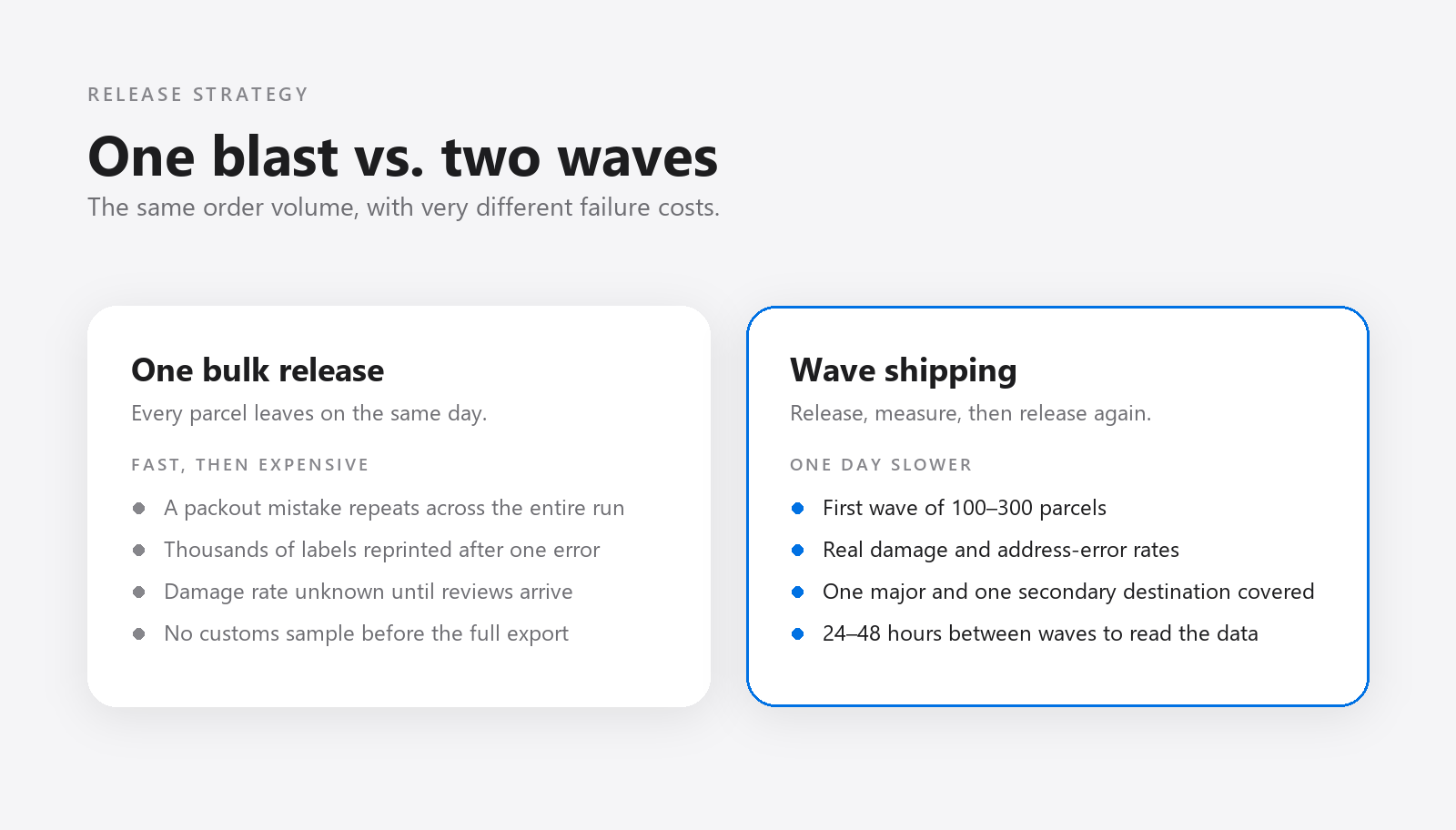
A single release feels efficient. It also multiplies any mistake by the full order count — a wrong insert caught after 4,000 labels are printed means 4,000 relabels.
Wave shipping costs a day and buys three things: a real damage rate, a real address-error rate, and a customs sample. Cover at least one major destination and one secondary destination in the first wave, or you will not see the clearance differences. Leave 24–48 hours between waves to read the numbers instead of waiting for the queue to empty.
What the reward budget actually pays for
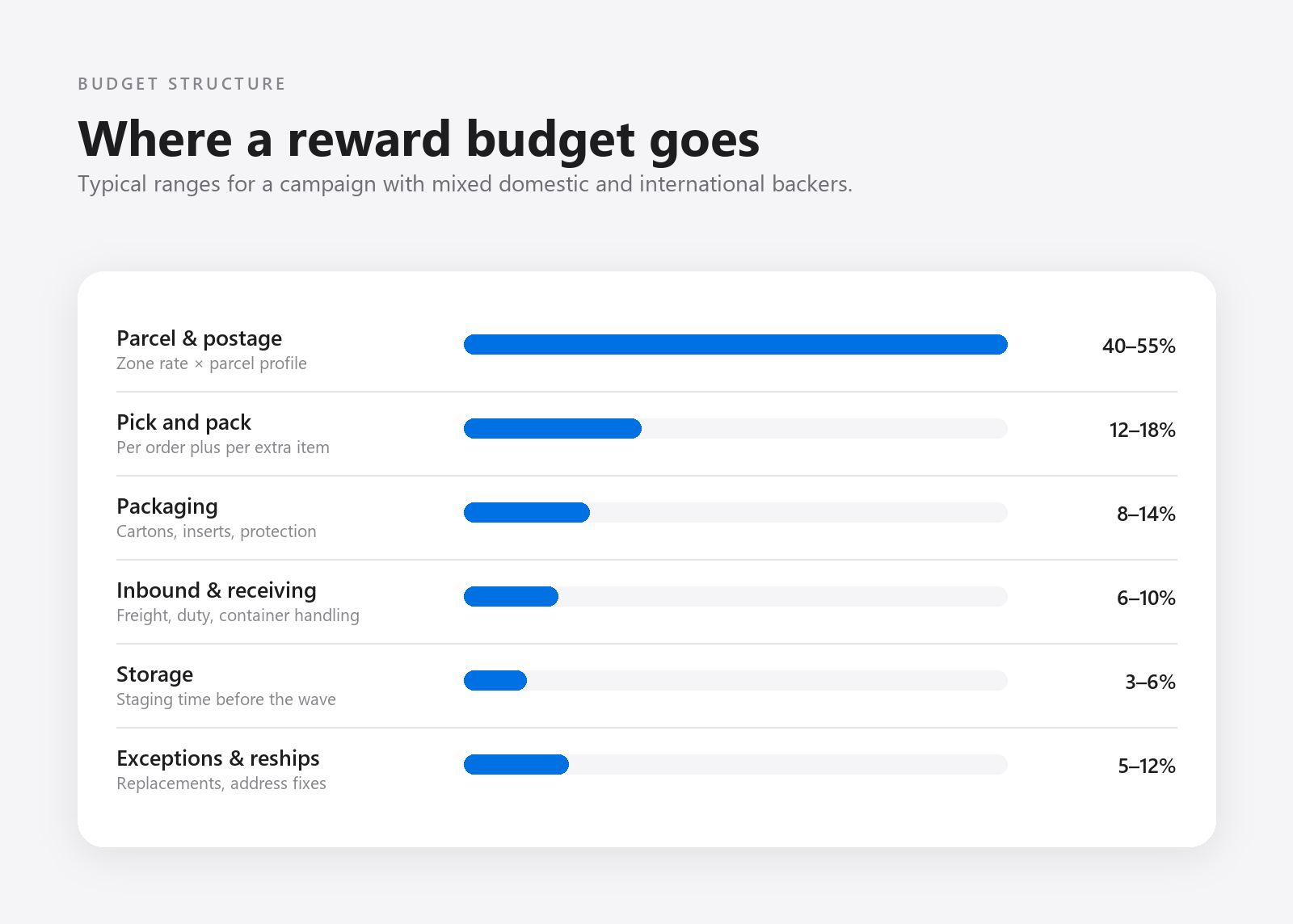
Parcel cost dominates, but it is not the only line that moves. The one creators forget is exceptions: replacements, reships and address corrections can keep arriving for six months after the main delivery, and they need their own budget line rather than a slice of the freight estimate.
Six questions worth asking a fulfillment partner
- Can you turn our tier list into a written packing list, per tier, before we commit?
- Can you release our orders in waves, or only as one bulk import?
- Do you quote DDP and DAP separately for each destination country?
- What is your address-validation and freeze-date process?
- Where does replacement stock live, and how is it billed?
- If our goods are made in China, can you take the inbound container directly?
A partner who answers all six in writing — not in a call — is usually the one who has done this before. Our crowdfunding fulfillment service is built around exactly these six points, and if your tiers include assembled kits, the kitting workflow runs on the same floor.
FAQ
When should we start planning fulfillment? Before launch, at least at budget level. Onboarding a warehouse takes four to eight weeks before the goods arrive, and the packout test has to happen while packaging is still changeable.
How many orders before outsourcing makes sense? Kickstarter suggests a fulfillment partner above 500 packages. Our threshold is lower when complexity is higher: more than five destination countries or more than four tiers, and 300 parcels is enough to justify it.
Who pays duties and taxes? You How to Choose. DDP means you pay and the backer sees no bill; DAP means the backer pays on delivery. DDP protects the experience and your reviews; DAP protects the budget. Split the decision by market rather than applying one rule everywhere — and do not price a campaign on the assumption that the US $800 de minimis threshold will hold, because it has been under repeated legislative pressure and low-value parcels can start carrying duty with little notice.
What if a backer moves after the freeze date? Treat it as a reship: new label, new cost, clearly stated in advance. Backers accept rules they can read on the project page; they do not accept rules invented after the parcel is returned.
References
Background and platform guidance used for this article. No competitor pages are cited, and every link below is set to nofollow.
- Kickstarter Creator Handbook — Fulfillment: partner threshold, 3% overage, five-tier guidance. https://www.kickstarter.com/help/handbook/fulfillment
- Wikipedia — Crowdfunding: how reward-based crowdfunding works as a funding model. https://en.wikipedia.org/wiki/Crowdfunding
- Wikipedia — Dimensional weight: why carriers bill on volume rather than scale weight. https://en.wikipedia.org/wiki/Dimensional_weight
- Reddit — r/kickstarter: creator discussion on post-campaign delivery and backer communication. https://www.reddit.com/r/kickstarter/