
Kickstarter Fulfillment: The Post-Campaign Guide
Short answer: the two weeks after your campaign funds decide how the next three months go. Do five things in that window — export the backer report, open your pledge manager and survey, lock the final carton and weight, choose who ships, and set one hard address-freeze date — and the rest is weekly rhythm. Skip them and you will discover, on arrival day, that your address file is still a mess.
If you are still deciding how rewards should leave the building at all, start with the overview of crowdfunding fulfillment and come back here for the platform mechanics.
A timeline that survives contact with a factory
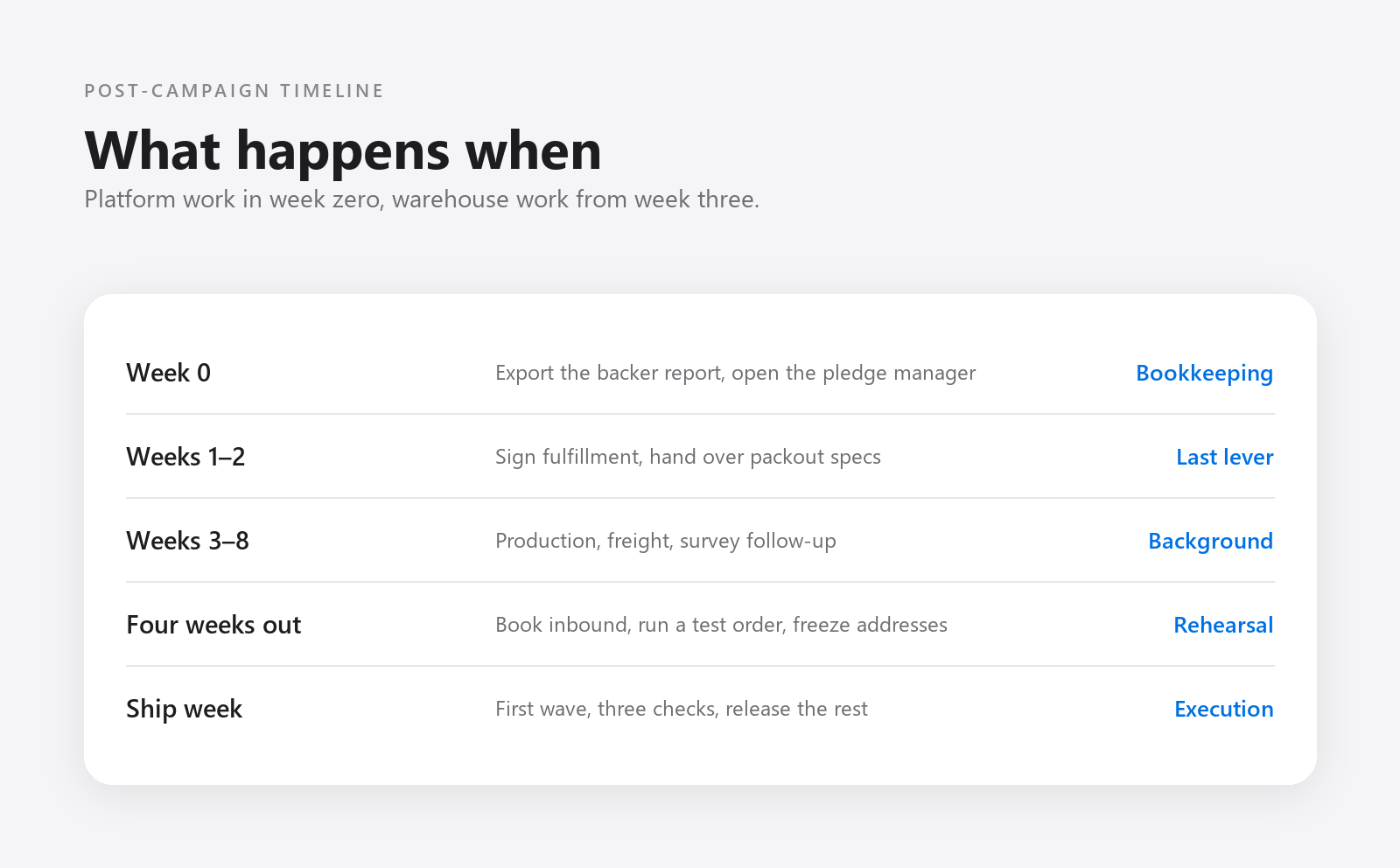
Week 0 is bookkeeping: export the backer report and launch the pledge manager before the goodwill of the campaign wears off. Weeks 1–2 are the only window where a fulfillment partner can still influence your packaging. Weeks 3–8 belong to production and freight, and your job is to keep the survey response rate climbing in the background. Two to four weeks before arrival, book the inbound appointment and run a test order. Ship week is execution, not decisions.
Add a 30% time buffer and a 20–30% budget buffer to whatever your suppliers told you. That is not pessimism. A factory that says two weeks means four, and the freight quote you signed in month one was based on a carton you have since changed.
Ship it yourself, or hand it over?
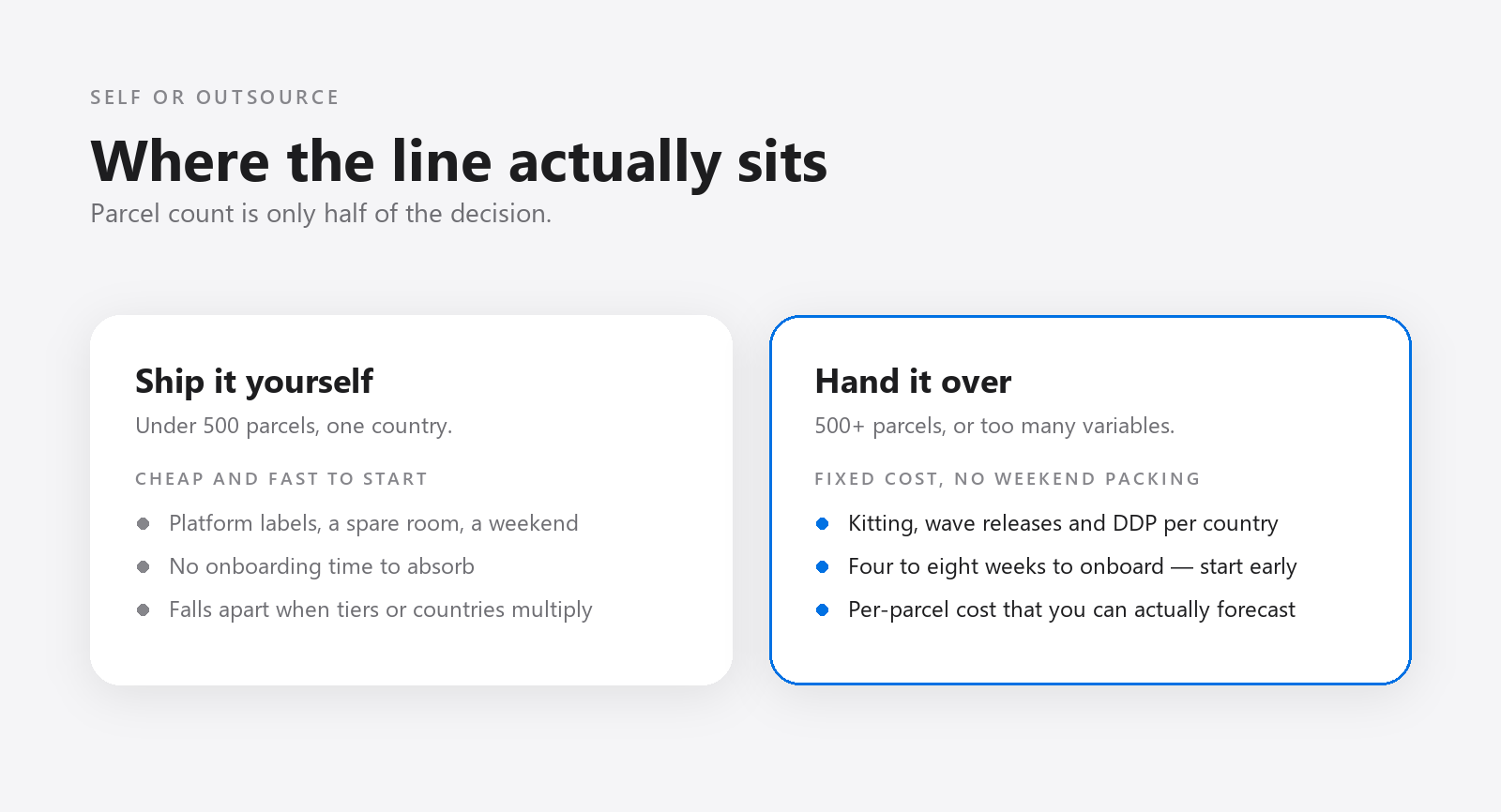
Kickstarter's own guidance is direct: above 500 packages, consider a fulfillment partner. Our version is a little more specific, because parcel count is only half the story.
- Under 500 parcels, one destination country, three tiers or fewer: self-fulfillment works. Platform labels, a spare room, a weekend.
- Above 500 parcels, or five-plus countries, or four-plus tiers: outsource. The problem is not volume, it is variables.
- In between: outsource the first wave, self-fulfill the long tail. Creators rarely consider this split, and it is often the cheapest option.
Release at 85% survey completion
The most common stall is waiting for the last 12% of backers to submit an address. Waiting costs warehouse days and storage fees. Shipping early feels like abandoning people.
Release at 85%. Hold stock proportional to the missing responses, run those as a separate catch-up batch, and put the freeze date in a project update so nobody is surprised. Kickstarter reminds non-responders every two days for a survey and every seven days for a pledge manager — if someone still has not answered after that, another week will not fix it.
One trap worth knowing: backers who signed up with Apple's private relay address cannot be reached by a third-party survey tool at all. Their relay address only works inside Kickstarter. Message them through the platform, or accept that they will arrive in the catch-up batch.
| What the platform gives you | What it will not do for you |
|---|---|
| Pledge counts by tier and by country | Decide which tiers to pre-kit |
| Survey completion and rewards-sent percentages | Keep "rewards sent" honest if nobody updates it |
| Shipping funds collected per country | Choose DDP or DAP for you |
| Backer report export | Archive itself after your delivery date passes |
That last row matters more than it looks. Backer report access expires one year after your project's estimated delivery date. Export and store the file yourself: shipping records, address changes, reship evidence.
The weekly loop
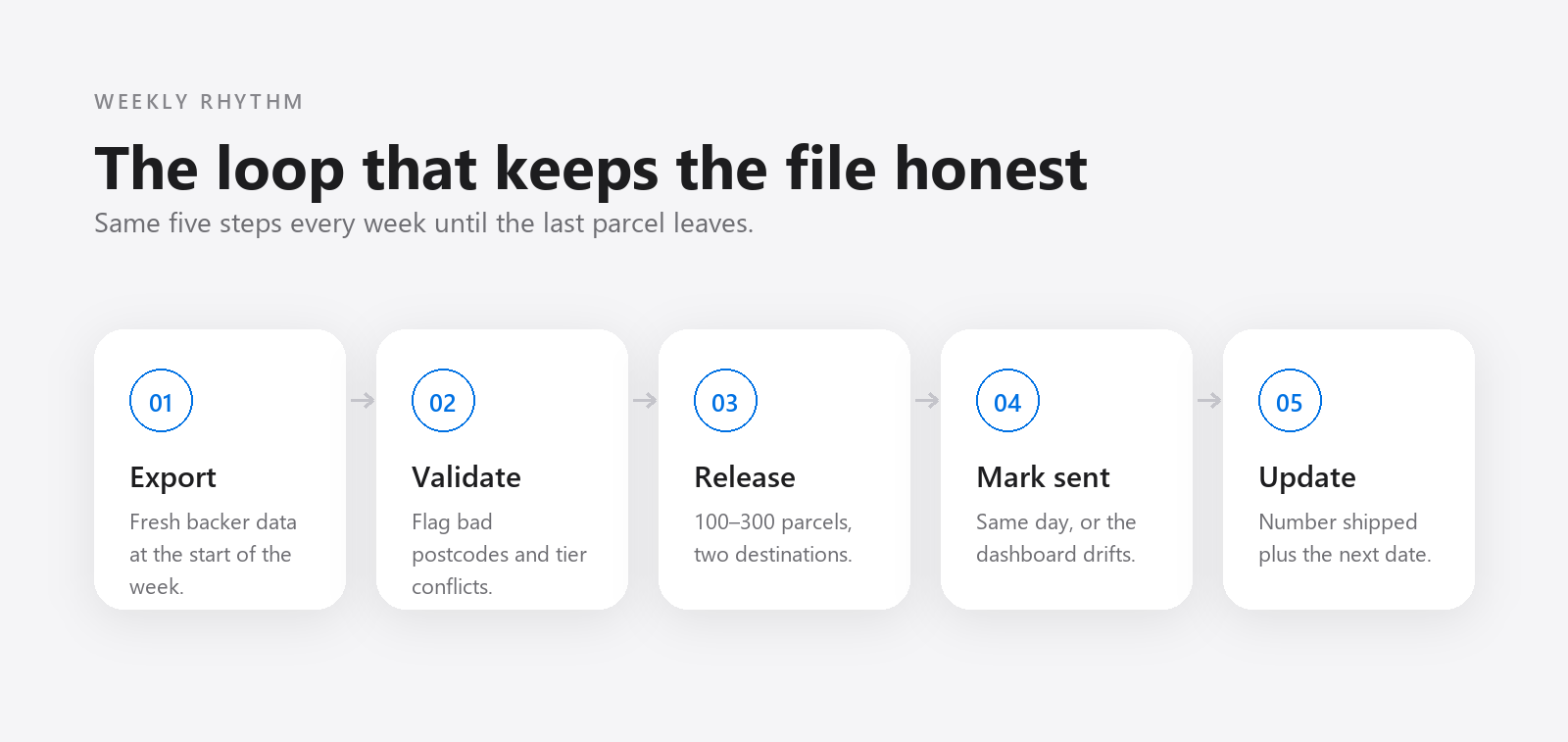
- Export fresh backer data and run address validation.
- Pull the exception list — missing apartment numbers, bad postcodes, tier conflicts — into one sheet with a status per row.
- Release a wave: 100–300 parcels, covering at least one major and one secondary destination.
- Mark those pledges as rewards sent in the backer report the same day. The dashboard reflects what you typed, not what the warehouse did.
- Post an update with the number shipped and the date of the next wave.
The reconciliation in step 4 is the one people skip. After three weeks of drift, the dashboard is decorative and your support inbox becomes the real tracking system.
The duty sentence you have to write
Platform pledges do not include VAT, GST or import duty. Say so, in the project page and again in the survey, in plain words: commercial invoice declared as merchandise, value equal to the pledge amount, freight and duties paid by the backer on international orders. Rewards cannot be declared as Gifting Send Gifts or under-declared — that is not a grey area, it is a customs offence.
Campaigns that state this up front get fewer refusals at the door. Campaigns that mention it after the first parcel is held are the ones with a comment section full of duty complaints.
FAQ
How often should I post updates? Weekly while shipping, monthly otherwise. Give dates, not adjectives.
Can I ship before every survey is in? Yes — at 85%, with proportional stock held back. Anything after the freeze date becomes a reship, and the backer should know that in advance.
Domestic first or international first? Domestic first, then a mixed international wave. You want clearance differences to show up in parcels 200–500, not in the last thousand.
Do I need a 3PL for a 300-backer project? Not always. If it is one country, three tiers and a simple product, self-fulfillment is fine. If it is five countries and add-ons, 300 parcels is already too many variables for a spreadsheet.
References
Platform documentation and neutral references only; every link below is nofollow.
- Kickstarter Creator Handbook — Fulfillment: partner threshold, 3% overage, tier guidance. https://www.kickstarter.com/help/handbook/fulfillment
- Kickstarter Help Center — Fulfillment dashboard: what the metrics measure and how rewards-sent is tracked. https://help.kickstarter.com/hc/en-us/articles/360035848053
- Kickstarter Help Center — Getting backer information: survey reminder cadence and private relay addresses. https://help.kickstarter.com/en-us/articles/16236402
- Wikipedia — Crowdfunding: reward-based crowdfunding as a funding model. https://en.wikipedia.org/wiki/Crowdfunding