
Kickstarter vs Indiegogo: Which Platform Is Better for Your Launch?
How to Choose the platform before the campaign, not before the ship date. The fee difference between Kickstarter and Indiegogo is a rounding error. What separates them is what happens to your order file afterwards: where the address first appears, when the shipping price stops being editable, whether a batch can be locked and unlocked, and whether the queue ever closes.
Most comparisons rank fees, traffic and success rate, then send you to your audience. None of that decides whether four thousand parcels leave the warehouse in the right order in week three.
The fee table won't decide anything
Kickstarter takes 5% of funds raised, plus processing at 3% + $0.30 per pledge, with a discounted micropledge rate under $10. Indiegogo takes 5%, plus 3% and a small per-transaction fee, and counts shipping money toward the total — so postage gets taxed too. Collect it separately or fold it into the goal.
A four-dollar shipping error on 3,000 parcels costs $12,000. That error is created in the first week and paid for in the twelfth, and it dwarfs the fee gap. Price the parcel first.
Where the address actually lives
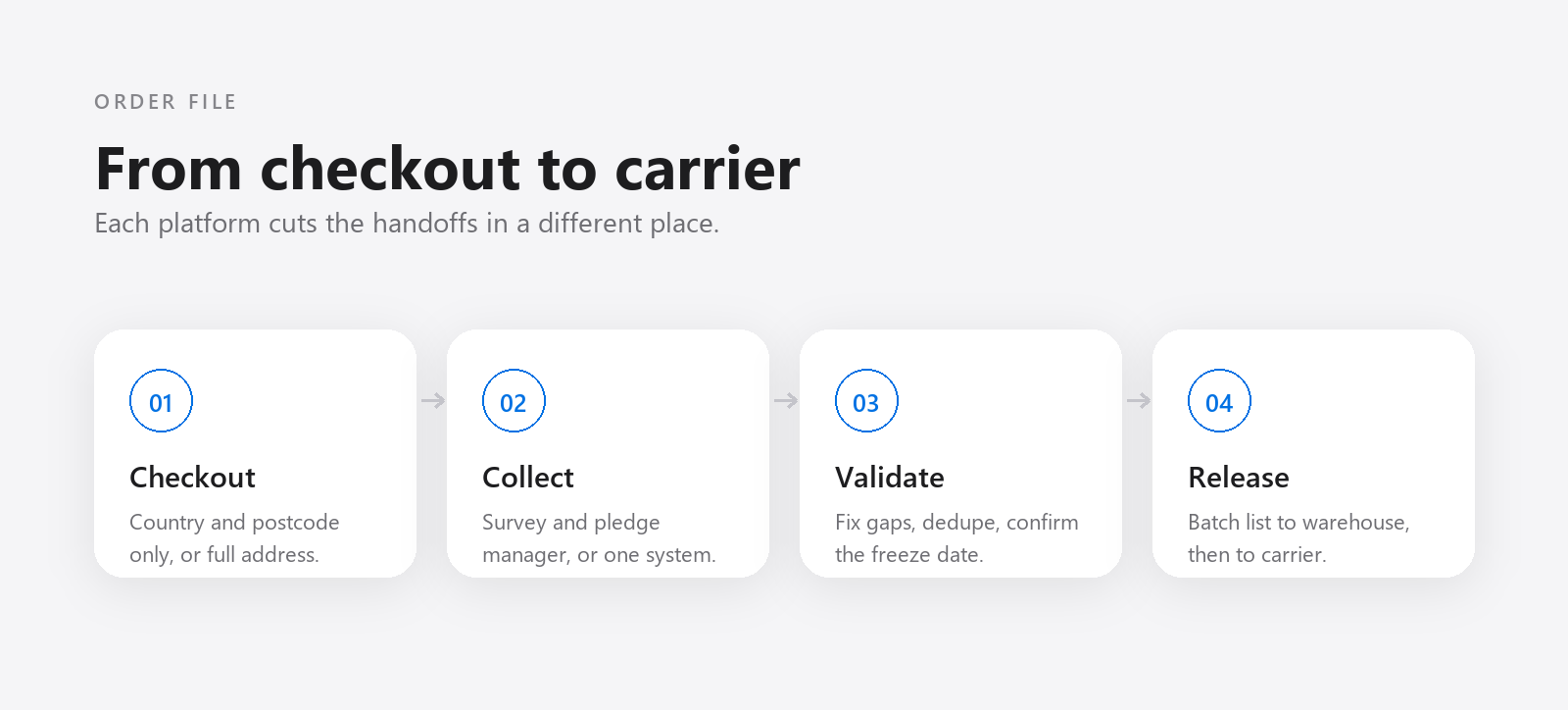
On Kickstarter, checkout captures a destination country and a postcode. Nothing else. The street address arrives later, when the campaign ends and backers open the survey the platform emails them. Until then your order file has four thousand rows and no front doors.
On Indiegogo, the Pledge Manager collects address, shipping money and add-ons in one system, and can be switched to Shipping Only later to keep taking addresses and postage while blocking new products.
The consequence is handoffs. A Kickstarter campaign selling add-ons usually runs a second, external pledge manager to collect that money, so the data travels platform → tool → warehouse, and every hop is a chance to lose a column. Indiegogo skips two hops and inherits harder rules in exchange.
| Question that matters in ship week | Kickstarter | Indiegogo |
|---|---|---|
| When you first see a street address | After the campaign, in the survey | In the Pledge Manager, before the pick list exists |
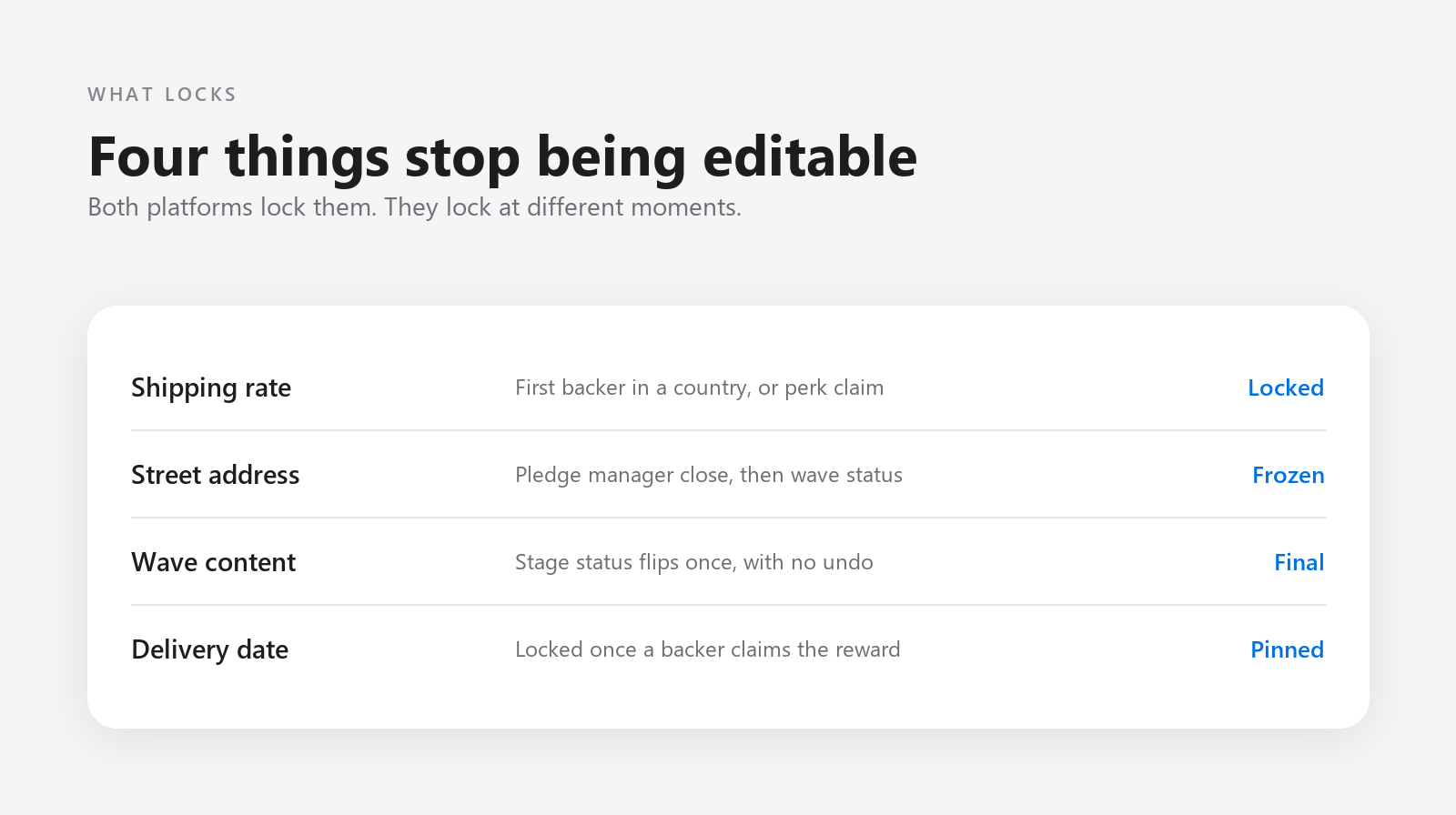
| What freezes the shipping price | The first backer in that country | The moment the perk is claimed |
| Who controls wave release | Your batch file and the warehouse | Shipping Stages, with a Each Order Status that cannot be undone |
| After the deadline | Orders stop; later sales run elsewhere | InDemand keeps taking orders |
| If the goal is missed | Nothing charged, nothing ships | Fixed: refunded. Flexible: paid out, perks still owed |
| Typical ship-week failure | A lost column between two systems | A stage flipped before stock is counted |
Two details decide how complete the file is at freeze time. Kickstarter's reminders fire every two days for a survey and every seven for a pledge manager, and backers on Apple's private relay address cannot be reached by any off-platform tool — message them inside the platform or expect them in the catch-up batch. And the backer report expires a year after the last estimated delivery date; export it, since shipping records and reship evidence live there.
The shipping rate is a one-way door, and the two doors close at different moments
Kickstarter's rule is specific: once a backer from a country has pledged for a reward, you cannot edit the shipping price for that country on that reward. You can add countries. You cannot re-price the ones you already sold.
So the first UK backer freezes your UK rate. The pricing decision is made by whoever clicks first.
Indiegogo hangs the rate on the perk, by destination — worldwide, a region such as the EU, and single-country rates where a country sits awkwardly inside a region. Narrow beats broad: set the EU at $20 and Italy at $10, and an Italian backer pays $10.
Both reward the same discipline: price from the final carton, not the prototype, then add 15–20%. A box that grows half an inch in each direction can jump a billing band, and the jump is permanent.
Three passes, in this order:
- Fix the buckets first. US, EU, UK, Canada, Australia, rest of world is the floor. Then pull out the destinations that only look like they belong — Alaska, Hawaii, Puerto Rico, Norway, Switzerland. Remote-area coverage is the quiet cost in every crowdfunding on a Budget; averaged into a regional rate, you absorb it.
- Price the real carton, then buffer. The carton approved in month one is rarely the one that ships.
- Say whether the rate includes duty. Prepaid and duty-unpaid are different products with different support loads.
Waves: one platform has a switch, the other has a spreadsheet
Indiegogo ships with Shipping Stages: each stage carries a description and an estimated ship date backers see at checkout, products are assigned to stages, and three statuses control what new orders can buy.
Kickstarter has no equivalent. A wave there is a definition inside your pledge manager or your own file, and the warehouse releases stock against whatever batch list you hand over. More flexible, less protected: nothing stops you packing parcels while addresses are still editable.
The operating discipline follows. On Kickstarter a wave can be re-cut at 11pm, so the discipline has to come from you. On Indiegogo the status flip is immediate and cannot be undone: goods in, counted, checked, and only then the flip. Do it the other way and you own a locked wave with nothing to put in the Corporate Gift Boxes.
A sensible first batch? A hardware team shipping an Indiegogo campaign ran 200 production units, brought the second batch off the line mid-month, sent it to the regional warehouses and released parcels in order-number sequence. Two hundred units surfaces label, packaging and manual problems without exposing the backer base.
Gifting at Scale that: 60–70% in the first wave and 30–40% held for the tail and the exceptions beats an even split.
Does the order queue ever close?
On Kickstarter, yes. Pledges stop at the deadline and anything sold afterwards happens elsewhere — a different system with a different file.
On Indiegogo, not by default. InDemand keeps the project taking orders after the campaign ends, with no goal and no end date, and perks stay editable. Two things land in the warehouse: an inventory plan that is wrong if it only covers campaign orders, and late orders that never generate a survey row because the backer entered an address at checkout. Export those separately, or you get rows with an order number and no street. Reserve stock at the rate late orders actually arrive, plus the 2–3% replacement buffer.
Who carries the refund when the goal is missed
Kickstarter is all-or-nothing: no goal, no charge, no funds — and in fulfillment terms, no parcels, no reships, no refund queue.
Indiegogo offers two models, locked at launch. Fixed funding behaves like Kickstarter. Flexible funding pays out whether or not the goal is met, and the perks are still owed. Hold 60% of the budget and owe 100% of the parcels, and the delivery plan has to survive that rather than assume the goal.
Successful campaigns are typically paid out about 15 working days after closing, usually after the production deposit is due. And the platform's leverage is limited: it can chase a creator and ban one who stops communicating, but it will not ship the rewards for you.
Which categories get rejected — and why the folklore is wrong
Kickstarter allows fifteen categories and requires a project to create something new. For Design and Technology the prototype has to be demonstrated, with no CGI standing in for functionality that doesn't exist. Charitable donation is capped at 10%. Service businesses, marketplaces, health claims, alcohol, energy drinks, equity, weapons and drugs are out.
Indiegogo's content policy prohibits charities, resale, alcohol and tobacco, weapons, drugs, health claims, financial products and political campaigns.
Put the lists side by side and the folklore collapses: for a physical product they are nearly identical. "Indiegogo is looser" describes how money is released and how long the queue stays open, not what you may sell. A private-label product bought off a shelf and re-listed under your own brand is rejected in both places.
Creators also blur rejected with held. A battery-powered device is allowed on both platforms; what stops it is customs documentation — battery declarations and certification — not moderation.
Two ways to lose a week, and they look nothing alike
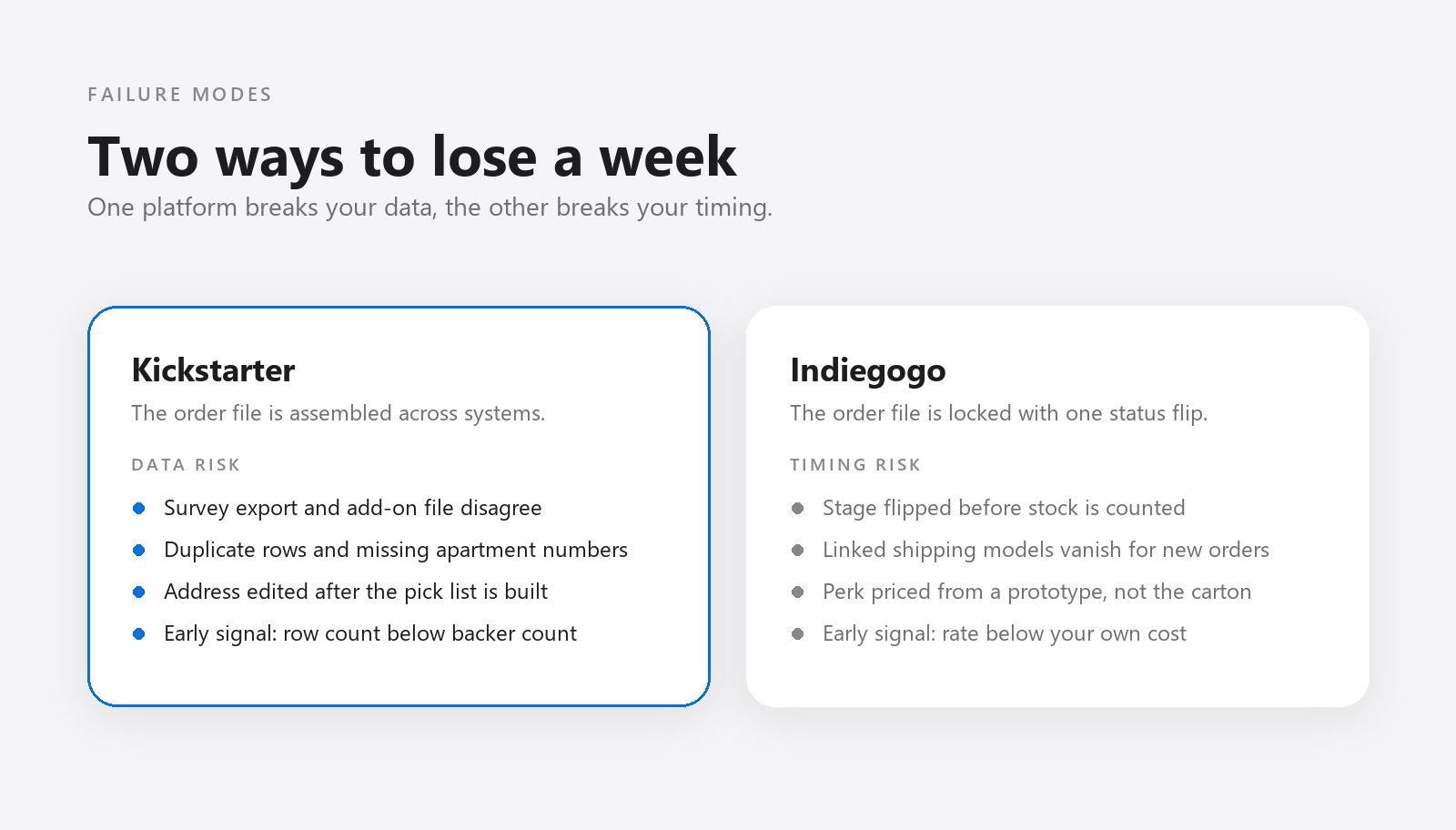
On Kickstarter the failure is usually a lost column: the survey export and the add-on file disagree, duplicates appear, apartment numbers go missing, or an address changes after the pick list was built. The early signal is arithmetic — exported rows no longer match the backer count.
On Indiegogo it is usually a timing error: a stage flipped before the goods are counted, or a perk priced from a prototype so every parcel now costs four dollars more than it collected. The early signal is a destination whose rate sits below your own calculated cost.
One is a data problem, the other a sequencing problem. Pick the failure your team is less likely to commit.
The decision rule
| Your situation | Default that fits | Why |
|---|---|---|
| Under 500 parcels, one country, three tiers | Either; Kickstarter is simpler | The queue closes at the deadline and stays closed |
| 20+ countries, four waves, paid add-ons | Indiegogo | Address, postage, add-ons and waves in one system |
| Goal may land at 60–70% | Indiegogo flexible, only if you can deliver on 60% | Funds are kept, so the parcels are still owed |
| The page should keep selling afterwards | Indiegogo InDemand | Kickstarter needs a separate store |
| Prototype still changing | Neither, yet | Kickstarter requires a demonstrated prototype |
The short version
Pick the platform whose failure mode you will live with. Many countries and several waves: Indiegogo removes two data handoffs and charges you a status you cannot undo. One country, one or two batches: Kickstarter gives you a queue that closes itself.
Fix two numbers before launch — the rate from the final carton and the size of the first wave — and fees stop being a decision.
If you have a wave plan you are unsure about, send the parcel count, the country split and the number of tiers. We will come back with a release schedule before we talk about price.
References (Neutral Third-Party Sources)
Platform documentation and public rules only. Every link below is nofollow; no fulfillment provider is cited.
- Kickstarter — Fees: United States: the 5% platform fee, 3% + $0.30 processing, the micropledge rate, and the fact that unsuccessful projects are not charged. https://www.kickstarter.com/help/fees
- Kickstarter Help — Can I edit my rewards after I've launched my project?: shipping can be expanded to new countries, but a country's shipping information cannot be edited once a backer there has pledged. https://help.kickstarter.com/en-us/articles/16236617-can-i-edit-my-rewards-after-i-ve-launched-my-project
- Kickstarter Help — Why does Kickstarter use all-or-nothing funding?: no money changes hands if the goal is missed, and goal and deadline lock at launch. https://help.kickstarter.com/hc/en-us/articles/115005047893-Why-does-Kickstarter-use-all-or-nothing-funding
- Kickstarter Help — How can I get my backers' information to fulfill rewards?: survey timing, the 7-day and 2-day reminder cadence, and the Apple private relay limitation. https://help.kickstarter.com/en-us/articles/16236402
- Kickstarter — Our Rules: the fifteen categories, the prototype requirement for Design and Technology, the 10% charity cap, and the prohibited items list. https://www.kickstarter.com/rules
- Kickstarter Creator Handbook — Fulfillment: the 500-package threshold for a fulfillment partner, 3% overage, address collection after funding, and backer report expiry. https://www.kickstarter.com/help/handbook/fulfillment
- Indiegogo — Fees: 5% platform fee plus 3% and a per-transaction charge. https://www.indiegogo.com/info/fees
- Indiegogo Help — Shipping Stages (Multi-Wave Shipping): stage setup, three statuses, and the warning that a status change is immediate and cannot be undone. https://help.indiegogo.com/article/627-shipping-stages-multi-wave-shipping
- Indiegogo Help — How to Manage Access and Close Your Pledge Manager: Shipping Only mode, soft close versus permanent hard close, and the add-on toggle for orders preparing for shipping. https://help.indiegogo.com/article/479-closing-pledge-manager
- Indiegogo — Content Policy: the prohibited category list, including charities, resale, alcohol, weapons and health claims. https://www.indiegogo.com/en/terms/contentpolicy