
3PL on the East Coast: Choosing a Fulfillment Partner Near You
vs Fulfillment Choosing an East Coast 3PL is freight math, not a vendor search. Your warehouse's ZIP code is the origin on every shipping-zone lookup for every order you ship, so a building seventy miles one way or the other changes the bill on your entire order book. Get the location right and you lower the zone on your best customers; get it wrong and you pay a distance penalty on the market that matters most.
This article works through that arithmetic: how zones price a parcel, why the East Coast pays off for East Coast customers, what port access does for importers, and the single-node-versus-split decision. No rankings, no named providers — just the criteria to score a location yourself.
Zones are distance, and distance is money
Ground carriers price domestic parcels by zone, and the zones are bands of distance, not a flat per-mile rate. The USPS Domestic Mail Manual defines them by radius from the origin: Zone 1 is about 50 miles, Zone 2 about 150, and so on out to Zone 8 at roughly 1,800 miles and beyond. A parcel that travels one or two zones costs a fraction of one that crosses eight.
The origin on that lookup is your warehouse's ZIP. Move the warehouse closer to the customer and the zone drops; drop the zone and the per-parcel rate drops on the same billable weight. That is the entire mechanism, and everything else in this article is what happens once you act on it.
A single warehouse on one coast cannot avoid the wide zones. Ship nationwide from one East Coast building and a large share of your customers sit in Zones 5 through 8 — the expensive end of the chart.
Why the East Coast wins for East Coast customers
The East Coast advantage is density. The corridor from Boston through New York, Philadelphia, Baltimore and down to Washington, D.C. is the densest stretch of consumers in the country, and a building in northern New Jersey or eastern Pennsylvania reaches most of it in one to two days by ground.
The rule of thumb is blunt and useful: if more than about 40 percent of your orders ship to the Northeast and Mid-Atlantic, a single New Jersey or Pennsylvania warehouse covers most of your volume in one to two days. If your heavy demand is Southeast or Florida, anchor in Georgia instead. Match the node to your own order map, not to the closest port.
Port access matters only if you import
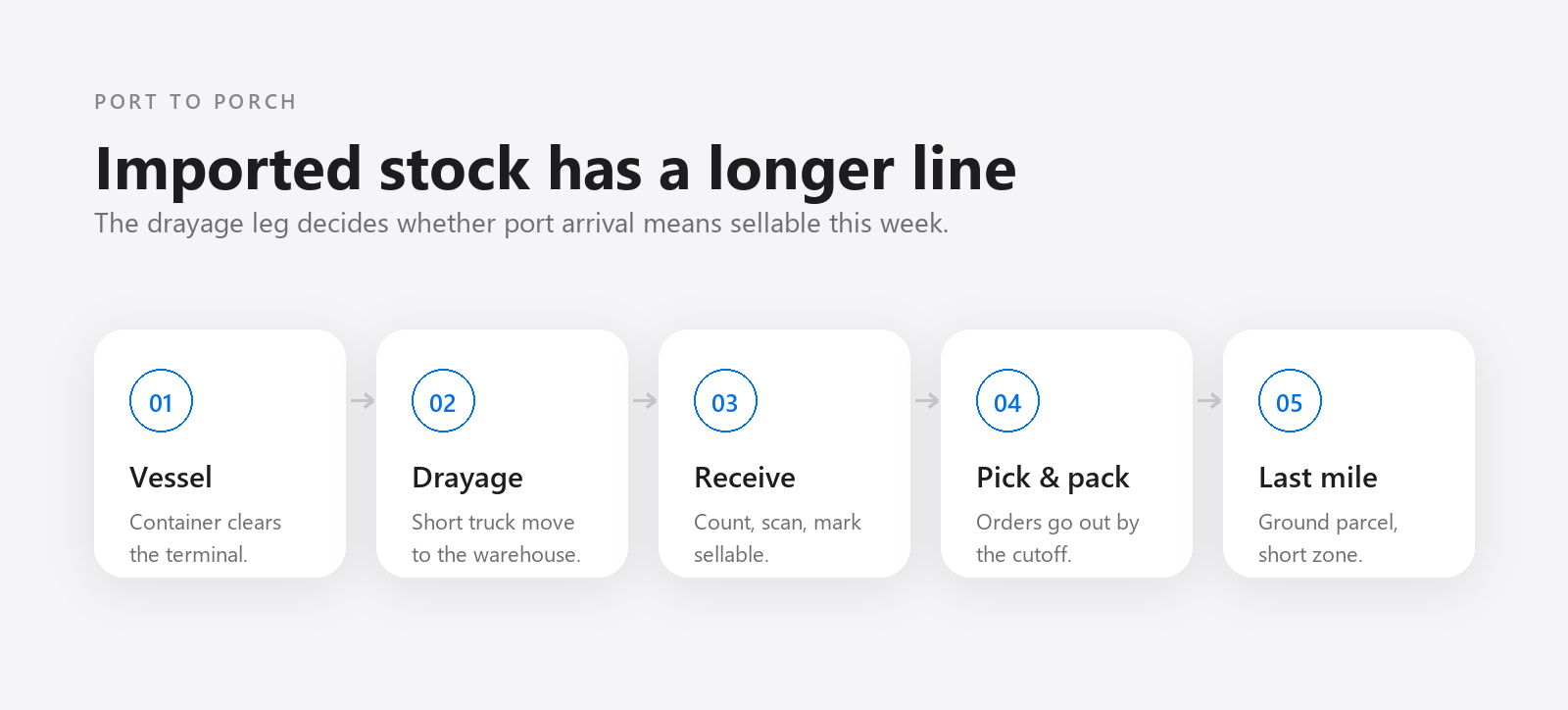
The port argument is real but conditional. If you import container volume, a warehouse near the Port of New York and New Jersey — the busiest container gateway on the East Coast — cuts the drayage leg, the short truck move from the terminal to the warehouse, and turns "arrived at port" into "sellable in the system" within a day or two instead of a week.
Farther south, Savannah and Charleston have grown into major gateways, and a Georgia warehouse gives you port proximity at meaningfully lower rent than the New York metro. The lesson is the same for every importer: decide whether your priority is inbound port access or outbound customer proximity, because they pull toward different ZIP codes.
If you ship only domestic goods and never touch a container, the port is a distraction. Score it a zero and move on.
The three anchor regions trade cost against speed
Most East Coast decisions come down to three anchor regions, and each is a straight trade-off.
| Region | Speed to the Northeast | Warehouse cost | Port access | Best fit |
|---|---|---|---|---|
| Northern New Jersey | Fastest | Highest | NY/NJ, the busiest East Coast port | Speed-first brands |
| Eastern / central Pennsylvania | One to two days | Meaningfully lower | Inland, truck to NY/NJ | Cost-conscious Northeast shippers |
| Georgia (Savannah / Atlanta) | Two to three days | Lower still | Savannah, a top container gateway | Southeast and import-heavy brands |
Pennsylvania is the quiet middle: the Lehigh Valley and Harrisburg keep one-to-two-day coverage of the Northeast while cutting rent and labor. It is why so many operators sit one step inland from the New York metro rather than inside it.
Single node or split: the arithmetic
The split decision is where the location question stops being theoretical. Adding a second warehouse drops the zone on the customers it serves — but only for the SKUs actually stocked in both places.
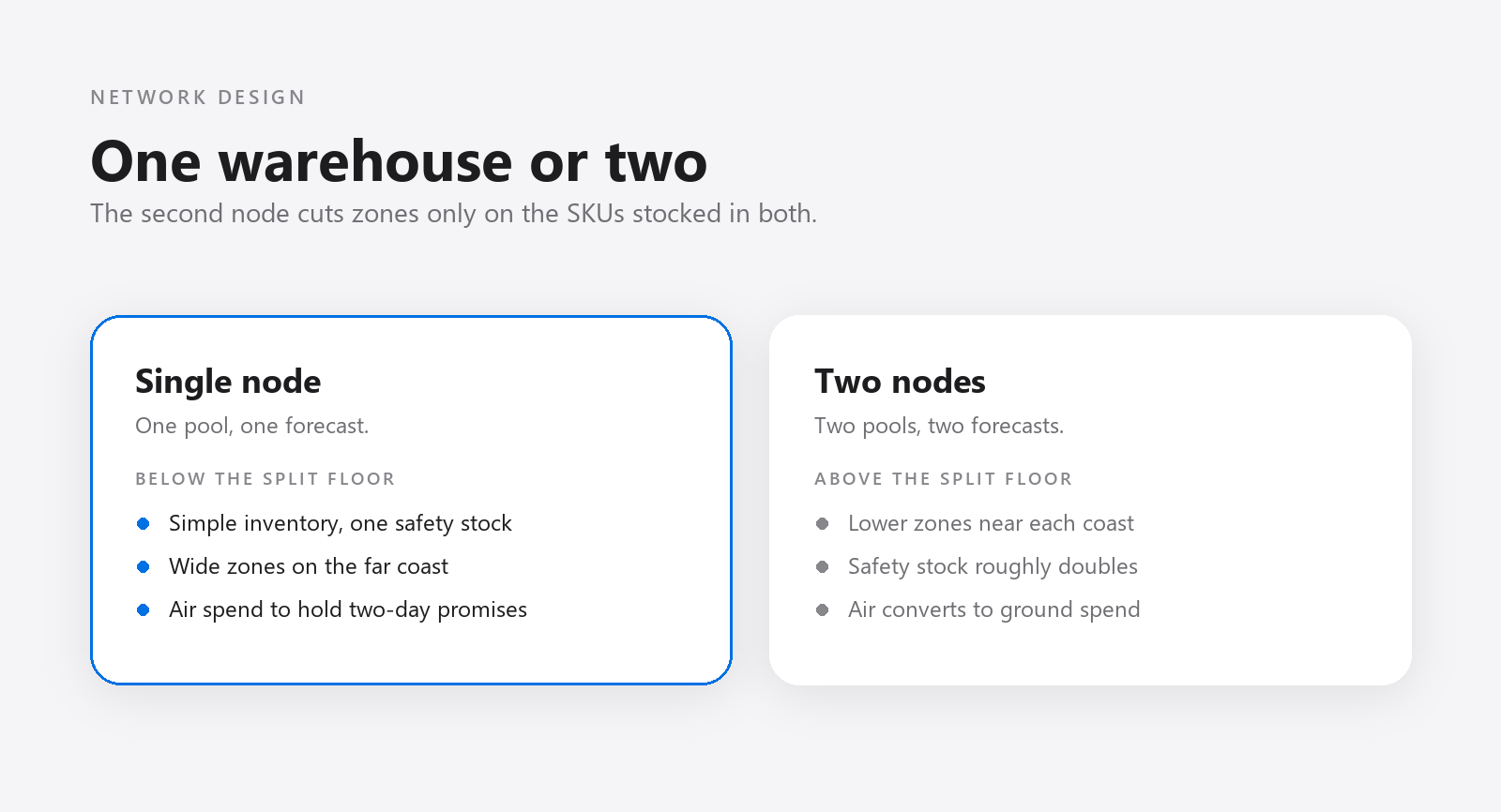
The savings are real but easy to overstate. Industry data across fulfillment operators points to roughly a tenth off parcel cost from a second center, and more from a third — but that saving only lands on the units that exist in the closer location when the order comes in. A SKU stocked at only one coast ships long zones to everyone else regardless of how good the map looks.
The other side of the trade is safety stock. Splitting inventory doubles it: you now hold a buffer in two places instead of one, and you forecast per node rather than for the whole book. Below a certain volume that extra inventory costs more than the zone savings return. The economics generally favor a second node only once you are shipping a meaningful, predictable daily volume — roughly fifty to a hundred orders a day is the commonly cited floor.
That floor matters more than the map. A second node on paper cuts every zone on the page, but a thin node with a third of your catalog in it cancels most of its own orders for lack of stock.
Three signals it is time to split
Don't split on a hunch. Split when the order data says so.
First, pull your last ninety days of orders by destination state. If a heavy concentration sits on the far coast from your warehouse, you are paying a distance penalty on your best market. Second, watch shipping cost per order. If it climbs while order value and weight stay flat, that is usually zone creep — your mix shifted toward the far coast, not the carrier getting more expensive. Third, check how much air you buy to hold a two-day promise. A closer node converts air spend into ground spend, and that conversion is usually the single biggest line item.
A scorecard for any location
Before you sign anything, score the location on six lines, in writing. The right answer on paper is the one you can defend in the invoice later.
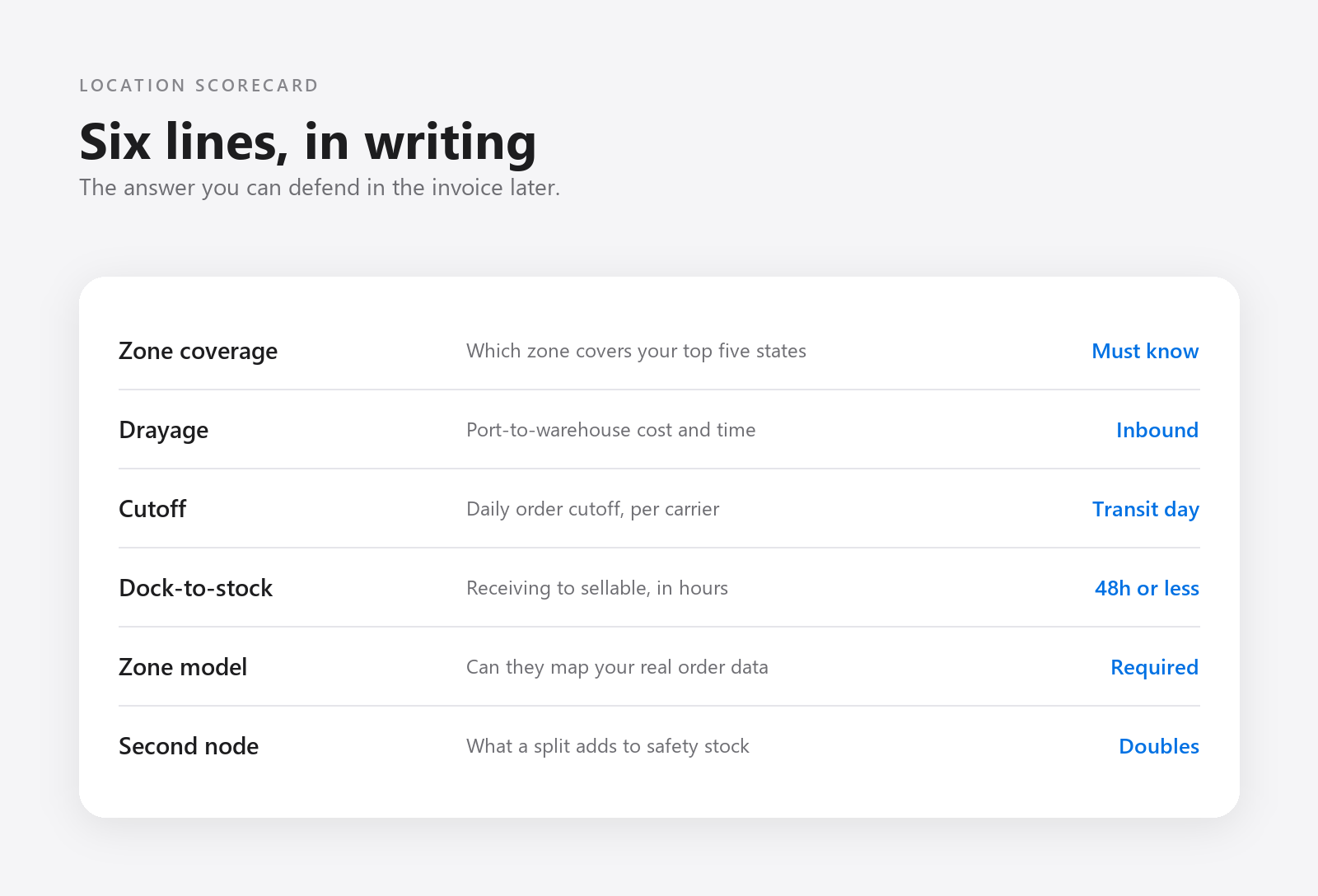
| Question | Why it matters | A bad answer sounds like |
|---|---|---|
| What zone covers your top five states? | That number sets most of your freight | "We don't have a zone map" |
| How far is drayage, and at what cost? | Port-to-warehouse is a hidden inbound line | "The port is close enough" |
| What is the daily cutoff, per carrier? | A late cutoff is worth a full transit day | "Standard times" |
| How fast is dock-to-stock? | Slow receiving cancels the location advantage | "Within a few days" |
| Can you Which Logistics Model the zone math on real orders? | A partner should map your data, not a map | "Trust us" |
| What does a second node add to stock? | Splitting doubles safety stock | "It just works" |
Three "right-column" answers and you are buying a building, not a freight decision.
The short version
An East Coast 3PL earns its place the moment your customers live east of the Mississippi and your freight bill proves it. Match the node to your order map, decide whether port or customer proximity wins, and only split when the volume can support a second safety stock. The location is a number you can calculate before you ever talk to a provider.
If you want the arithmetic done on your data, send us your last ninety days of orders by destination ZIP and your SKU count — we will map the zones and the split point before we talk about pricing.
References (Neutral Third-Party Sources)
- USPS — Domestic Mail Manual, Section 608: the official definition of postal zones 1–8 by radial distance from the origin, the basis for zone-based parcel pricing. https://pe.usps.com/text/DMM300/608.htm
- U.S. Customs and Border Protection — De minimis shipments: the entry threshold that decides whether low-value imports clear duty-free, part of the inbound cost picture. https://www.cbp.gov/trade/programs-administration/entry-summary/de-minimis-shipments
- Federal Trade Commission — Mail, Internet, or Telephone Order Merchandise Rule: the shipping baseline and the duty to notify buyers of delay. https://www.ftc.gov/business-guidance/resources/business-guide-ftcs-mail-internet-or-telephone-order-merchandise-rule
- U.S. Bureau of Labor Statistics — Warehousing and Storage: NAICS 493: how warehousing establishments are defined and where the location decision sits. https://www.bls.gov/iag/tgs/iag493.htm
- GS1 — Global Location Number (GLN): the identifier that gives each physical node in a split network a machine-readable identity. https://www.gs1.org/standards/id-keys/gln