
3PL for Small Business: When It Makes Sense (And Costs)
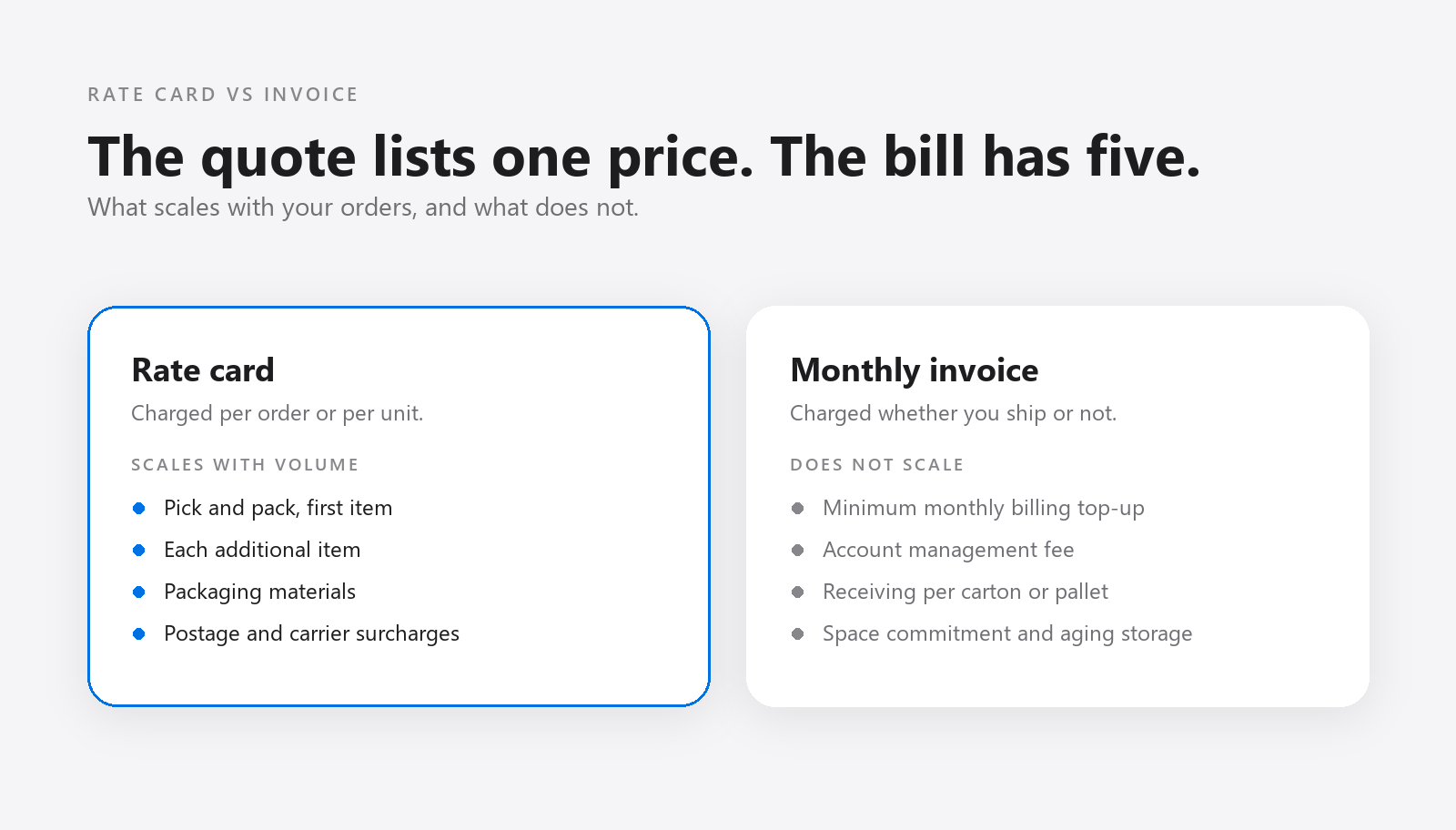
A 3PL prices your account, not your problem. Two brands get the same rate card: one ships 800 orders a month and pays $2.25 a pick, the other ships 80 and pays a $500 monthly minimum, a receiving fee per carton, and storage per bin. Nobody is overcharging the small brand. It is being billed for a share of fixed capacity that larger accounts have already spread thin.
That is why "how many orders before I should outsource" is the wrong question. The question that decides it is narrower: once the minimum, the receiving fee, the slow-moving storage and the mis-ship cost are folded into one number, what does an order actually cost you — and is that number higher or lower than what it costs to pack it yourself?
This article gives the formula, three worked volumes, and one conclusion the rate cards never state: past the minimum, cost per order barely moves.
The price list is never the price
On a large account, a monthly invoice splits cleanly into pick and pack, packaging, storage and postage. On a small account, the first lines are the ones that do not scale with anything you did: minimum monthly billing, an account management fee, an integration fee, a receiving charge.
None of this is malice. Warehouse rent, equipment depreciation and base wages are fixed costs — a 400,000 sq ft building costs the same to hold whether it ships 100,000 orders a day or 10,000. A 3PL slices that fixed cost into a monthly fee and charges small accounts the slice they occupy.
You are not haggling over the pick fee. You are deciding how much fixed capacity you are willing to rent before you have the volume to fill it.
Three different minimums hide in one contract
They usually appear together, and sales calls tend to mention only the first.
| Type | How it bills | What it does to a small account |
|---|---|---|
| Minimum monthly billing | If the month's fees fall below $X, you pay $X | Silent waste in slow months; the difference buys nothing |
| Minimum order volume | Below N orders, you are billed for N or pay a shortfall penalty | Fine in Q4, punishing in January and February |
| Minimum space commitment | You hold N pallets or bins whether or not they are full | Worst one for brands with long-tail SKUs |
Stack all three and the real entry ticket reads "$500 plus 300 orders plus five bins" — while the quote in your inbox only mentions the $500.
Run the floor math before you ask for a quote
One line does the work:
Effective cost per order = max(monthly variable charges, monthly minimum) ÷ orders shipped that month
Variable charges here means pick and pack, packaging, storage allocated per order, returns handling and the account fee. Plug in a mid-range set of industry figures — $2.25 first pick, $0.40 per additional item, $0.75 packaging, $0.30 storage per order, $0.25 returns, $60 account fee — and three volumes look like this:
| Line | 80 orders/mo | 200 orders/mo | 500 orders/mo |
|---|---|---|---|
| Variable charges | $294 | $734 | $1,835 |
| Account fee | $60 | $60 | $60 |
| Amount invoiced | $354 | $794 | $1,895 |
| $500 minimum applies | Yes, $146 top-up | No | No |
| Effective cost per order | $6.25 | $3.97 | $3.79 |
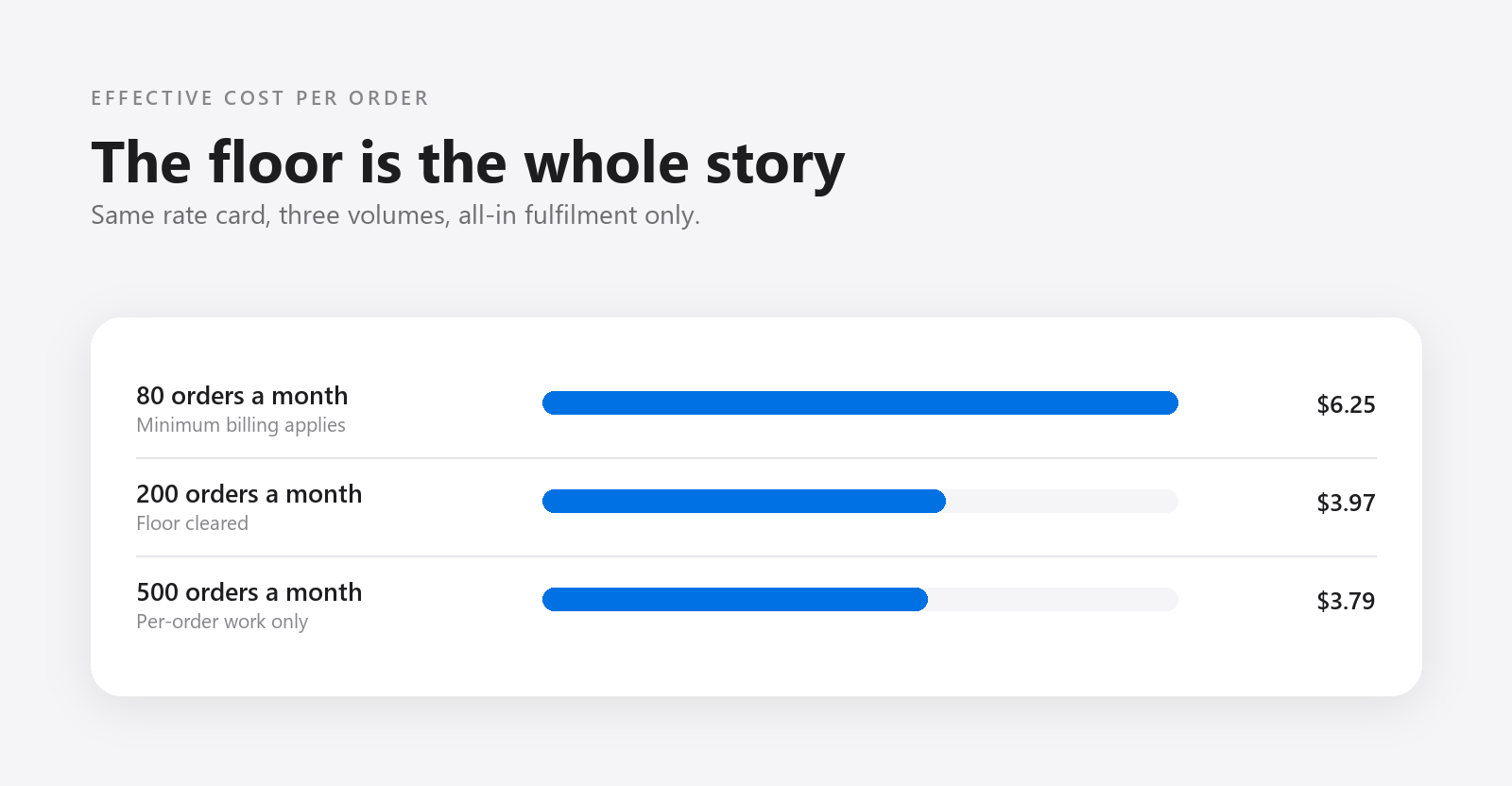
Read the last two columns again. Volume rises 150%, and cost per order falls 4.5%. Once you clear the floor, the rest of the bill is per order, so scale stops buying you a discount. Everything expensive happens before you cross that line, which is why "just grow into it" is not a plan — growth helps only at the moment it takes you over the minimum, not afterwards.
Inbound receiving is where small accounts get taxed
A large account takes a trailer a week. Receiving is quoted per pallet, the cost per unit almost disappears, and nobody thinks about it again.
A small account gets thirty cartons every ten weeks, pays per carton, and books a dock window it may not hit. The rhythm inside a decent warehouse is roughly 48 hours from arrival to put-away and 24 hours from order to dispatch, with a cutoff late in the evening — one operator we studied publishes 22:00 same-day dispatch, with an on-time dispatch rate above 99%. For a small brand that timeline means two quiet costs: miss the appointment and your goods wait for the next slot, and goods that are not on the shelf cannot be sold while your ads keep spending.
Three things are worth asking for: consolidate replenishments into fewer, larger drops; price receiving per pallet rather than per carton; and put the appointment window in the contract instead of in an email.
Storage is rent on inventory that is not selling
Storage quotes look harmless — per pallet per month, or per cubic foot per month. The number that matters is that rate multiplied by the days you hold.
Take a $40 unit occupying 0.35 cubic feet at $0.55 per cubic foot per month. Thirty days of storage costs $0.19. A hundred and twenty days costs $0.77. But the bin it sits in is not free, because your bin count is capped by the space commitment: the slow SKU is occupying a slot that a sellable unit could use.
Warehouses score this explicitly. In the operating Which Logistics Model one Chinese warehouse group describes, fast-pick locations are expected to turn at least three times a day, and stock that has not moved in seven days starts costing the supervisor points. Your dead stock is not inventory on their books; it is wasted cube — cube, in warehouse shorthand, meaning the physical volume a SKU occupies rather than its unit count.
So the first-load list is the wrong place for long-tail SKUs. Move them through your own space or a temporary hold first, and let a product earn its bin.
The break-even line is volume times density
Two brands at 300 orders a month can reach opposite answers.
One sells eight SKUs at 1.2 units per order with standard packaging; picking is nearly mechanical. The other sells sixty SKUs at 2.6 units per order and drops a gift with half of them. Same order count, roughly three times the touches per order, and far more chances to get it wrong. The 3PL quotes per order while the work happens per action, and you pay the gap.
Judge density on three numbers: SKU count, average units per order, and the share of orders that need a human decision — gifts, personalization, presale allocation. If any of the three runs high, the crossover moves up, sometimes past 500 orders a month.
The middle option most people skip
Between your garage and full outsourcing sits a thinner arrangement: shared bins, on-demand space, or outsourcing only the last mile — the final carrier leg to the customer — or only part of the catalogue.
It is not cheaper per order. Its value is that it pushes fixed cost close to zero: no monthly minimum, a few bins rented by the month, added in peak and released in the trough. What you give up is depth — no named account manager, an earlier cutoff, slower handling of exceptions.
This fits brands at 100 to 300 orders a month with a short SKU list and obvious seasonality. It fits badly when you need lot traceability (batch numbers carried from receiving through returns), versioned packaging, or gift rules applied per order. Those three are exactly what breaks in a move between warehouses.
What to get in writing before you sign
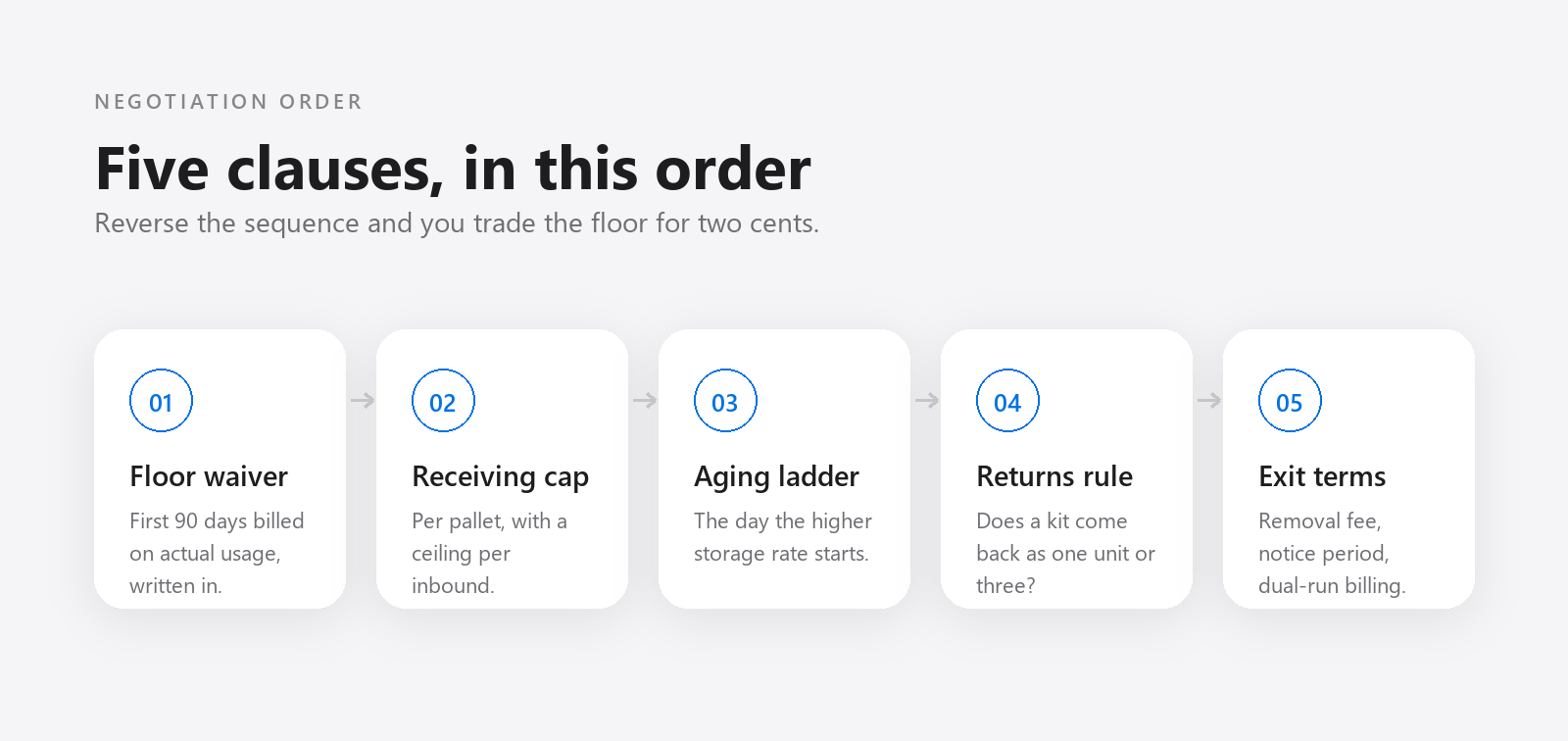
Order matters. Floor first, receiving second, storage aging third, per-unit price last — reverse it and you save two cents on the pick fee while paying two hundred more on the minimum.
- A minimum-waiver window. First 90 days billed on actual usage, written into the agreement rather than promised in an email.
- A receiving cap. Per-pallet pricing, a ceiling on any single inbound, and a stated maximum for missed appointments.
- An aging ladder for storage. The day the higher rate starts, the size of the step, and whether exceptions can be requested.
- A returns definition. Whether a kit comes back as one unit or is broken into components, what the teardown costs, and whether credit flows back to the right supplier.
- Exit terms. Inventory removal fee per pallet, notice period, and whether a dual-run period is billed twice.
The fourth item gets skipped most often. A bundle sold as one SKU returns as three separate items that have to be re-received, re-labelled and reconciled — work that a warehouse without a proper reverse process does by hand, on your invoice.
When staying in-house is the right answer
Below about 100 orders a month, with fewer than 15 SKUs and steady hands, packing it yourself is usually still cheaper per order. The number to compare against is not minimum wage times minutes. Load it with piece rate (pay per unit packed rather than per hour), accuracy bonuses, temp training, and the reship plus support cost of the orders you get wrong. A well-run in-house bench tends to land between $3.50 and $4.50 per order all-in, and drops under $2.50 only where fixed costs are genuinely spread.
The honest signal to move is a week of missed cutoffs, wrong variants, or turning down wholesale because you cannot build a pallet.
The short version
Whether a 3PL makes sense for a small business comes down to three numbers, none of which is a volume threshold: what the minimum costs you per order, how dense your orders are, and what it costs to leave.
If you have your last 30 days of orders, your SKU count and your average units per order, send them over — we will model the all-in cost per order on your actual mix before anyone quotes a rate.
References (Neutral Third-Party Sources)
- USPS — Ground Advantage: 2–5 day domestic ground product, dimensional weight divisor of 139, and published nonstandard package fees. https://www.usps.com/ship/ground-advantage.htm
- UPS — Shipping Zones and Rates: a zone is a destination-based geographic region that determines the cost of a shipment. https://www.ups.com/us/en/support/shipping-support/shipping-costs-rates.page
- Federal Trade Commission — Mail, Internet, or Telephone Order Merchandise Rule: sellers must ship within the advertised window, or within 30 days when no window is stated. https://www.ftc.gov/legal-library/browse/rules/mail-internet-or-telephone-order-merchandise-rule
- U.S. Census Bureau — North American Industry Classification System: warehousing and storage is tracked as its own industry class, which is why warehouse capacity is priced as a fixed asset. https://www.census.gov/naics/
- GS1 US — What is a GTIN?: a GTIN is a globally unique product identifier while a SKU is internal, which is why barcodes stop matching after a warehouse move. https://www.gs1us.org/upcs-barcodes-prefixes/what-is-a-gtin