
3PL Fulfillment Companies: How to Compare Services
Comparing 3PL fulfillment companies is a company-vetting problem, not a price problem. You are not choosing between warehouses; you are choosing between operators whose accuracy, balance sheet, and system integration will determine whether your orders ship on time for the next two years. The per-order rate is the last thing you should look at, not the first.
Most comparison shopping fails because it starts from a price list. A price list tells you what a provider charges when everything goes right. It says nothing about what happens when the cheap warehouse goes dark, or when a low-bid operator ships 1,000 orders with the wrong item. This article walks through the comparison in the order that actually matters: what kind of company you are dealing with, how it fails, how to size it, and only then how to score the quotes.
A fulfillment company is not a freight forwarder
Before comparing anyone, get the category right. A 3PL fulfillment company makes its money from operating your orders: receiving your stock, storing it, picking it, packing it, and shipping it — what Chinese cross-border sellers call "一件代发", or drop-ship-per-order. A freight forwarder moves freight (ocean or air) and clears customs. A carrier like USPS or UPS only delivers the parcel.
The distinction matters because the risk profile is completely different. A forwarder that fails mid-shipment strands a container at a port; a fulfillment operator that fails strands your sellable inventory inside a locked warehouse, where you cannot retrieve it or redirect it. When you compare companies, you are comparing the second kind of risk.
Why the cheapest quote usually fails first
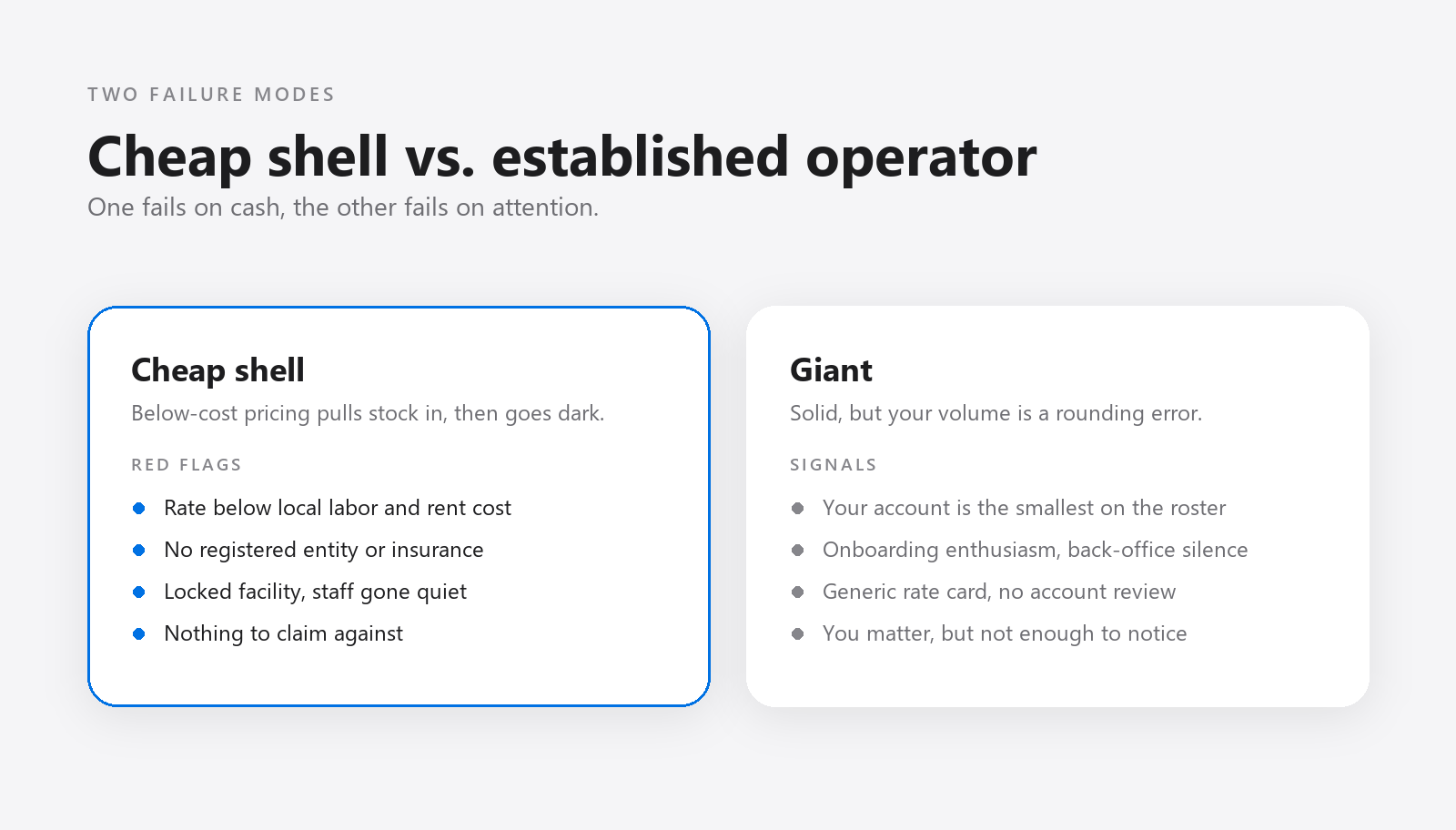
The industry has a word for this now: "低价海外仓" — low-price overseas warehouses that price below the actual cost of local labor and rent. In March 2026 a cluster of these around the Los Angeles and Long Beach ports collapsed, stranding more than 2,000 sellers and an estimated 200 million RMB in goods. The pattern was identical every time: a headline rate like "$0.60 within the pound" for drop-ship-per-order fulfillment, far below what US warehouse labor alone costs, used to pull inventory in fast, followed by staff going quiet and the facility getting locked.
The tell is not the low number itself. It is that the number cannot survive the math. If local receiving, storage, and pick-pack labor cost more than the quoted rate, the operator either loses money per order and will eventually break, or it plans to recover the loss somewhere you cannot see. Either way, "cheap" is a leading indicator, not a bargain.
The size sweet spot: too small is fragile, too big ignores you
One of the least intuitive parts of choosing a 3PL is that you can be too small for a provider and too big for a different one at the same time.
A provider that is too small relative to the risk you hand it is dangerous. Chinese manufacturing logistics buyers have a blunt rule here: if a company has no real assets and no team — what they call a "空壳仓库", an empty-shell warehouse — it cannot compensate you when it loses high-value goods. There is nothing to collect against.
But the opposite problem is just as real and gets less attention. If your order volume is a rounding error on a large provider's roster, you get the onboarding salesperson's enthusiasm and the back office's indifference. The working advice from buyers who have been burned both ways: a provider where your business is big enough to matter, but where the provider is still big enough to survive a bad quarter. There is no formula for it — you have to ask directly how many accounts are larger than you.
Price stopped being the deciding factor a while ago
The oldest assumption in this market — that the lowest bid wins — has been wrong for years. A 2018 industry write-up from a warehouse-management-system vendor put it plainly: low-price 3PLs consistently miss their delivery windows by half a day to a full day, and for a long time buyers tolerated it because the price was "right." Then downstream customers started getting fined for late goods, and the tolerance evaporated.
What buyers actually weigh now, in rough order: accuracy and on-time delivery, a standardized price structure (one that adjusts by calendar, not by who is asking), and only then the number. If a provider cannot tell you its damage rate, loss rate, signature-return rate, and on-time dispatch rate as hard numbers, the low price is buying you a mystery.
Send every candidate the same order profile
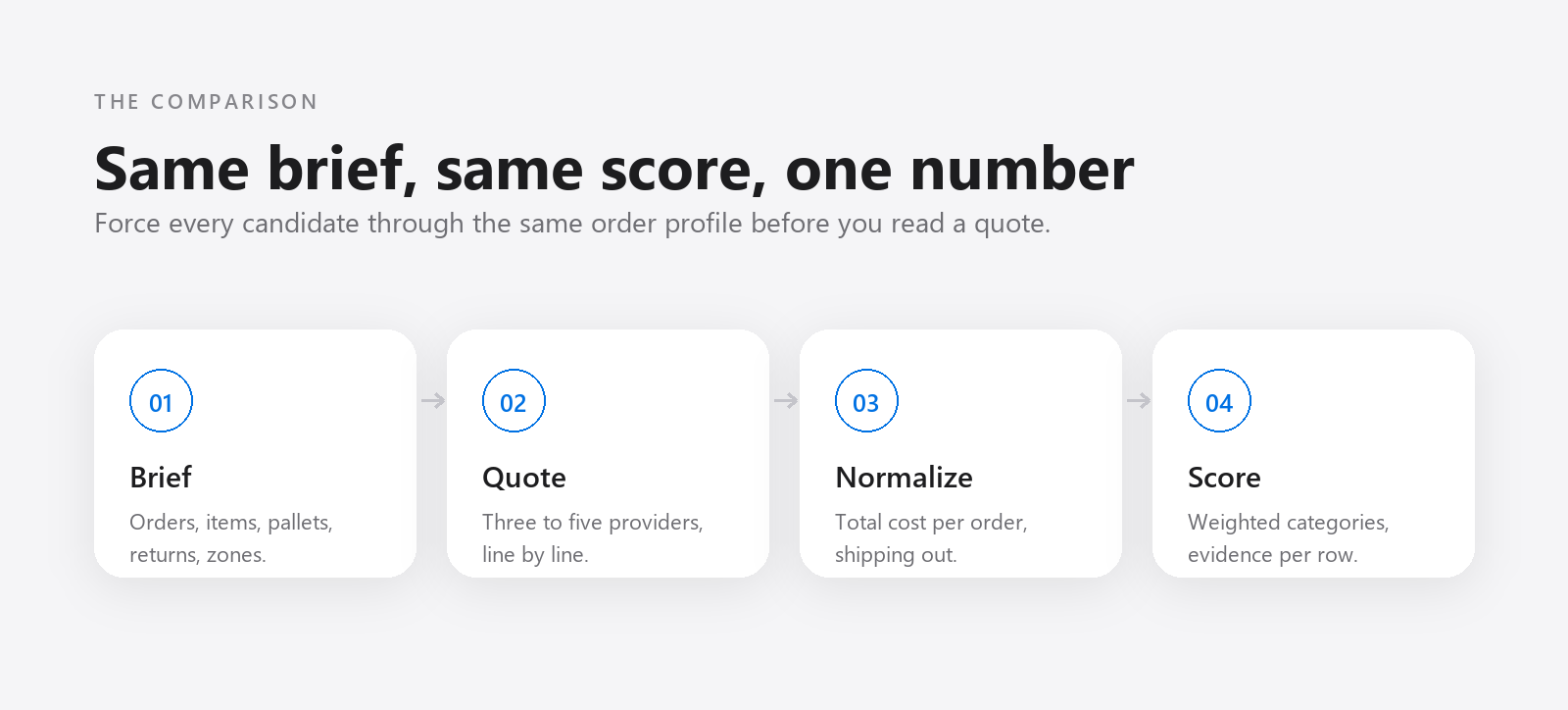
The only way to make two quotes comparable is to hand every provider the exact same scenario. That means one short brief: average orders per month, average items per order, average parcel weight and dimensions, SKU count, storage pallets, return rate, and destination split. Send it to three to five companies, not fifteen.
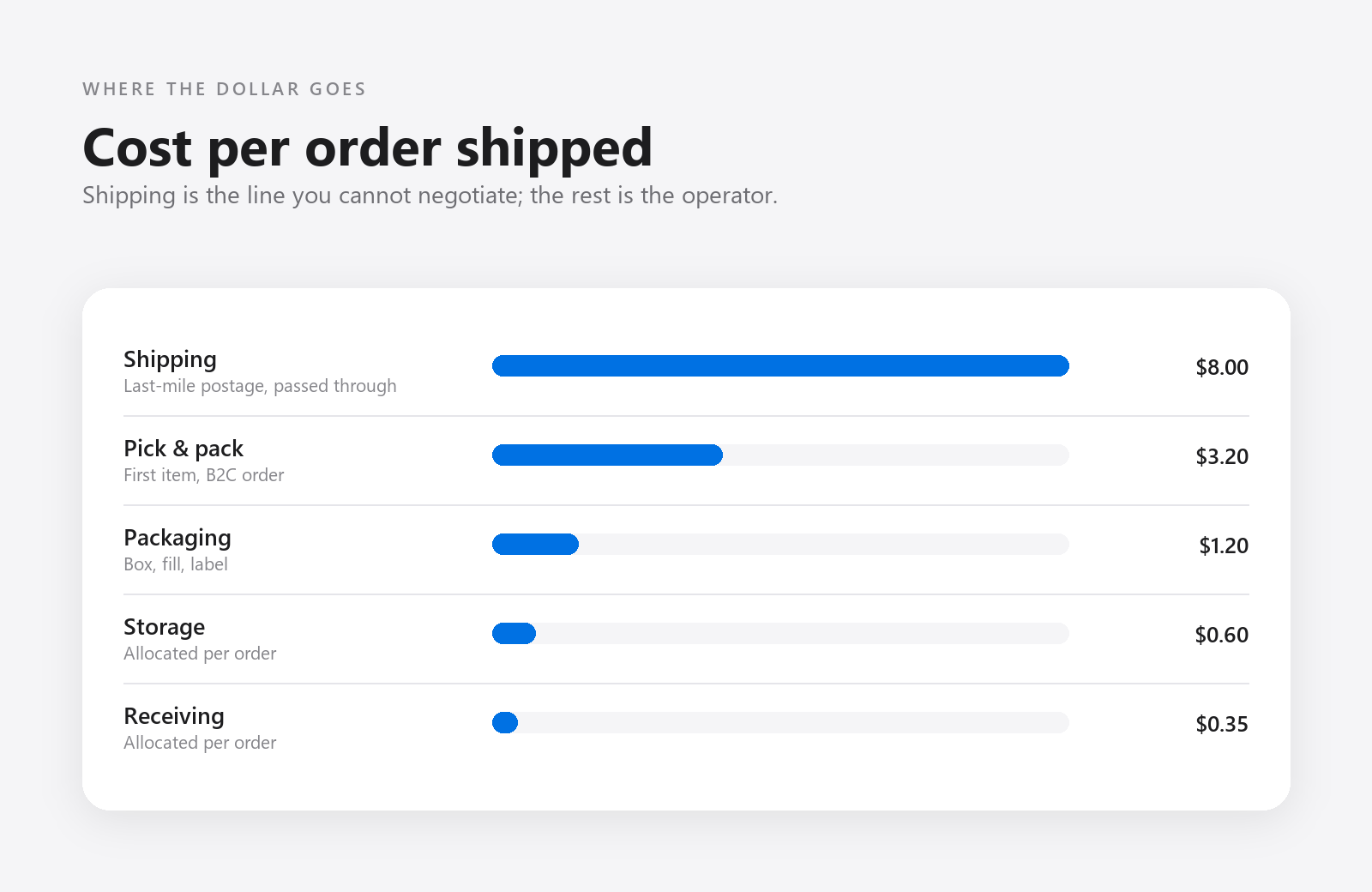
The brief has a second job. It exposes the providers who cannot or will not model your actual business. A company that quotes off a single headline rate without asking about your units-per-order or pallet count is pricing a fantasy. The honest comparison is always one number: total cost per order shipped, with shipping separated out, so you can see warehouse efficiency and delivery cost independently.
Build a scorecard, not a spreadsheet
A spreadsheet ranks by total. A scorecard ranks by what you will feel in month six. Weight the categories before you score anyone, and do it in the proportion that manufacturing logistics buyers actually use for their formal tenders: roughly 30% on qualification (licenses, financials, insurance, real facility) and 70% on commercial fit (price, accuracy, systems, service).
| Category | Weight | What to verify |
|---|---|---|
| Financial health | 20% | Registered entity, insurance limits, who pays a loss claim |
| Accuracy method | 20% | Barcode scan at pick, weight check at pack, how errors are caught |
| System integration | 15% | WMS/ERP sync, how orders flow, can you see stock live |
| Peak capacity | 15% | Contracted surge terms, not a sales promise |
| Network fit | 15% | Warehouse location vs. your customer zones |
| Price structure | 15% | Line-item quote you can reconcile, not one blended number |
Score each provider the same way, and write a one-line note with the evidence behind every score. The note is what makes the trade-off visible: you can see, in writing, that the cheaper provider lost points on accuracy rather than discovering it in November.
The numbers you can anchor a quote to
Ranges below are third-party industry survey figures, not our quotes. Use them to spot a number that is off by an order of magnitude before you waste a sales call.
| Cost line | Typical range |
|---|---|
| Setup / onboarding (one-time) | $0–$1,000 |
| Receiving (per pallet) | $5–$15 |
| Pallet storage (per month) | $15–$40 |
| B2C pick and pack (first item) | $2.00–$3.50 |
| Each additional item | $0.30–$0.75 |
| Returns processing (per unit) | $1–$7 |
| Monthly minimum | $0–$750 |
The monthly minimum is the line that quietly decides whether a 3PL is right for you at all. At small volume, a $500 minimum spread over 200 orders is $2.50 per order before any labor — which is why a provider comparison only makes sense once your volume can absorb the floor.
Ten questions that surface the real company
Ask these and listen for who answers with a number versus who answers with a story.
- How many accounts are larger than mine, and how many smaller?
- Give me two references with my exact order profile and their ship window.
- What is your order accuracy rate, and how is it measured — scan, weigh, or eyeball?
- Which surcharges are in the quote: residential, remote, oversize, peak season, fuel?
- What happens when my inventory arrives without the expected labels or counts?
- What are your liability terms for a lost or damaged high-value item?
- Can I exit the contract, and what does it cost to get my inventory back?
- Which platforms do you integrate with natively, and which need manual entry?
- Who owns the packaging and custom materials if we part ways?
- Send me the rate card for peak season, not just the base card.
If a provider cannot answer the second question with real references, the rest of the conversation is a guess either way.
The short version
Comparing 3PL fulfillment companies comes down to three moves done in order. First, confirm you are talking to a fulfillment operator, not a forwarder. Second, rule out the two failure modes: the cheap shell company that cannot survive its own pricing, and the giant that will not notice you. Third, force every candidate through the same order profile and the same weighted scorecard, and decide on cost per order — not on the headline rate.
If you want the scorecard built for your volume and product mix, send us the order profile — monthly orders, items per order, pallet count, and destination split — and we will come back with the comparison before we talk pricing.
References (Neutral Third-Party Sources)
- Wikipedia — Third-party logistics: the definition of a 3PL as an outsourced provider of logistics services, and the scope of activities (transportation, warehousing, fulfillment) it covers. https://en.wikipedia.org/wiki/Third-party_logistics
- Wikipedia — Fourth-party logistics: the origin of the 4PL term (Accenture, 1996) as an asset-light integrator, used here to contrast with asset-based 3PL operators. https://en.wikipedia.org/wiki/Fourth-party_logistics
- USPS — Mail & Shipping Services: dimensional-weight billing (length × width × height ÷ 139) and nonstandard-package surcharges, referenced for the shipping and surcharge sections. https://www.usps.com/ship/mail-shipping-services.htm
- Wikipedia — Warehouse management system: how a WMS drives barcode scanning, order picking, and accuracy, referenced in the system-integration scorecard row. https://en.wikipedia.org/wiki/Warehouse_management_system