
3PL Last Mile Delivery: The Most Expensive Mile, Explained
The last mile is the most expensive single leg of any shipment — and it is the one your customer actually sees. Industry research puts the final leg, from the local hub to the customer's door, at roughly 40–53% of total shipping spend, and that share has only climbed. It costs the most because it is where a truckload's density finally collapses into a few dozen separate doorsteps.
This article breaks down where the money goes, why residential costs more than commercial, what a failed first attempt really costs, and the levers that thin the bill. No specific 3PL is named.
Why the last mile costs the most
The first and middle miles are cheap because they move goods in bulk: a container, a trailer, a full pallet. The last mile — 尾程 (wěichéng), the final delivery leg from a local hub to a door — is the opposite. One van, dozens of individual addresses, a stop every few minutes.
The cost is not the distance. It is the density. On a middle-mile line, a driver's labor and fuel are spread across thousands of parcels. On a delivery route, they are spread across maybe 150 stops a shift — roughly four minutes a stop. The same driver-hour buys far fewer parcels, so the cost per parcel explodes. Rural and low-density suburban routes make it worse: a carrier's per-stop cost stays about fixed while the number of stops per route mile drops, which is why rural delivery can run two to four times the per-package cost of a dense urban route.
Where the money actually goes
A last-mile bill is mostly labor, and the rest is the friction around it.
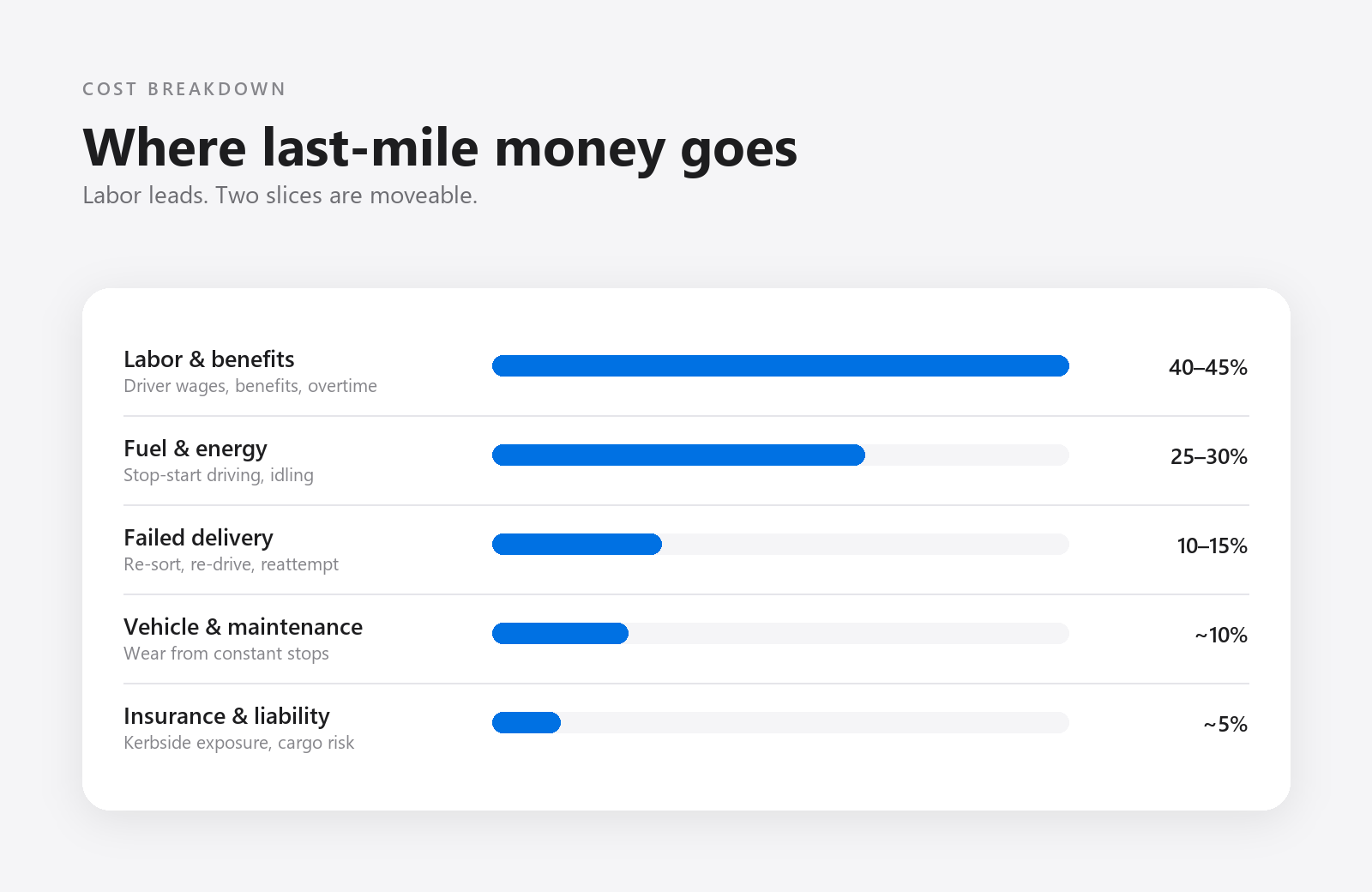
Driver labor and Process 038 Benefits are the biggest slice — around 40–45% of last-mile cost. Fuel and energy come next at 25–30%, driven by stop-and-start urban driving and idling. Failed-delivery recovery runs 10–15%, vehicle wear about 10%, and insurance and liability about 5%. The exact mix shifts by carrier and region, but the shape does not: the two lines you can actually move are labor (by raising stop density) and failed-delivery recovery (by raising first-attempt success).
Wages explain why: US couriers and messengers earn a median of about $40,000 a year and light delivery drivers about $45,000 (BLS, May 2024), before benefits and peak-week overtime.
Residential is a surcharge, not a default
Most shippers learn this the first time they compare a home delivery against a business delivery of the same parcel.
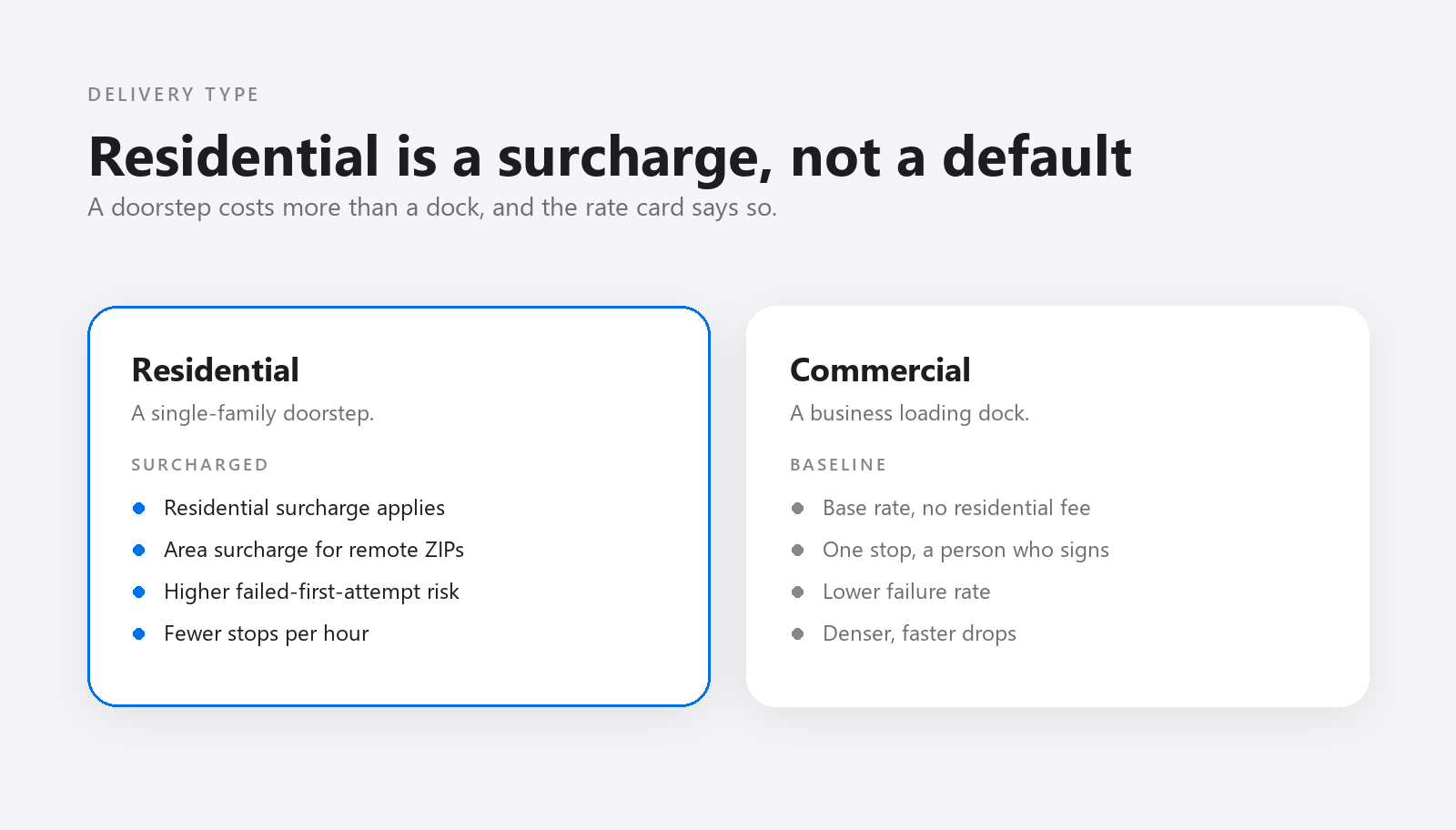
Residential addresses are treated as a cost upgrade by the national carriers. UPS and FedEx apply a residential surcharge on top of the base rate, and a delivery area surcharge on top of that for remote ZIP codes. The rate card makes the point plainly: commercial delivery to a loading dock is the baseline, and a single-family doorstep is the exception you pay for. The dock has one stop and a person who signs; the doorstep has a parking problem, a walk, and often no one home.
That gap is the clearest, most controllable signal in last-mile pricing. If most of your orders go to residential addresses, you are already paying a surcharge on them — so the negotiation is not about the base rate but how that surcharge is applied, and whether a regional carrier beats it on dense suburban lanes.
Signature, photo, and the safe-place decision
How a parcel is released at the door changes both cost and outcome. Carriers offer a few levels, each trading a few dollars for a different kind of risk.
| Release option | What happens | When it makes sense |
|---|---|---|
| Direct signature (DSR) | Someone at the address must sign | High-value, fraud-prone or dispute-heavy items |
| Indirect signature (ISR) | A neighbor or building manager can sign | Apartments, offices, moderate-value parcels |
| No signature (NSR) | Left at the door regardless | Low-value, time-sensitive, low-theft areas |
| Photo confirmation | A photo proves where it was left | Proof without a person, cheaper than DSR |
| Safe place | Left in a designated spot | Houses with a porch or locker, recurring orders |
The point is not to pick one for everything but to How to Choose per SKU and destination: a high-value electronic should not ride on NSR, and a $9 phone case should not carry a signature fee. Where you can, use photo confirmation and a safe-place instruction — proof of delivery without the cost, or the failed attempt, a signature invites.
A failed delivery costs more than the parcel
The most expensive parcel on a route is the one that does not get delivered.
When a first attempt fails — no one home, a locked gate, a signature required and nobody to sign — the carrier does not simply try again for free. The parcel is re-sorted, re-loaded, and re-driven on another day. FedEx's own policy is to reattempt up to three times, then return the parcel to the shipper. Each reattempt is another slice of labor and fuel. Industry estimates put the secondary cost of a single failed first attempt in the tens of dollars — more than the delivery itself earned.
Failed first attempts are not rare. Residential failure rates run in the single digits to mid-teens depending on the area, and they cluster in apartments, gated communities, and anywhere a signature is required but the recipient is at work. Every failure also creates a support ticket and a "where is my order" message. The cheapest fix is not a cheaper carrier — it is a higher first-attempt success rate.
The carrier mix that thins the bill
No single carrier is right for every parcel. They have genuinely different cost shapes, and a 3PL earns its keep by routing each label to the cheapest carrier that still meets the promise.
| Carrier shape | Cost profile | Best fit |
|---|---|---|
| National postal (USPS) | Lowest on light residential, no residential surcharge | Sub-1 lb parcels to long zones |
| National parcel (UPS / FedEx) | Strong on heavier short-zone, but residential + area surcharges | Heavier parcels to nearby zones |
| Regional / last-mile networks | Beat nationals on dense lanes, often no area surcharge | Suburban volume inside their footprint |
Light parcels start around a few dollars on the postal network, while a pound-class parcel can run five to seven dollars before surcharges. Regional last-mile networks — the 落地配 (luòdìpèi, local delivery networks that go deep in one region rather than covering the whole country) — can undercut that on their home lanes, and the gap widens sharply as parcels get heavier, in some weight bands by several times. The trap is that a regional network covers only its region, so the win is real only where your orders actually land.
Four levers that actually move cost
Most of last-mile cost is decided before the parcel is handed over. These four levers move the invoice more than any base-rate negotiation.
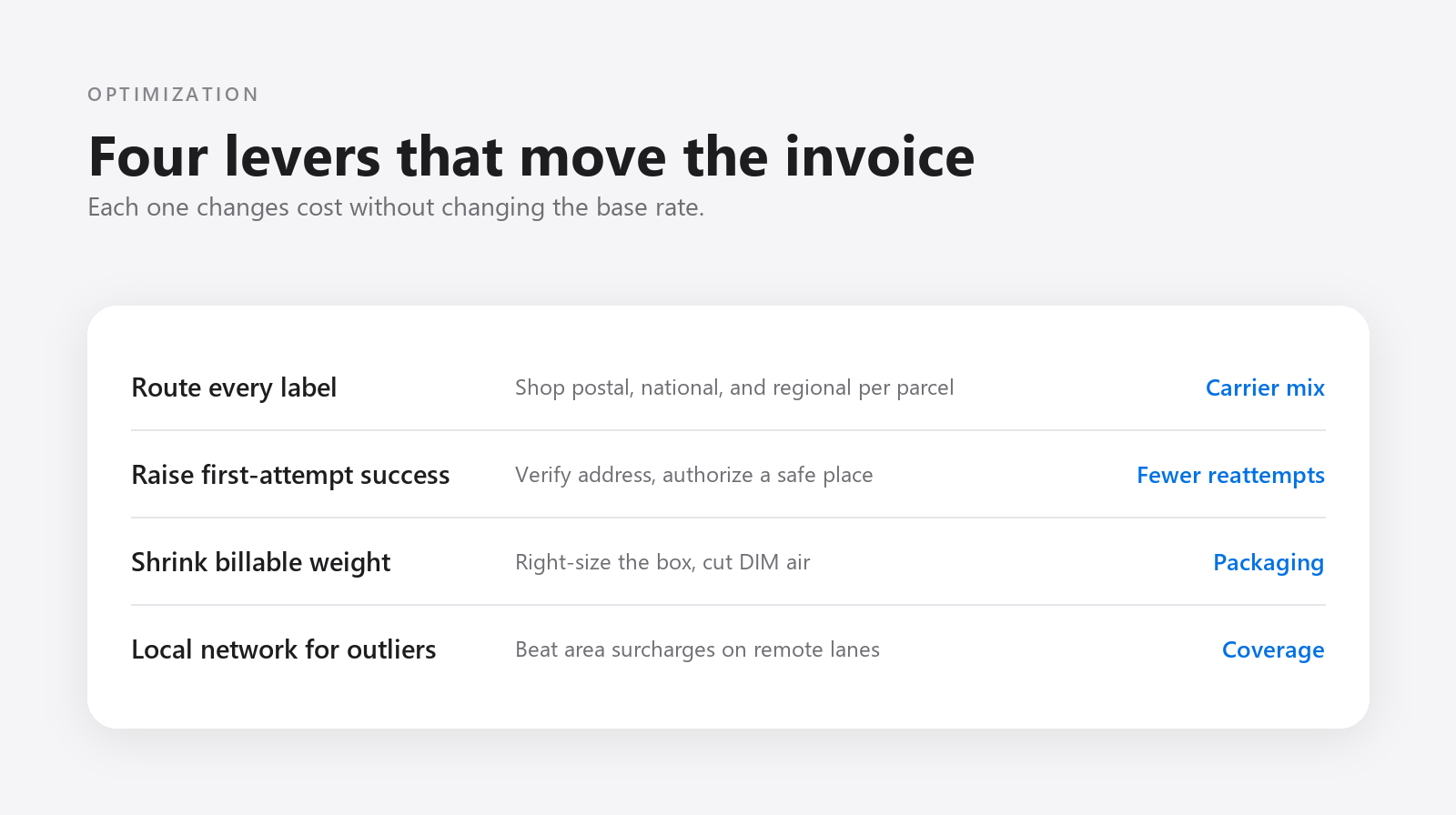
Route each label, don't default to one carrier. Rate-shop every label across the postal, national, and regional networks that cover your zones — a single default almost guarantees you overpay on a slice of orders.
Raise first-attempt success. Verify the address (unit, gate code, ZIP), let the customer choose a safe place or a signature level that matches the item, and send a pre-delivery message. Each failed attempt avoided is the single biggest saving available.
Shrink the billable weight. Carriers bill the larger of actual and dimensional weight, so an oversized carton with three inches of air can double the charge. Right-sizing the box is a packaging decision that lands directly on the last-mile invoice.
Send the outliers to a local network. Remote and low-density parcels are where the national carriers' area surcharges bite hardest. A regional or 落地配 partner that covers that specific area can often beat it — but confirm the coverage, because a label the partner cannot actually accept is a parcel that cannot ship.
Density is the real battlefield
Every lever above is really a way to buy back density — more delivered parcels per driver-hour.
The structural fix is to move inventory closer to the customer. Positioning stock across a few regional facilities does not change any route's last-mile density, but it changes where the line between middle mile and last mile is drawn. A parcel that ships from a warehouse one state away travels a shorter last mile and, just as important, lands in a cheaper zone. That is why the same product can cost meaningfully less to deliver from two facilities than from one — and why "where is the stock" is a last-mile question, not a warehousing question.
The caveat is that spreading inventory costs money in its own right — more safety stock, more facility minimums. The saving in last-mile freight has to beat the extra carrying cost. There is no universal answer; there is only the arithmetic for your own order map.
The short version
The last mile is 40–53% of shipping spend because it is the one leg where density collapses. Labor is the biggest slice, residential and remote surcharges sit on top of the base rate, and a failed first attempt can cost more than the delivery earned. Route each label across carriers, raise first-attempt success, shrink billable weight, and push the outliers to a local network — and remember that moving stock closer to the customer re-draws the line between middle mile and last mile, which is where the durable savings live.
If you want your own order map priced against the carrier mix, send us your monthly volume, weight bands and ZIP distribution — we will show you where the last-mile spend sits before anything else.
References (Neutral Third-Party Sources)
- FedEx — Delivery Options and Signature Services: direct, indirect and adult signature required, no-signature release, photo proof of delivery, and the three-reattempt-then-return rule. https://www.fedex.com/en-us/delivery-options.html
- UPS — Shipping Zones and Rates: zone structure, the residential and delivery/remote area surcharge listings, and the annual rate-guide cadence. https://www.ups.com/us/en/support/shipping-support/shipping-costs-rates.page
- USPS — Where is my package? Tracking Status Help: delivery and attempted-delivery scans, including "Notice Left" when a signature is required and no one is available. https://faq.usps.com/articles/Knowledge/Where-is-my-package
- U.S. Bureau of Labor Statistics — Occupational Employment and Wage Statistics: median wages for couriers and messengers and delivery drivers, the labor base behind last-mile cost. https://www.bls.gov/oes/current/oes_nat.htm
- Federal Trade Commission — Mail, Internet, or Telephone Order Merchandise Rule: the 30-day shipping baseline and the duty to notify buyers of delay. https://www.ftc.gov/business-guidance/resources/business-guide-ftcs-mail-internet-or-telephone-order-merchandise-rule