
3PL in Los Angeles: Port-Side Fulfillment for Importers
A Los Angeles 3PL is a port decision before it is a warehouse decision. The Port of Los Angeles and the Port of Long Beach, side by side in San Pedro Bay, form the largest container gateway in the Western Hemisphere and the default landing point for cargo crossing the Pacific. If you import, a warehouse near that gateway turns "arrived at port" into "sellable in the system" in a day or two instead of a week. If you do not import, much of that advantage evaporates.
This article works through the Los Angeles question for importers: what the ports actually do for you, how the short drayage leg decides your dock-to-stock time, why customs and warehousing belong in the same pass, how Southern California compares to the Bay Area, and the judgment call on whether you need a local LA warehouse at all. No rankings, no named providers.
The San Pedro Bay ports are the importer's front door
Los Angeles and Long Beach are two separate port authorities operating adjacent to one another, but in practice they function as a single freight market. Together they handle roughly a third of all U.S. containerized waterborne trade, and the Port of Los Angeles alone describes itself as moving more containers than any other port in the Western Hemisphere.
For an importer, that Gifts That Scale means two things. First, your freight probably lands there already, so a Los Angeles-area warehouse is where your inventory is, not where you would like it to be. Second, the supporting infrastructure — rail, drayage carriers, and the Inland Empire warehouse belt an hour east — exists precisely to move that volume. You are not building anything new; you are plugging into the largest existing network in the hemisphere.
Drayage is the short leg that decides everything
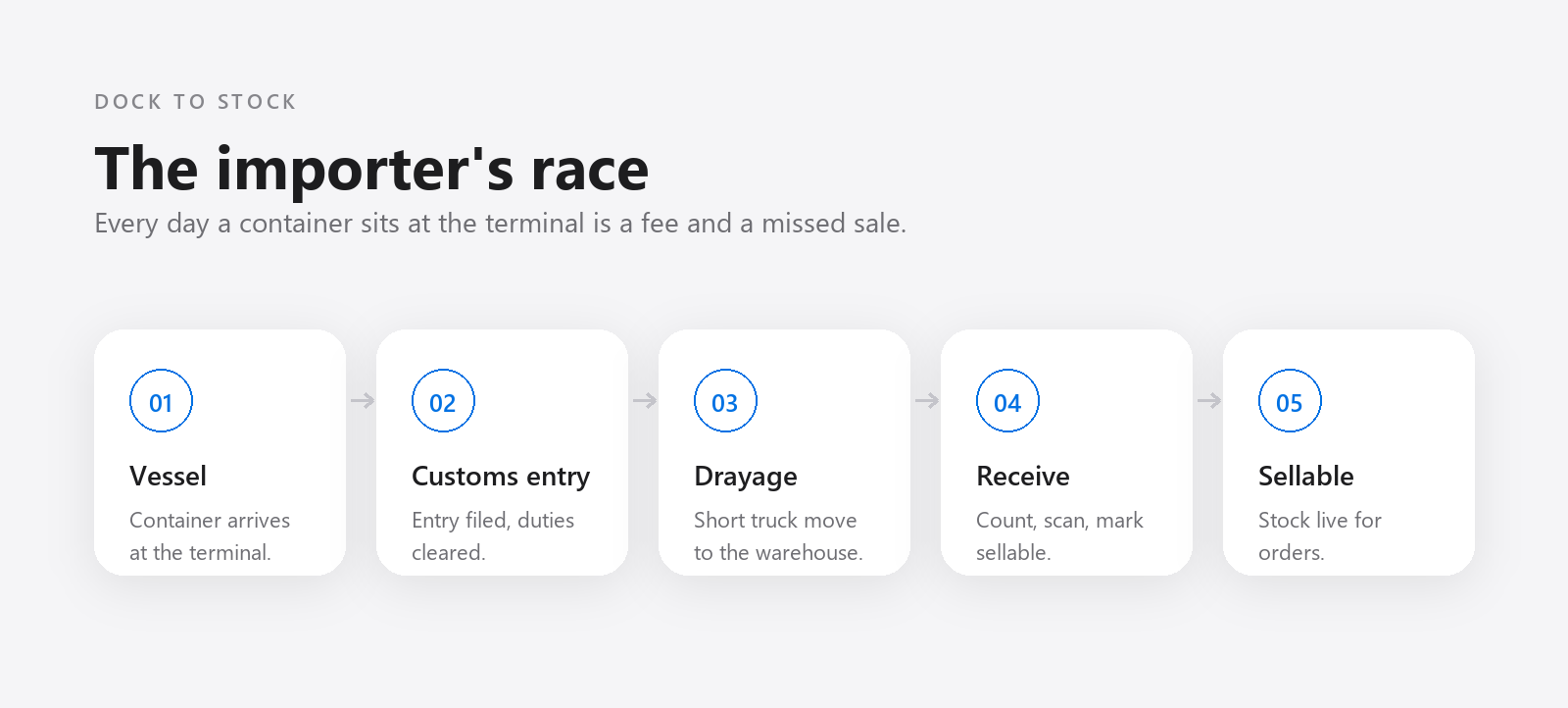
Drayage is the short truck move from the terminal to the warehouse, and in Los Angeles it is the step where importers either save a week or bleed fees. The port complex runs more than a dozen container terminals, each with its own appointment system, gate hours, and rules, so the leg that looks like a 20-minute drive is to What Really a coordination problem.
The fees are the quiet killer. Once a container sits at the terminal past its free days, it accrues demurrage — a daily storage charge — and, if the chassis is late back, per-diem as well. Together these can run into the hundreds of dollars per day, and they compound fast when a single appointment is missed. A 3PL that tracks last-free-day dates and books terminal appointments is worth more than one that simply "does drayage."
Dock-to-stock is the same clock, measured end to end: the time from a container hitting the dock to the goods being scanned into sellable inventory. Near-port warehouses win this by days, and days of sitting inventory are days you are not selling.
Customs clearance and warehousing, combined
The underrated part of Los Angeles fulfillment is that customs and the warehouse can sit next to each other. A broker files entry, the goods clear, and the same building receives them — one pass, one handoff, no extra truck move from a remote bonded facility to a separate warehouse.
The Port of Los Angeles even manages a foreign-trade zone — FTZ 202 — where goods can be stored, and duties deferred until they leave the zone into U.S. commerce. For importers holding inventory before it sells, that deferral is a real cash-flow lever, and it only exists if your warehouse and your customs picture are in the same place.
None of this matters to a brand shipping domestic goods that never touch a container. For them, the port is scenery.
Southern California vs the Bay Area
The honest comparison inside California is not "Los Angeles or nothing" — it is Southern California versus the Bay Area, and each is built for a different job.
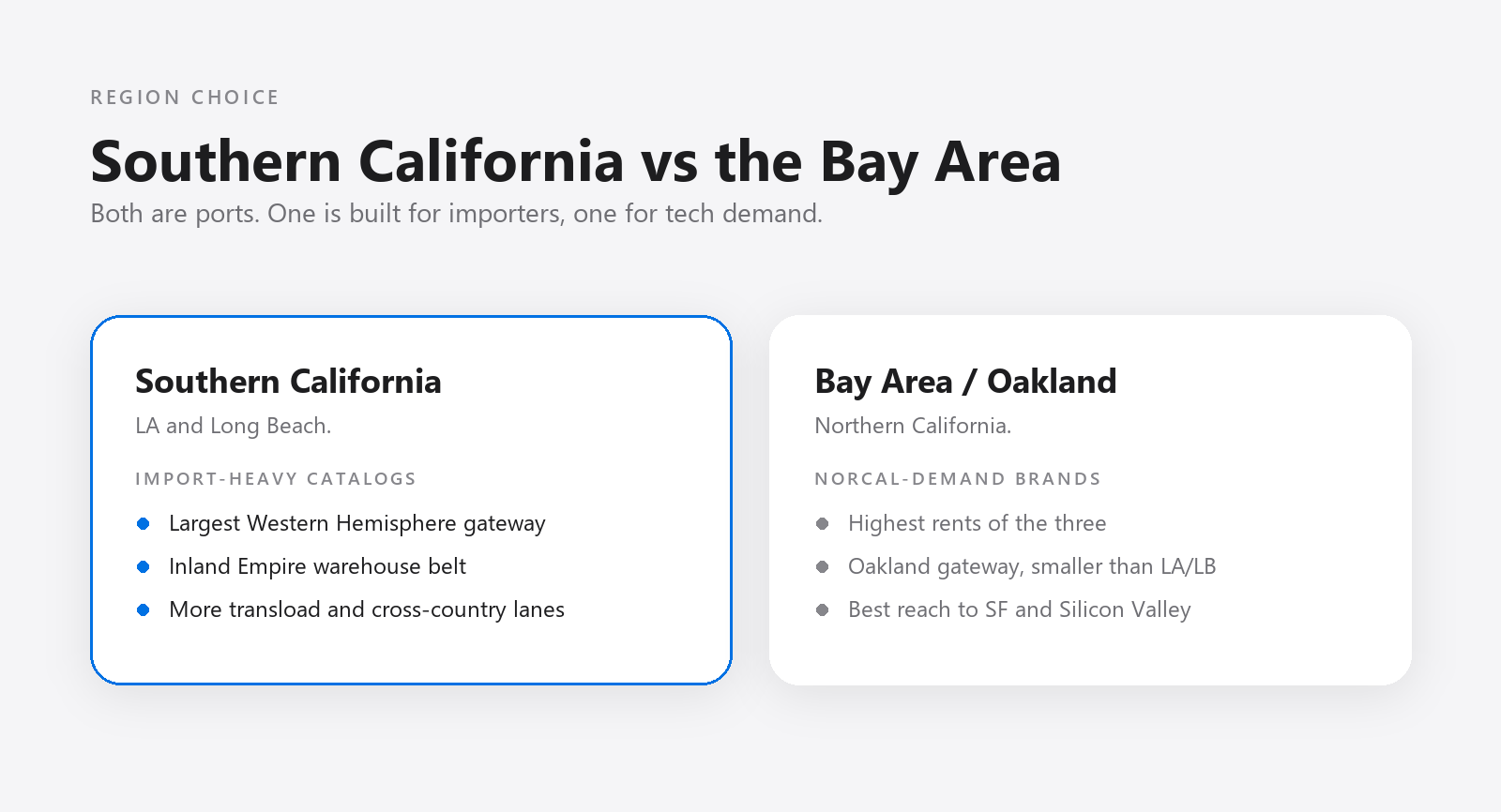
| Factor | Southern California (LA / Long Beach) | Bay Area (Oakland) |
|---|---|---|
| Gateway scale | Largest in the Western Hemisphere | Major, but far smaller than LA/LB |
| Warehouse cost | High, climbing near the harbor | Highest of the three West Coast anchors |
| Inbound for importers | Deep drayage market, Inland Empire belt | Good, but thinner transload capacity |
| Customer reach | SoCal and the Southwest, fastest | SF and Silicon Valley, fastest |
The rule of thumb: if your catalog is import-heavy and ships nationwide, anchor in Southern California and transload from the port. If your demand is concentrated in Northern California tech markets and you are not chasing container volumes, the Bay Area keeps you closer to the customers you actually have. Both are legitimate; they just answer different questions.
Do you even need a local Los Angeles warehouse?
This is the question most people skip, and it has a clean test. Ask three things in order.
First, do you import container volume? If no, a Los Angeles warehouse is a location decision you can make anywhere — the port adds nothing.
Second, where are your customers? If your orders concentrate east of the Rockies, a Los Angeles node ships most of your volume in the expensive zones, and a central or eastern node is the cheaper map.
Third, can you afford the near-port rent premium without the inbound savings to offset it? The premium only pays for itself when drayage savings and dock-to-stock speed actually touch your unit economics.
If the answer to the first question is no, or the second points east, you likely do not need a local Los Angeles warehouse — you need a different node entirely. Do not buy harbor-front rent to serve customers who live on the other coast.
The low-price trap in the LA basin
Because the Los Angeles basin is the densest warehouse market in the country, it is also where the sharpest price competition lives — and where the sharpest operators take advantage of it. In the overseas-seller community, the recurring story is the same: a "one-piece dropship" warehouse — one that picks and ships single retail orders rather than pallets — advertises a rate far below the cost of local labor and rent, books thousands of sellers, then disappears.
The numbers people cite are the tell. A per-pound rate quoted below what it costs to pay a picker, rent the floor, and buy a box in Southern California is not a deal; it is a bait. When these operations fail, sellers arrive to find a locked yard, a seal on the door, and inventory they cannot retrieve. The lesson is not "avoid cheap" — it is "score the quote against the local cost floor, and walk away from anything that cannot add up." A below-cost quote in Los Angeles is a red flag, not a find.
A scorecard for a Los Angeles 3PL
Before you sign anything, score the partner on six lines, in writing. The right answer on paper is the one you can defend in the invoice later.
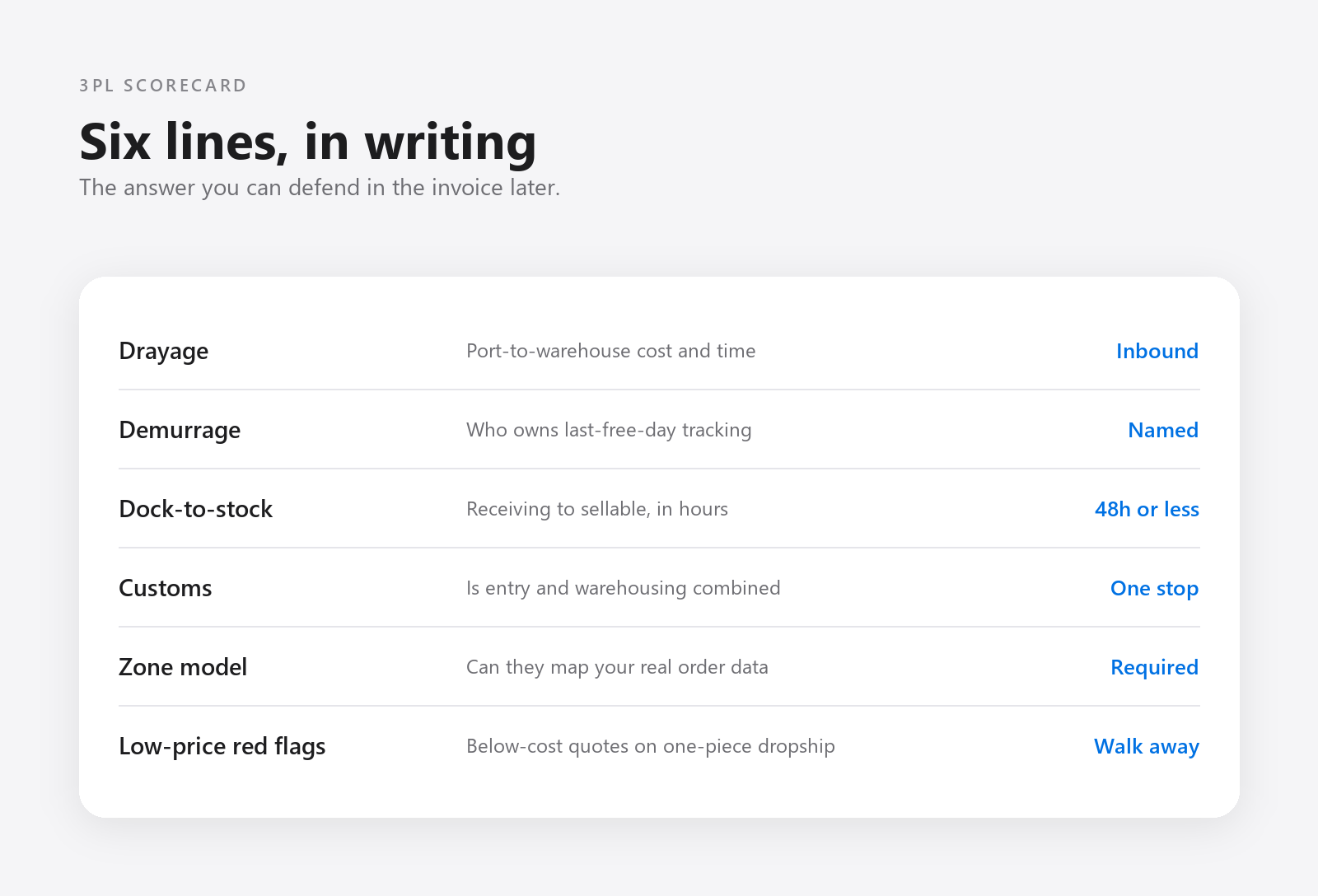
| Question | Why it matters | A bad answer sounds like |
|---|---|---|
| How far is drayage, and at what cost? | The port-to-warehouse leg is a hidden inbound line | "The port is close enough" |
| Who tracks last-free-day and appointments? | Missed deadlines turn into demurrage and per-diem | "The carrier handles it" |
| How fast is dock-to-stock? | Slow receiving cancels the port advantage | "Within a few days" |
| Is customs entry combined with warehousing? | One pass beats two handoffs | "We ship to a separate facility" |
| Can you model the zone math on real orders? | A partner should map your data, not a map | "Trust us" |
| Does the quote clear the local cost floor? | Below-cost pricing in LA is a red flag | "Pound rate, very cheap" |
Three "right-column" answers and you are signing a liability, not a fulfillment decision.
The short version
A Los Angeles 3PL earns its place the moment you import through San Pedro Bay and your customers live where the port's reach is short. Score it on drayage, dock-to-stock, combined customs, and the price floor — and be honest about the first question, because if you do not import, the port is scenery. The decision is a number and a checklist you can run before you ever talk to a provider.
If you want the arithmetic done on your data, send us your last ninety days of orders by destination ZIP, your SKU count, and whether you import container volume — we will map the zones, the drayage savings, and whether Los Angeles is even your node before we talk about pricing.
References (Neutral Third-Party Sources)
- Port of Los Angeles — Business / Your Trade Gateway: the port's statement that it moves more containers than any other port in the Western Hemisphere, and its drayage and warehouse infrastructure. https://www.portoflosangeles.org/busi
- Port of Los Angeles — Warehousing and Distribution / Foreign-Trade Zone 202: how near-port warehousing and a foreign-trade zone support deferred-duty storage and combined customs. https://portoflosangeles.org/business/supply-chain/warehousing-and-distribution
- Port of Long Beach — About the Port: the port's description of itself as the premier U.S. trans-Pacific gateway and its 2024 record container year. https://polb.com/port-info/
- USPS — Domestic Mail Manual, Section 608: the official definition of postal zones 1–8 by radial distance, the basis for the outbound zone math. https://pe.usps.com/text/DMM300/608.htm
- U.S. Bureau of Labor Statistics — Warehousing and Storage: NAICS 493: what warehousing and storage establishments do, including the logistics services that overlap with fulfillment. https://www.bls.gov/iag/tgs/iag493.htm
- GS1 — Global Location Number (GLN): the identifier that gives each physical warehouse node a machine-readable identity. https://www.gs1.org/standards/id-keys/gln