
3PL Pricing: How 3PLs Charge (Fees, Explained Simply)
A 3PL quote has three inputs behind it — time, space and risk — and eight lines that turn those three into a monthly number. The line you compare first, pick and pack, is the one every provider publishes and the one that matters least on its own. Two quotes that differ by 60 cents a pick can end up 25% apart on the invoice, because the storage schedule, the minimum and the surcharge language are doing the real work.
This is the provider's side of that arithmetic: why the rate card is shaped the way it is, what changes between an à la carte quote and an all-in one, and the three clauses a brand can usually move.
Time, space and risk: the three inputs
A warehouse sells three things it had to buy before you arrived: labour hours, floor and rack space, and the capacity to absorb your bad weeks.
Labour is the easiest to see and the easiest to price per unit. Space is bought in blocks — a lease, a rack bay, a pallet position — and paid whether the pallet moves or not. A 40,000 square metre operation pays the same rent on a day with 100,000 orders as on a day with 10,000, which is precisely why operating cost per order collapses as volume rises.
Risk is the part brands underestimate. Peak capacity, returns handling, mis-ship liability and slow-moving stock all consume resources that the provider must reserve in advance. Outsourcing converts a brand's fixed cost into a variable one, and the industry figure for the saving is roughly 10–20% of total logistics cost, depending on volume shape. That conversion is not free: the provider charges for the option to be ready.
The eight-line rate card
Chinese operators describe the bill in four buckets — storage fee, handling fee, dispatch fee, last-mile freight — and then break each one down. English-language rate cards do the same thing with more granular labels.
| Line | Usual unit | What sets the number | Who carries the variability |
|---|---|---|---|
| Onboarding and integration | One-off, or per SKU | Store platform, ERP, label rules | Brand |
| Inbound receiving | Pallet, carton, or hour | Palletised or loose, labelled or not | Brand |
| Storage | Pallet-month, cubic foot-month, or bin-month | Cube, dwell, temperature | Shared |
| Pick and pack | Order, plus each extra item | Items per order, pick density | Provider, partly |
| Packaging | Box, mailer, insert | Right-sizing, print, assembly | Brand |
| Last mile | Parcel, by zone and billable weight | Weight, DIM, zone, service | Shared |
| Returns | Per return, or per hour | Volume, inspection depth | Brand |
| Account minimum | Month | Your slowest month | Brand |
Two conventions are worth memorising because they are not negotiable in practice. Billable weight follows the provider's manifest, not your Gifts That Scale at home. And "packing included" usually means labour is included and materials are not.
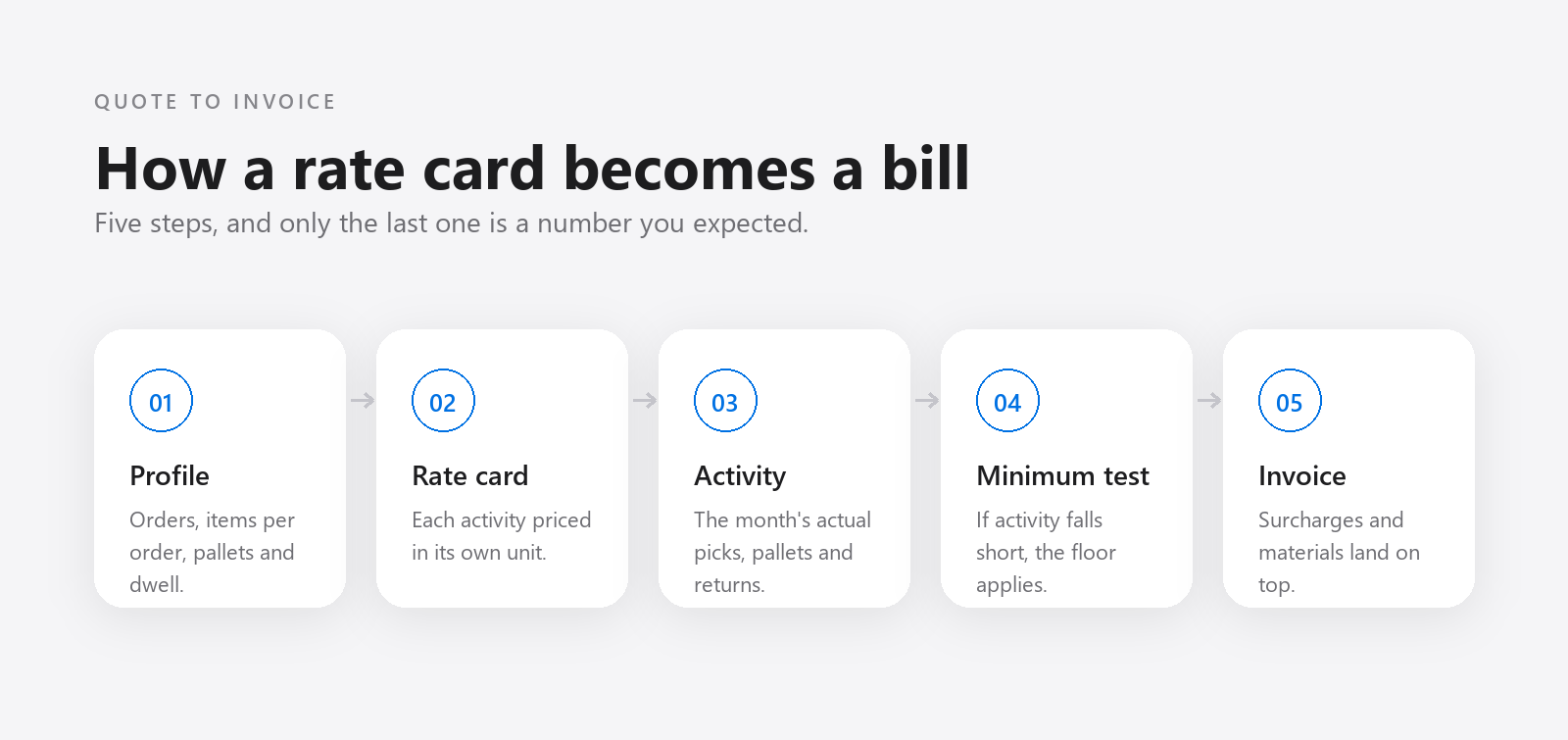
Why pick and pack is per order plus per item
Because the work comes in two shapes. Opening an order costs a fixed slice of time: pull the pick list, walk the route, verify, pack, label, stage. Each additional unit adds handling time but not another walk to the printer.
You can see the same split in a manual operation. A packing line on fixed monthly wages of 4,000–5,000 yuan put 20-plus people on roughly 2,000 parcels a day. Switching to piece rate at 0.10 yuan a parcel lifted individual pay to 8,000–10,000 yuan and moved 12 people — six packing, six picking — to more than 20,000 parcels a day, around 1,700 parcels per person. Per-parcel labour fell even though every worker earned more.
That is the economics behind the rate card. A per-order fee pays for the walk; a per-item fee pays for the handling. A provider quoting a single blended pick rate is either assuming a basket size or hiding one.
Which makes basket size the first thing to model. If your average order carries 2.2 units, the additional-item fee is not a rounding error — at $0.45 to $0.75 an item it is 15–25% of handling cost, and it is the number most often left out when brands compare headline rates.
Storage is priced by the space you take, not the unit you ship
Three units get used, and they reward different behaviours.
Per pallet-month is the default for full-case inventory. It is easy to audit and it punishes slow turnover only through the number of months. Per cubic foot-month is closer to true cost and much less forgiving: it charges for air inside the carton. Per bin or shelf-month suits small, high-count SKUs.
Cubic-foot pricing makes packaging a financial decision. Standard pallets are 48 × 40 inches, and case dimensions decide how many fit. A modest change in carton size can raise pallet load by about 20%, which cuts storage cost per unit by the same proportion and also reduces the dimensional weight billed on the way out. Brands treat packaging as a marketing line; providers treat it as a capacity line.
Pallet breakdown — splitting a full pallet into mixed cases for individual picks — is billed separately by most warehouses, and it is the charge that surprises importers who assumed receiving covered it.
Receiving decides the rest of the rate card
Inbound is where a quote is quietly re-priced. A clean, palletised, labelled delivery can be received per pallet in minutes. Loose cartons, mixed SKUs, missing barcodes and no advance shipping notice turn the same job into hourly labour, and mixed or unlabelled inbound is commonly quoted at two to three times the palletised rate.
Two details make the difference. A pallet or carton carries a unique identifier — a Serial Shipping Container Code — that lets the warehouse scan, count and reconcile against your paperwork instead of opening boxes. And the receiving record is the only evidence that exists if a weight dispute starts three weeks later.
Ask what happens to a delivery that arrives without labels. The answer tells you more about the operation than the pick rate does.
The minimum monthly spend is fixed-cost recovery
A minimum is not a fee for existing. It is the provider covering space and staffing it reserved on your forecast.
The logic is identical to running your own facility. Rent, equipment depreciation and base wages do not fall when orders do; only packaging and piece-rate labour track volume. A provider that reserves two rack bays and a shift for you has spent that money before your first order lands.
That is why minimums are usually framed as activity minimums — a floor on handling, storage and receiving charges combined — rather than a flat retainer. It also explains why a low-volume month feels punitive: the delta is the reserved capacity you did not use.
Three quotes, one requirement
Here is the same account priced three ways. 1,500 orders a month, 2.2 units per order, six pallets in stock, two inbound pallets, 8% return rate. Postage excluded from every column.
| Structure | What it charges | 1,500 orders | Per order | 4,500 orders | Per order |
|---|---|---|---|---|---|
| À la carte | Every activity, separately | $6,860 | $4.57 | $20,286 | $4.51 |
| All-in per order | $5.60 flat, storage included, returns $4.00 | $8,880 | $5.92 | $26,640 | $5.92 |
| Hybrid | $350 platform fee + tiered activity rates | $7,166 | $4.78 | $18,842 | $4.19 |
Three things fall out of that table.
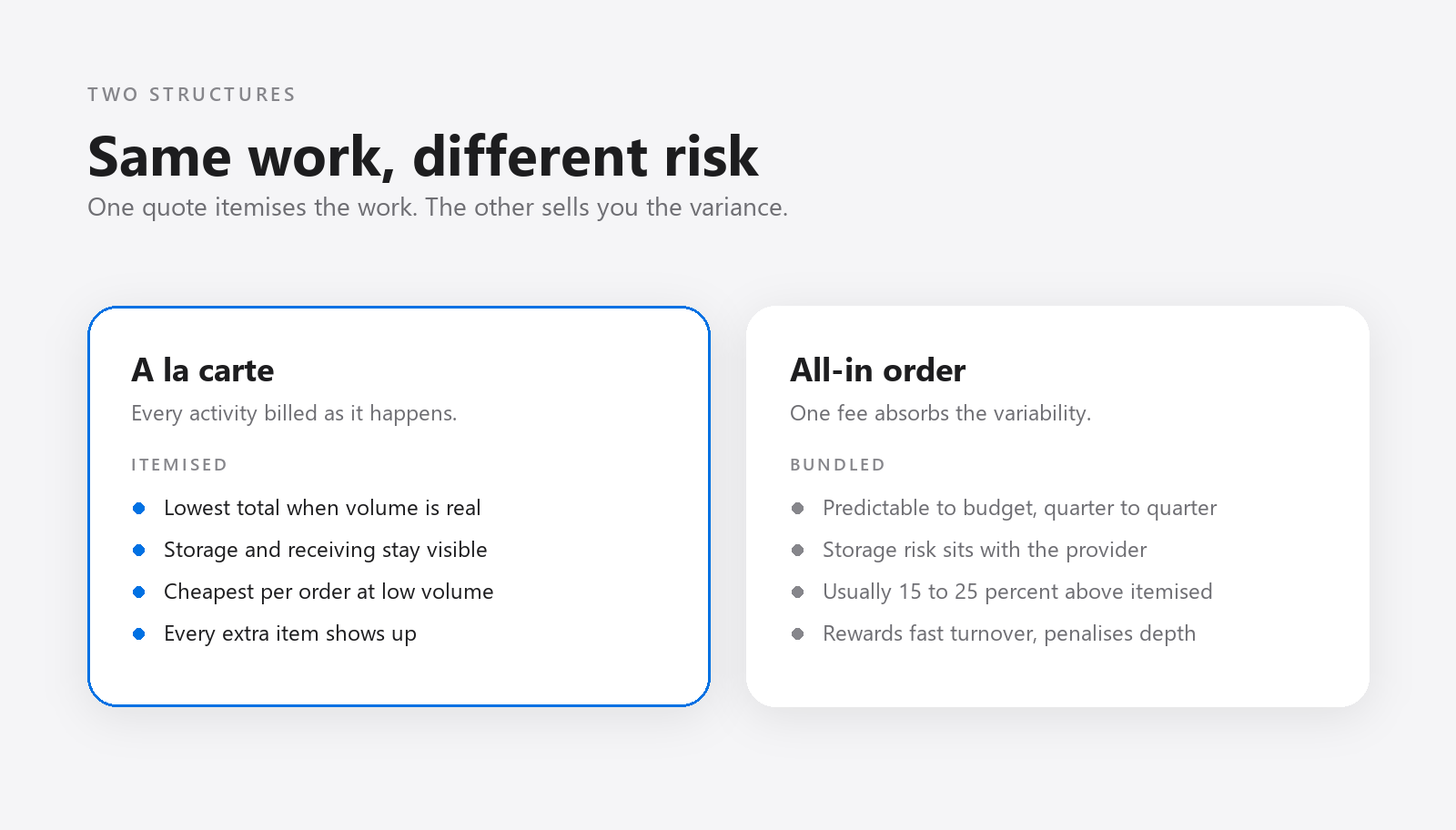
The all-in quote is the most expensive at both volumes and the easiest to Without Breaking Budget. It is not a bad product; it is insurance with a margin attached, and it suits a brand whose SKU count is small and whose turnover is fast.
The ranking between the other two flips. At 1,500 orders the à la carte quote wins by 21 cents; at 4,500 the hybrid wins by 32 cents, because the tier break starts working and the per-item rate drops. The break point, not the headline rate, is what changed the answer.
And the à la carte total barely moves per order as volume triples, because there is no volume mechanism in it. A structure without tiers is a structure that never gets cheaper.
The three levers worth pulling
The minimum. Ask for a ramp — 50% for the first 90 days — or for storage to be excluded from the minimum calculation, since storage is the line that punishes you for holding stock rather than for shipping slowly. If the provider will not move the number, ask whether a slow month can carry forward.
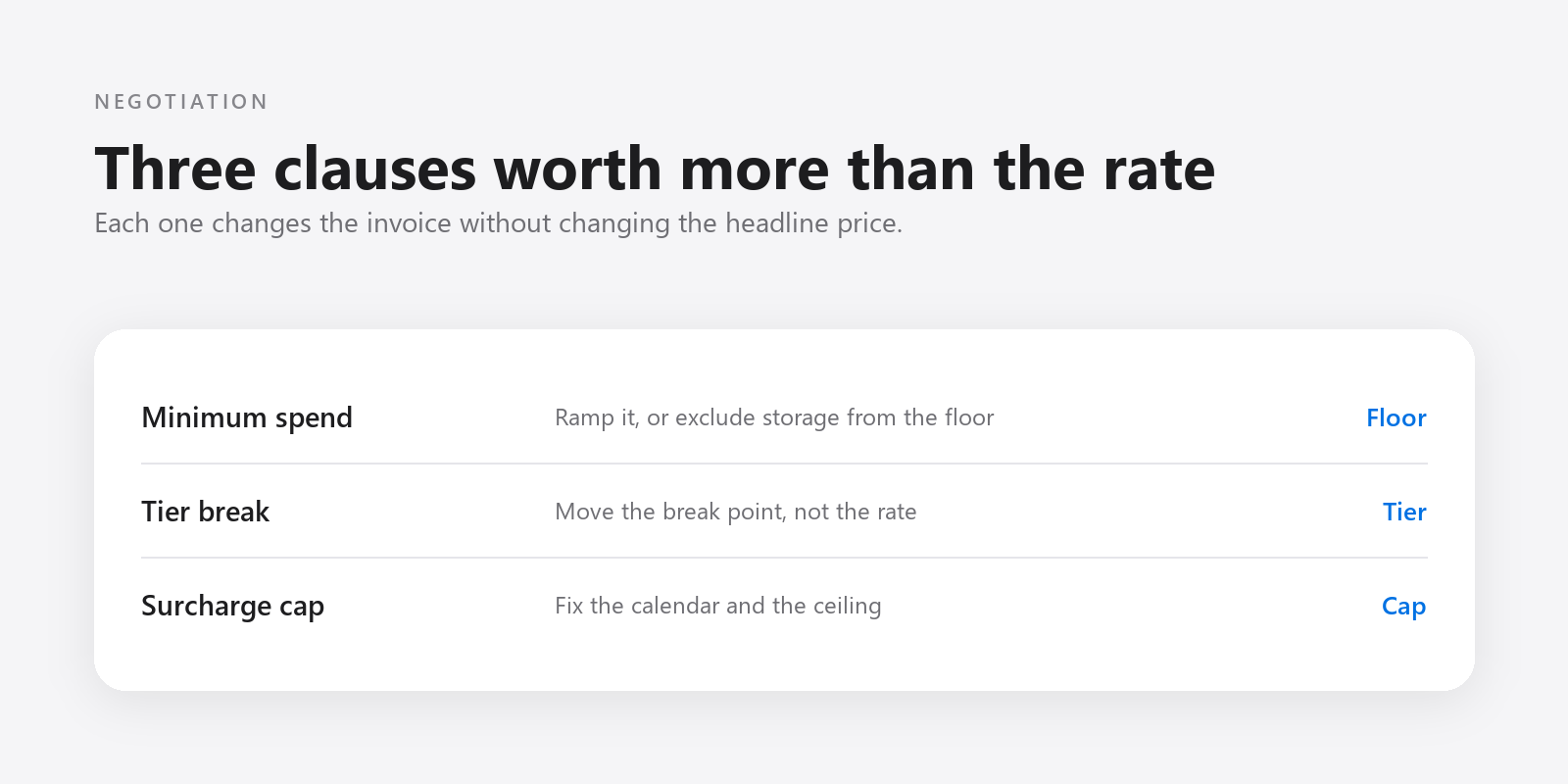
The tier break. Moving a break point from 2,001 to 1,500 orders is worth more than a 10-cent cut on the rate, and it is often easier to get, because it costs nothing until you grow. Offer a twelve-month term or a forecast commitment in exchange.
The surcharge cap. Cap the peak uplift at a stated percentage, define the calendar (start and end dates, not "peak season"), fix packaging markup, and push the aged-inventory trigger from 90 to 180 days. This is where invoices drift furthest from quotes.
There is a fourth, less comfortable lever: your own forecast. Providers price variability. A brand that ships 400 orders one week and 4,000 the next pays for the swing in labour and space, whichever structure it picks.
What to put in the RFQ so quotes compare
Send the same eight fields to every provider, and require a response against each one:
- Monthly orders, and the distribution across the month, not just the average
- Average and maximum items per order
- Pallet count, average dwell, and the SKU count behind it
- Inbound format: palletised or loose, labelled or not, ASN available
- Return rate and what should happen to a returned unit
- Zone mix and average billable weight
- The surcharges you expect to hit: peak, oversize, address correction
- Whether the platform fee, integration and materials are inside or outside the rate
Add a ninth line in the cover email: how billable weight is determined. The convention is that the provider's manifest governs, which means the only defence you have is a jointly witnessed inbound weight record — worth agreeing on before the first dispute, not after it.
Then convert each response to cost per order at your real volume, including the minimum test. A quote that looks 40 cents cheaper per pick can lose to one with a lower minimum as soon as your January arrives.
The short version
A 3PL charges for time, space and reserved capacity, and the rate card is just those three written in units. Read the per-order plus per-item structure as labour, read storage as rent on cube, and read the minimum as the provider's own fixed cost passed back. Then price all three structures at two volumes before you choose, because the cheapest quote at your current size is not reliably the cheapest at twice it.
Send us the eight fields and the two or three quotes you are holding. We will rebuild them on one basis and show you where the difference actually sits — usually in the minimum and the surcharge wording, not the pick fee.
References (Neutral Third-Party Sources)
- UPS — Shipping Zones and Rates: how zones and rate tiers are structured, and how additional-handling and remote-area charges sit outside the base rate. https://www.ups.com/us/en/support/shipping-support/shipping-costs-rates.page
- UPS — Fuel Surcharges: the index-linked mechanism behind a floating surcharge, adjusted weekly, which is why transport lines move and handling lines usually do not. https://www.ups.com/us/en/support/shipping-support/shipping-costs-rates/fuel-surcharges
- USPS — Postage Rates & Prices: the published domestic rate structure, showing how parcel pricing is revised on a schedule. https://www.usps.com/business/prices.htm
- GS1 — Serial Shipping Container Code (SSCC): the pallet and carton identifier used for scan-based receiving and reconciliation. https://www.gs1.org/standards/id-keys/sscc
- Federal Trade Commission — Mail, Internet, or Telephone Order Merchandise Rule (16 CFR 435): the shipping-time obligation a provider's service level has to support. https://www.ftc.gov/legal-library/browse/rules/mail-internet-or-telephone-order-merchandise-rule
- National Retail Federation — 2023 Consumer Returns in the Retail Industry: online returns at 17.6% of sales, the driver behind per-return pricing. https://nrf.com/research/2023-consumer-returns-retail-industry