
3PL vs 4PL: Which Logistics Model Is Right for You?
A 3PL runs the work; a 4PL manages the people who run the work. A third-party 3PL Third-Party Logistics provider owns or operates warehouses and labor and executes your orders. A fourth-party logistics provider owns none of that — it picks and supervises a roster of 3PLs, carriers, forwarders, and customs brokers on your behalf, and you pay it a fee for the orchestration instead of paying each vendor separately.
The choice between the two is not "bigger is better." It's a decision about how much control and visibility you're willing to trade for how much of your own management time you want back. Get the frame right and the rest of the decision falls into place.
Who owns the warehouse — that's the whole difference
Start with assets, because everything else follows from it. A 3PL is usually asset-based: it leases or owns warehouse space, hires pickers and packers, and runs the scanners and weigh stations. A 4PL is, by definition, non-asset. It has no trucks, no racks, and no warehouse labor of its own. What it has is a view across the whole logistics market and the ability to choose, combine, and police the operators that do own those things.
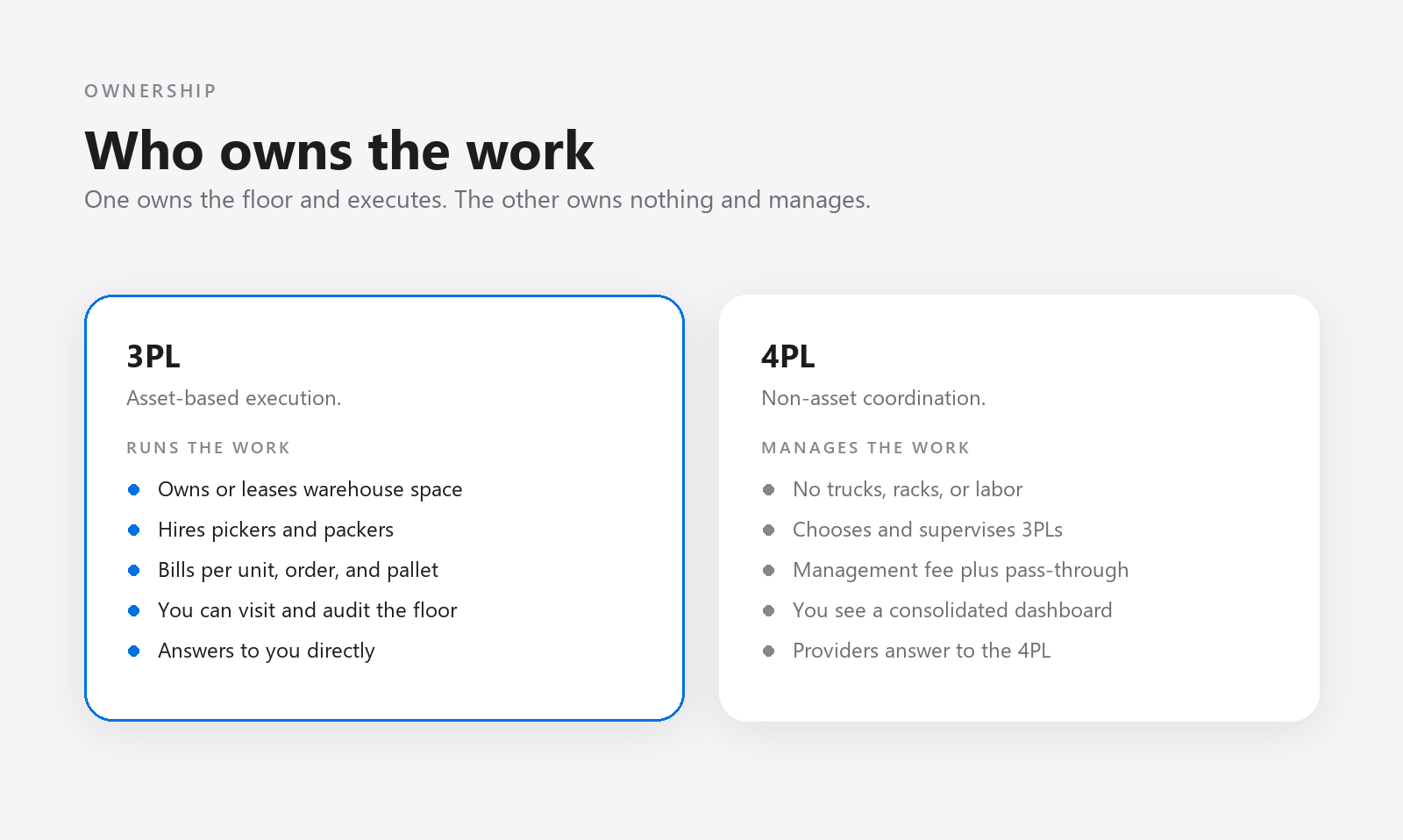
That distinction produces two very different businesses. The 3PL makes its margin on the difference between what its floor work costs and what it charges you. The 4PL makes its margin on a management fee, plus the spread it can negotiate by pooling volume across the providers it manages.
What you give up in exchange
Hiring a 3PL means you lose the direct line-of-sight you'd have in your own building, but you keep a single vendor whose floor you can visit and whose scanners you can audit. Hiring a 4PL means you lose that directness one step further: the 3PL answers to the 4PL, not to you.
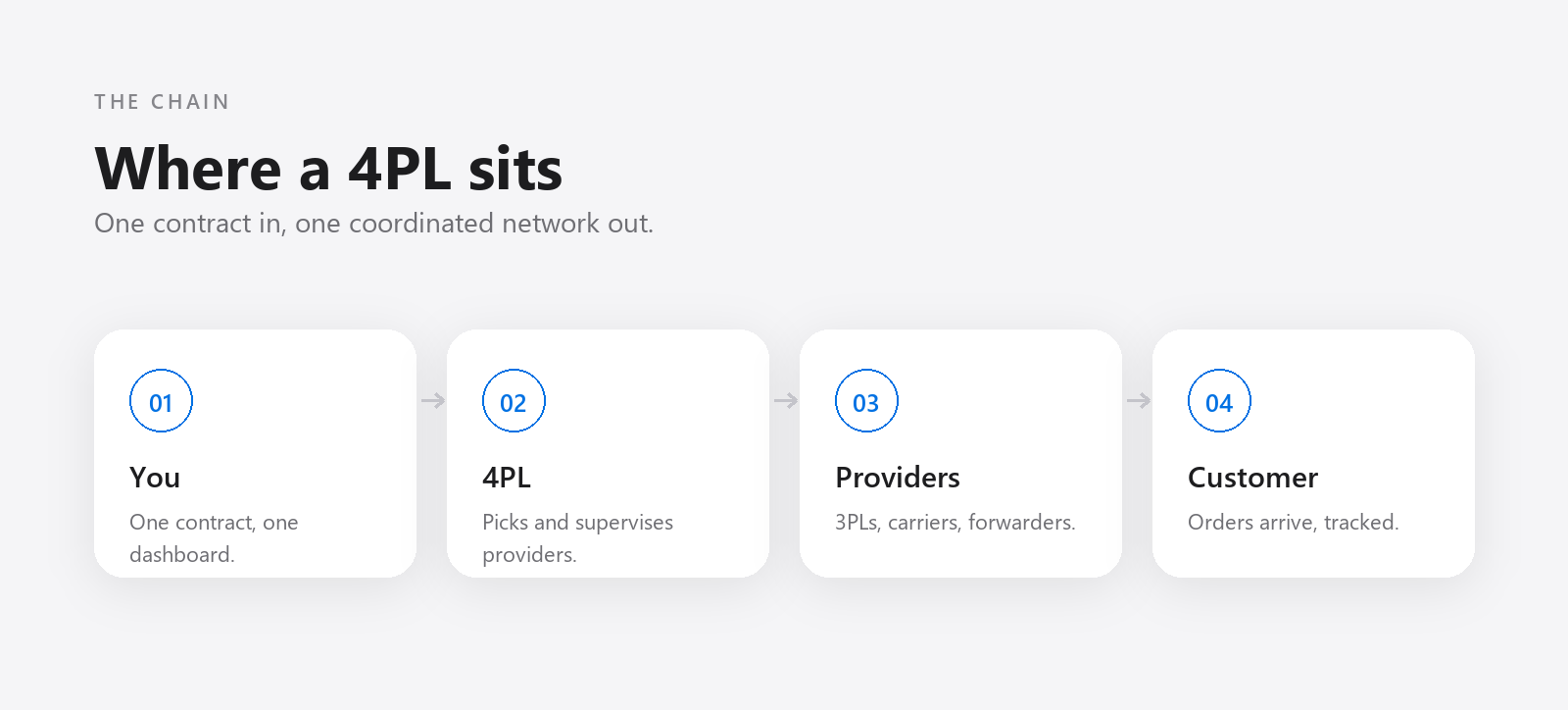
That extra layer is only worth it when the coordination problem is big enough to pay for itself. If you run one warehouse and one carrier, a 4PL is a fee on top of a problem you can already see. If you run four warehouses across three regions with six carriers and two customs brokers, the layer is what keeps the whole thing from being your full-time job.
How each one charges
The pricing structures are the cleanest way to tell the two apart before you read a single contract.
| Dimension | 3PL | 4PL |
|---|---|---|
| Who does the physical work | The 3PL's own warehouse and labor | Subcontracted 3PLs and carriers |
| Owns assets | Usually yes (space, labor) | No |
| How you're billed | Per activity: per unit, per order, per pallet | Management fee plus pass-through costs |
| Who holds the carrier contracts | The 3PL or you | The 4PL, negotiated on your behalf |
| What you see day to day | Your own SKU data in their WMS | A consolidated dashboard over multiple vendors |
| Best fit | One or two lanes, want direct control | Many lanes, regions, and vendors |
The key phrase to watch for is pass-through. A 4PL's headline fee looks small precisely because the real costs — freight, storage, labor — are billed through at whatever the underlying providers charge. Ask whether the 4PL marks up pass-through or charges a flat management fee, because that answer changes the whole economics.
Here's the trap in practice. One 4PL quotes a 5% management fee on top of at-cost freight, another quotes a flat monthly fee but quietly adds three points to every carrier invoice. The second looks cheaper in a spreadsheet until you compare it against the carrier's own rate card. Always demand the underlying invoices, not just the summary line.
When a 4PL actually earns its fee
There's no order-count threshold that flips you from 3PL to 4PL. The switch is justified by complexity, not volume, and you can read it off a short list of signals.
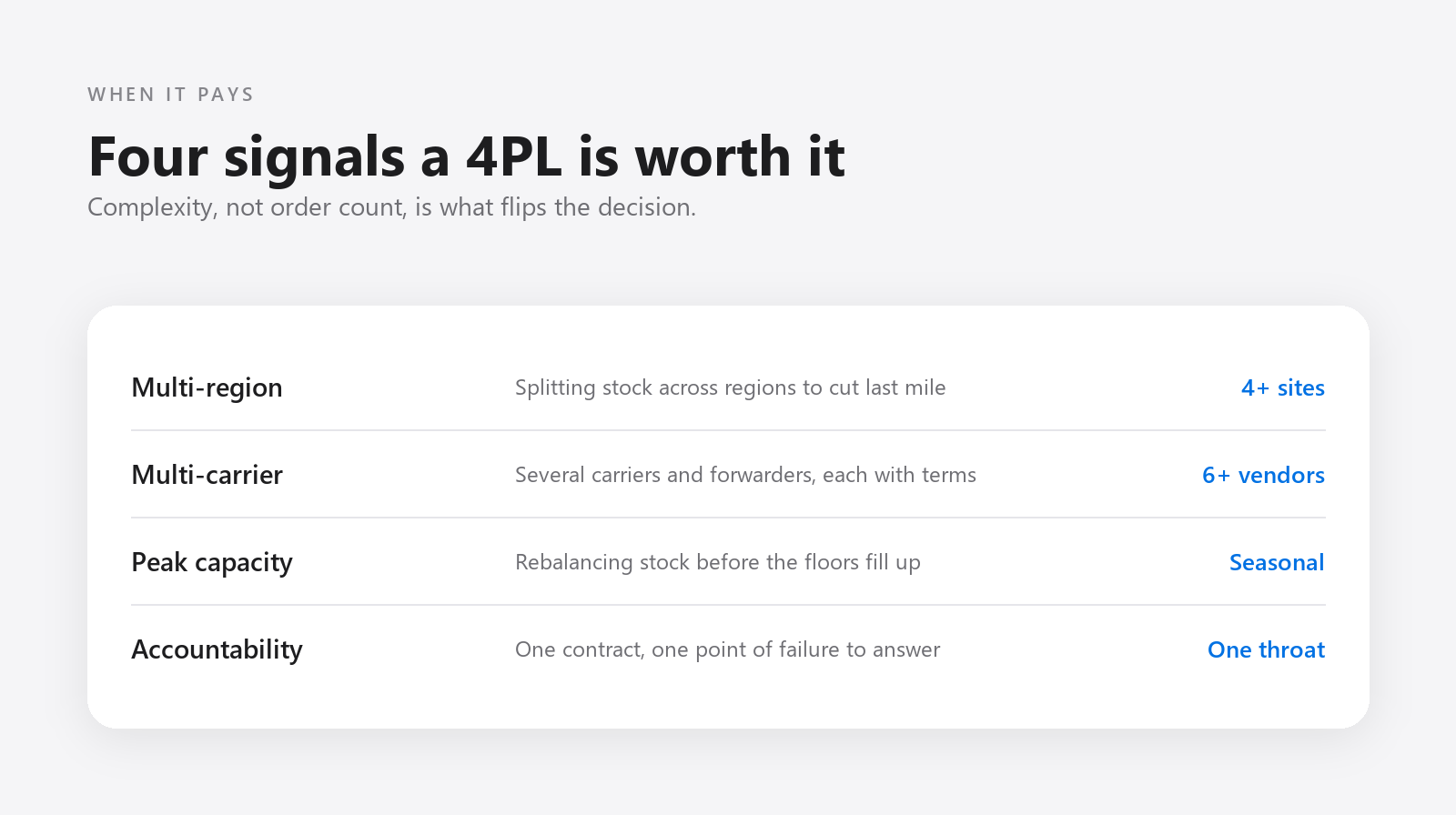
You're a candidate for a 4PL when you need to split inventory across regions to cut the last mile — the final delivery leg to the customer — and suddenly you're managing not one warehouse but four. When you depend on several carriers and a couple of freight forwarders for ocean and air, and each has its own contract, surcharge schedule, and claims process. When a peak season pushes your network past its storage capacity and you need someone to rebalance stock between buildings before the floor fills up. When one vendor's failure shouldn't be your problem to solve at 3 a.m.
The last point is the one most sellers ignore. A 4PL's real product is accountability consolidation: one contract, one throat to choke when a carrier drops a container or a warehouse misses a ship window.
When a 3PL is the right call
If you run a single sales channel from one or two warehouses and your carrier mix is stable, a 3PL is almost always cheaper and simpler. You keep the direct relationship, you can visit the floor, and the per-activity pricing is easy to audit against your own order file. Adding a 4PL on top of that is paying for coordination you don't need.
The honest middle case is this: many sellers outgrow a single 3PL into a two-warehouse setup and don't need a 4PL — they need a second 3PL and a well-built order-routing rule. A 4PL only becomes the cheaper option when the number of vendors you'd otherwise have to manage starts producing its own full-time job.
The tell is your calendar, not your order count. If you're already spending a morning a week reconciling carrier invoices and chasing a customs broker, the coordination cost is already real whether or not you've put a name on it.
The accountability question nobody prices in
When you consolidate vendors under a 4PL, you're also consolidating risk into a single point. That's a feature when the 4PL is solid and a liability when it isn't. Freight-forwarder collapses are a recurring story in cross-border logistics — a forwarder whose cash flow breaks leaves containers sitting at the port while shippers are told to pay again to release their own goods. A 4PL that can't absorb a provider failure is just a broker with a nicer dashboard.
So the due-diligence question is not "how many vendors can you manage." It's "what happens when one of them fails, and who carries that loss." Get that in writing before you hand over the vendor list.
Questions to ask both parties
- Which providers would actually run my freight and warehousing, and can I see their names?
- Do you mark up pass-through costs, or charge a flat management fee?
- Who holds the carrier contracts — you or me?
- If a carrier or warehouse fails, what's your recovery plan and who pays?
- Can I see one consolidated view of inventory across every location, or will I be stitching together portals?
The answers tell you whether you're buying coordination or just another layer of markup.
The short version
A 3PL executes your orders with its own warehouse and labor and bills you per activity. A 4PL owns nothing and manages a roster of 3PLs, carriers, and forwarders for a management fee plus pass-through. Choose by complexity, not volume: one or two lanes, stay with a 3PL; many regions, carriers, and warehouses, and a 4PL starts to earn its fee. Either way, pin down who owns the assets, who holds the contracts, and who carries the loss when a provider fails.
If you're trying to decide whether your current warehouse setup has outgrown a 3PL, send us your regions, carrier list, and order volume — we'll tell you whether a 4PL would pay for itself before we discuss anything else.
References (Neutral Third-Party Sources)
Facts and definitions in this article were checked against public, non-commercial sources. No fulfillment-provider pages are cited.
- Wikipedia — Third-party logistics: the asset-based versus non-asset distinction, and the tiering from 2PL through 4PL and 5PL. https://en.wikipedia.org/wiki/Third-party_logistics
- Wikipedia — Logistics: the origin of the 4PL concept as an integrator defined by Accenture, and the description of a 4PL as a general contractor managing 3PLs, truckers, and customs agents. https://en.wikipedia.org/wiki/Logistics
- GS1 — Global Trade Item Number (GTIN): the product-identification standard that underpins inventory visibility across the multiple warehouses a 4PL coordinates. https://www.gs1.org/standards/id-keys/gtin
- U.S. Customs and Border Protection — De minimis shipments: the entry threshold affecting cross-border parcels handled by the forwarders a 4PL coordinates. https://www.cbp.gov/trade/programs-administration/entry-summary/de-minimis-shipments