
3PL Warehousing Services: Storage, Picking, and Shipping
A 3PL warehouse sells four things, and "storage" is only one of them. You are buying space, labor, and carrier capacity, split across four fee buckets: storage, operations (receiving, picking, packing), last-mile shipping, and value-added work. Reading a warehouse quote is reading how the operator slices those three costs — space, labor, and capacity — into line items, and every slice is a place a cheap quote hides its profit.
The mistake most first-time buyers make is treating the warehouse like a self-storage unit: pay for the shelf, and everything else is incidental. In reality the shelf is usually the smallest line. This article walks through each service and how it is billed, in the order your goods actually move through the building.
The four fee buckets
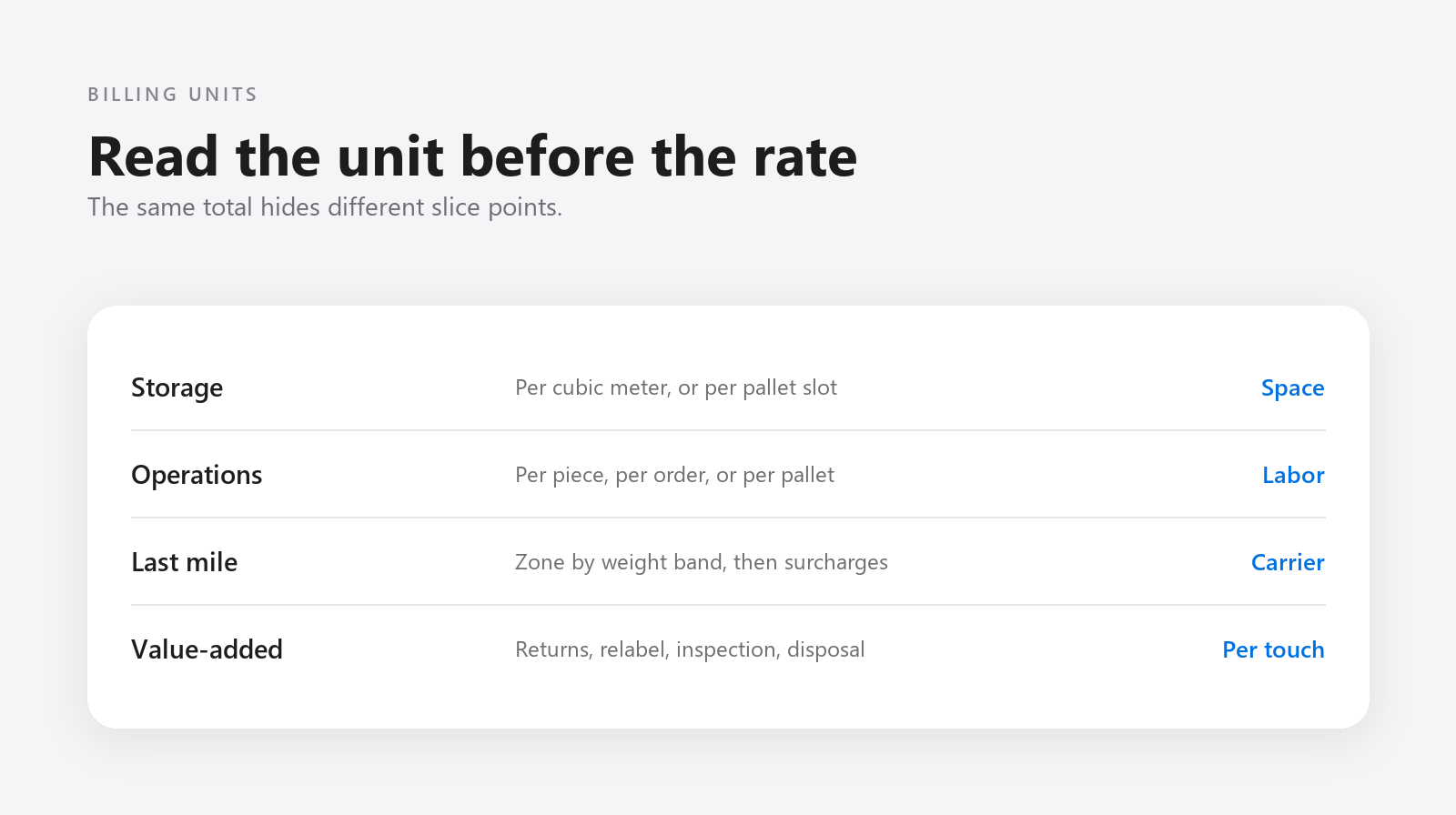
A complete warehouse quote splits into four categories, and a quote that does not split them is not comparable. Chinese cross-border sellers learn this the hard way: two quotes with the same total can differ two or three times once you look at what each one bundles.
| Bucket | What it charges for | Billed by |
|---|---|---|
| Storage | Space your inventory occupies | Cubic meter per day, or pallet slot per day |
| Operations | Labor: receive, put-away, pick, pack, label | Per piece, per order, or per pallet |
| Last-mile shipping | The parcel from warehouse to buyer | Zone, weight band, then surcharges |
| Value-added | Returns, relabeling, inspection, disposal | Per unit, per touch, or per hour |
Storage and operations are negotiable. Last-mile is not — it follows the parcel — which is why a warehouse that looks cheap on the shelf and expensive on the outbound label is usually the reverse of what you assumed.
Receiving: the first billable touch
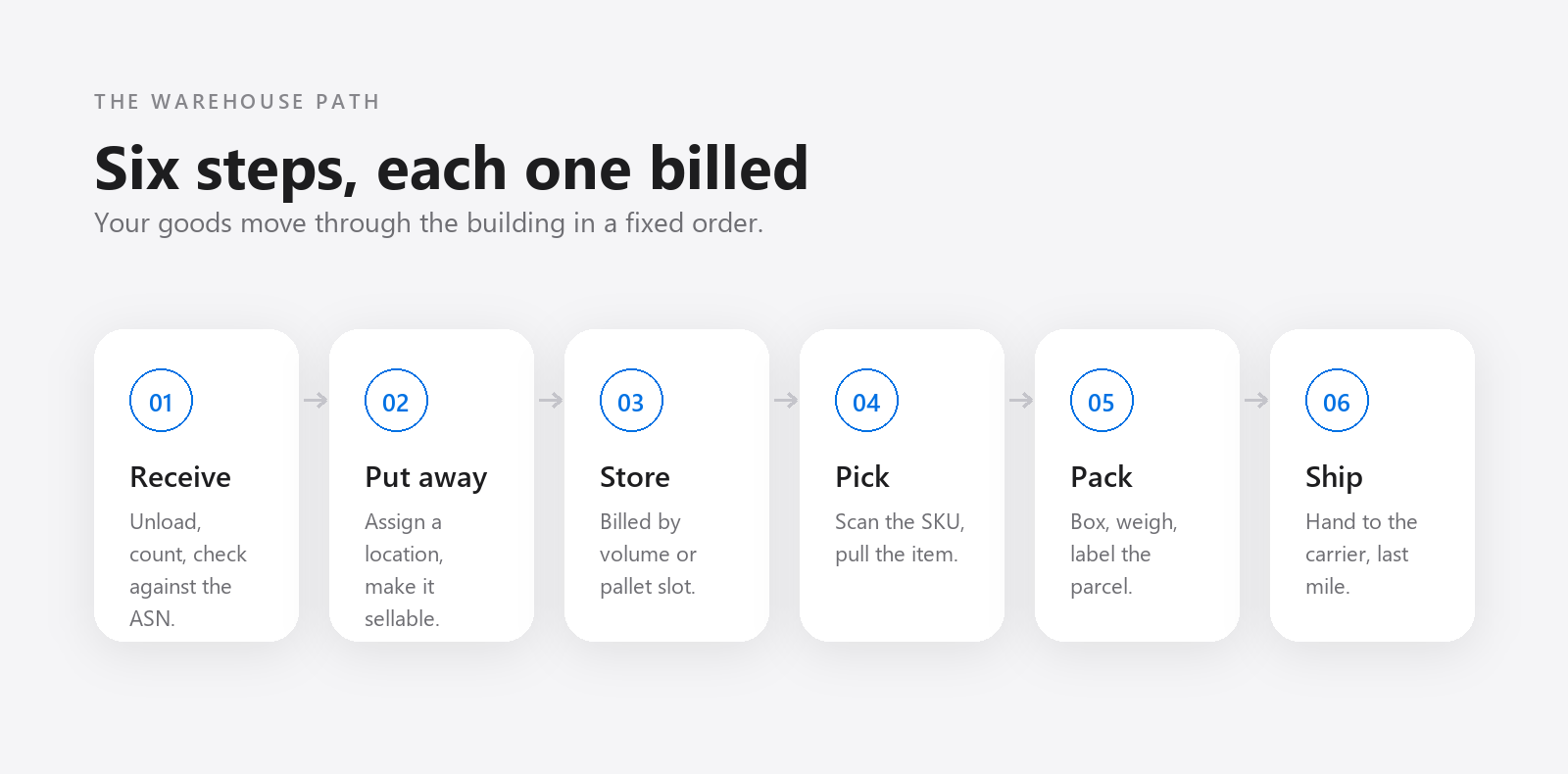
Receiving is where your goods become sellable inventory, and it is billed per pallet or per carton inbound. The warehouse checks the shipment against your advance shipping notice, flags shortages or damage, and counts it into stock. Only after the count is an item available to pick — which is why the receiving speed decides whether a restock lands on the shelf in a day or sits in a queue for three.
Two details hide in this line. First, the free-storage grace period: new stock often gets 7 to 30 days of free storage before the meter starts, and that grace can vanish in peak season. Second, the clock. "Within 24 hours" means nothing until you know whether the clock starts at receipt or at unload — two warehouses quoting the same 24 hours can be a full shift apart in practice.
Storage: by volume or by pallet slot
Storage is the fee most buyers over-focus on, and the one where the billing unit matters more than the rate. There are two mainstream methods.
By volume (cubic meters per day), you pay for the space you actually occupy. Loose SKUs and irregular shapes suit this. By pallet slot (a fixed position per day), you pay for a slot whether it is stacked to the ceiling or half empty. A standard slot is roughly 1.2m × 1m × 1.5m — about 1.8 cubic meters — and if your cartons are light and only a dozen fit per slot, you are paying for air.
The test is not the headline rate. It is the cost per unit per month: divide the rate by how many units actually fit in the billed space. Three other lines ride on top and are easy to miss: a volume discount that kicks in only past a threshold, a monthly minimum that floors the bill for small accounts, and a long-term storage surcharge that starts after inventory sits unsold — usually somewhere around 90 to 180 days — and climbs until it eats the margin on a slow mover.
Picking and packing: per item, per order
Operations fees are split by action, which is the honest way to bill them: receive, put-away, pick, and pack each carry their own rate. A drop-ship-per-order (one order, one or two items) runs through all four; a full-pallet outbound runs through only two.
The unit you are billed in decides whether the warehouse fits your business. Per-piece pricing suits one-order-at-a-time, high-SKU sellers; per-pallet pricing suits B2B transfers and FBA restocks, where one pallet holds dozens of cartons and per-piece billing would be absurd. The cheap spots to get caught: whether packaging materials are in the pack fee or separate (a few cents to a few dollars per order), whether labeling is free or per label, and whether mixed-carton splits cost extra.
Accuracy is the hidden half of this line. Good warehouses stop mis-picks mechanically rather than by eyeball: a barcode scan at pick, and a weight check at pack where a parcel more than a few grams off the expected weight trips an alarm. Operators who run these checks talk about error rates below a fraction of a percent; operators who don't talk about them at all.
Shipping: zone, weight band, then surcharges
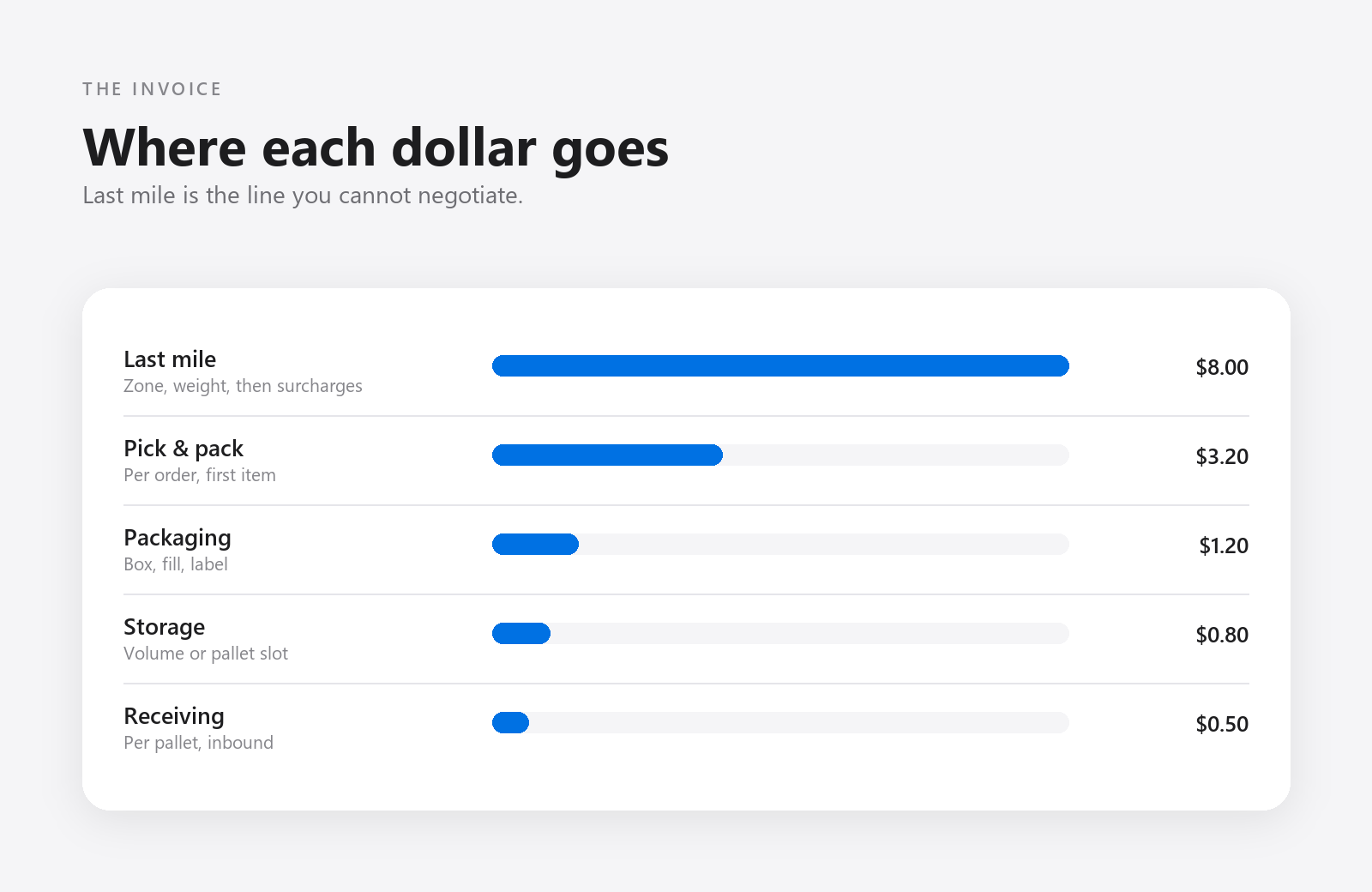
Last mile is the largest line on the invoice, and it is three variables multiplied together: the zone (how far the buyer is from the warehouse, usually split into zones 1 through 8), the weight band (rounded up, often per pound), and the carrier discount. This is where dimensional weight bites: carriers bill the greater of actual and dimensional weight, so a large light box of pillows ships as if it weighed far more than it does.
The surcharges are the layer most buyers forget to ask about, and they arrive on the second invoice: residential delivery, remote-area delivery, oversize (a side over 48 inches), overweight (over 50 pounds), a peak-season surcharge that runs roughly October through January, and a fuel surcharge that floats month to month. None of these are negotiable per order — but a warehouse placed near your customers lowers the zone, and with it several of the surcharges at once.
The fees nobody quotes up front
The base quote covers the happy path. The second month's statement introduces the rest: a per-unit returns fee covering inspection, relabeling, and restocking (which can outrun the outbound cost in high-return categories), a relabeling fee for non-compliant labels, and a disposal fee for inventory you finally give up on. For cross-border sellers, duty and tax sit on top of all of it — and low-value parcel exemptions have been tightening, so a "duty-included" line is increasingly a guess rather than a guarantee.
These are not hidden in the sense of being illegal; they are hidden in the sense of being line 11 of a 14-line statement you did not ask to see before signing. The fix is to ask for the complete surcharge schedule before the contract, not the base rate card.
Three pricing mistakes that cost the most
The most expensive mistakes are not overpaying; they are misreading.
Mistake one: "zero storage" means cheap. Storage cost does not disappear; it moves. A warehouse with zero storage and a high per-piece operations fee, versus one with storage and a low operations fee, converges on the same total once volume arrives — the zero-storage one just hides where the money comes from.
Mistake two: comparing the operations rate alone. A $0.30 operations fee that excludes packaging, excludes labeling, and charges extra for mixed cartons can cost more per order than a $0.60 fee that includes all three.
Mistake three: price over speed. A warehouse that shelves your restock two days slower is a warehouse that costs you two days of being out of stock. The lost sales and ranking damage from those two days usually dwarf whatever you saved on the rate.
The short version
A 3PL warehouse bill is space, labor, and carrier capacity, sliced into four buckets — storage, operations, last mile, and value-added — and each is billed in a different unit. Read the billing units before the rates, ask for the complete surcharge schedule instead of the base card, and judge accuracy and speed as part of the price. The cheapest quote is usually the one that quoted the fewest lines.
References (Neutral Third-Party Sources)
- Wikipedia — Warehouse: the function and layout of a warehouse — receiving, storage, picking, packing, and shipping — referenced for the service breakdown. https://en.wikipedia.org/wiki/Warehouse
- Wikipedia — Order fulfillment: the steps a fulfillment operation performs from receiving an order to shipping it, including picking and packing. https://en.wikipedia.org/wiki/Order_fulfillment
- USPS — Mail & Shipping Services: dimensional-weight billing (length × width × height ÷ 139) and nonstandard-package surcharges, referenced in the shipping section. https://www.usps.com/ship/mail-shipping-services.htm
- U.S. Customs and Border Protection — De minimis shipments: the low-value entry threshold that decides whether parcels clear duty-free, referenced for cross-border duty caveats. https://www.cbp.gov/trade/programs-administration/entry-summary/de-minimis-shipments