
Apparel Fulfillment: How Clothing Brands Handle Orders & Returns
Apparel fulfillment is harder than standard fulfillment for three reasons: SKUs multiply, returns run high, and getting the size right is the whole job. A customer who orders a black shirt in medium has not received the right order if you ship the same shirt in large. Every other mistake in the warehouse is a logistics problem. That one is a product problem wearing a logistics hat.
Most of the cost lives in two places: the size-and-color matrix and the reverse line. This article walks both, plus how to pack a garment so it arrives the way it left.
One style is not one SKU
The defining fact of apparel is the variant matrix. A single style in five sizes and four colors is twenty SKUs. A tee that runs XS through 3XL across five colorways is thirty-five. A brand with a hundred styles is quietly managing two thousand SKUs before a second collection launches.
That changes the system requirement before anything else. The WMS has to track stock at the size-and-color level, not the style level. A system that shows "this shirt is available" when the medium has sold out is telling a lie the customer discovers at checkout.
Each variant needs its own barcode and its own location. When Small/Black and Small/Green look identical on a shelf, the only thing that separates them is the scan.
Slot the sizes by how fast they sell, not by style
The instinct is to keep a style's sizes together. The math says otherwise.
Mediums and larges outsell XS and 3XL by a wide margin, so the fast sizes belong in the accessible pick faces near the pack benches. Grouping all six sizes together alphabetically puts a size nobody orders in prime space while the size everyone orders sits in the back. Slot by velocity, and treat the slow tail as a separate storage problem.
The forward pick zone should turn over several times a day; a size that has not moved in a week is taking up space the peak will need. That rule is the same one a general warehouse applies to fast movers, and it bites harder in apparel because the tail — the odd sizes — is longer.
Picking is where the size error happens
Wrong size or color is the number one apparel mis-ship, and it is almost always a picking error, not a packing one.
The fix is boring: scan at pick and at pack, and make the scan refuse to advance on the wrong variant. Warehouses that let human eyes be the final check run manual error rates of a few percent; the same operation with per-variant barcodes and a scan at both ends drops that well under one percent. It is the same discipline as any warehouse's mis-ship ceiling — a few wrong items in a thousand, not a few wrong sizes in a hundred.
A second scan at the pack bench catches what the pick scan missed: two near-identical colorways grabbed from adjacent slots.
Returns are the reverse line, and apparel runs it harder
Returns are not an exception path in apparel. They are a second assembly line running backwards.
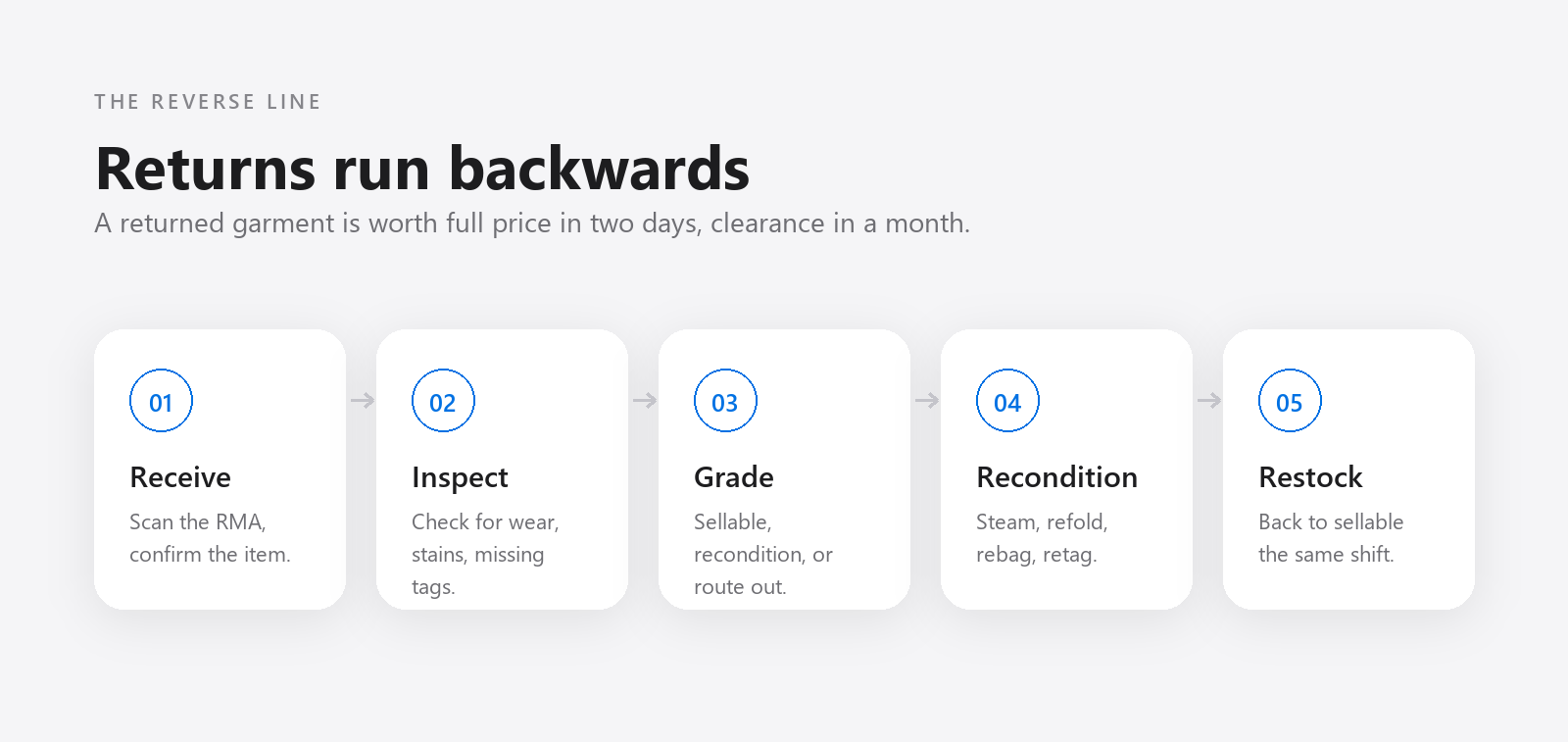
The National Retail Federation's 2025 returns landscape puts the online return rate at roughly 19%, and apparel and footwear run higher because fit cannot be confirmed until the garment is tried on. Bracketing makes it worse: a shopper orders the same item in three sizes, keeps one, and sends two back.
That volume means returns compete with outbound work for the same people and the same space. A center that treats returns as a side job will end the season with racks of "to be checked later" stock that is out of season by the time anyone looks at it.
Grade, recondition, restock — in hours, not days
The value of a returned garment decays on a clock. A jacket returned in December is worth full price if it is back on the rack in two days and worth clearance if it sits until March.
The standard sequence is: receive and verify against the return authorization, inspect, grade, recondition, and restock. The grading is usually three bands — sellable as-new, needs work (steaming, re-folding, re-bagging, a fresh hangtag), and defective or worn. Reconditioning means steam out the wrinkles, re-fold to spec, replace the poly bag, reattach the size sticker and hangtag. What cannot be resold as new gets marked down, liquidated, or disposed of.
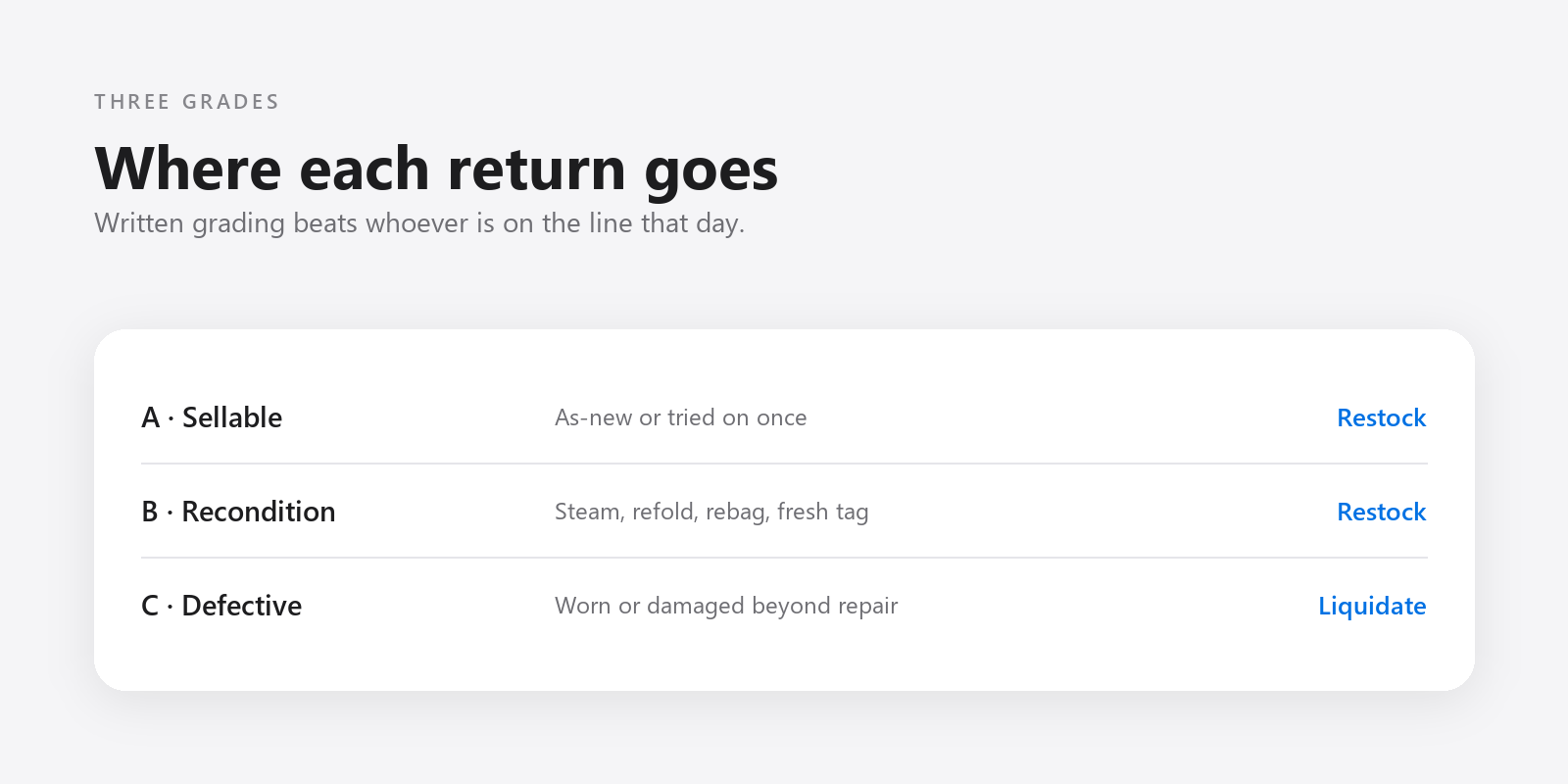
Ask a fulfillment partner for return-to-restock time in hours, not days, and ask whether the grading criteria are written down or left to whoever is on the line. The difference between the two answers is the difference between recovered inventory and shrink. A single return costs real money before any markdown — inspection labor, repackaging, and the return shipping itself — so speed is the only lever that buys value back instead of just spending it.
Pack so it arrives the way it left
Apparel packaging is not one decision. It is a set of methods matched to the garment, and getting it wrong costs you either freight, damage, or unboxing quality.
| Method | Best for | What you trade |
|---|---|---|
| Folded and poly-bagged | Tees, knits, denim, fleece | Cheapest; needs a documented fold spec |
| Flat-packed in a mailer | Single light items | Lowest dimensional weight; creases easily |
| Garment on hanger (GOH) | Blazers, dresses, outerwear | Prevents wrinkles; needs rail storage and taller cartons |
| Boxed with tissue | Premium, gifting, drops | Slow pack times; price the labor in up front |
The poly bag is the quiet workhorse: it keeps the garment clean and dry in transit and gives the unboxing a finished look. The hanger is the opposite end — rail storage, more cube, more cost per unit — and it only earns its keep on structured pieces and wholesale programs that require goods to arrive on hangers.
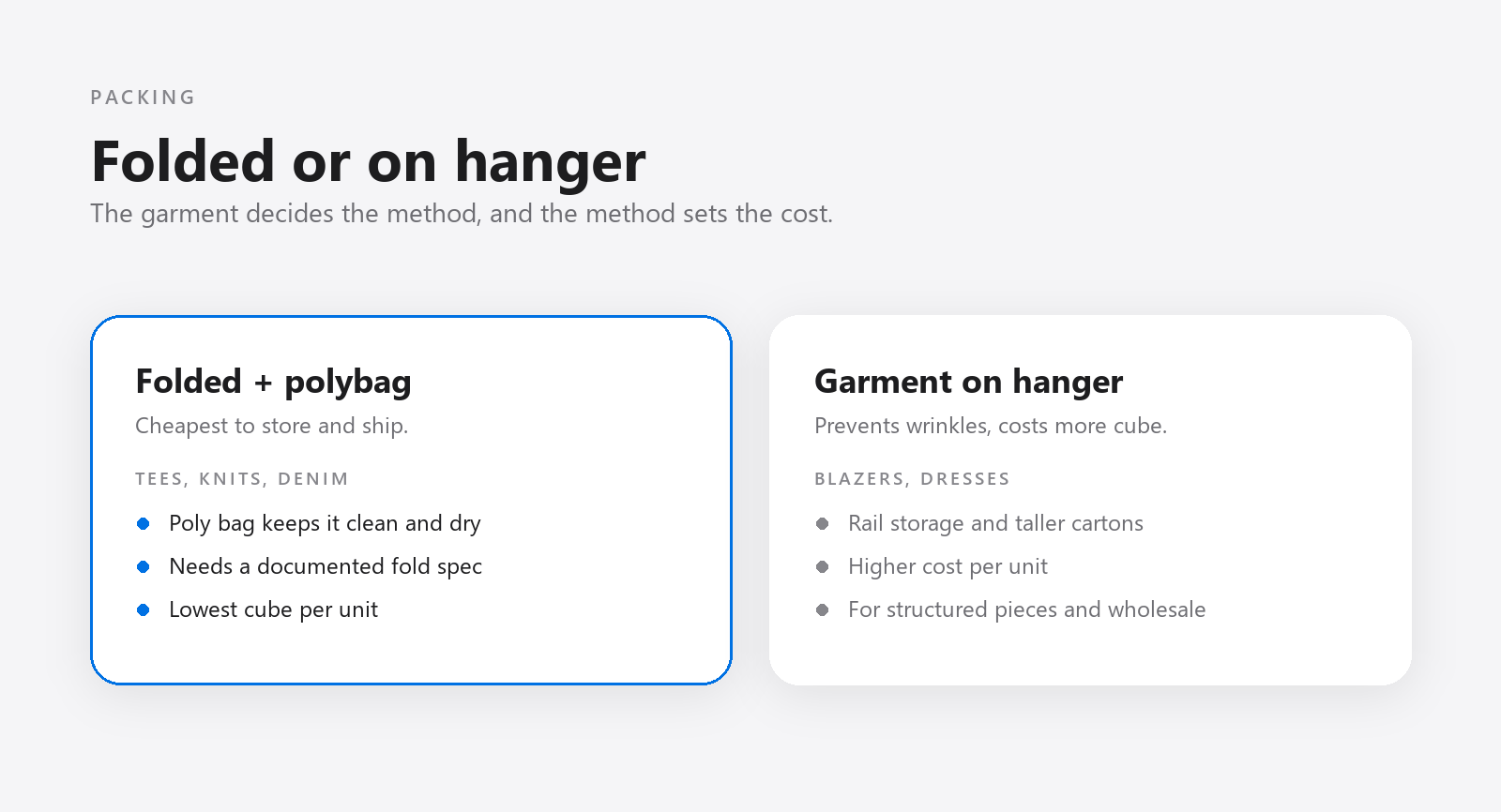
Whatever method you pick, document the fold spec. Two packers on different shifts should produce the same parcel, and the only way that happens is a written spec, not a shared sense of "that looks about right."
The seasonal clock decides everything
Apparel demand is lumpy in a way most categories are not. A drop, a collab or a holiday sale can put a quarter's volume into seventy-two hours, and the season itself sets a deadline no warehouse can extend.
Two consequences follow. The inbound side needs an appointment booked before the container lands, so the stock is sellable on How to Launch day instead of sitting at the dock. The returns side needs capacity planned before the peak, because the wave comes back seven to twenty-one days after the sale — the January returns tide is the January work, not the December work.
Pre-kitting bundles and pre-printing inserts in the days before a drop moves work off the critical path, the same way pre-packing does in any high-volume shed.
A short checklist for a clothing brand
Five questions settle most of it. Does the system track stock at the size-and-color level? Are fast sizes slotted near the pack benches? Is every variant scanned at pick and at pack? What is the return-to-restock time, in hours? And is the grading criteria written down?
If the answer to any of them is a shrug, the errors you cannot see are already in the order file.
The short version
Apparel fulfillment is hard because the variant matrix multiplies the work and the return rate multiplies it again. Track stock at the variant level, slot by velocity, scan at both ends, and run returns as a reverse line with a clock on it. Get those four right and the category stops being the hard one.
If you are sizing an apparel account — style count, size run, return rate — send us the numbers and we will map the variant and returns plan before we talk about pricing.
References (Neutral Third-Party Sources)
- National Retail Federation — 2025 Retail Returns Landscape: total returns projected at $849.9 billion in 2025, with an estimated 19.3% of online sales returned. https://nrf.com/research/2025-retail-returns-landscape
- GS1 — Global Trade Item Number (GTIN): how a trade item is identified at each variant and packaging level, the basis for one barcode per size and color. https://www.gs1.org/standards/id-keys/gtin
- Federal Trade Commission — Mail, Internet, or Telephone Order Merchandise Rule: the shipping baseline and the duty to notify buyers of delay. https://www.ftc.gov/business-guidance/resources/business-guide-ftcs-mail-internet-or-telephone-order-merchandise-rule
- U.S. Bureau of Labor Statistics — Retail Sales Workers: the store-side labor model apparel returns and exchanges draw on. https://www.bls.gov/ooh/sales/retail-sales-workers.htm
- Shopify Help Center — Fulfilling orders: what the fulfillment action covers, from picking and packing to handing parcels to a carrier. https://help.shopify.com/en/manual/fulfillment/fulfilling-orders