
Coffee Fulfillment: How to Ship Fresh Beans Without the Hassle
Coffee fulfillment is harder than standard fulfillment because freshness is the product itself, and the clock starts the moment the beans leave the roaster. A bag that sits in a warehouse for two extra weeks is not late — it's stale. Every other decision in coffee 3PL Third-Party Logistics flows from that one fact: how you rotate stock, how you pack the bag, when you cut off subscription orders, and what you do with a return.
Most of the cost and most of the mistakes live in three places: the freshness window, the crush-proof packaging, and the subscription rhythm. This article walks all three.
Roast date is the clock, not the ship date
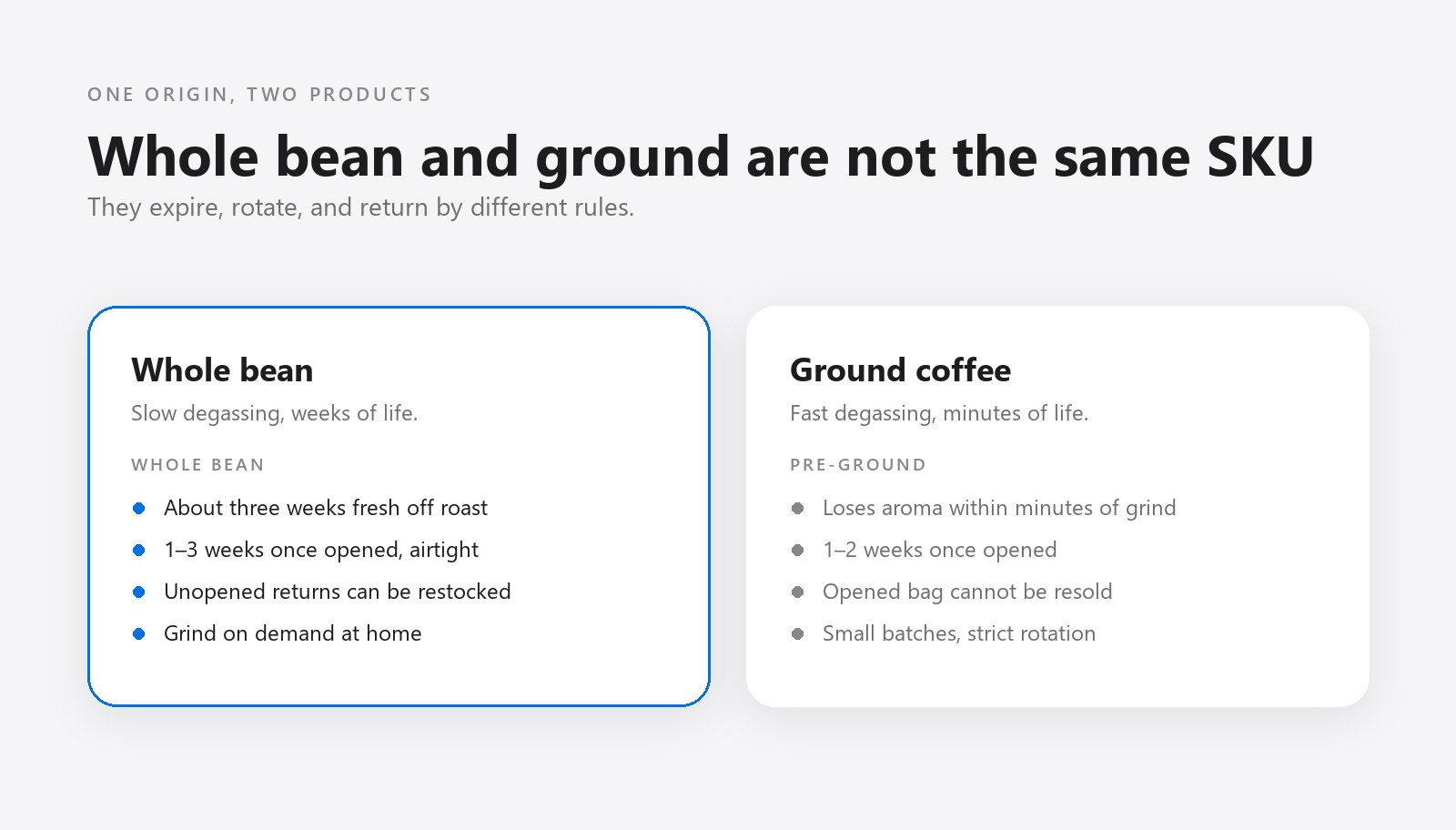
Ordinary goods are tracked by SKU and batch. Coffee adds one more field: the roast date. Roasting traps carbon dioxide inside the bean, and that gas escapes quickly for roughly the first 20 days before tapering off sharply. Using that release as the yardstick, the Specialty Coffee Association puts whole-bean coffee's "fresh" window at about three weeks, while ground coffee loses its CO₂ — and its aroma — in minutes after grinding.
The practical rule follows. A coffee warehouse's first-in, first-out (FIFO) rotation — oldest stock out the door first — can't run on inbound order alone; it has to run on roast date. Two bags of the same SKU roasted a week apart are not interchangeable, and the older roast always ships first. Stock that's been sitting past that three-week mark should be marked down or pulled before a customer tastes the flatness and writes the review.
The SKU count doubles the moment you grind
A single origin isn't one SKU. Whole bean versus ground are two different products, and weight and roast level multiply on top of that. A roaster with a handful of origins, three sizes, and a grind option is quietly managing dozens of SKUs before the first holiday blend lands.
Each variant needs its own barcode — that's exactly what a GTIN is for — because a picker looking at two Georgia Fulfillment Near-identical bags, one dark roast and one light, one whole bean and one ground, will eventually grab the wrong one if the only check is human eyes. The warehouse fix is the boring triple check: unique barcode, quantity comparison, and weight comparison, so a wrong scan can't advance to the next step. That's the discipline that holds mis-shipment down, not a picker's memory for lot numbers.
The valve bag is your first line of defense
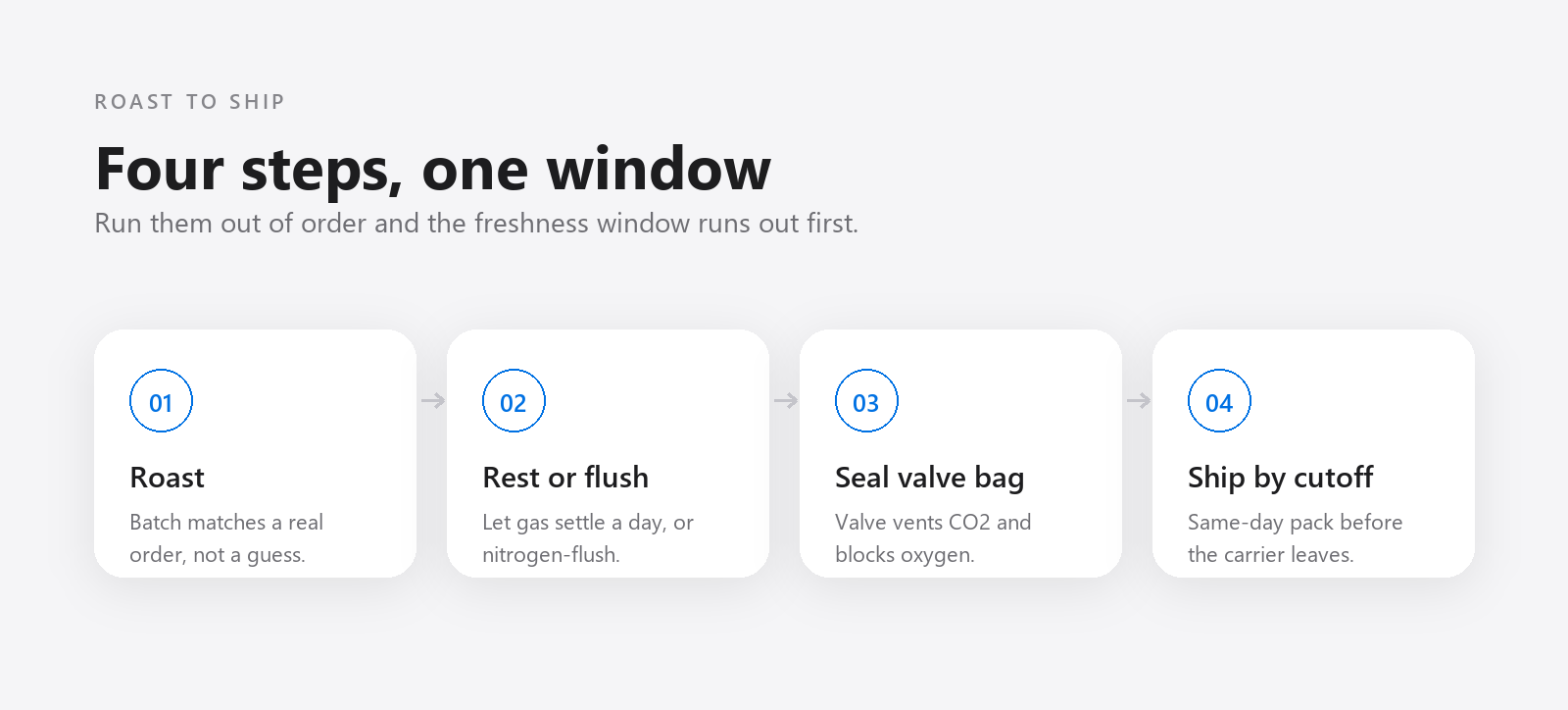
Fresh beans keep releasing gas. Seal them in an airtight bag with no exit, and the pressure builds until the seal fails. A one-way degassing valve is the answer: it lets CO₂ out and keeps oxygen from getting back in. For whole-bean coffee packed within a week of roast, the valve is non-negotiable; nitrogen-flushed ground coffee can often skip it.
The bag material itself sits under a food-contact rule — FDA 21 CFR 177.1520 lists the olefin polymers (polypropylene, polyethylene and related copolymers) cleared for touching food. And here's the counter-intuitive part: the first 24 to 48 hours after roast are the heaviest outgassing, so sealing and shipping that day can actually bulge and burst a seal. "Fresher is better" stops being a hard rule at the point where the gas has nowhere to go. Resting the beans a day or flushing with nitrogen is a condition, not a slogan.
Pack so a bag survives the truck
Coffee's other enemy is compression. The bag has to sit tight in its box with no room to shift, with fill and corner support placed so nothing presses directly on the valve. A soft pack bouncing around inside a loose carton is a damaged seal waiting to happen.
The quieter risk is upstream. When a packaging supplier goes down — a production halt, a material shortage, a holiday rush — shipping slips by three or four days, and in coffee, three or four days is the most expensive slice of the freshness window. So packaging is a two-source buy: keep safety stock, and the moment a delay is known, tell customers before the complaints stack up. The notification is cheaper than the apology.
Whole bean vs ground: two shelf lives, two rules
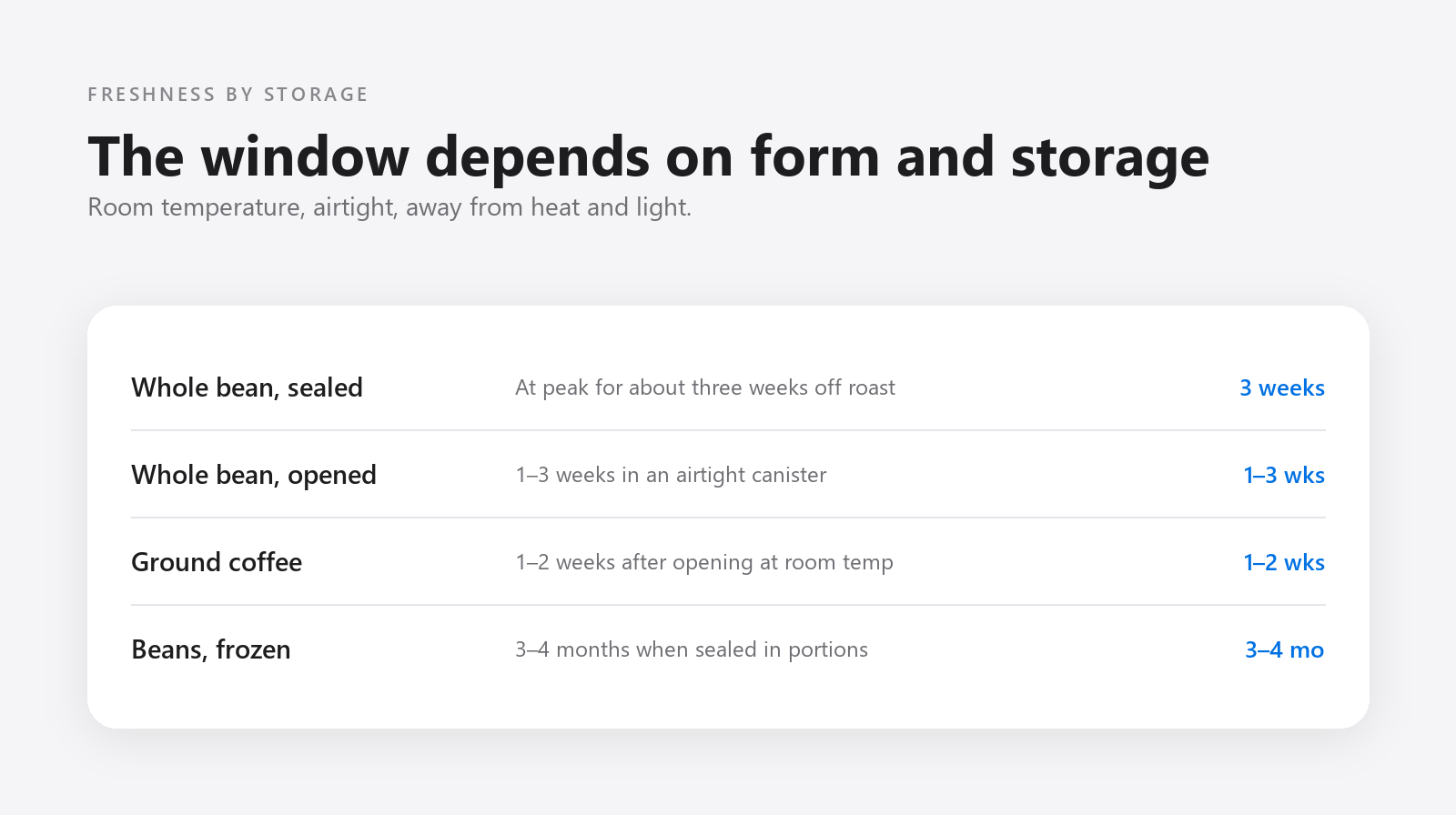
| Form | Fresh window (room temp) | Degassing | Return rule |
|---|---|---|---|
| Whole bean, sealed | ~3 weeks off roast | Slow, over days | Unopened: restockable, re-dated |
| Whole bean, opened | 1–3 weeks airtight | Slows after opening | Generally non-returnable once opened |
| Ground coffee | 1–2 weeks after opening | Minutes after grinding | Opened: cannot be resold |
| Frozen (beans, sealed) | 3–4 months | Near-stopped | Non-returnable |
Ground coffee is the fragile line item. Its surface area explodes after grinding, so CO₂ and aroma leave fast, and once the bag is opened it's effectively past its peak. That means ground SKUs must be replenished in small, frequent batches and rotated strictly by date — you can't buy a quarter of ground coffee and let it sit the way you might with whole bean.
Shipping is the one place coffee behaves itself: it isn't perishable in the refrigerated sense, so ground transport works. It's also dense, which makes it a good candidate for USPS Priority Mail Cubic — a size-based rate that fits packages up to 20 pounds and 0.5 cubic feet, priced by volume instead of weight. A small, heavy box of beans often lands in a cheap cubic tier.
Subscription coffee: roast to a cutoff, not to a queue
Subscriptions are coffee's biggest repeat-purchase engine, and the easiest place to waste either coffee or time. Recurring orders arrive on a schedule, so if the roast batches don't line up with that schedule, you end up with beans roasted with no order waiting, or orders waiting on a roast.
Set the cutoff first — the time after which an order doesn't make that day's roast-and-ship — then work the roast batches backward from it, so every batch comes out of the roaster with a matching order already in hand. For a category whose SKUs turn over fast and change constantly, that cutoff discipline is the difference between a subscription that scales and one that turns into daily firefighting.
Returns are food, not furniture
Coffee returns don't behave like apparel returns. An opened bag of ground coffee generally can't be inspected and put back on the shelf — food safety draws the line there. So coffee returns split into two tracks. Damage (a crushed bag, a broken seal) goes through the carrier's damage claim — the formal payout process for a parcel damaged in transit — not back into inventory as if it were a simple return. Unopened whole bean can take the normal return path, but it has to be re-dated and returned to the rotation in the right position, never mixed back into the fresh lot.
The policy has to be stated before checkout: "opened bags are non-returnable, transit damage is claimed separately." Written clearly up front, it saves the customer-service argument later, because no one is ever happy to learn the rule at the return desk.
The manual-versus-outsourced line for a small roaster
At small volume, packing in-house is genuinely fine: roast, bag, label, buy the label, hand it to the carrier. The trigger to outsource is your own time, not a round order number. When packing is something you do between answering emails, keep the margin. When packing becomes the thing keeping you from roasting or selling, the math has flipped.
The cost structure makes the decision concrete. Rent and equipment are fixed costs; Corporate Gift Boxes and piece-rate labor are variable. Outsourcing converts fixed cost into variable, and the rule of thumb that shows up again and again in warehousing is a 10–20% saving on the shifted work once volume supports it. A useful middle step is hybrid: keep your flagship whole-bean in-house and hand off only the ground SKUs or the subscription volume that's crushing you.
A short checklist for a coffee brand
Five questions settle most of it. Does the warehouse rotate by roast date, or just by inbound order? Do whole bean and ground each carry their own barcode, with a scan and a weight check at the pack bench? Is the valve bag FDA-compliant, and is there a written SOP for resting versus nitrogen-flushing? Do the subscription cutoff and the roast schedule actually line up? And is the return policy — opened ground non-returnable, transit damage claimed separately — written down where customers see it?
If any answer is a shrug, the mistake you can't see is already in the order file.
The short version
Coffee fulfillment is hard because freshness is the product and the clock starts at roast. Rotate by roast date, treat whole bean and ground as separate products with separate shelf lives, protect the valve bag in a snug box, roast subscriptions against a real cutoff, and split returns into "opened, can't resell" and "damaged, claim the carrier." Get those five right and the category stops being the hard one.
If you're sizing a coffee account — roast batch sizes, the whole-bean-versus-ground SKU count, and subscription volume — send us the numbers and we'll map the rotation and the manual-versus-outsourced break-even before we talk pricing.
References (Neutral Third-Party Sources)
Facts in this article were checked against the Specialty Coffee Association, the National Coffee Association, USPS, GS1, and FDA. No fulfillment-provider pages are cited.
- Specialty Coffee Association — Coffee Decoded: What is "freshly roasted" coffee?: CO₂ degassing is rapid for roughly the first 20 days after roasting, and whole-bean coffee is reasonably "fresh" for about three weeks while ground coffee loses its CO₂ within minutes. https://sca.coffee/sca-news/coffee-decoded-9-fresh-coffee
- National Coffee Association — How to Store Coffee: whole-bean coffee keeps 1–3 weeks at room temperature and ground coffee 1–2 weeks, with air, moisture, heat, and light as the four enemies. https://www.ncausa.org/About-Coffee/How-to-Store-Coffee
- USPS Postal Explorer — DMM 223: Priority Mail Prices and Eligibility: Priority Mail Cubic pricing applies to pieces at or under 20 pounds and 0.5 cubic feet with a longest side of 22 inches or less, priced across five size tiers. https://pe.usps.com/text/dmm300/223.htm
- GS1 — Global Trade Item Number (GTIN): a GTIN uniquely identifies each trade item and each variant and packaging level, the basis for one barcode per grind and size. https://www.gs1.org/standards/id-keys/gtin
- FDA — 21 CFR 177.1520 Olefin polymers: the olefin polymers cleared for use as food-contact articles and components, the compliance floor for valve-bag materials. https://www.ecfr.gov/current/title-21/chapter-I/subchapter-B/part-177/subpart-B/section-177.1520