
What Is Dropshipping vs Fulfillment? Choosing the Right Model
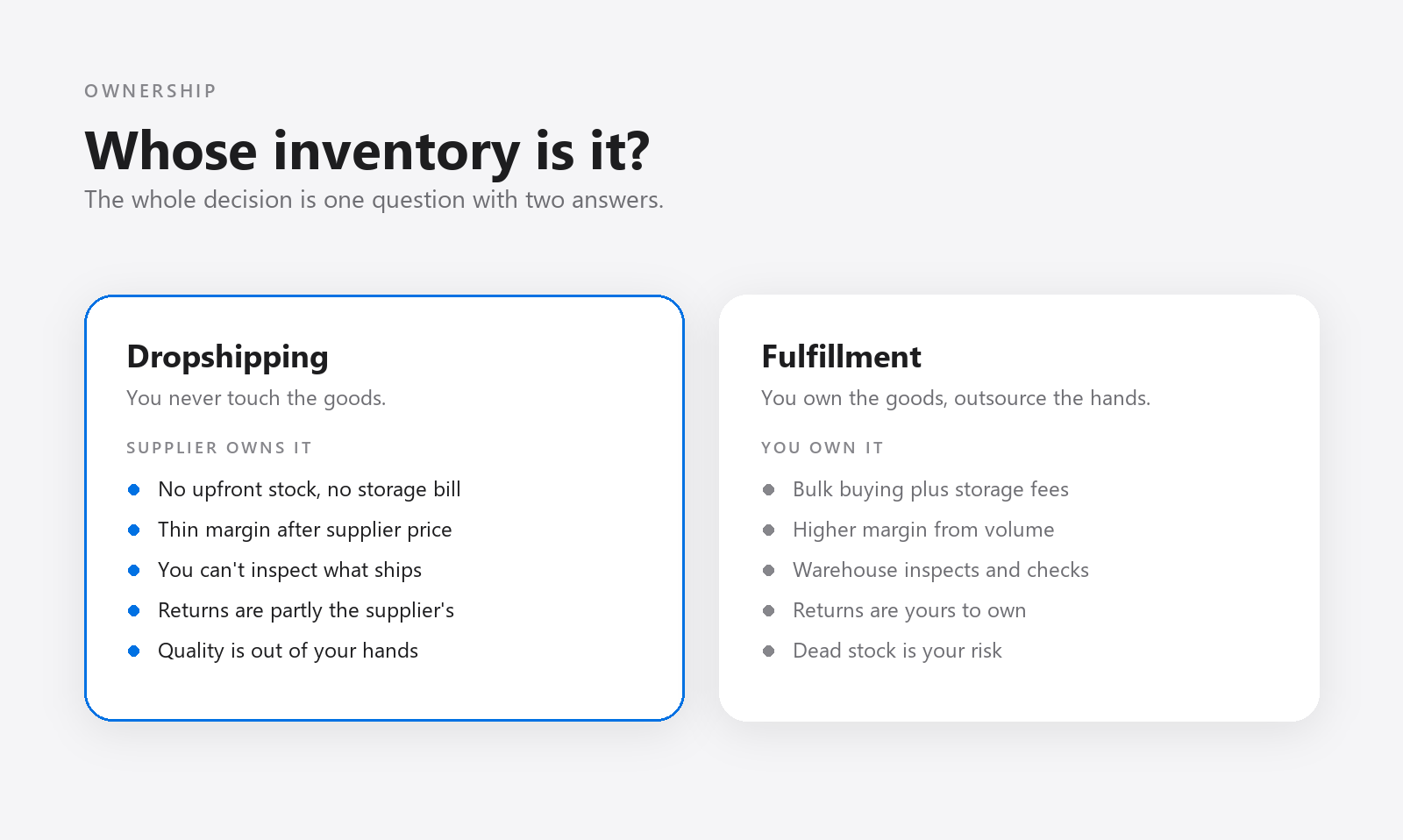
Dropshipping means you never touch the goods; fulfillment means you own the goods and pay someone else to handle them. The entire decision between the two models collapses into one question: whose inventory is it? If the stock belongs to a supplier who ships it on your behalf, you're dropshipping. If the stock belongs to you and a warehouse just picks, packs, and ships it, you're running fulfillment.
Everything that follows — the margins, the quality control, the returns, the cash position — is a consequence of that single ownership fact. Get it right and the rest of the decision writes itself.
Dropshipping, in plain terms
You list a product, a customer buys it from your store, and you forward the order to a supplier who holds the inventory and ships directly to your customer. You never buy the stock up front, never store it, and never see the parcel. Your margin is the difference between what the customer paid you and what the supplier charged.
The upside is a thin, flexible business: no warehouse lease, no upfront inventory, no dead stock to write off. The downside is that you control almost nothing about the product that arrives. You're selling someone else's item, someone else's packaging, and someone else's idea of on-time.
There's also a specific failure mode worth naming. When the supplier runs out of stock or mis-ships an order, you usually find out from the customer complaint, not from the supplier — because you had no visibility into their floor, and no parcel you could have weighed or checked before it left.
Fulfillment, in plain terms
You buy inventory up front, ship it to a warehouse — your own or a 3PL's — and orders are picked, packed, and shipped from that stock. You own the goods the entire way, and you decide the packaging, the inserts, and the return policy.
The upside is control and, usually, margin: buying in bulk drops your unit cost, and the customer experience is yours to design. The downside is the capital you've tied up in stock, plus the storage bill that keeps running whether the units sell or not.
That storage bill is the difference that people forget to put on paper. Rent is a fixed cost: it accrues every month on every unit, moving or not. Dropshipping has no equivalent line, because the supplier carries it. When a fulfillment seller says a product "made money," the honest version subtracts the months of storage it sat through first.
The margin math
The two models live on opposite ends of the risk-and-reward line, and the difference is easiest to see in the cash.
| Dimension | Dropshipping | Fulfillment |
|---|---|---|
| Inventory ownership | Supplier owns it | You own it |
| Upfront capital | Near zero | Bulk purchase plus storage |
| Unit margin | Thin, after the supplier's price | Higher, from bulk buying |
| Cash tied up | Almost none | Sits in stock and storage fees |
| Biggest risk | Supplier quality and reliability | Dead stock you can't sell |
| Quality control | You can't inspect | You or your warehouse can |
| Returns | Supplier's problem, partly yours | Yours to own and fix |
The trade-off in one line: dropshipping gives you low margin but almost no downside risk; fulfillment gives you higher margin but you eat the downside when a product goes dead. Dead stock — inventory that sits unsold — is the silent killer of the fulfillment model, because the storage bill keeps running on units nobody wants while the cash you need is locked inside them.
Who owns quality control
This is where the models split most painfully. In dropshipping, the product is packed by a supplier you may never have visited, and the first time you see the actual item is often when a customer posts a complaint. You cannot weigh a parcel you never touch, and you cannot fix a wrong item you never saw.
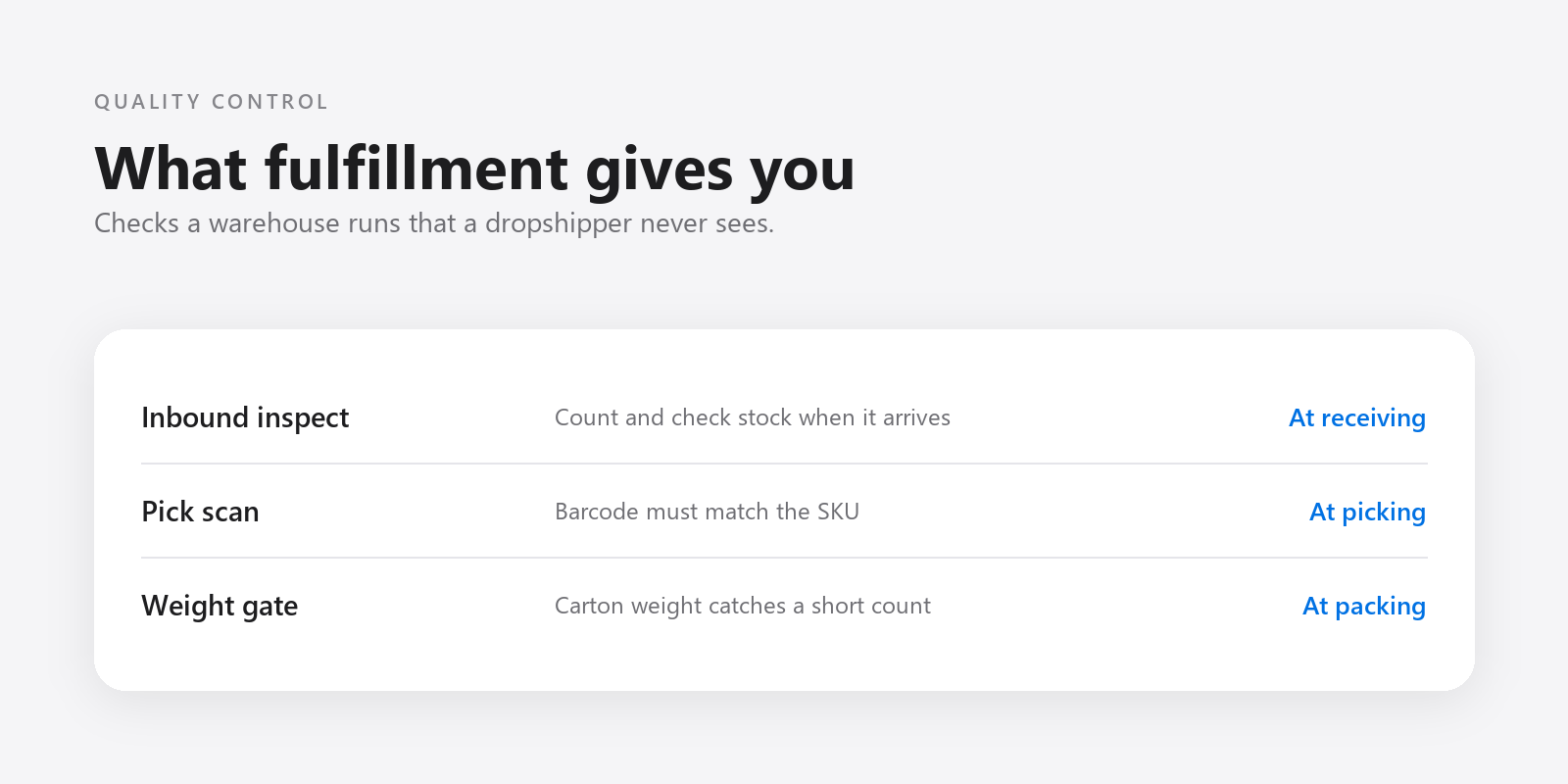
In fulfillment, you or a warehouse you chose can inspect on the way in and at packing. A warehouse can scan the SKU at picking and weigh the carton before it leaves, catching a wrong item or a short count before it reaches a customer. That's not a perk of fulfillment — it's the entire reason the mis-shipment rate can be driven down, and it's a control you simply don't have in dropshipping.
Returns and who owns the problem
Returns expose the difference in responsibility. In dropshipping, the customer sends the item back and the supplier decides what happens next; you're caught in the middle, managing an unhappy buyer against a supplier's restocking rules. In fulfillment, the return comes to your warehouse, gets inspected, and either restocks or scraps — and you decide which, because it's your stock.
That sounds like fulfillment makes returns easier. It doesn't. It makes them yours. A return in dropshipping is mostly a communication problem; a return in fulfillment is a physical, billed series of steps — inbound, inspection, restock or scrap — that you pay for and own. Neither model escapes returns; they just hand the work to different people.
The hybrid model and its three triggers
Most sellers don't have to choose one and only one. A hybrid — hold your fast movers in a warehouse while dropshipping or direct-shipping the long tail — is common, and it's usually justified by one of three triggers.
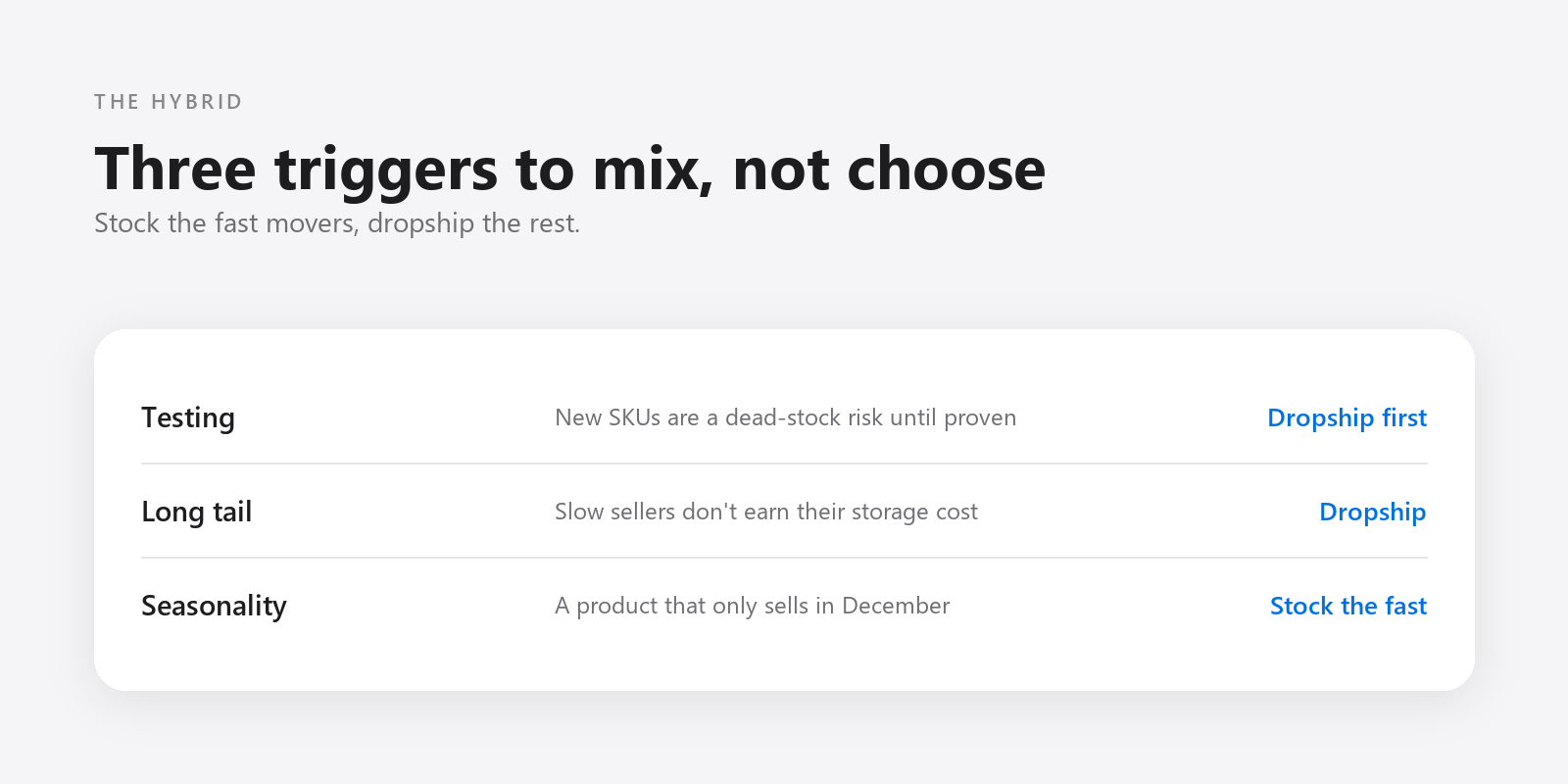
The first is testing. A new product you haven't validated is a dead-stock risk if you buy a container of it, so you dropship it until the sales data says otherwise. The second is the long tail. SKUs that sell slowly but steadily don't earn their storage cost, so you dropship them instead of letting them eat rent. The third is seasonality. A product that only sells in December isn't worth holding eleven months a year, so you dropship it and stock only what turns over fast.
The split that keeps coming up in cross-border trade is roughly 60–70% stocked and 30–40% on the fly — inventory held only where turnover justifies it, so the dead-stock risk stays on the fast movers where you can actually see it coming.
Questions to ask before you choose
- Do I control the packaging and the customer experience, or am I buying them off a shelf?
- If a product goes dead, how much cash is locked inside it, and for how long?
- Can I inspect the product before it reaches a customer?
- Who actually decides what happens to a return — me or a supplier I've never met?
- Which of my SKUs sell fast enough to earn their storage cost?
The last question is the one that usually resolves the whole debate, because it forces you to separate the products that deserve inventory from the ones that don't.
The short version
Dropshipping is "don't touch the goods"; fulfillment is "own the goods, outsource the hands." Dropshipping trades margin for zero inventory risk, and its blind spot is quality control you can't do. Fulfillment trades capital and dead-stock risk for control and usually better margin. Most sellers land somewhere in between — stock the fast movers, dropship the long tail and the new Company Swag Ideas — and the decision hinges on whose inventory it is and whether a slow SKU earns its rent.
If you're staring at your catalog wondering which products deserve a warehouse and which should be dropshipped, send us your SKU list with rough sales velocity — we'll sort it into "stock it" and "don't" before we talk about anything else. The sorting exercise alone is usually worth it, because it forces the question most sellers avoid: whether a product is actually earning the space it occupies.
References (Neutral Third-Party Sources)
Facts and definitions in this article were checked against public, non-commercial sources. No fulfillment-provider pages are cited.
- Wikipedia — Drop shipping: the definition of dropshipping, where the retailer never holds inventory and the supplier ships directly to the customer. https://en.wikipedia.org/wiki/Drop_shipping
- Wikipedia — Is Order Fulfillment: the receiving, storage, picking, packing, and shipping workflow that defines the fulfillment model. https://en.wikipedia.org/wiki/Order_fulfillment
- GS1 — Global Trade Item Number (GTIN): the product-identification standard behind the barcodes scanned when a warehouse inspects and picks inventory. https://www.gs1.org/standards/id-keys/gtin
- U.S. Customs and Border Protection — De minimis shipments: the entry threshold affecting the cross-border parcels common to the direct-shipping half of a hybrid model. https://www.cbp.gov/trade/programs-administration/entry-summary/de-minimis-shipments