
DTC Fulfillment: A Complete Guide for Direct-to-Consumer Brands
Fulfillment doesn't win the first order. It wins the second one. The first order proves you can take money and put a box on a truck. The second proves the customer believed the experience enough to repeat it, and that decision is made in three places: how fast the parcel left, what it looked like when it opened, and what the tracking page told them while they waited.
Every DTC brand I have seen struggle with fulfillment was optimizing the wrong number. Cost per order is a process metric. So is on-time shipping, and so is accuracy. They tell you whether the machine ran. They do not tell you whether the customer came back — and the customer coming back is the only reason direct-to-consumer economics work at all.
Here is what to build, in what order, and what breaks on the way.
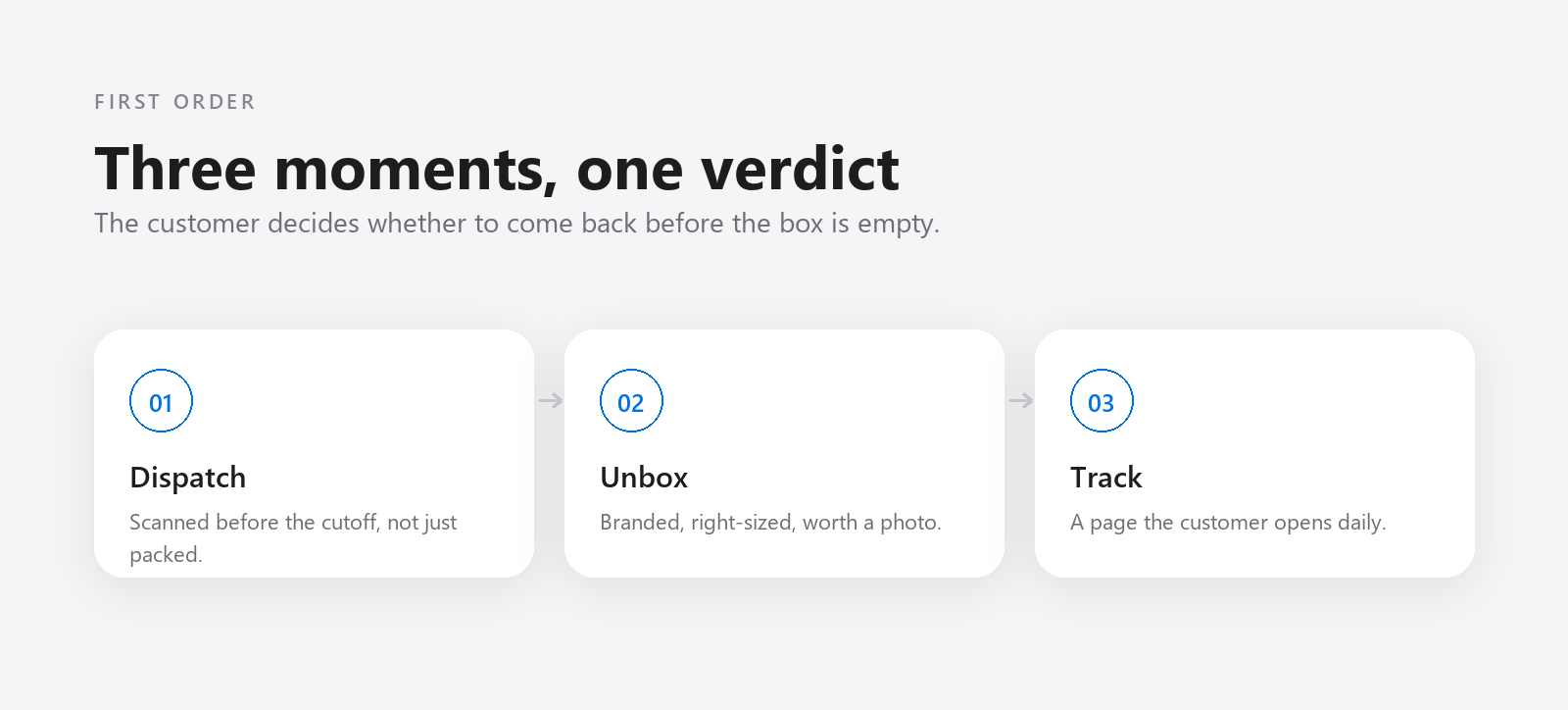
Three moments decide the second order
Dispatch. Customers don't remember which carrier you used. They remember how long the parcel sat. A well-run warehouse states it plainly: orders placed before 10pm go out the same day, dispatch timeliness above 99%, and first carrier scan — the industry calls it A-scan — above 97%. Those two numbers measure different things. Dispatch is the warehouse's promise. A-scan is the moment the carrier accepts the parcel, and that is what the customer actually feels.
Unboxing. Packaging is a marketing spend with a freight bill attached. Sealed, branded, photographable — good. Oversized — expensive twice, because dimensional weight prices the air inside the box. USPS bills anything over one cubic foot at length × width × height ÷ 139, rounding every fraction of an inch up, so half an inch in each direction can move the parcel into a higher tier.
Tracking. The cheapest of the three and the most neglected. A customer opens the tracking page more often than your homepage. What they find there — your brand, a clear next step, an honest date — decides whether the wait feels like a process or a problem.
A shipping promise is a legal promise
The FTC's Mail, Internet, or Telephone Order Merchandise Rule is short and unforgiving. A seller must have a reasonable basis for any shipping time it advertises. If no time is stated, the default is 30 days. Miss the promise and you must notify the buyer, give a revised date, and let them How to Choose between waiting and a refund.
That changes what a cutoff time is. It is not a slogan on a product page; it is a contract with the warehouse. If the dock closes at 6pm, an order placed at 4pm is not "shipping today" unless it is picked, packed, labelled and scanned before six. Advertise "order by 3pm for same-day dispatch" and you have just promised a 3pm cutoff to every customer, whatever the contract says.
Two operational rules follow. Publish the cutoff you can hold on your worst normal day, not your best one. And treat A-scan as the reporting line, not dispatch — a parcel scanned at 11pm is a next-day delivery wearing today's label.
Returns are a retention cost, not a warehouse cost
Returns get booked as a logistics expense. That framing hides the part that matters.
| Cost line | What it covers | Typical range |
|---|---|---|
| Return processing | Receive, open, inspect, decide restock or scrap | $1.50–$4.00 per unit |
| Restocking | Put a sellable unit back into pickable stock | $0.50–$1.50 per unit |
| Scrap | Product cost when it cannot be resold | Full landed cost |
| Reship | Second trip through the last mile after a failure | $7–$12 per parcel |
Add a fourth, invisible line: the customer's next decision. A return handled with a clear timeline — received, inspected, refunded, three days — reads as competence. A return that disappears into a warehouse reads as a brand that doesn't answer. Same cost, opposite outcome.
This is why free returns are a pricing decision, not a logistics one. Without Breaking Budget it in the margin, or meet it as a surprise in the last week of the quarter. And price the components separately when you sign: in most fee structures, returns processing is a stand-alone service, not part of the pick-and-pack rate.
Consumables tolerate returns badly because the unit is often unsellable. Apparel tolerates them better but sees far more of them. The category determines the rate; your process determines whether the rate turns into churn.
One warehouse, two rhythms
Most DTC brands end up running two order types through one building: subscription or replenishment orders that ship on a calendar, and one-time orders that ship when they are placed.
Three collisions follow, and every one of them shows up as a customer complaint rather than an operations report.
Cutoff collision. A subscription batch has a fixed ship date and a fixed component reserve. A one-time order has a cutoff. Run them in one wave and the batch eats the day; run them in separate waves and you need two labour plans. Decide which one owns the dock on ship day, and write it down.
Inventory collision. Subscription components are reserved in whole batches; one-time orders decrement by the unit. Without an allocation rule, one-time orders quietly consume the components reserved for the next batch, and you discover it when 40 subscribers get a partial box.
Workstation collision. Kitting and pick-pack are different motions. Kitting repeats the same five moves thousands of times, which is why a piece-rate line can hit extraordinary throughput — one operator described twelve people shipping more than 20,000 orders a day once packing moved to a per-parcel piece rate, roughly three times the previous rate on fixed salaries. Pick-pack is the opposite: a different sequence every time. Put them on the same bench and both slow down.
The fix is boring and effective: separate the calendar, separate the stock, separate the bench.
The three-stage path
There is no single right answer, only a right answer for your volume. The three stages solve three different problems, and the trigger to move is operational, not aspirational.
| Stage | What it solves | Trigger to move on |
|---|---|---|
| Own space | Cash instead of fees | Fulfillment takes 20+ hours a week, or mis-ships exceed 1% for two straight weeks |
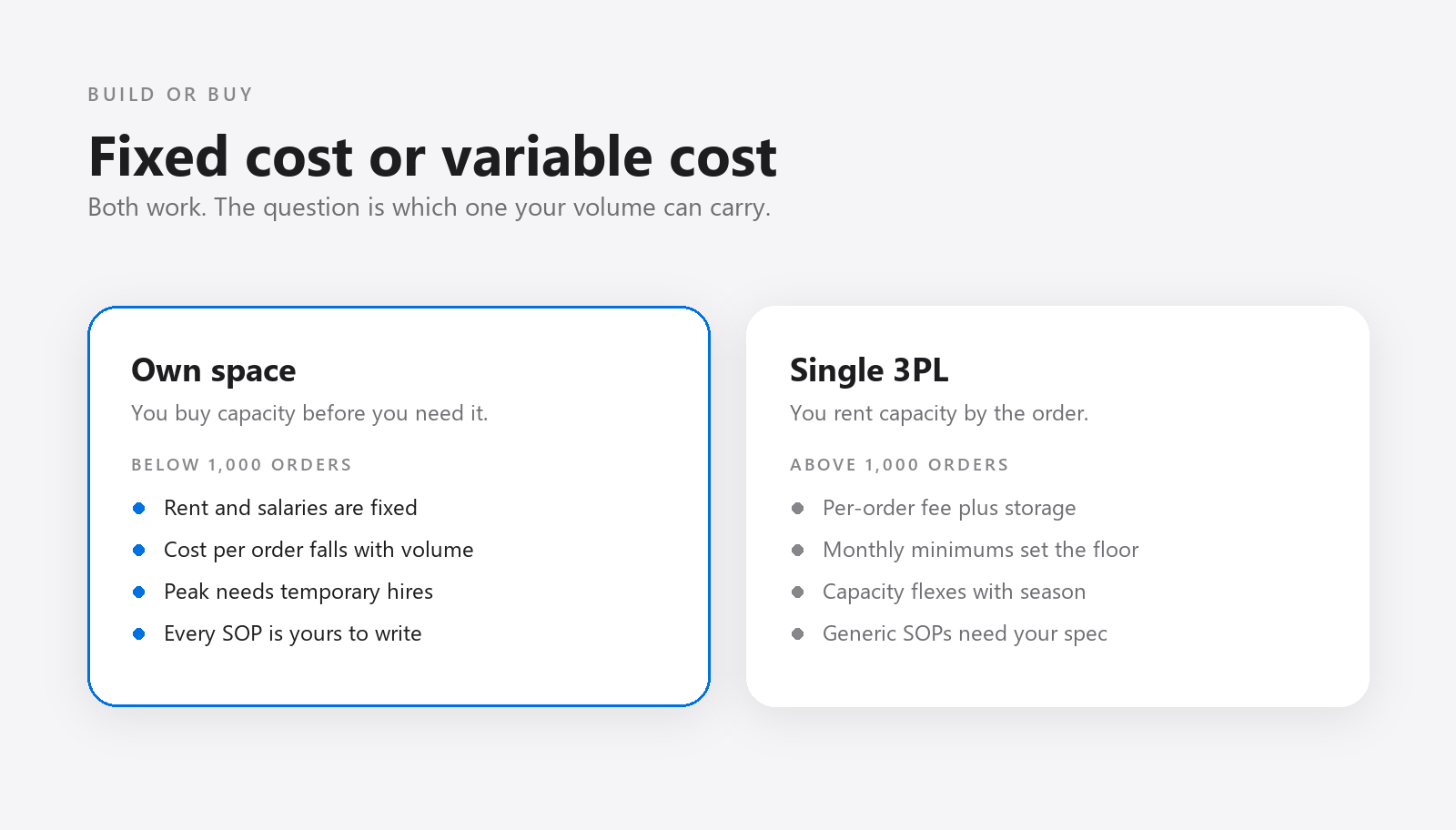
| Single 3PL | Fixed cost into variable cost | Volume holds above 1,000 orders a month and peak needs 2–3× temporary labour |
| Hybrid | Structure instead of effort | Many short-lived SKUs, or B2B and returns need separate handling |
Outsourcing converts fixed cost into variable cost — warehouse rent and salaried labour become a per-order fee. Operators who have run both put the net saving in the 10–20% range, and the real gain is not the percentage; it is that you stop paying for capacity you are not using. Below roughly 1,000 orders a month, though, you are mostly paying a minimum, and the arithmetic usually favours doing it yourself a little longer.
Hybrid is where most brands above a few million in revenue land, and it is the least discussed. It usually means a 3PL for consumer parcels plus a China-side or near-supply warehouse for fast-moving, short-lifecycle SKUs and for wholesale. That split exists for a reason: roughly seven in ten overseas DTC brands source from China, and for a brand with hundreds of SKUs on eight-week lifecycles, shipping from the source beats shipping from a US rack.
What breaks during a switch
A switch is not a move. It is a transplant, and the patient is your customer relationship.
Dual-run. Keep both facilities able to ship for two weeks. Reconcile inventory by SKU, never by total units — totals agree beautifully while the wrong SKUs sit in the wrong building.
The freeze window. Stop address edits and add-ons for the migration days. Otherwise you produce a batch of parcels that were packed before the address changed.
The error spike. Mispicks rise in the first two weeks at any new facility. Write the threshold before you move — a mis-ship rate above 1% for five consecutive days is a rollback trigger, not a conversation.
The promise. Drop your advertised delivery time by a day for the switch week. Absorbing one day of honesty is cheaper than absorbing a hundred "where is my order" tickets.
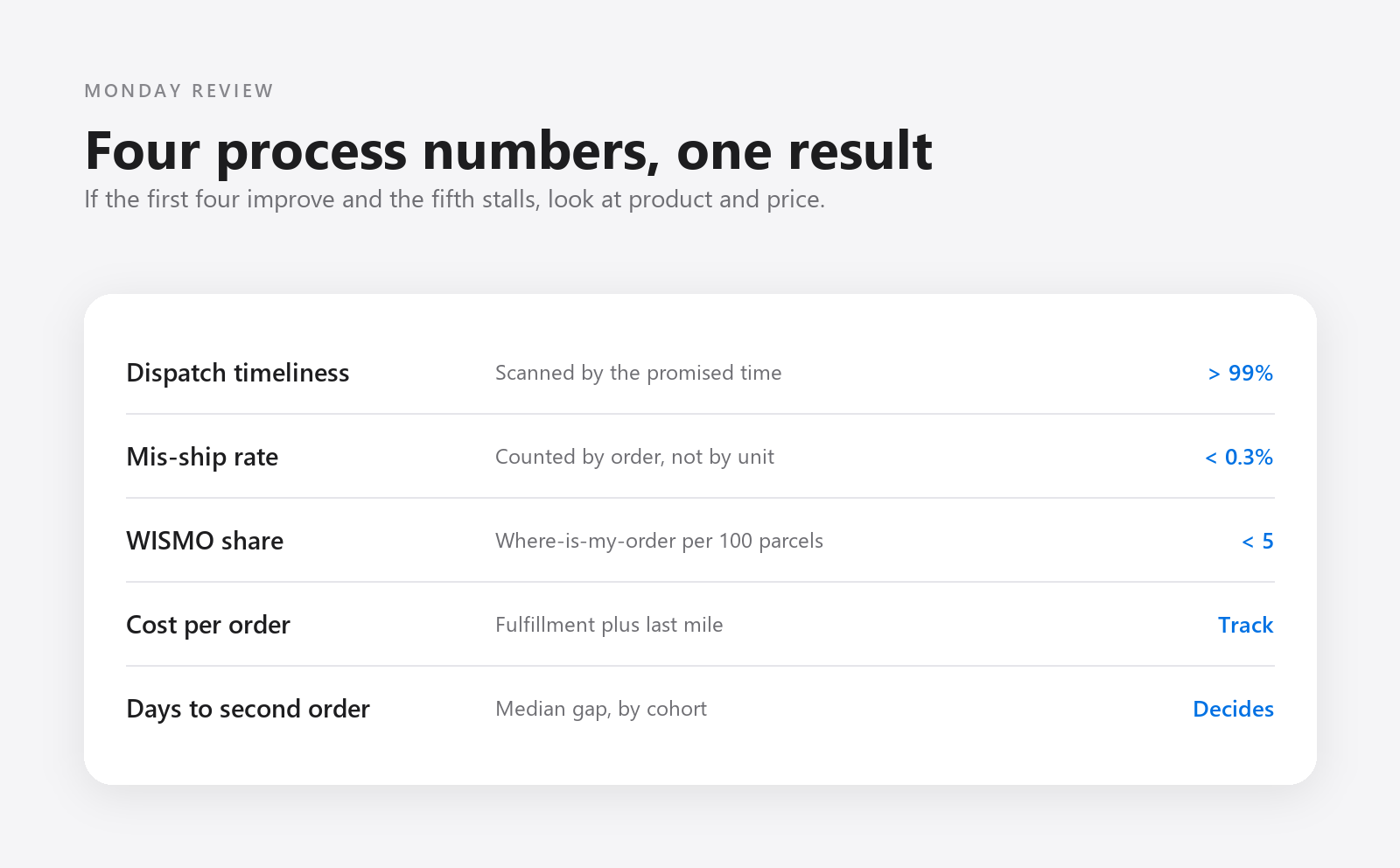
Five numbers, every Monday
- Dispatch timeliness — parcels scanned by the promised time, divided by parcels promised.
- Mis-ship rate — counted by order, not by unit.
- WISMO share — "where is my order" contacts per 100 shipments.
- Cost per order — fulfillment plus last mile, product excluded.
- Days to second order — median gap, cohort by acquisition month.
The first four are process. The fifth is the result. If the first four improve and the fifth doesn't move, the problem is not in the warehouse — it is the product, the price, or the promise you made at checkout.
Where to start
Fix the promise before you fix the warehouse. Publish a cutoff you can hold, report on A-scan rather than dispatch, and price returns as a retention cost instead of an exception. Then decide the stage you are actually at: below a thousand orders a month, buy time, not capacity. Above it, buy structure, and keep the subscription calendar and the one-time cutoff on separate clocks.
If you send over your monthly order count, SKU count, return rate and current warehouse location, we will map which of the five numbers your current setup is most likely bending — before we talk about a quote.
References (Neutral Third-Party Sources)
- Federal Trade Commission — Mail, Internet, or Telephone Order Merchandise Rule: the reasonable-basis requirement, the 30-day default, and the delay-or-refund obligation. https://www.ftc.gov/legal-library/browse/rules/mail-internet-or-telephone-order-merchandise-rule
- Federal Trade Commission — Negative Option Rule: disclosure obligations for prenotification subscription plans. https://www.ftc.gov/legal-library/browse/rules/negative-option-rule
- USPS — USPS Ground Advantage: 2–5 day service, 70 lb ceiling, included insurance, dimensional-weight divisor of 139, and nonstandard-parcel fees. https://www.usps.com/ship/ground-advantage.htm
- USPS — USPS Ground Advantage for Business: no fuel, delivery-area or residential surcharges, and the return service for customer returns. https://www.usps.com/business/ground-advantage.htm
- U.S. Bureau of Labor Statistics — Occupational Employment and Wage Statistics, 53-7064 Packers and Packagers, Hand (May 2022): median hourly wage used to sanity-check per-order labour assumptions. https://www.bls.gov/oes/2022/may/oes537064.htm
- GS1 — EAN/UPC barcodes: the item-level identifier that makes scan verification and return identification possible. https://www.gs1.org/standards/barcodes/ean-upc