
Ecommerce Fulfillment: How It Works, Options & Real Costs
Ecommerce fulfillment is four promises made to a customer, and you only notice the cost when one of them breaks. The customer expects the item they ordered to actually be in stock, the parcel to leave quickly, the shipping to not eat your margin, and the return to be painless when it comes back. Fulfillment is the machinery that keeps all four true at once.
Most sellers think of fulfillment as "shipping." It's not. Shipping is the last mile — the final leg to the customer's door. Fulfillment is everything before it: receiving, storage, picking, packing, and the returns loop. Get that distinction and the cost question stops being a mystery.
The physical flow, start to finish
Whatever the model, the Corporate Gift Boxes move through the same six steps. Inbound cartons are unloaded and counted against the packing list. Each SKU goes into a logged location. Orders arrive and a picker pulls the right units. Packing boxes them with the right dunnage and prints a label. The parcel is handed to a carrier. Then returns come back in, get inspected, and are restocked or scrapped.
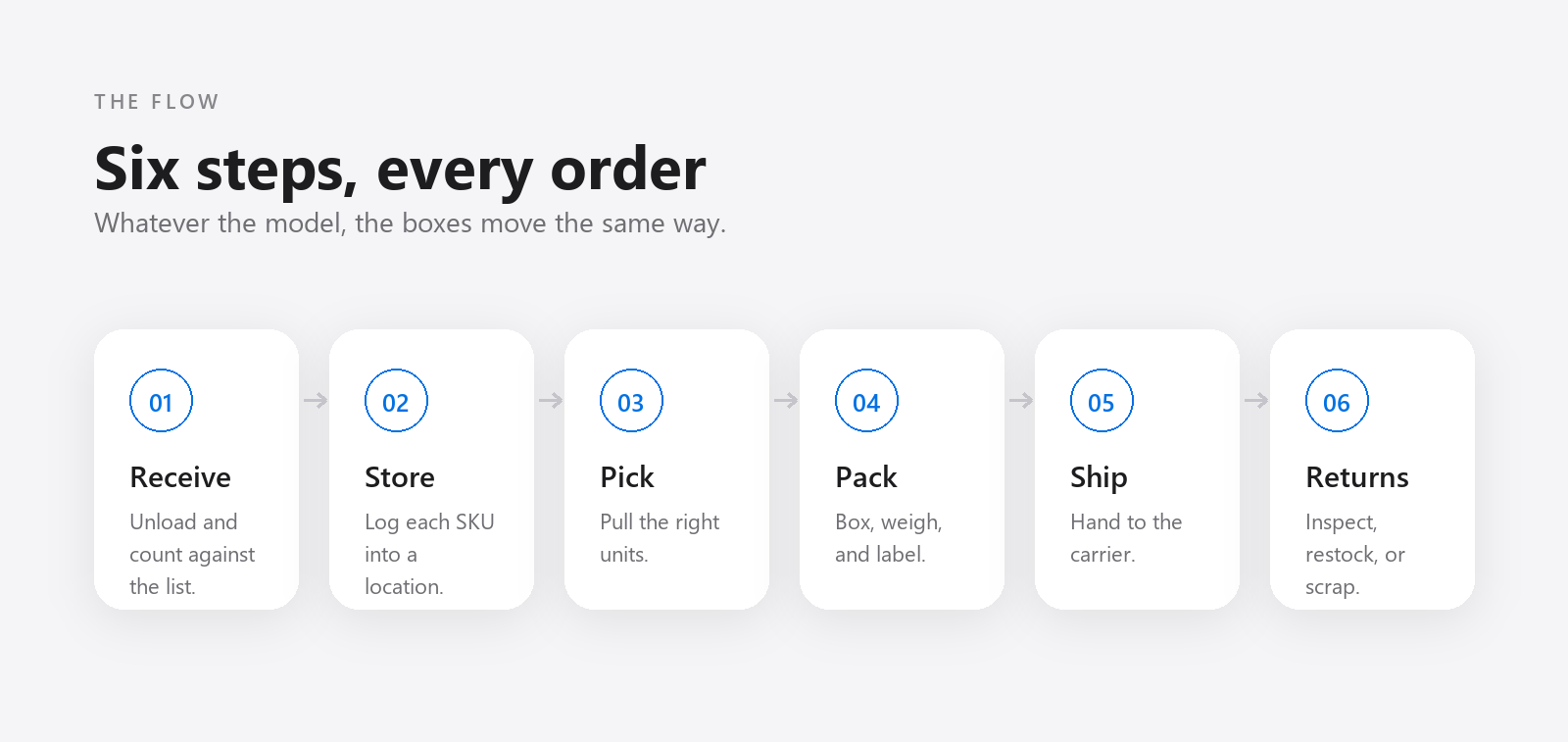
The speed of the whole chain is set by the slowest step, and that's usually not the carrier. A warehouse that takes three days to process an inbound shipment delays every order that depended on that stock, even if the parcel itself flies. Tight operators quote the inbound turnaround as a number — often 48 hours or less — and it's worth asking for before you commit.
The three ways to run it
You have three basic options, and they're a ladder of how much of the work you take on.
| Model | Who runs the floor | Who owns the space | When it fits |
|---|---|---|---|
| In-house | You and your own staff | You | Few hundred orders a month, spare room |
| Shared 3PL | A provider's staff | The provider, shared with others | Outgrew the spare room, want to offload labor |
| Dedicated bins | A provider's staff | Your own reserved space in their building | High volume or special handling, want a 3PL plus control |
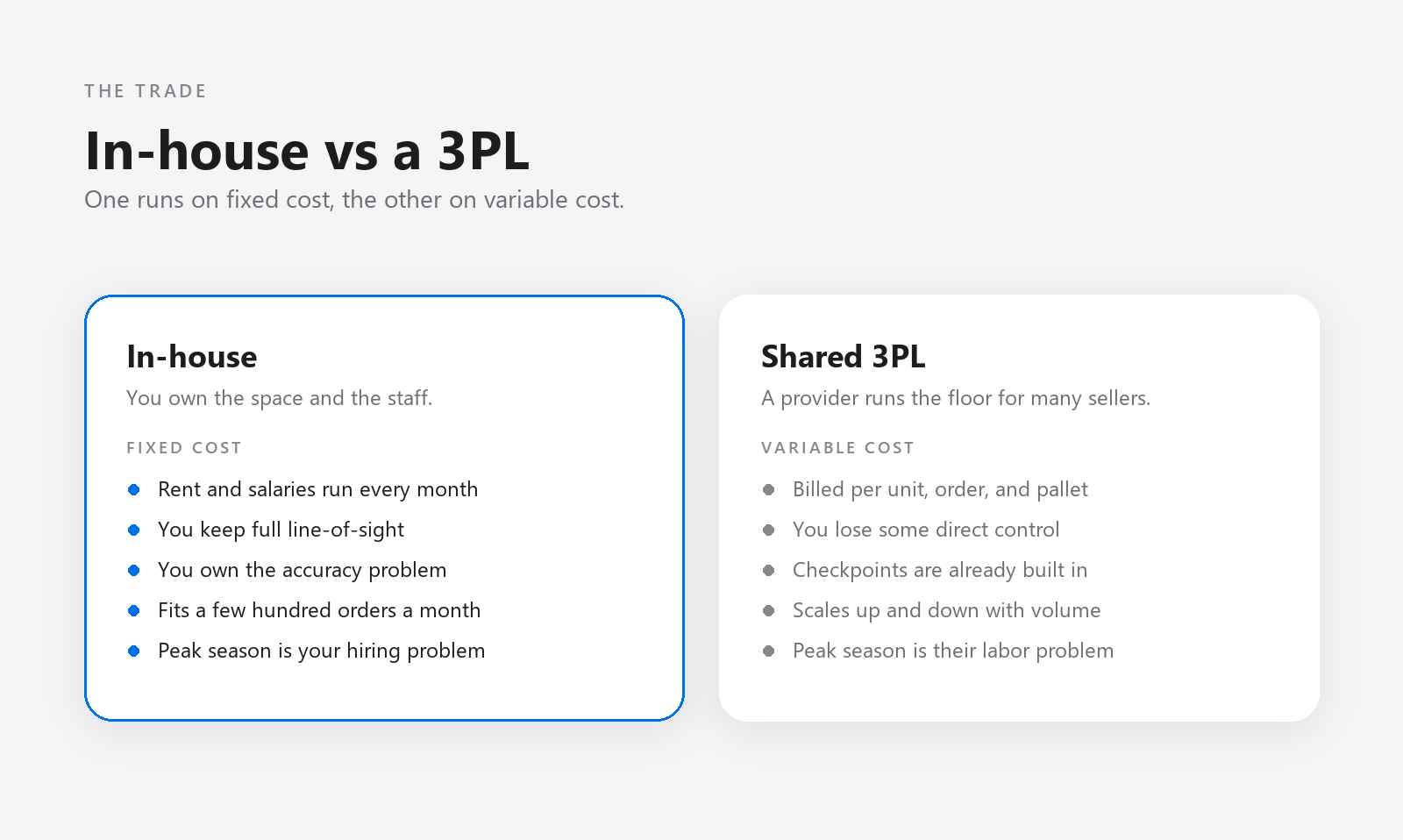
In-house is a fixed-cost business: your rent and your salaries keep running whether you sell one unit or a thousand. A shared 3PL converts most of that into variable cost, billed per unit and per order. Dedicated bins are the hybrid — you pay for reserved space so you keep priority and control, but the provider's labor still does the work.
What each SKU to What Really costs
The single biggest budgeting mistake is pricing fulfillment as one number. It's at least six lines, and two of them behave differently from the rest.
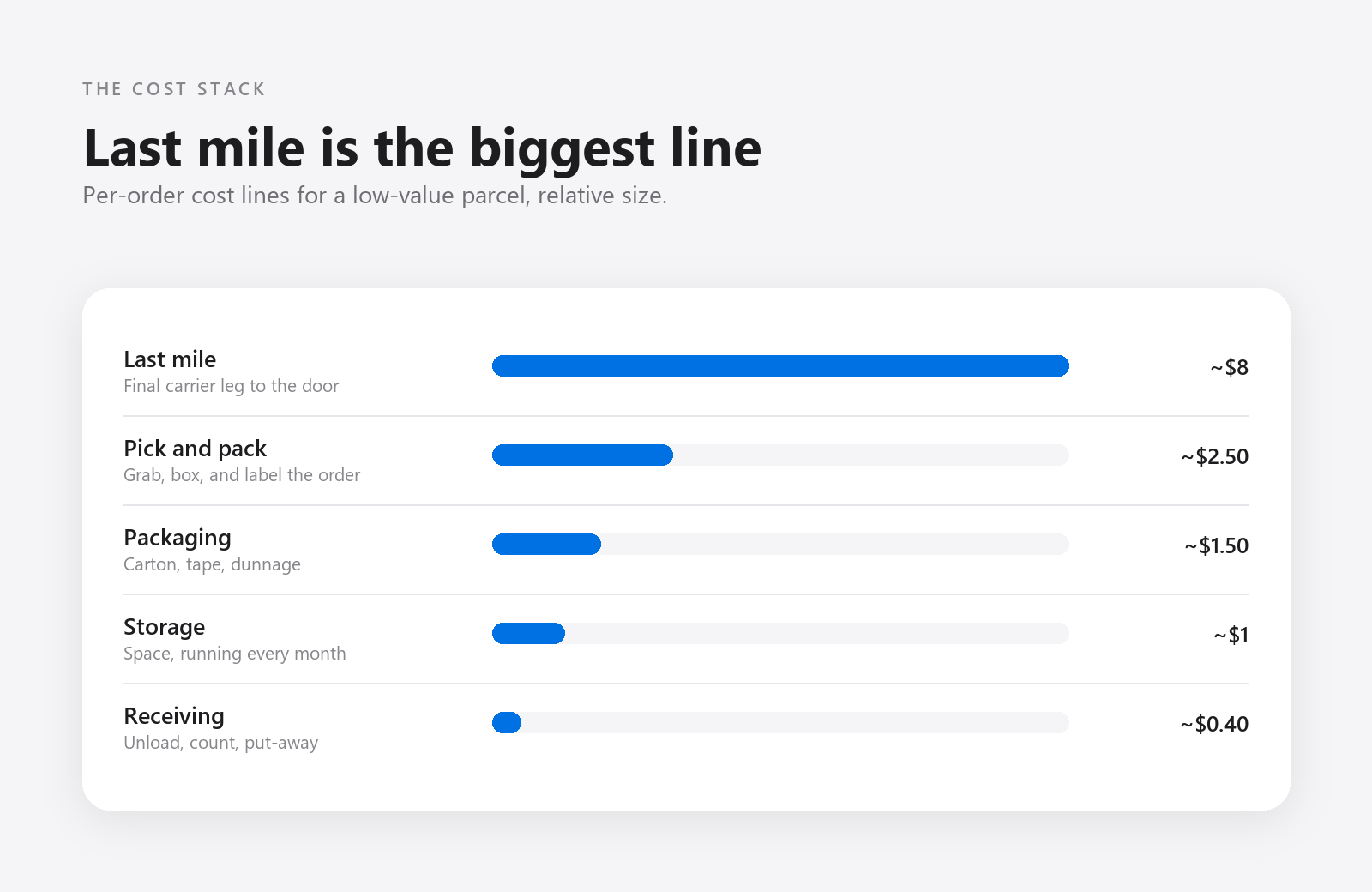
Storage is the fixed cost that never sleeps: you pay for space whether stock moves or not, and slow-moving inventory quietly runs up a bill every month. Packaging and labor are variable — they scale with orders. Then there's the line that surprises everyone: last mile. On a low-value order, the final carrier leg is frequently the largest single cost on the whole ticket.
A useful discipline from warehouse finance is to separate every cost into fixed or variable before you decide anything. Rent, salaries, and equipment are fixed; packaging, piece-rate labor, and freight are variable. Outsourcing is, at its core, a trade that swaps fixed cost for variable cost — which is exactly why it gets more attractive as volume swings get wider.
The trigger points to switch models
There is no single order count that flips you between models, but there are three signals that show up in a specific order.
The first is labor. When picking and packing stops being a thing you fit around your day and becomes the thing that consumes it, in-house has failed you — not because you're too busy, but because a paid worker on piece rate will out-pack you three to one. The second is space. When stock starts spilling out of the spare room and you're renting overflow space at a premium, a shared 3PL's per-pallet rate beats your emergency storage. The third is accuracy. When the mis-shipment rate climbs because you're packing faster than you can check, the checkpoints a warehouse already has — barcode scan, weight gate, label cross-check — stop being a nice-to-have and start being the reason to leave.
Many sellers never switch all at once. A common shape is running a warehouse for the fast movers while dropshipping or direct-shipping the long tail, roughly 60–70% stocked and 30–40% on the fly. That split lets you hold inventory only where turnover justifies it, and avoid the dead stock that eats more margin than any shipping fee ever will.
Where accuracy is won or lost
The metric that matters is the mis-shipment rate — how often a customer gets the wrong item, a short count, or someone else's label. Tight operations push this to fractions of a percent, and they don't do it with more careful people. They do it with machines that make the error impossible to pass through.
A picker scans a barcode and the system confirms the SKU before the item can advance. The packed carton crosses a weight gate calibrated to catch a difference of a few grams — a missing freebie or a wrong unit trips it. The shipping label is cross-checked against the order so a mismatch can't print. Human eyes are the fallback, not the system, because eyes are at their worst in hour six of a peak shift, which is precisely when volume is at its highest.
Returns are a promise too
Nobody budgets for returns until they arrive, and then they arrive in waves. A return is not just a refund — it's an inbound shipment, an inspection, a restock or a scrap decision, and a customer who needs a resolution. The warehouse charges for each of those steps.
The part sellers miss is the restock decision. A returned unit that goes back on the shelf as sellable has to be verified; if it isn't, it becomes the next mis-shipment. Ask any provider, before you sign, what their return workflow actually does to a returned unit — inspect, restock, or quarantine — because that answer is where the return promise either gets kept or quietly broken.
It's also a line item worth watching on the invoice, not just in the policy. A return typically bills the same inbound and inspection steps as a new shipment, so a high return rate on a thin-margin product can quietly double your handling cost on the units that come back.
Questions to ask before you commit
- What's your mis-shipment rate, and how is it measured?
- Is storage per pallet or per cubic foot, and how do you handle slow-moving stock?
- Which lines are in the quote — receiving, packaging, label, returns, and any peak-season surcharge?
- Do you scan at picking and weigh at packing?
- What happens to a returned unit — inspected, restocked, or quarantined?
The first and last questions tell you more than any slide deck.
The short version
Fulfillment is four promises — stock that's accurate, orders that leave fast, shipping that doesn't eat margin, and returns that don't hurt. It runs through the same six physical steps no matter the model, and the model you choose is a trade between fixed and variable cost. Switch when labor, space, or accuracy start failing, not at a magic order count, and price every SKU as at least six lines with last mile named separately.
If you want a straight read on whether your current setup has crossed the line, send us your monthly order count, SKU count, and a few product weights — we'll map the fixed versus variable split and tell you where the break-even actually is before we talk pricing.
References (Neutral Third-Party Sources)
Facts and concepts in this article were checked against public, non-commercial sources. No fulfillment-provider pages are cited.
- Wikipedia — Is Order Fulfillment: the receiving, storage, picking, packing, shipping, and returns sequence that defines the fulfillment workflow. https://en.wikipedia.org/wiki/Order_fulfillment
- Wikipedia — Third-party logistics: the outsourced model and the asset-based versus non-asset distinction relevant to in-house versus 3PL trade-offs. https://en.wikipedia.org/wiki/Third-party_logistics
- GS1 — Global Trade Item Number (GTIN): the product-identification standard behind the barcodes scanned at receiving and picking. https://www.gs1.org/standards/id-keys/gtin
- U.S. Customs and Border Protection — De minimis shipments: the entry threshold affecting cross-border parcels and their last-mile routing. https://www.cbp.gov/trade/programs-administration/entry-summary/de-minimis-shipments