
Fulfillment Services for Startups: How to Scale Without a Warehouse
Do it yourself up to about 100 orders a month. Rent shared space from 100 to 500. Buy dedicated slots from 500 to 1,000. Those three stages are not about how big your company feels. They are about how many touches each order needs, and who pays for the fixed capacity behind those touches.
The expensive mistake is not picking the wrong provider. It is signing the third stage while you are still in the first: a minimum monthly bill, a space commitment and a receiving fee all start on day one, and the volume that was supposed to absorb them arrives eight months later.
Decide the stage on three numbers — daily orders, SKU count, return rate — and move when any one of them crosses, not when all three do.
Stage one: 0–100 orders, keep it in-house but stop guessing
At this volume, packing it yourself is correct. A single order takes under two minutes on a kitchen table, and any minimum monthly bill will cost more than your tape and cartons.
What this stage is really for is data. Four fields decide whether stage two works:
- Weight and carton size per SKU. Dimensional weight is length × width × height ÷ 139, with any fraction of an inch rounded up, and USPS applies a list of nonstandard package fees on top.
- Actual sell-through per SKU, not the range you hoped for.
- Return reasons, granular enough to separate colour, size, damage and wrong item.
- Gift rules — what goes into an order, and under which condition.
Lose any of the four and stage two's first week punishes you twice: the inbound weight will not match what you declared, so you get billed on dimensional weight; and the warehouse will not know that order type A carries a free insert, so the rule ends up in an order note that a human has to read.
Stage two: 100–500 orders, rent space, not a relationship
Past 100 orders the problem stops being packing fatigue and becomes the cutoff. A decent warehouse works to roughly 48 hours from arrival to put-away and 24 hours from order to dispatch, with orders placed before a late-evening cutoff leaving the same day — one operator we studied publishes 22:00, with on-time dispatch above 99%.
That timeline, not speed, is what you are buying. It is also the reason a startup can advertise a promise it can keep: the FTC's Mail, Internet, or Telephone Order Merchandise Rule requires shipping within the advertised window, or within 30 days when no window is stated. Selling preorders with no stock and no cutoff is a compliance problem wearing a marketing costume.
Shared bins or a light managed arrangement fit this stage best. You rent a few positions by the month, the floor is low or absent, and you add space in peak and release it in the trough. What you give up is depth: no named account manager, exceptions in a shared queue, one packaging version only.
This is also the stage where brands quietly lose money. A shared arrangement still carries a floor and per-drop receiving, while your volume is not yet enough to spread either — and you are no longer the one absorbing the labour. The middle stretch is usually the most expensive per order in the whole climb.
Stage three: 500–1,000 orders, buy slots and a cutoff
Above roughly 500 orders a month, dedicated slots, a fixed pick face and a named contact start to pay. The reason is touches per order: once the catalogue passes about 40 SKUs, picking stops being "grab" and becomes "find", and the walking route becomes your labour cost.
Dedicated space comes with an obligation people forget to price. Fast-pick locations are expected to turn — three times a day in the operating model one warehouse group publishes — and stock that has not moved in seven days starts costing the supervisor points. Your slow SKUs are not inventory in their building; they are wasted cube, the physical volume a SKU occupies. Cut the catalogue before you buy slots, not after the aging fees arrive.
Three switches, not one
| Signal | Move to stage two | Move to stage three | Why this one |
|---|---|---|---|
| Daily orders | Steady 4/day, about 120 a month | Steady 17/day, about 500 a month | Volume spreads fixed cost, but it is the slowest signal to arrive |
| SKU count | Over 25, start bin coding | Over 40, negotiate a dedicated pick face | SKU count decides whether picking is grab or find |
| Return rate | Over 8%, design a reverse flow | Over 12%, separate returns from outbound picks | Returns consume labour, cube and cash at the same time |
Return rate is the one founders ignore. Daily orders can be absorbed by working later. SKU count can be absorbed by better labelling. Returns cannot: they hit units per labour hour, bin space, customer service and cash in the same month, and the mis-ship rate that drives them only shows up after peak.
What gets lost in the handoff
Every move loses something, and the same three things go missing every time.
| What disappears | How you notice | Why it happens |
|---|---|---|
| Batch numbers | Returns cannot be traced to a production run, so a whole lot is scrapped | The lot was never written into the SKU code or bin rule |
| Gift rules | An order arrives one insert short; the Gifting at Scale catches it | The rule lived in a support script, not in the order logic |
| Packaging version | Reviews say "doesn't look like the photo" | No version number and no expiry date on the old carton |
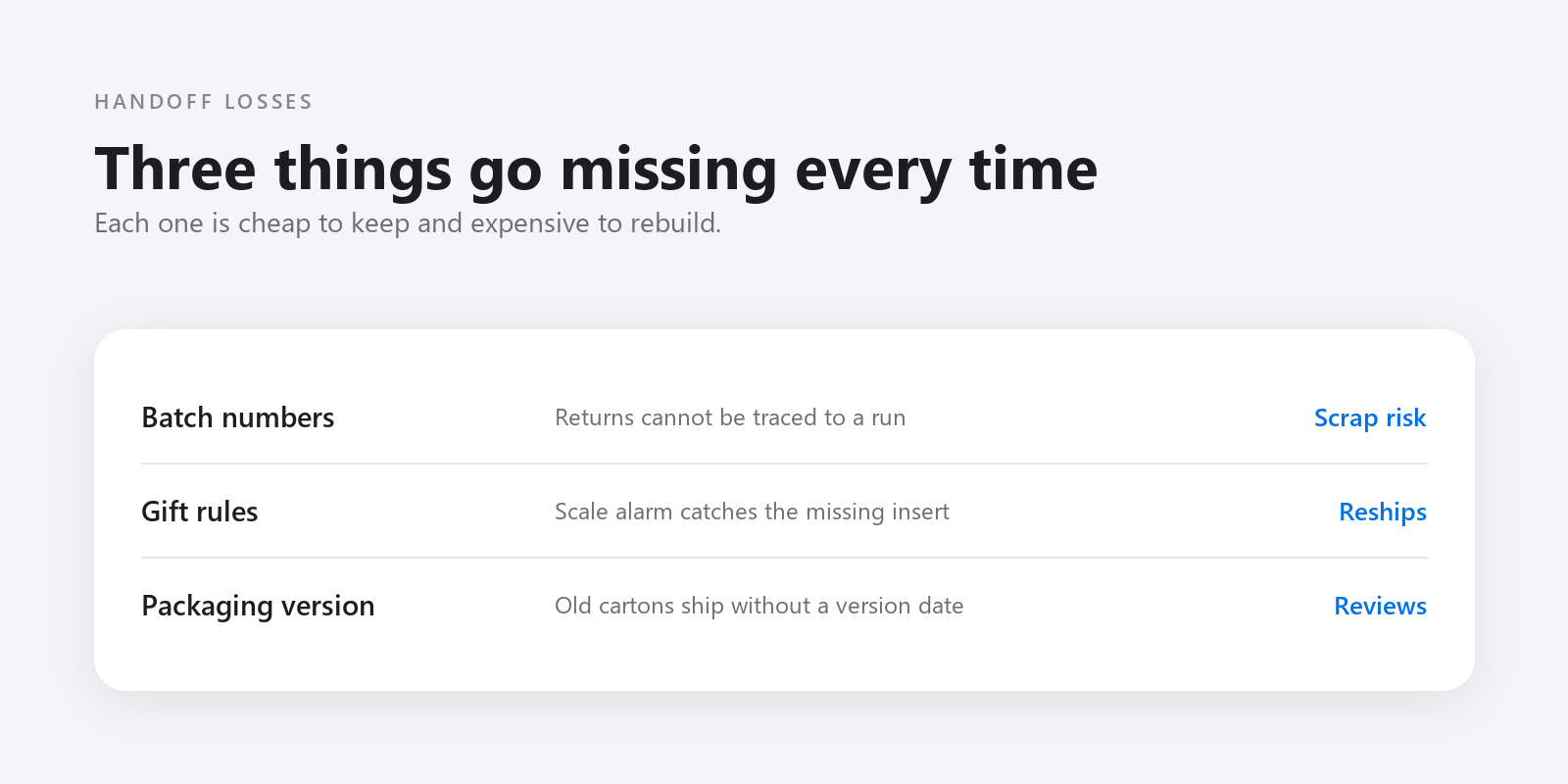
The scale detail matters more than it sounds. Warehouses that weigh every parcel and alarm on a five-gram variance will catch a missing insert — but they will also flag every order where your gift rule changed and nobody told them.
Bundles make this worse. A kit sold as one SKU comes back as three components that have to be re-received, re-labelled and reconciled to the right supplier. That reverse teardown is a separate process, not a step inside outbound picking, and plenty of warehouses bill it as one.
The switch itself: give yourself fourteen days
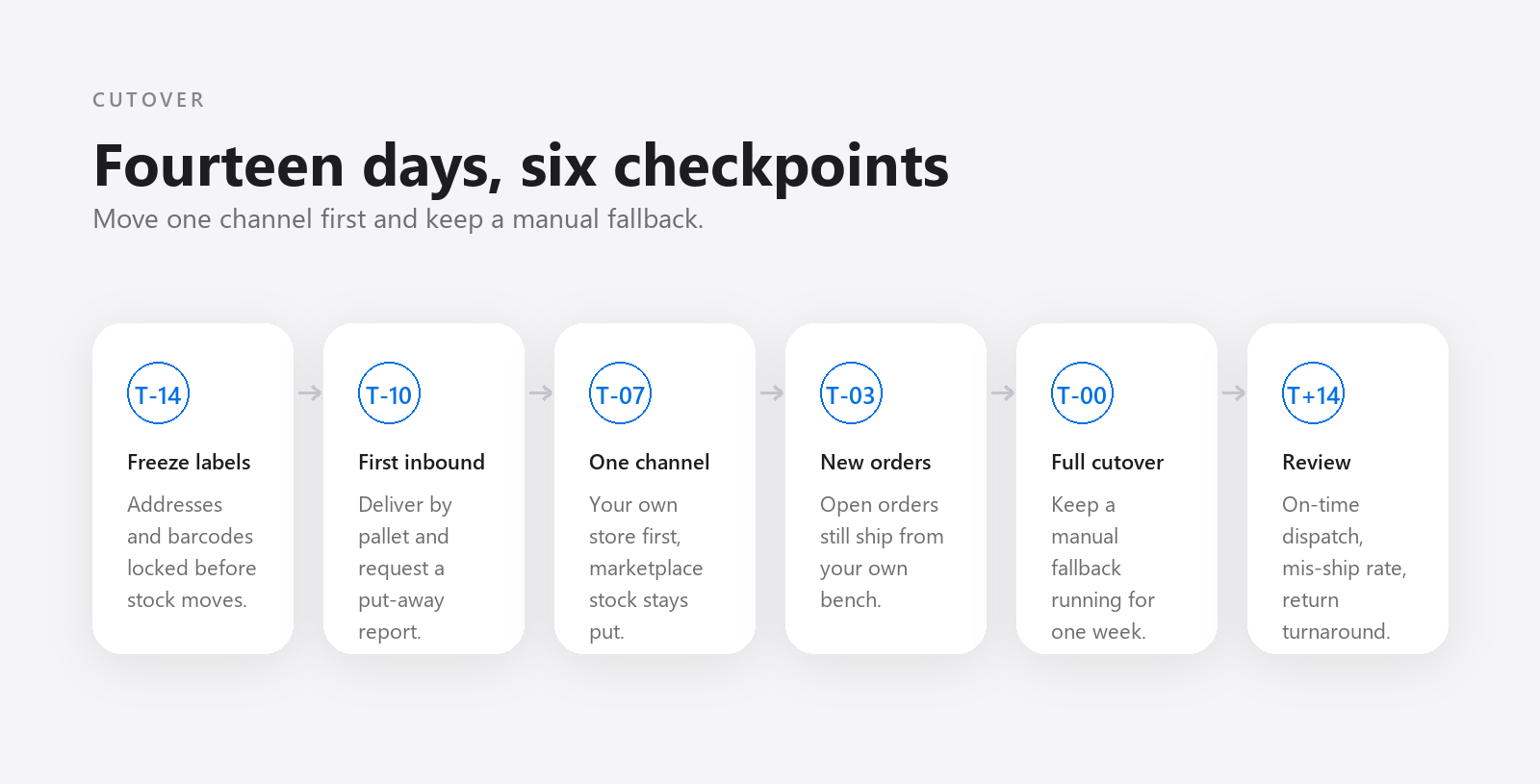
- T-14 — Freeze addresses and barcodes. A GTIN is globally unique while a SKU is internal, so mismatched identifiers mean relabelling at the dock.
- T-10 — First inbound lands, delivered by the pallet rather than the carton, with a put-away report back to you.
- T-7 — Cut over one channel, usually your own store, and leave marketplace stock where it is.
- T-3 — New orders only; anything already open still ships from your table.
- T-0 — Full cutover, with a manual fallback for one week.
- T+14 — Review three numbers: on-time dispatch, mis-ship rate, return turnaround.
What each stage costs per order
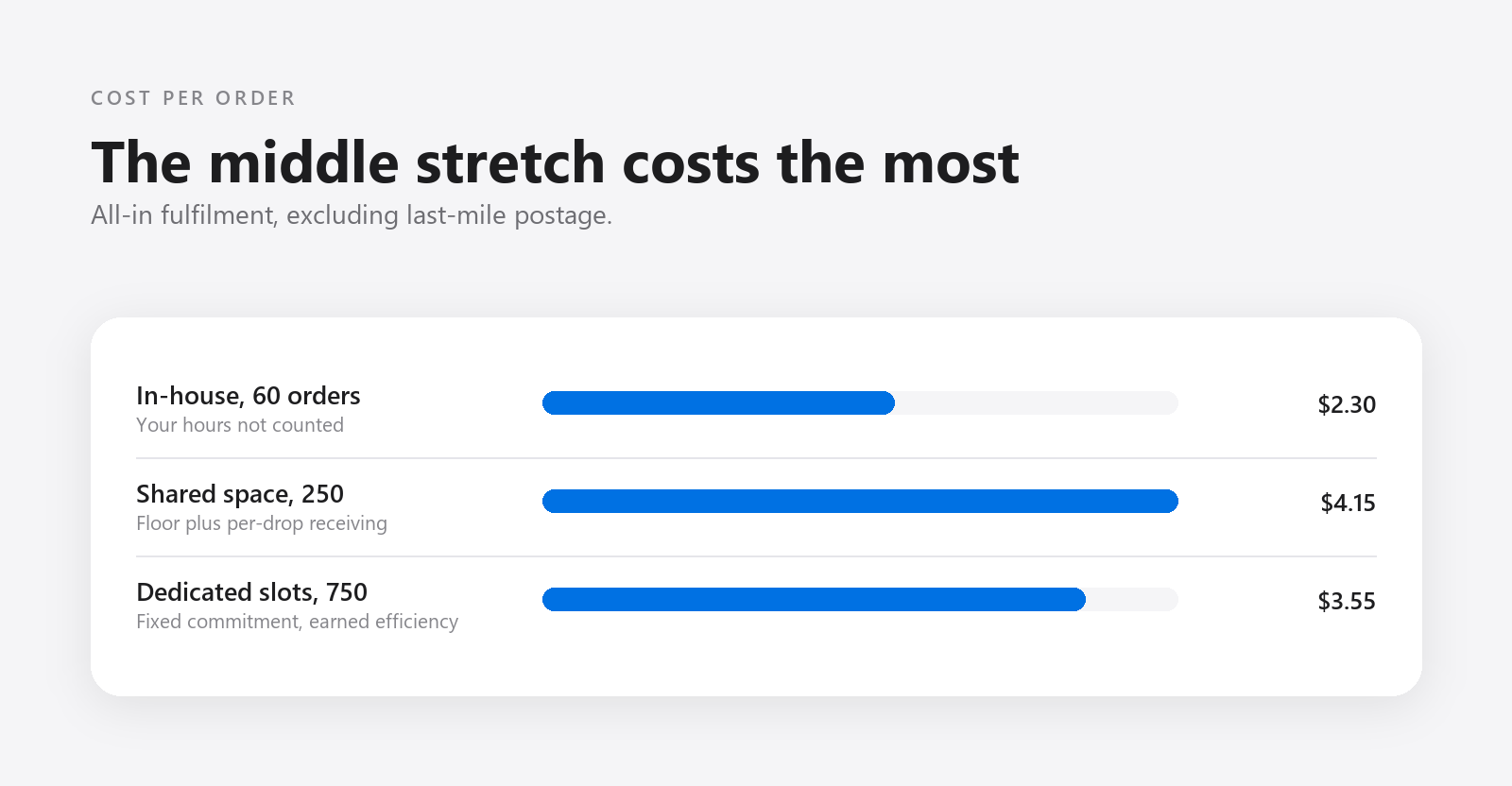
| Stage | All-in cost per order | What you actually pay |
|---|---|---|
| 0–100, in-house | About $2.30 | Cheapest in cash, but it costs you two hours a day |
| 100–500, shared space | About $4.15 | A floor plus per-drop receiving, with labour efficiency not yet earned |
| 500–1,000, dedicated slots | About $3.55 | Fixed commitment bought back as speed and accuracy |
The $2.30 in stage one omits your own time. At $18 an hour and six minutes an order, the real figure is closer to $4.10 — roughly what shared space costs. So the question that ends stage one is not a cost question. It is where your hours are going.
Five questions before you sign
- What is the cutoff, and what is your historical on-time dispatch rate?
- Is inbound priced per carton or per pallet, how fast is put-away, and what does a missed appointment cost?
- What is your pick accuracy, who pays when it fails, and how fast?
- How do returns work — is a kit broken down, what does teardown cost, and are batch numbers preserved?
- What does leaving cost: removal fee, notice period, and whether a dual-run is billed twice?
The short version
No warehouse is not a problem. Signing a warehouse before you have the data is. Record weight, frequency, return reasons and gift rules in stage one; rent space and not a relationship in stage two, and accept that it will be the most expensive stretch per order; buy slots and cutoff time in stage three, after you have cut the catalogue.
Send us your daily order count, SKU count and return rate, and we will come back with a stage call and a cutover checklist before anyone quotes a rate.
References (Neutral Third-Party Sources)
- USPS — Ground Advantage: 2–5 day ground delivery, dimensional weight divisor of 139, and published nonstandard package fees. https://www.usps.com/ship/ground-advantage.htm
- Federal Trade Commission — Mail, Internet, or Telephone Order Merchandise Rule: ship within the advertised window, or within 30 days when none is stated. https://www.ftc.gov/legal-library/browse/rules/mail-internet-or-telephone-order-merchandise-rule
- GS1 US — What is a GTIN?: GTINs are globally unique identifiers while SKUs are internal, and SGTINs can identify individual units. https://www.gs1us.org/upcs-barcodes-prefixes/what-is-a-gtin
- UPS — Shipping Zones and Rates: zones are destination-based regions that set shipment cost, with separate daily and retail rate guides. https://www.ups.com/us/en/support/shipping-support/shipping-costs-rates.page
- U.S. Census Bureau — North American Industry Classification System: warehousing and storage is classified as its own industry, which is why space is priced as fixed capacity. https://www.census.gov/naics/