
Order Fulfillment Process: A Step-by-Step Walkthrough
The order fulfillment process is eight physical handoffs, not one flow. A parcel moves from dock to doorstep through a chain of people — a receiver, an inspector, a put-away worker, a picker, a packer, a dispatcher — and at every handoff somebody owns a clock. When an order goes late, it is almost never because picking is slow. It is because one of those clocks was never set.
Most write-ups compress the process into three verbs — pick, pack, ship — and skip the two stations where most of the damage actually happens. This walkthrough goes station by station instead: who does what, at what time, against what SLA, and where each step stalls.
The line has eight stations, not six
Ask for the "order fulfillment process" and you usually get a six-step list: receiving, storage, picking, packing, shipping, returns. The physical line is longer, and the two extra stations are the expensive ones.
Receiving, inspection, put-away, order review, picking, packing, labeling, dispatch. Eight stations, each with an owner and a clock. Returns are not a station on this line — they are a second line running backwards, and they deserve their own treatment.
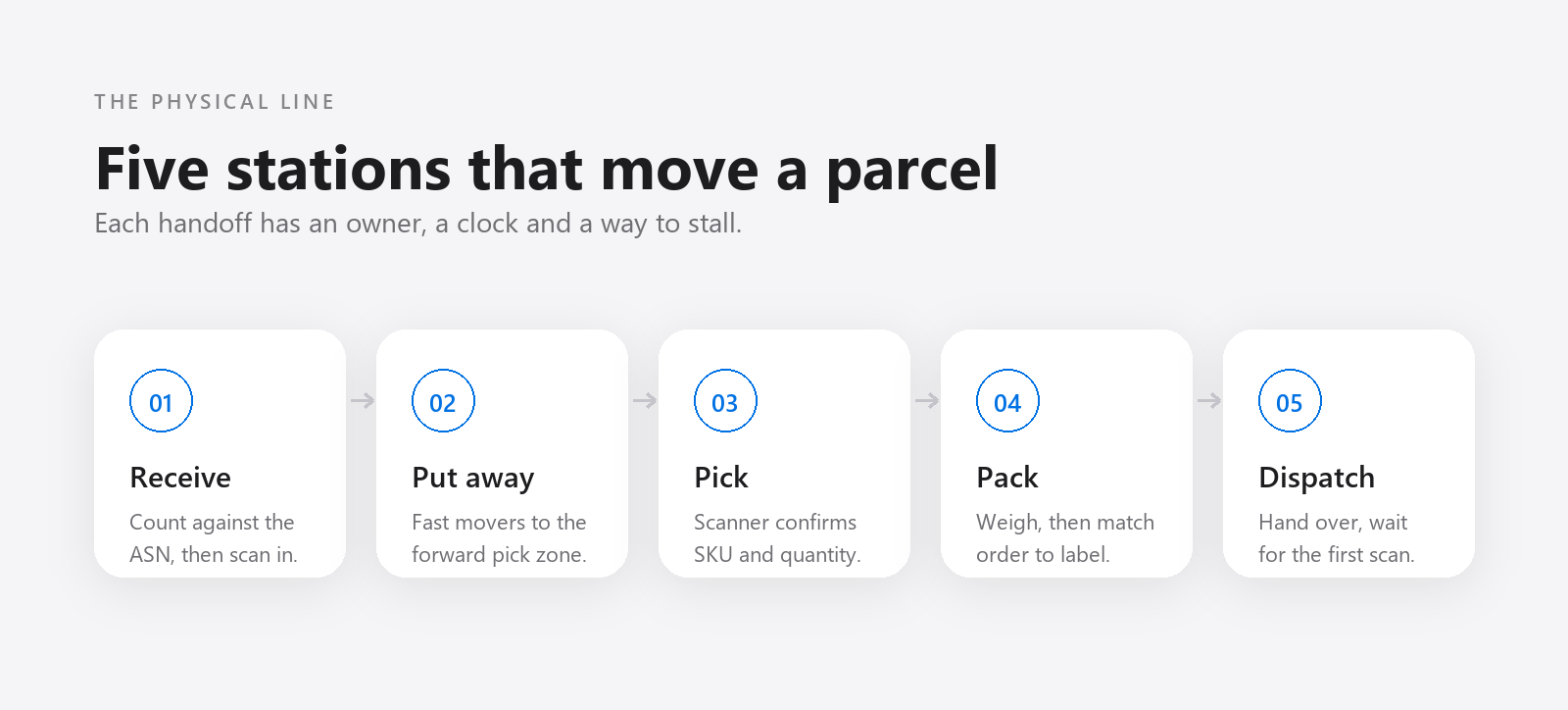
The clock is the part worth writing down. Every station has a service level: dock-to-stock hours, a dispatch cutoff, a mis-ship ceiling. Without them the line looks fine and runs late, because nobody owns the gap between stations.
Receiving: the dock decides the week
The receiver unloads, counts against the advance shipping notice, checks for visible damage, and only then scans stock into the system. That last scan is the moment the SKU stops reading as zero. Until it happens, the listing keeps selling into a hole.
The benchmark is dock-to-stock inside 24 to 48 business hours. Strong sites turn standard inbounds around the same day; anything routinely past 48 hours is worth flagging in a contract, because it means new stock sits un-pickable for days during a restock or a launch.
The stall point is the dock door, not the counting. Three inbound loads landing on a Tuesday with no booked slot means unloading competes with dispatch for the same doors and the same people. Before a peak, mature operations forecast demand about a week out and re-check sold units, stock left, and the carrier's pickup capacity every couple of hours — the number that matters is not total square footage, it is whether the doors can absorb the week.
Inspection and put-away: where the fast movers go
After the count comes a quick quality pass — a pre-shipment inspection at the inbound end, so damage is caught before it becomes a customer complaint — then put-away moves the stock to a location.
The decision that quietly decides the whole month is where. Fast movers go into the forward pick zone close to the pack benches; slow movers go to the back. Those fast-pick slots should turn over several times a day. A slot that has not moved in a week while sitting in prime space is a management failure, not an inventory fact.
Put-away is where the trade-off between density and access first shows up. Store a fast mover at pallet density and you save floor space, then pay it back every time a picker walks 90 seconds for one unit, twice an hour, all day.
Order review: the cheap place to catch mistakes
An order entering the system is not an order ready to pick. The reviewer checks three things: stock is present, the address is deliverable, the record is complete.
A PO box for a carrier that will not deliver to one, an address missing an apartment number, an order for a SKU that shows two units when the shelf has one — all cheap to fix here and expensive after picking. Only approved orders generate a pick list.
That pick list should be sorted by location, not by order number. Sorted by location, a picker walks a route; sorted by order number, every picker reinvents the route. The location column is the difference between a new hire who is productive in three days and one who spends a month memorising aisle numbers.
Picking: labor is walking
The picker works with a scanner. The scan will not advance on the wrong SKU, so the system, not memory, makes the final call. Warehouses that run this way report pick error under 0.3% — about three wrong items in a thousand.
The hidden cost is travel, not grabbing. Most of a picker's day is walking between slots, which is why the pick path is decided the moment a slot is assigned, long before anyone optimises a pick list. Software can sequence stops; it cannot remove distance.
Batch picking, zone picking, wave picking — the method matters less than the slotting underneath it. Put twenty fast SKUs in one bay and a batch pick is a short loop. Spread them across four zones and the same batch becomes a tour with three extra scans and a consolidation step.
Packing: the five-gram gate
The packer pre-loads a weight for every SKU, bundle and free Build Branded Gift, then weighs each finished parcel. A deviation above five grams triggers an alert. Five grams is about the weight of a sheet of paper, so it will not catch a missing card — but it will catch a missing accessory, a doubled gift, or two near-identical SKUs swapped at the shelf, which is where most wrong-item complaints come from.
Then comes the outbound match: the order barcode and the carrier label are compared before the label prints. If they disagree, no label. That one rule exists for a single failure mode — A's goods with B's address on the box — and it is worth the extra two seconds.
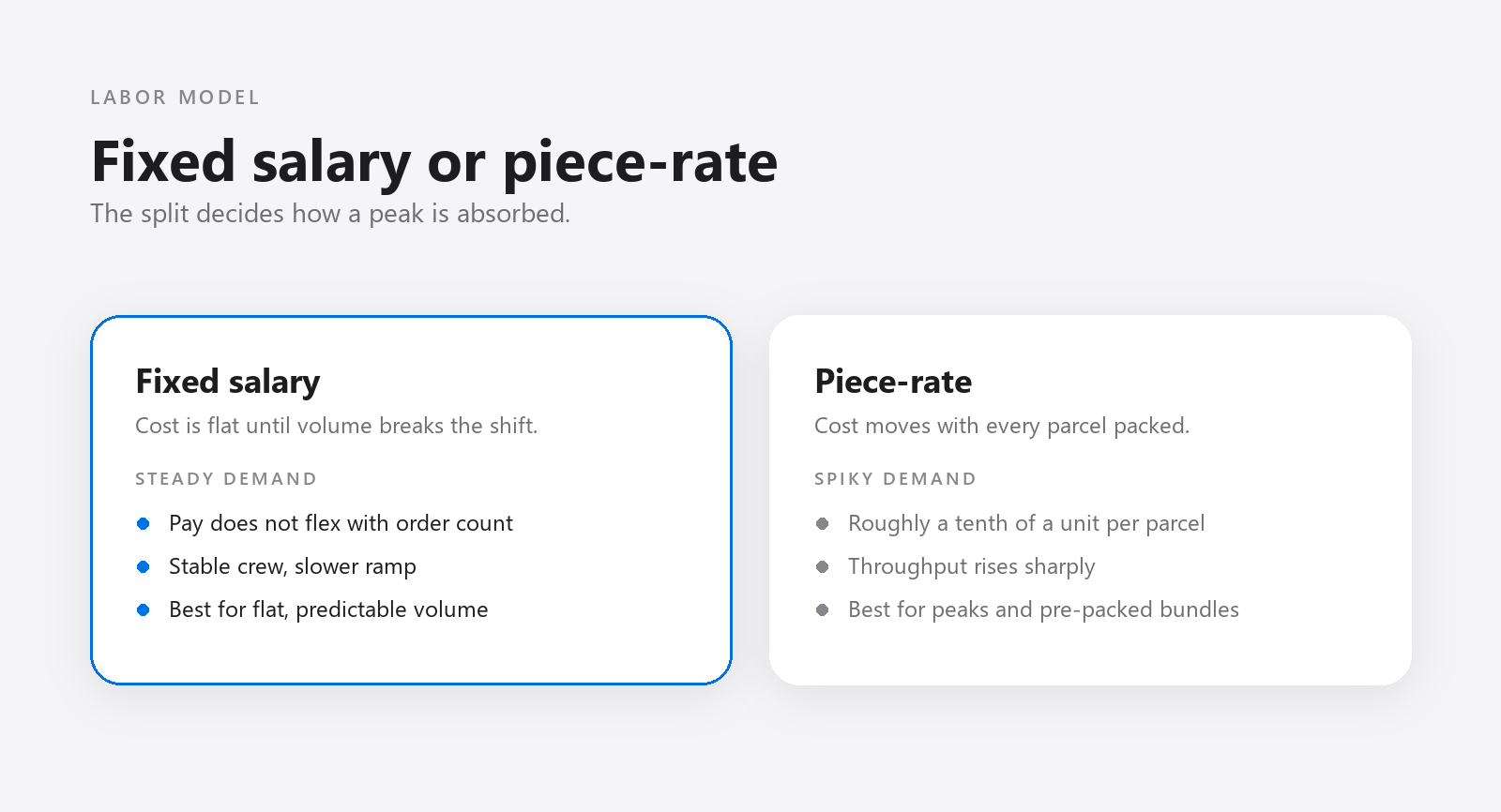
Labor shows up here too. In high-volume sheds, packing is paid per parcel, around a tenth of a currency unit. The arithmetic is blunt: a crew clearing roughly 2,000 orders a day on fixed salaries moved to piece work, and a similar-sized crew cleared ten times that once pre-packing took work off the critical path. Assembling the top-selling bundles ahead of a spike and staging them beside the bench turns a five-minute order into a label and a seal.
Labeling is not shipping
Printing a label does not mean a carrier has the parcel. USPS states it plainly: the Each Order Status "Shipping Label Created, USPS Awaiting Item" means a label exists with a tracking number and the package has not been given to the carrier. Possession begins at "USPS In Possession of Item." Between those two scans there is a gap with no data in it, and that gap is where "it shipped three days ago and hasn't moved" complaints are born.
The dispatch cutoff is the hard constraint. Same-day dispatch is not an attitude, it is a scheduling rule: orders approved before the cutoff join today's wave, everything after joins tomorrow's. Before you put that promise on a product page, check that the carrier's pickup time is later than your cutoff. Plenty of operations hit their own deadline and then sit on sealed bags until the next morning.
The first scan and the last mile
The first carrier scan is the only proof outside your building that the parcel exists. Everything before it is your word.
Watch first-scan coverage: of the orders marked shipped in the last seven days, how many tracking numbers still show zero carrier events. When that number climbs past a few percent, the wording in your support macros is wrong, not the warehouse. The parcel is in an outbound cage, not on a truck.
After the first scan the parcel enters the last mile — the carrier's local leg from hub to doorstep — and your control drops to near zero. That is why the cutoff, the weight gate and the label match all live upstream of this point. Everything after the handoff is a promise you keep through a tracking number, not a process you run.
Eight steps, one clock each
The labor behind the line splits into fixed and variable. Rent and a base wage are fixed; packaging and piece-rate wages move with order volume. A peak plan is not "add people" — it is a fixed core of trained staff on the accuracy-critical steps, plus an elastic pool for packing and sorting, booked days in advance and run through a pressure test before the spike.
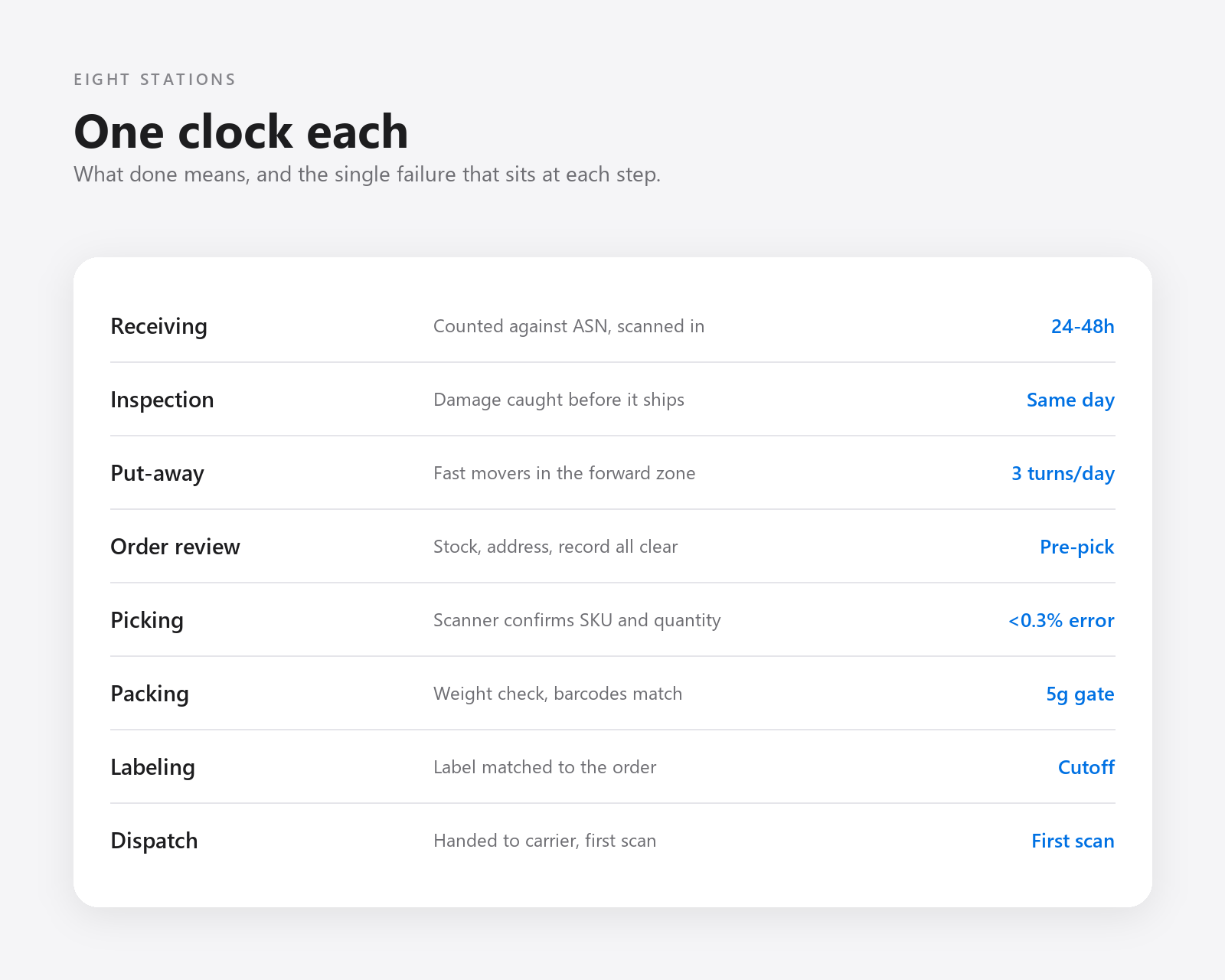
Here is the line as a single card, one row per station:
| Station | Who owns it | What "done" means | Where it stalls |
|---|---|---|---|
| Receiving | Receiving clerk | Counted against the ASN, scanned in | No dock slot booked; doors shared with dispatch |
| Inspection | Inspector | Damage caught before it ships | Skipped under volume pressure |
| Put-away | Put-away worker | Fast movers in the forward pick zone | Slow movers left in prime space |
| Order review | Reviewer | Stock, address and record all clear | Bad addresses passed downstream |
| Picking | Picker | Scanner confirms SKU and quantity | Walking distance from bad slotting |
| Packing | Packer | Weight check passes, barcodes match | The scale switched off in busy hours |
| Labeling | Dispatcher | Label matched to order | Cutoff later than carrier pickup |
| Dispatch | Dispatcher | Handed to the carrier, first scan pending | Labels printed, parcels still in the cage |
Read the right-hand column top to bottom and you have the list of things that generate "where is my order" tickets. Almost every one traces back to a row in that table.
The short version
The order fulfillment process is not hard because picking is hard. It is hard because eight handoffs happen before a customer touches the box, and each handoff is a chance to lose the thread. Set a clock at every station, put a scale and a barcode match at the pack bench, and treat the label as a promise rather than proof.
If you are mapping your own line and want a second pair of eyes on where the hours go, send us your monthly order count, SKU count and your current cutoff — we will come back with a station-by-station gap list before we talk about pricing.
References (Neutral Third-Party Sources)
- U.S. Bureau of Labor Statistics — Warehousing and Storage: NAICS 493: how the industry is defined, plus the occupation data behind the stations (stock clerks and order fillers, shipping and receiving clerks). https://www.bls.gov/iag/tgs/iag493.htm
- USPS — Where is my package? Tracking Status Help: "Shipping Label Created, USPS Awaiting Item" means the package has not been given to USPS; possession starts at a later scan. https://faq.usps.com/articles/Knowledge/Where-is-my-package
- Federal Trade Commission — Mail, Internet, or Telephone Order Merchandise Rule: the 30-day shipping baseline and the duty to notify buyers when a delay is expected. https://www.ftc.gov/business-guidance/resources/business-guide-ftcs-mail-internet-or-telephone-order-merchandise-rule
- GS1 — Serial Shipping Container Code (SSCC): the identifier that lets a pallet, case or parcel move as one logistic unit and be scanned as one object. https://www.gs1.org/standards/id-keys/sscc
- Shopify Help Center — Fulfilling orders: what the fulfillment action covers, from picking and packing to buying a label and handing parcels to a carrier. https://help.shopify.com/en/manual/fulfillment/fulfilling-orders