
Employee Appreciation Gifts: Ideas That Actually Motivate
The calendar matters more than the budget. The same money spent three times across the year lands harder than the same money spent once in December, and the difference is not generosity — it is timing.
Most programmes that disappoint do not buy the wrong thing. They buy a reasonable thing on the wrong date. A parcel that arrives on day 30 of someone's employment says "we noticed you stayed". The identical parcel that arrives in a December all-hands says "the company ordered 200 units". Swag Ideas Employees can tell those two apart.
Your calendar does more work than your budget
Gallup's workplace research puts the baseline plainly: only about one in three U.S. workers strongly agree they received recognition or praise for good work in the past seven days. The same work finds that employees who do not feel adequately recognised are twice as likely to say they will leave within a year.
Note the unit. Seven days, not twelve months. Gallup recommends aiming for recognition roughly every week, kept close enough in time that the person can still connect the praise to the work.
Ryan Fehr, a management professor at the University of Washington, put the blunter version to Greater Good: employee awards once a year won't cut it. A single annual ceremony spends the entire recognition budget in one afternoon, then says nothing for eleven months.
Doubling the per-head budget rarely fixes this. Moving $50 to $100 on the same date changes the gift's price; splitting $50 into two $25 moments changes what the person believes about their job.
Four moments worth putting on the calendar
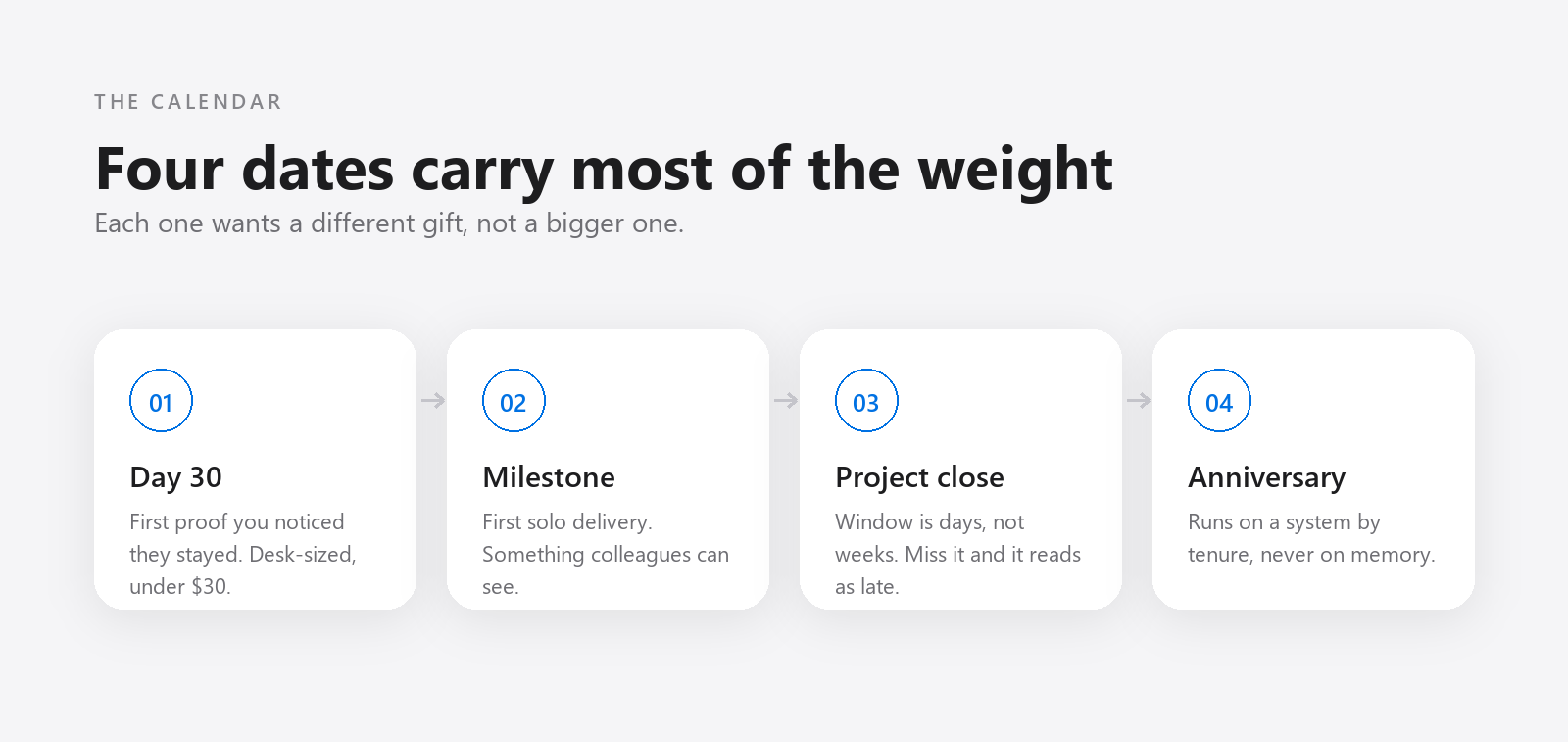
Day 30 of employment. Not day one. Day one is a welcome, and the company is expected to do it. Day 30 is the first moment you can say "you stayed". A desk plant, a decent pen, a card with the name written by hand. Under $30 is normal here.
A milestone inside the work. First solo delivery, first client signed, first junior hire trained. These need something the person can put on a desk where colleagues will see it, because the function of the gift is to be seen. Visibility beats utility.
The end of a project. The most commonly skipped moment, and the cheapest to get right. Teams are disbanded within days of a launch, so the window is short. Miss it and the same gift becomes a back-payment three weeks later, at half the effect.
Birthday and service anniversary. These should run on a system, not on memory. Anniversary tiers by tenure — one year, three, five — and birthdays at a flat per-head amount. The flat amount matters: when the budget is discretionary, whoever sits closest to HR gets the better gift, and everyone notices.
What $25, $75 and $150 actually buy
Three tiers cover almost every case. A fourth tier does not buy better gifts; it buys slower approvals.
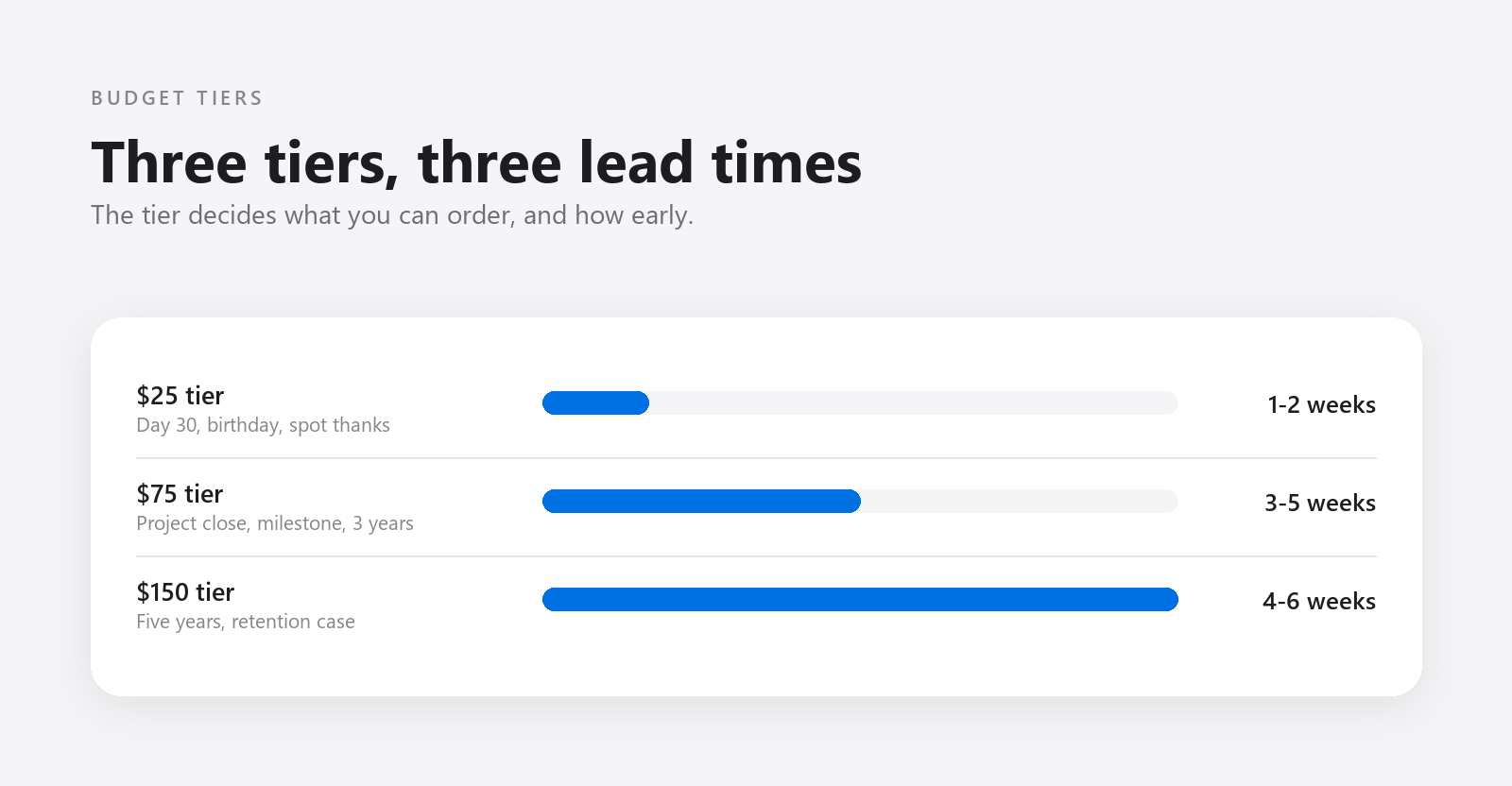
| Tier | What it buys | Typical trigger | What goes wrong here | Order to delivery |
|---|---|---|---|---|
| $25 | Desk plant, hand cream, good pen, coaster set, small stress object | Day 30, birthday, spot thank-you | The filler box: a low unit price invites padding with things nobody needs | 1–2 weeks from stock |
| $75 | Insulated bottle, commuter bag, desk organiser, anything engravable | Project close, milestone, three years | A logo the size of a business card, which turns a gift into advertising | 3–5 weeks custom |
| $150 | Speaker, noise-cancelling headphones, cabin bag, curated set, an experience | Five years, retention case, annual award | Treating price as thoughtfulness, with no card and no name | 4–6 weeks custom |
Cheap does not automatically mean cheap-looking. A $10 hand cream in a box with a ribbon reads as a gift; a $5 chocolate box with a good print finish can feel like three times its price. The opposite holds too: a box of small items that each answer no real need reads as clutter, and ends up unsellable secondhand. Padding is not a budget problem — it is a signal about how much thought went in.
Two supply facts sit under that table and are worth knowing before you promise a date. Minimum order quantities are real: 500 units is a common threshold, and a factory that agrees to run 30 will usually price them about 50% higher per unit, because tooling, sampling and scheduling are fixed costs that do not halve with the order. Lead time splits the same way — small runs often finish in 7 to 15 days, while a bulk order needing scheduling, production, inspection and freight is closer to 30 days before it ships. The late order is always the expensive one.
The tax line between a card and an object
Almost no gift guide mentions this, and it decides whether a self-serve catalogue is possible at all.
Under U.S. federal fringe-benefit rules, a low-value holiday or birthday gift can qualify as a de minimis benefit — too small to account for — provided it is not cash. Cash equivalents are excluded entirely: gift cards, gift certificates and gift coupons are taxable wages however small the amount.
So a $25 coffee card is payroll. A $25 mug probably is not. The recipient experience is nearly identical; the accounting is not.
There is a second door, for service and safety awards. Those must be tangible personal property, presented at a meaningful ceremony, with the exclusion capped at $1,600 under a qualified plan and $400 otherwise. Inside that rule sits the sentence that makes catalogues work: an arrangement letting the employee choose from a limited, pre-selected assortment of tangible items can still qualify. A curated list of eight objects is a different instrument from a stored-value card.
Outside the U.S., assume nothing. Treatment varies by country, and the safe move is to have local finance confirm the position in writing before the programme is designed around it.
A catalog or one gift for everyone
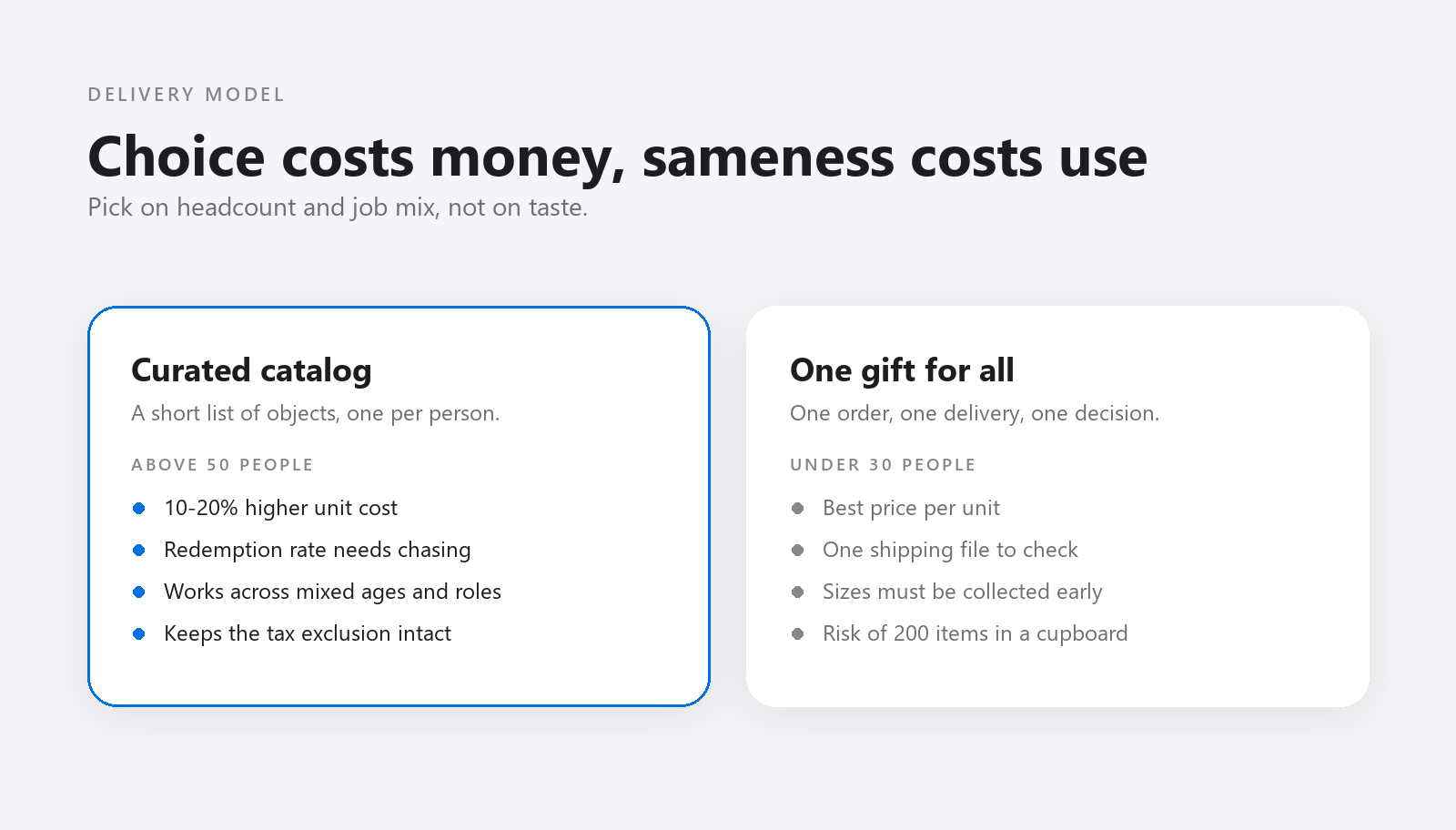
A catalogue is usually right above roughly 50 people, or whenever the group spans very different jobs and ages. A 22-year-old intern and a 52-year-old warehouse supervisor do not share a definition of "useful", and pretending otherwise is how you end up with 200 identical items in a storage room.
The costs are real. Per-unit cost runs 10–20% above a single bulk buy, because you carry scattered inventory and pay for individual fulfilment rather than one drop. Administration rises too: you now own redemption rates, reminders and expiry dates. A redemption rate — the share of people who claim their item — of 50–60% is common, and a low rate nearly always means the list is wrong, not that staff are ungrateful.
Below about 30 people, send one gift and offer an exchange. The overhead does not amortise at that size, and a survey asking what people want becomes a promise you cannot downgrade next year.
Shipping is the hidden half of either model. One bulk delivery to one office is simple; 200 parcels to 200 homes is a pick-and-pack job with address validation attached, and should be quoted as one.
Three ways a gift dies before anyone uses it
| Failure | Early signal | Who owns the fix |
|---|---|---|
| Wrong size | Sizes collected at the last minute, or not at all | Whoever owns the order form, four weeks before production |
| Address that no longer exists | A list untouched for a quarter | Whoever owns the shipping file, at the freeze date |
| Arrives after the moment | Order date set from the event date, not backwards from lead time | Whoever owns the calendar |
Size. Apparel needs sizes at least four weeks before production, plus a default exchange path. A wrong size is not the employee's mistake; it is a missing field in the process.
Address. The most underrated of the three. The U.S. Postal Service's national change-of-address dataset holds roughly 160 million permanent forwarding records, and its Move Update standard asks mailers to refresh address data within 95 days of a mailing. A list that sat untouched for a quarter already contains dead addresses. USPS also offers delivery-point validation, which flags whether an address currently exists in the delivery file.
The operational version is three steps: validate the file before dispatch, ask each person to confirm a delivery address (not the one on the onboarding form), and offer home or office as two options for remote staff. Set an address freeze three days before the order goes out, and treat anything later as the next batch — a Friday afternoon change will not make a Monday pick list.
Arriving late. The only one of the three with no repair. A gift that lands after the event stops being recognition and becomes an apology. Work backwards: custom at three to five weeks, bulk at six, plus transit, means a Q4 programme is decided in September.
The sixty seconds after the box opens
People judge a gift in about a minute: packaging, weight, finish. The same hand cream is "something the company handed out" in a poly bag and "something someone chose for me" in a box with a ribbon and a card with a name on it.
Packaging is the cheapest leverage in the programme. A box, a ribbon and a printed card usually cost a few dollars per unit and decide whether the other $70 registers at all.
Customisation is not the same as a logo. Real customisation covers colour, material, packaging and what sits inside; whether the box carries the company name or the project name changes what the gift means. A large logo across the front of the product demotes it to merchandise, and merchandise gets left in the office.
Run the year from one spreadsheet
One owner. One sheet. Four columns: date, list, tier, order date.
- Order date = event date − lead time − 5 days of buffer. Stock is 1–2 weeks, custom 3–5, bulk 6 or more.
- Address freeze = order date − 3 days. Later changes go into the next batch.
- Size collection = order date − 4 weeks for anything wearable.
- Budget per head, not per programme. A total-budget approval guarantees that some people get more than others.
One counter-intuitive rule: do not survey a team of 20 about what they want. The sample is too small, two loud voices set the answer, and the question becomes a commitment. Review last year instead — who never picked theirs up, what is still on a desk, what went home to a parent. Items still visible eleven months later are the categories that deserve next year's increase.
The short version
Fix the calendar first: day 30, milestone, project close, anniversary. Compress the budget to three tiers — $25, $75, $150 — and accept that the tier sets the lead time, not the other way round. Choose between a curated list and a single gift on headcount and job mix, and remember the tax line: a card is wages, a chosen object often is not. Then put the address freeze and the size deadline on the same sheet as the ship date.
If you have a headcount list and a budget per head and you are unsure how to split them, send both over — we will come back with a tier plan and a schedule before we talk about price.
References (Neutral Third-Party Sources)
Facts were checked against the following public sources. No gift supplier or fulfilment provider is cited.
- Internal Revenue Service — Publication 15-B, Employer's Tax Guide to Fringe Benefits: defines de minimis benefits, excludes gift cards and gift certificates from that treatment, and sets the $400 / $1,600 limits and limited-assortment exception for achievement awards. https://www.irs.gov/publications/p15b
- Gallup — The Importance of Employee Recognition: Low Cost, High Impact: the one-in-three figure for weekly recognition, the doubled likelihood of job-seeking among those not recognised, the seven-day recommendation, and the ranking of who gives memorable recognition. https://www.gallup.com/workplace/236441/employee-engagement-drives-growth.aspx
- Greater Good Science Center, UC Berkeley — How Gratitude Can Transform Your Workplace: distinguishes recognition from Client Appreciation and includes Ryan Fehr's view that annual awards are insufficient. https://greatergood.berkeley.edu/article/item/how_gratitude_can_transform_your_workplace
- United States Postal Service, PostalPro — Address Quality Solutions: explains the national change-of-address dataset, the 95-day Move Update window, delivery-point validation, and address correction for unresolvable records. https://postalpro.usps.com/address-quality