
Company Swag Ideas Employees Will Actually Keep (20 Examples)
One question filters most company swag before you spend a dollar: would this person buy it with their own money? Not "would they accept it" — of course they would, it is free. Would they reach for it in a shop, at that price, with no logo on it.
Run that test honestly against a catalogue and about eight in ten items fail. The survivors are unglamorous: a bottle, a hoodie, a notebook, a cap, a pen that writes.
What follows is the filtered list, then the part most guides skip — sizes, minimums, decoration methods, and how the box reaches a person who may not work in your office.
The test, and the three follow-ups
Does it survive a wash, a winter or a commute? A tee that pills after three cycles is not a gift, it is a chore. It gets worn once, in a photograph, then used as a cleaning cloth.
Is the logo small enough to wear in public? A mark at 3 inches reads as clothing. The same mark at 8 inches reads as a uniform, and a uniform stays at home.
Does it fit a life you did not design? A 32oz bottle does not fit a car cup holder. A wireless charger is useless to someone working from a kitchen table with one outlet.
One more, which matters more than it sounds: does it look like it cost money? That call happens in the first minute of Business Big-Brand Unboxing.
20 ideas, sorted by whether they survive the year
Tier is a read on retention, not quality. Price bands are US retail per unit at 100–300 pieces, before shipping.
| # | Item | Tier | Price | Why it lands or fails |
|---|---|---|---|---|
| 1 | Insulated water bottle | Keep | $28–45 | Used daily, seen in meetings, engraves well |
| 2 | Heavyweight hoodie | Keep | $40–70 | Worn at weekends if fit and colour are right |
| 3 | Hardback notebook | Keep | $12–22 | Survives a year of meetings, deboss looks costly |
| 4 | Machined pen | Keep | $10–25 | People keep a pen that writes; cheap ones get lost |
| 5 | Embroidered cap | Keep | $15–28 | Cheap to ship, worn for years, logo sits well in thread |
| 6 | Tech pouch | Keep | $15–30 | Cable mess is universal, the pouch lives in the bag |
| 7 | Heavy canvas tote | Keep | $12–25 | Leaves the office because it carries groceries |
| 8 | Soft tri-blend tee | Maybe | $12–25 | Good blank gets worn; boxy cotton gets donated |
| 9 | Knit beanie | Maybe | $10–20 | One size works, but only in cold months |
| 10 | Compact umbrella | Maybe | $15–30 | Genuinely used, then left in a taxi |
| 11 | Desk mat | Maybe | $25–45 | Good for desk workers, pointless for field teams |
| 12 | Wireless charging pad | Maybe | $20–35 | Depends on the phone and the desk |
| 13 | Crew socks | Maybe | $8–15 | Works if the pattern is good; sizing is a guess |
| 14 | Enamel pin or sticker pack | Maybe | $2–6 | Cheap joy, only for people who decorate things |
| 15 | Lanyard | Drawer | $1–3 | Only badge-heavy offices want one, and they issue their own |
| 16 | Stress ball | Drawer | $1–3 | Used for a week, then becomes a desk object nobody chose |
| 17 | Thin poly tote | Drawer | $2–4 | Tears at the handles, never leaves the house twice |
| 18 | USB flash drive | Drawer | $4–8 | The cloud made it redundant; capacity is always wrong |
| 19 | Plastic travel mug | Drawer | $6–10 | Leaks in a bag, which is the one thing a mug cannot do |
| 20 | Drawstring sports bag | Drawer | $3–6 | Thin cord, no structure, associated with free samples |
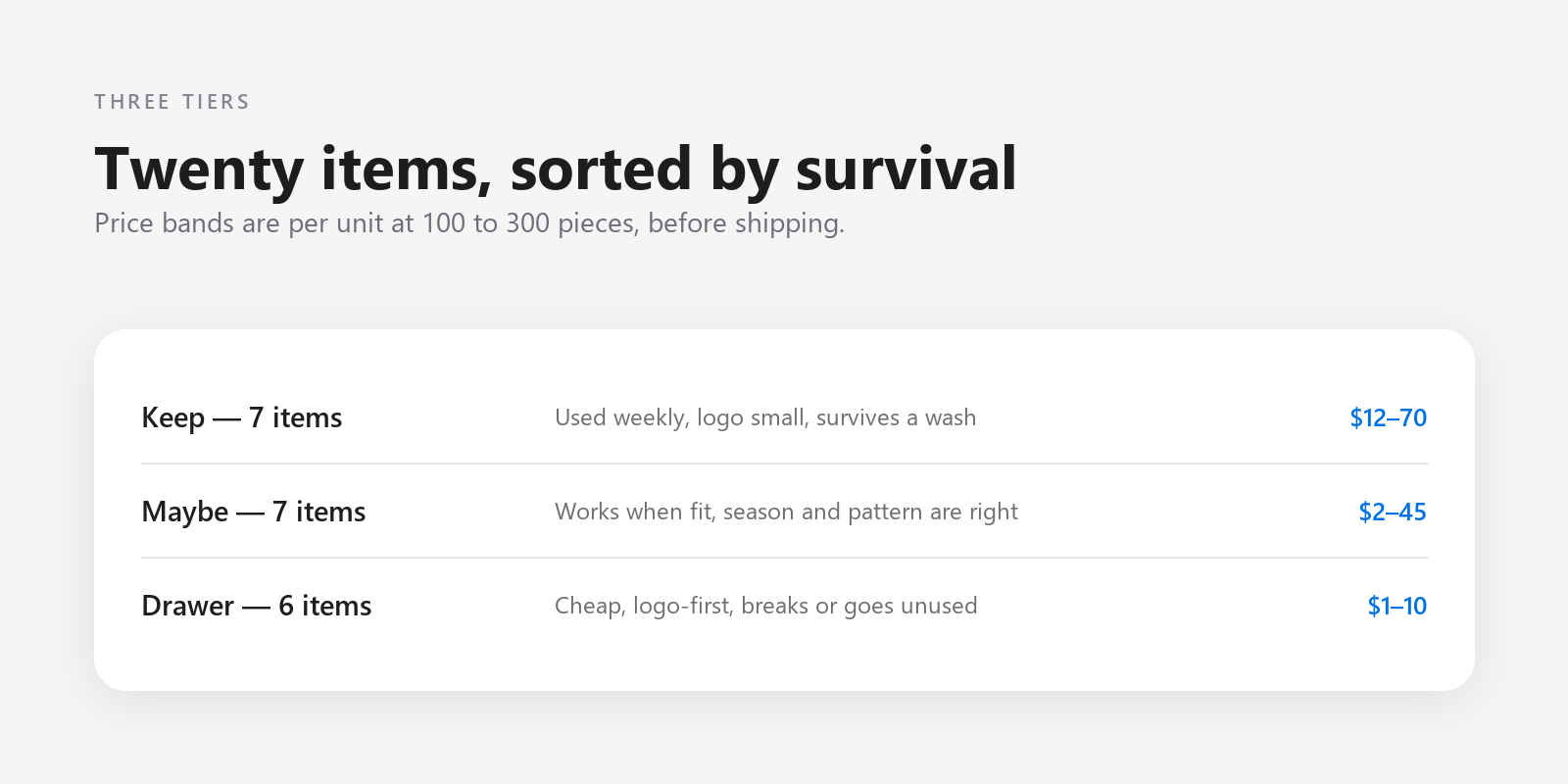
The pattern is not "expensive good, cheap bad". A $22 notebook beats a $45 desk mat for most teams, because the notebook travels and the mat does not. Price buys materials; usefulness is a separate decision.
The same item changes tier with the audience
For new hires, clothing jumps a tier: someone who just accepted a job will wear the hoodie, because wearing it is a way of joining. They will also notice the size you guessed, which is why the size form belongs with the offer letter.
For Thank You Gifts for Clients, apparel drops and desk objects rise. Nobody wears your hoodie to their own office, but a good notebook sits where other people see it.
For events, only packable items survive the trip home; anything needing a size at a busy stand produces a queue and a wrong guess.
Sizes: start at 1:3:4:2:1, then fix the tails
For a mixed adult group in the US, a workable starting split across S:M:L:XL:XXL is roughly 1:3:4:2:1. On 110 pieces that is 10 / 30 / 40 / 20 / 10.
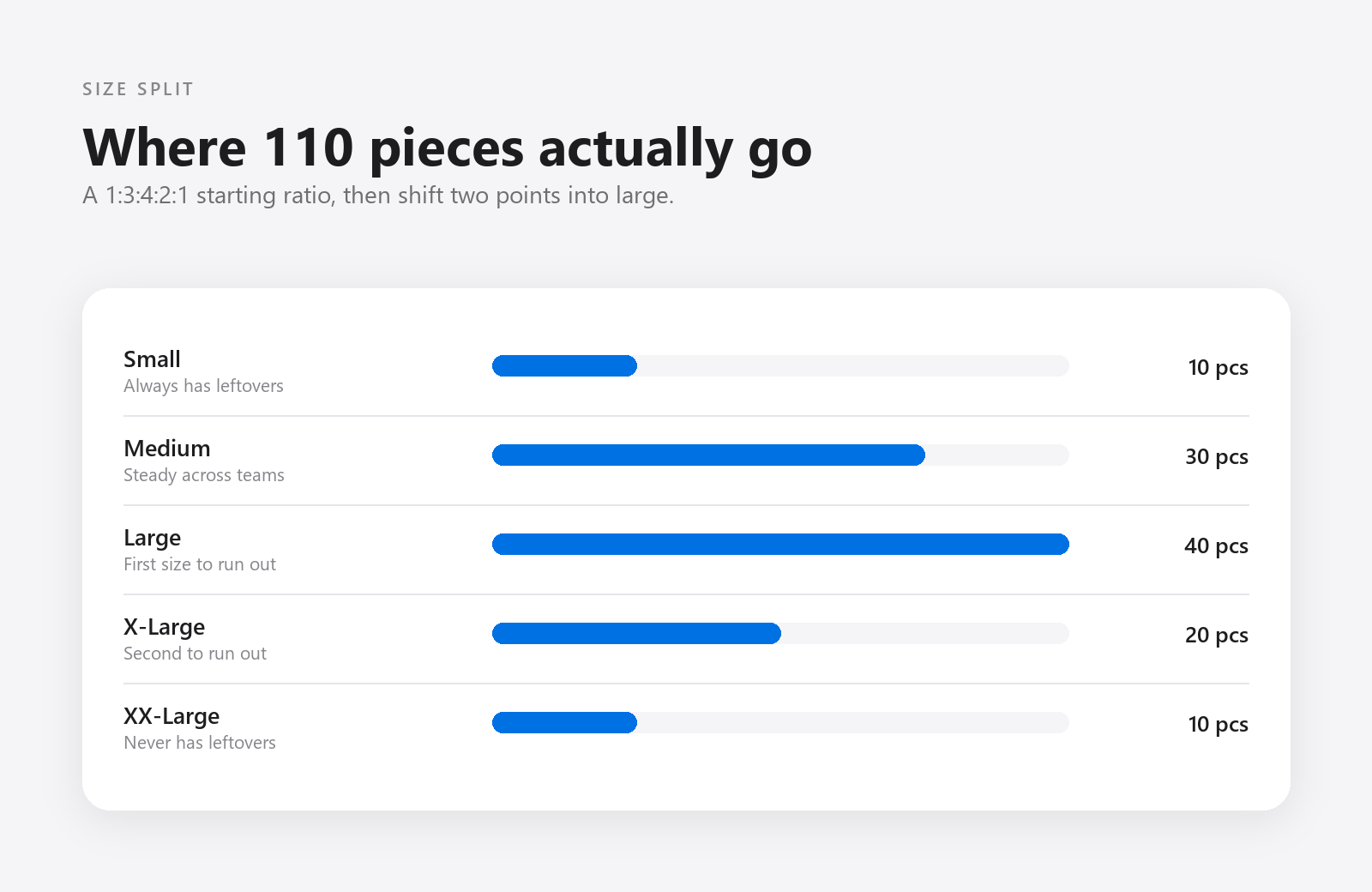
Three adjustments show up almost every time.
Large and XL run short — the most common complaint after a drop. Shift two points from small into large rather than ordering more of everything.
Women's cuts are not the same numbers: a women's medium sits closer to a unisex small, so a mixed headcount needs its own ratio or a unisex cut.
XXL and above never have leftovers; small always does. If you must guess, guess up. An oversized hoodie gets worn, an undersized one goes to the donation bag.
"One size fits most" is true for beanies and false for everything else. Every cap has a fit, and a bad fit is visible across a room.
MOQ, setup charges, and the 30-piece problem
Standard minimum order quantities for decorated goods sit around 500 pieces. A supplier who agrees to 30 will usually add close to 50% to the unit price, because the fixed costs do not shrink: a screen or embroidery file has to be set up, a pre-production sample made and approved, the line scheduled. Large runs start at roughly 30 days. A 30-piece run can come back in 7 to 15.
That is an awkward middle for a 40-person company. You cannot commit to 500 hoodies, and a 50% premium on 40 is painful.
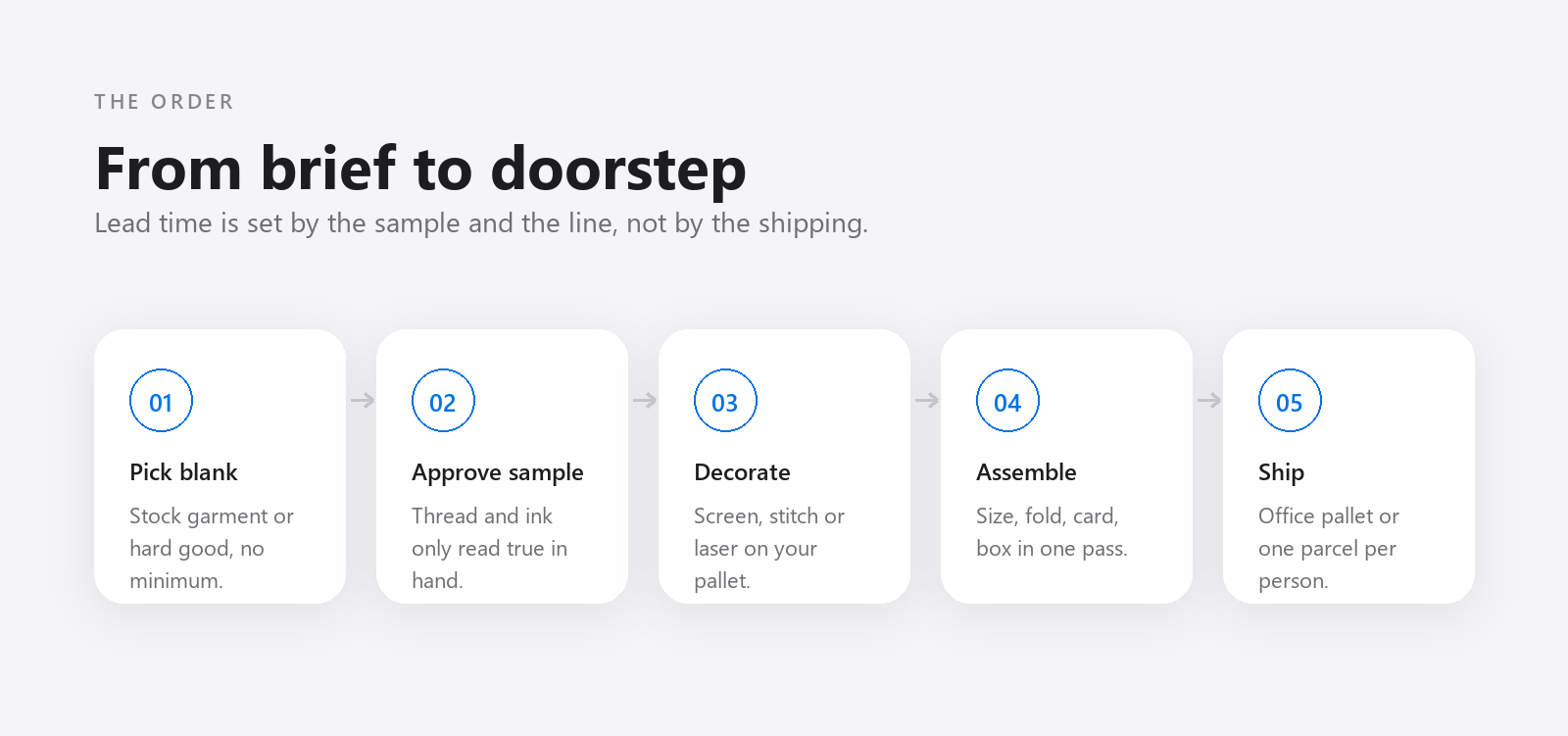
Three ways out, in order of how often they work.
Buy a stock blank and decorate locally. The blank has no minimum because it is not made for you; the decoration has a small one. You trade exclusivity for price.
Join a gang run. Several small orders share one print setup on a scheduled date. Cheaper and slower, with a fixed palette.
Pay the small-run premium on purpose, for a small group. Executive Holiday Gifts and first-week kits justify it. A whole company of 300 does not.
Screen print, embroidery, deboss: match the process to the object
The decoration method decides whether an item looks like merchandise or like a gift, and it also sets your minimums.
| Method | Best on | Setup | Breaks down when |
|---|---|---|---|
| Embroidery | Caps, hoodies, polos, fleece | Digitising file, one-time | Fine detail and text below 4mm |
| Screen print | Tees, totes, flat cotton | One screen per colour | Photographs and gradients |
| DTG | Small runs on cotton | None, per-piece cost | Dark garments and polyester blends |
| Deboss or laser | Leather, notebooks, metal, wood | A die or a machine file | Thin material, curved surfaces |
Two notes. Embroidery is priced by stitch count, so a wide chest logo costs more than a small sleeve mark — the opposite of print, where colours cost and size barely does. And a pre-production sample is not optional: thread colour on a screen is not the thread colour on a navy cap.
Hand it out or mail it home
Distribution is the part that quietly doubles the cost.
Handing out at the office works when everyone is there, which is less often than it used to be. It also assumes a right size for someone you may never have met, and a box they can carry home.
Shipping to a home address costs roughly $8–15 per parcel domestically, plus the labour of collecting and cleaning addresses. In exchange you reach remote hires who would otherwise get nothing, and you get a delivery date that is not "sometime in the first month".
Three things decide whether it lands. Collect addresses and sizes in one form, with a required postal code and country field, and chase the missing ten percent before the order closes. Ship to arrive after day one, because a box on the doorstep three days early sits in a hallway. Keep about 10% buffer in the two common sizes: a replacement shipped six weeks later is no longer a welcome gift. And if the address on file is an old one, mail forwarding will not rescue the parcel.
Cross-border: marking, duty, and the address file
If any recipients sit outside your home country, the parcel becomes an import, and the rules are not optional.
Under US rules, imported goods must carry the country of origin in English, in a place a buyer can see, legibly and permanently. Unmarked goods face an extra 10% duty on appraised value unless exported or destroyed under customs supervision. A hang tag works if it survives handling; a sticker on a poly bag usually does not.
Apparel adds a second layer: fiber content by percentage in descending order, country of origin, an RN number, care instructions. Those labels are the manufacturer's job. If your blanks already carry them, leave them on — cutting them out is how a swag order becomes a compliance problem.
Low-value parcels may clear without duty under a de minimis threshold, which in the US has long sat at $800 per person per day. That is not "no tax" elsewhere: VAT gets collected at the border or by the marketplace, and a shipment marked "gift" does not change it.
Then the boring part that decides everything: the address file. Leading zeros in postal codes, two-letter state codes, apartment numbers in their own field. Build the form to reject a five-digit zip in a country that uses six and you save a week of emails.
The short version
Test every item with one question: would they buy it themselves. Spend on fewer, better pieces from the top group, keep the logo small, and accept that apparel only works when the fit does. Order blanks early, decorate late, and place the embroidery order before headcount is final — lead time is the part you cannot compress.
If you are planning a drop for a distributed team, send us the headcount, the size split you expect and the countries involved — we will come back with a packing and shipping plan before we talk about price.
References (Neutral Third-Party Sources)
- FTC — Threading Your Way Through the Labeling Requirements Under the Textile and Wool Acts: fiber content by percentage, country of origin, and the identity requirement for textile products sold in the US. https://www.ftc.gov/business-guidance/resources/threading-your-way-through-labeling-requirements-under-textile-wool-acts
- FTC — Clothes Captioning: Complying with the Care Labeling Rule: what a care label must contain and who is responsible for it. https://www.ftc.gov/business-guidance/resources/clothes-captioning-complying-care-labeling-rule
- eCFR — 19 CFR Part 134, Country of Origin Marking: the marking requirement for imported articles, acceptable methods, and the 10% additional duty for unmarked goods. https://www.ecfr.gov/current/title-19/chapter-I/part-134
- USPS — Standard Forward Mail & Change of Address: why a parcel sent to an old address is not rescued by mail forwarding. https://www.usps.com/manage/forward.htm