
International Fulfillment: Ship Orders Worldwide Without the Chaos
Cross-border is not a domestic order with a different label on it. Every parcel that crosses a border picks up two things the domestic version never had: a tax settled at the frontier, and a set of data that has to be right before the label is printed. Freight is the third cost, and usually the easiest one to negotiate.
Break a direct-to-consumer parcel into four blocks and the difference becomes obvious. Pickup and linehaul look familiar. Then comes clearance and duty — the block that has no domestic equivalent — and last mile, which is now somebody else's postal system or a consolidator you have never met. When duty rates move, the change lands in that third block, and it arrives with an effective date and an expiry date. Pricing built on last quarter's numbers goes wrong quietly.
What the border actually adds
Two things, and neither appears on a freight quote.
The first is tax: import VAT, duty, and whatever handling fee the carrier charges for collecting them. The second is data: commodity code, declared value, country of origin, weight, a phone number that works on the day of delivery. A parcel stops for the second reason far more often than the first — a missing code or a vague description holds a shipment as effectively as an unpaid bill.
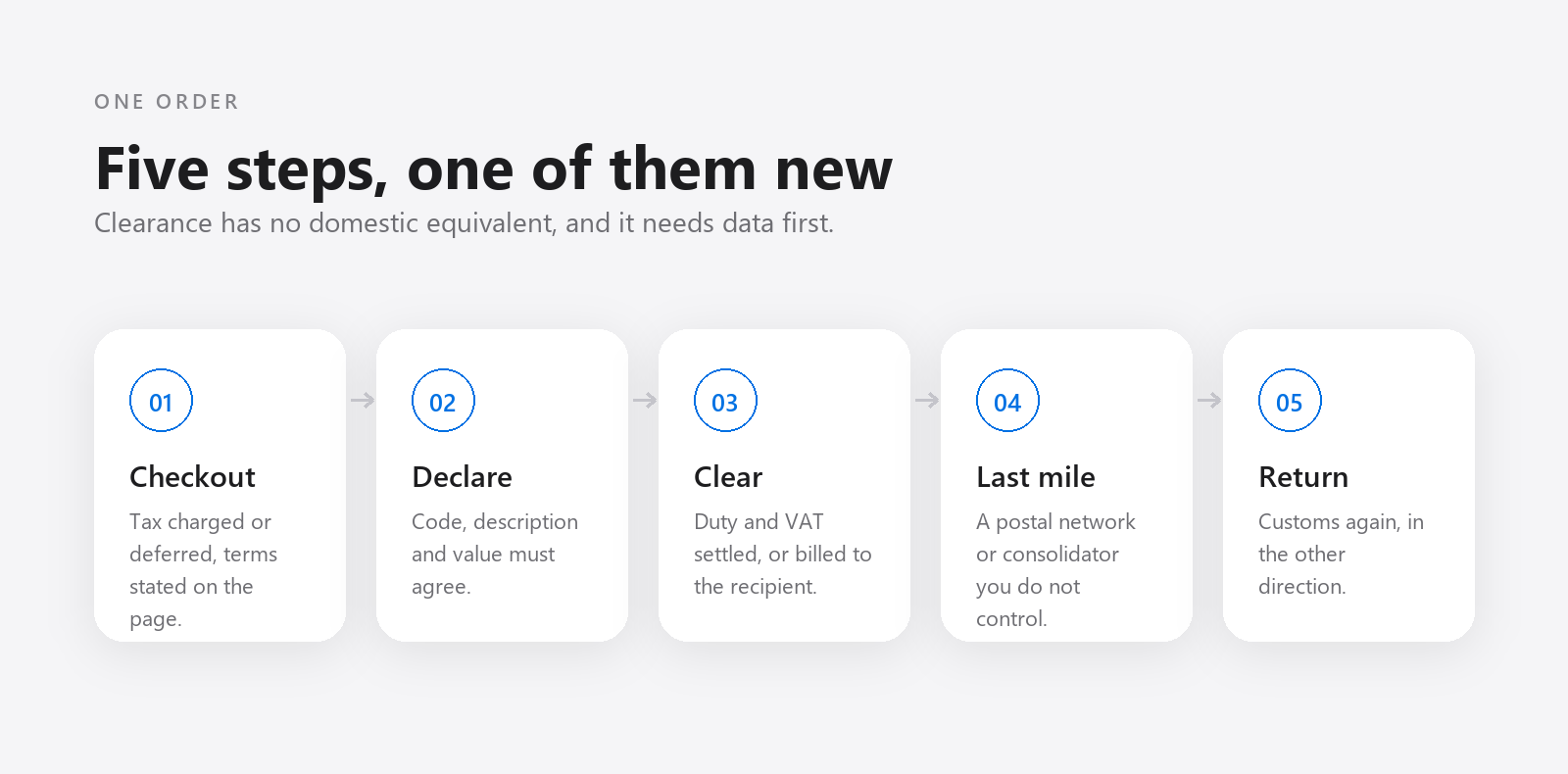
The practical test is simple. One held parcel costs a unit and an email. A held container costs cash flow, and if the forwarder — the firm that books the space and files the paperwork on your behalf — runs into trouble, it can cost the cargo itself. That is why the first design decision is not the carrier. It is who pays at the door.
DDP or DDU: decide per market, then print it
DDP means you pay the duty and import VAT; the customer receives the parcel and pays nothing more. DDU means the customer settles it on delivery. DDU was dropped from the Incoterms text in 2010 and its role is now taken by DAP, though the old name survives in everyday use.
DDU looks cheaper because the tax sits outside your cost base. What it actually sells is uncertainty, and uncertainty has a price: refused deliveries, parcels abandoned at a depot, a second delivery attempt, and a carrier that comes back to you for the return leg. Once the EU removed VAT relief on low-value imports in July 2021, the doorstep bill stopped being occasional and became routine in most European markets.
| DDP | DDU / DAP | |
|---|---|---|
| Who pays import VAT and duty | You, via the carrier or broker | The recipient, at delivery |
| Price shown at checkout | All-in | Ex-tax, plus a bill later |
| Typical failure | You under-quoted the tax and absorb it | Refusal, abandonment, second attempt |
| Works when | High order value, low returns, repeat buyers | B2B, buyer has a broker |
| Support load | Low | High, and concentrated on delivery day |
Whatever you How to Choose, put it on the product page and the checkout page. "I did not know I had to pay again" is a more common complaint than "it arrived late", and it is entirely preventable.
IOSS and the €150 line
IOSS is the EU scheme that lets you charge VAT at checkout, at the buyer's local rate, and remit it through one monthly return. The parcel then clears without anyone collecting VAT at the door. The ceiling is €150 of declared value per consignment — not per order, not per month, not per customer.
Below the line, IOSS makes a cross-border parcel behave like a domestic one. Above it, normal import procedures return: VAT and duty settled at the frontier, which is exactly where DDP earns its keep, because you now have to put the tax into the price yourself.
The EU also removed the €22 VAT exemption on small consignments in July 2021. The point was not the few euros of revenue. It was that every parcel now needs a declaration, and a declaration needs data. Whether that data is right depends on your product records, not on your carrier.
De minimis is a variable, not a strategy
Every market draws a line under which low-value goods clear with little or no tax. The lines are different, and they move.
| Market | Line as of writing | Below the line | Above the line |
|---|---|---|---|
| EU | €150 per consignment (IOSS ceiling) | VAT charged at checkout, nothing at the door | Standard import: VAT plus duty |
| UK | £135 | Seller accounts for VAT in the price | Recipient pays import VAT and duty |
| US | Around $800 (de minimis — check CBP's current guidance) | Usually enters duty-free | Formal or simplified entry |
The UK has an operational detail worth knowing before you ship DDU there: the carrier issues a bill, holds the parcel for roughly three weeks, and then returns it to sender. A failed DDU delivery in the UK is not a customer paying more. It is a parcel coming back across the Atlantic. Overcharges and returns can be reclaimed — postal items through form BOR286, other carriers through C285.
Building a price on the current threshold is a mistake with a delay fuse. When the line moves, you have to change the number, the date it applies from, and the treatment of orders already sold but not yet dispatched. Price as if duty is included, and treat the threshold as margin rather than as the foundation.
HS codes and declared value
The Harmonized System gives every product a six-digit code, drawn from more than 5,000 commodity groups, used by over 200 economies and covering more than 98% of world trade. It is revised every five to six years, and individual countries add digits of their own beneath the six.
That last part is why a code is an asset with an expiry date. Teams often classify once, at How to Launch, and never look again — then a revision lands, or the destination country subdivides a heading, and the code that cleared last year starts attracting queries.
Declared value is the second trap. Under-declaring buys a small duty saving against a much larger risk of examination, reassessment and penalty. Over-declaring simply costs money. The defensible figure is the actual transaction value, and it has to match the invoice, the order record and the payment.
Three fields must agree: code, description, value. A shipment declared as "electronic accessory", described as a Bluetooth speaker, valued at $9.90 is an invitation to inspect.
Batteries, liquids and the restricted list
Whether a battery can fly depends on its configuration and its watt-hour rating, not on the fact that a battery exists. Lithium cells shipped alone, packed with equipment, and contained in equipment are three different cases with three different packing rules; air transport adds classification, marking and documentation on top.
Three consequences follow. Battery-enabled lanes cost more than general cargo — commonly 20–40% more. Certification and declaration paperwork has to be ready before the first leg, not when the parcel is already at the border. And pure batteries, liquids, powders and flammables are poor first products for a team without a compliance process: platform requirements and carrier acceptance are both stricter, and both change.
Returns cost more on the way back
Outbound freight is wholesale; returns are retail. A return is a single-piece pickup with no volume rate, often at a residential address, and on a cross-border order it has to clear customs again in the other direction. Plenty of brands look at that arithmetic and abandon the parcel instead.
Three options that work. Put a returns address in the main market, even if it is one bay in a partner warehouse, and ship the accumulation back monthly. Refund low-value items without asking for them. And recover what is recoverable: a functional test, a clean-up and a new bag return some units to sellable stock, and in high-value categories that recovery is worth more than the freight saving you negotiated.
Direct, or one warehouse abroad
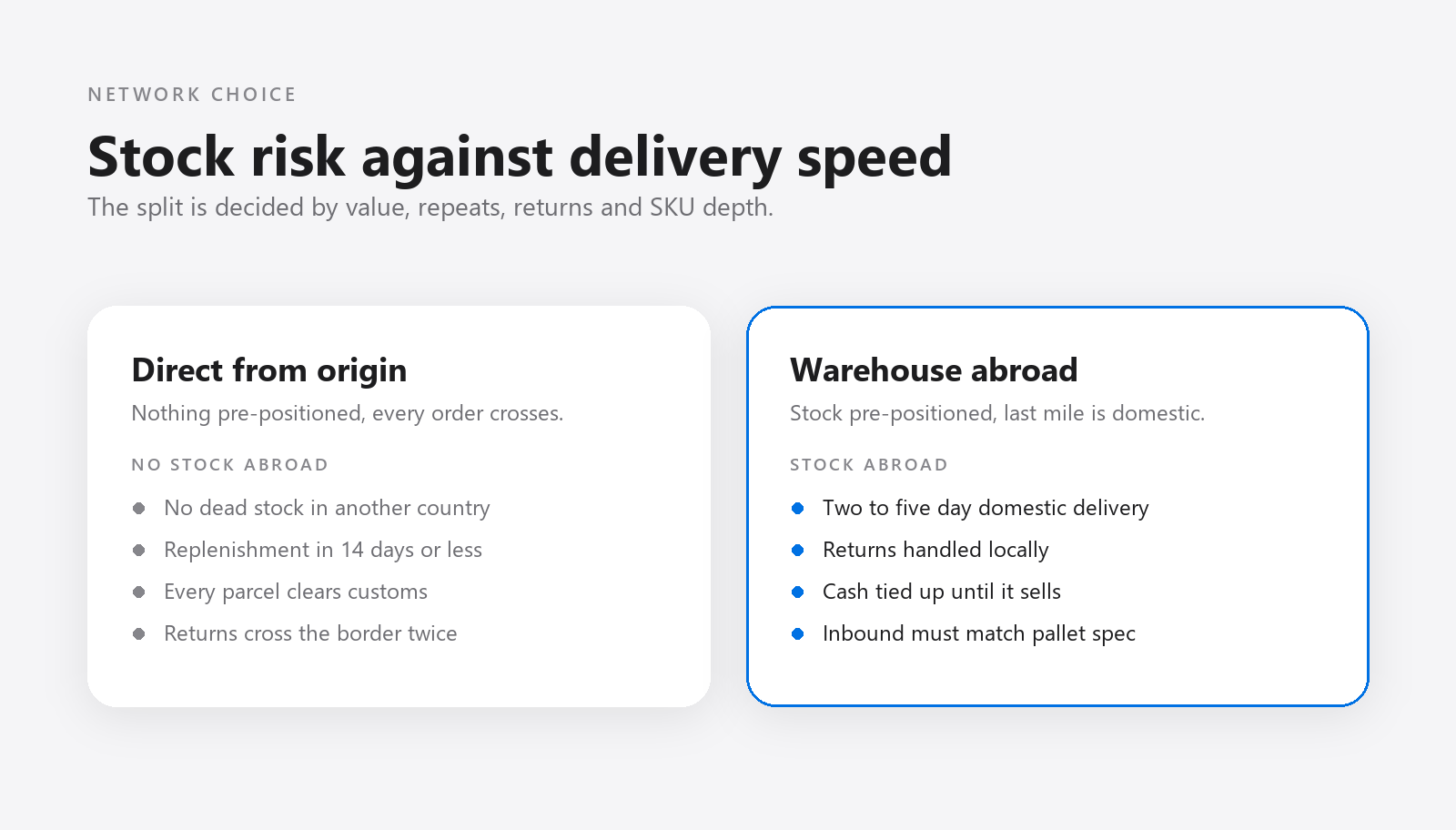
This is the decision that actually changes the cost structure. Four inputs decide it: order value, repeat rate, return rate, SKU depth.
Direct shipping wins on inventory risk. Nothing is pre-positioned, so nothing goes stale, and replenishment can run on a 14-day cycle, seven days for fast movers, or even made-to-order after the sale. It loses on transit time, on return cost, and on the customer's patience.
A warehouse abroad wins on delivery and returns. It loses on cash: stock that lands in another country is sunk until it sells, and unsold stock becomes storage fees plus a write-down. In practice, brands that run both often settle near a 60/40 or 70/30 split between warehouse stock and direct — the warehouse carries the volume lines, direct carries the tail.
Inbound specifications matter more than most teams expect. Retail and warehouse receivers in North America build around a 48×40 inch pallet with fixed height and label placement rules, and a load a couple of inches out of spec gets refused after you have paid the freight.
The order file: fourteen fields
Everything below has to be correct before a label exists, and the fields have to agree with each other.
- Recipient name, as it appears on ID
- Street address, with apartment number split out
- City, state or province, postal code
- Country, as a two-letter code
- Phone number — the only recovery route on a failed delivery
- Email, for tracking notifications
- HS code, six digits minimum
- Description in English, specific enough to classify
- Declared unit value and currency
- Country of origin
- Net and gross weight
- Piece count and packaging type
- Terms of sale: DDP or DAP
- Battery or restricted-goods flag
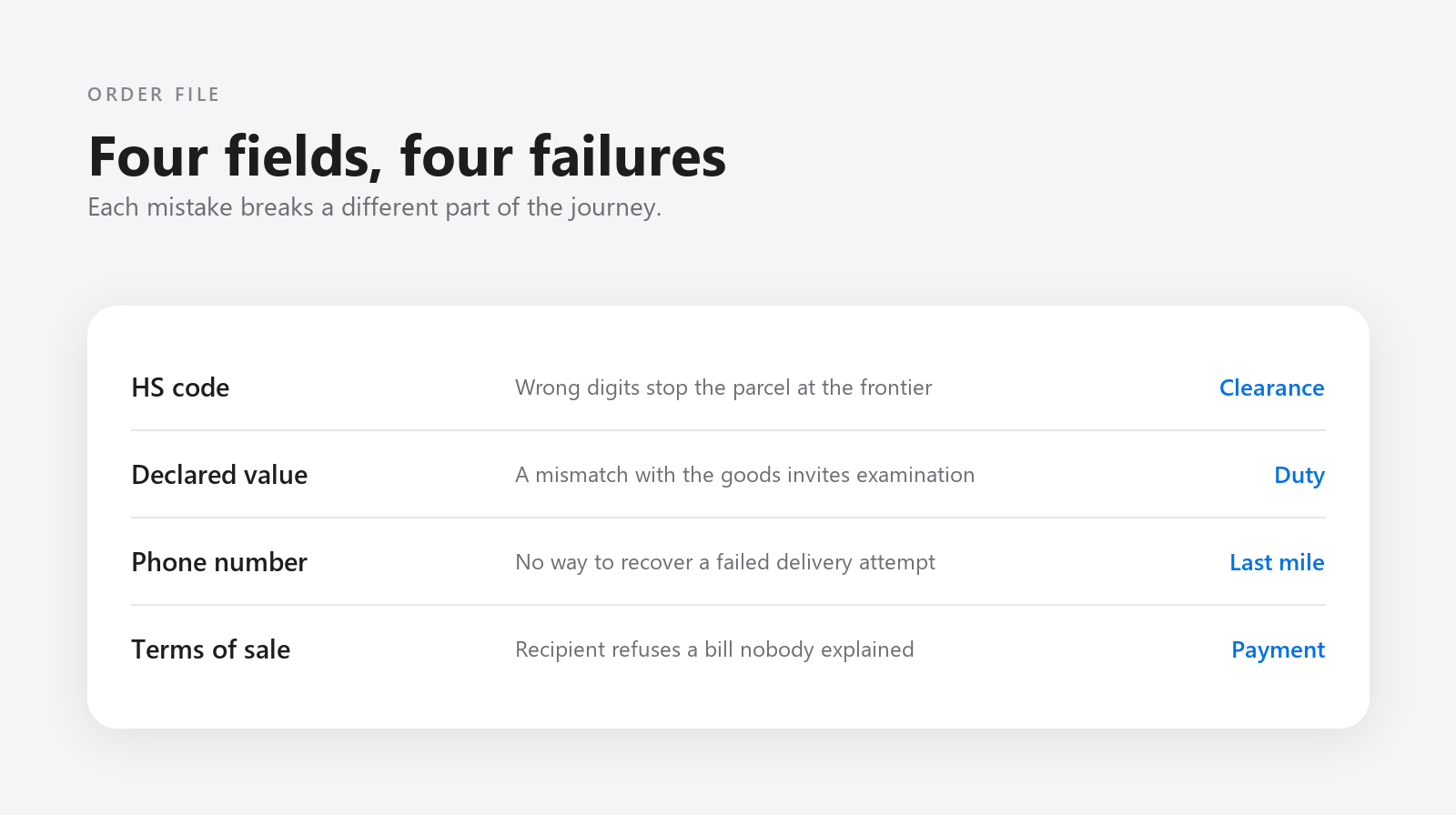
Each mistake fails differently. A bad address fails at delivery. A missing phone number fails after delivery. A wrong code stops at clearance. A value that does not match the goods triggers examination. Missing terms leave the recipient refusing to pay. That is why validation belongs before picking, when a bad address costs an email rather than a parcel — and why the packed weight should be checked against the declared weight, not assumed.
One market first
Do not open eight countries at once. Pick one — the UK and Germany are common first steps, the US another — and get four things right there: VAT treatment, IOSS or its absence, commodity codes, and a returns address. Run it for a quarter before adding the second market.
The teams that get into trouble are rarely short of capability. They are short of attention: every market is slightly wrong, in tax, in classification, in returns, and the small errors stack until nothing clears without a phone call.
If you are deciding between direct and a warehouse for a new market, send the destination, SKU count, monthly order volume and whether the products contain batteries. The model choice comes before the rate.
References (Neutral Third-Party Sources)
- ICC — Incoterms® rules: eleven three-letter trade terms, first published in 1936, current edition in force since 1 January 2020, defining tasks, costs and risk between seller and buyer. https://iccwbo.org/business-solutions/incoterms-rules/
- European Commission — VAT One Stop Shop, VAT e-Commerce: the July 2021 changes, removal of the €22 import VAT exemption, and IOSS for consignments not exceeding €150. https://vat-one-stop-shop.ec.europa.eu/index_en
- GOV.UK — Tax and customs for goods sent from abroad: the £135 line, who pays import VAT and duty, the roughly three-week hold before a parcel is returned, and the BOR286 and C285 refund routes. https://www.gov.uk/goods-sent-from-abroad/tax-and-duty
- GOV.UK — Trade Tariff: looking up commodity codes, duty rates and VAT for imports. https://www.gov.uk/trade-tariff
- World Customs Organization — What is the Harmonized System: more than 5,000 commodity groups, six-digit codes, over 200 economies, 98% of world trade, revised every five to six years. https://www.wcoomd.org/en/topics/nomenclature/overview/what-is-the-harmonized-system.aspx
- IATA — Batteries: lithium batteries are carried by air according to configuration and watt-hour rating or lithium content, with matching classification, packing and marking requirements. https://www.iata.org/en/programs/cargo/dgr/lithium-batteries/