
3PL Kitting Services: Combine Storage, Assembly & Shipping
A 3PL kitting service is three businesses billed as one: storage, handling and assembly. You rent cubic feet, pay per component movement, then pay again per kit built. Each part has its own unit of measure, its own minimum, and its own way of going wrong.
That is why two quotes for the same bundle can differ by 40% and both be honest. One is priced per kit with materials included; the other per component plus a base, and the gap only shows at your real volume.
Merging all three is usually right, but not at every order size. Below is the cost structure as it appears on an invoice, the risks that surface after go-live, and the volume band where combining pays.
What you are actually buying
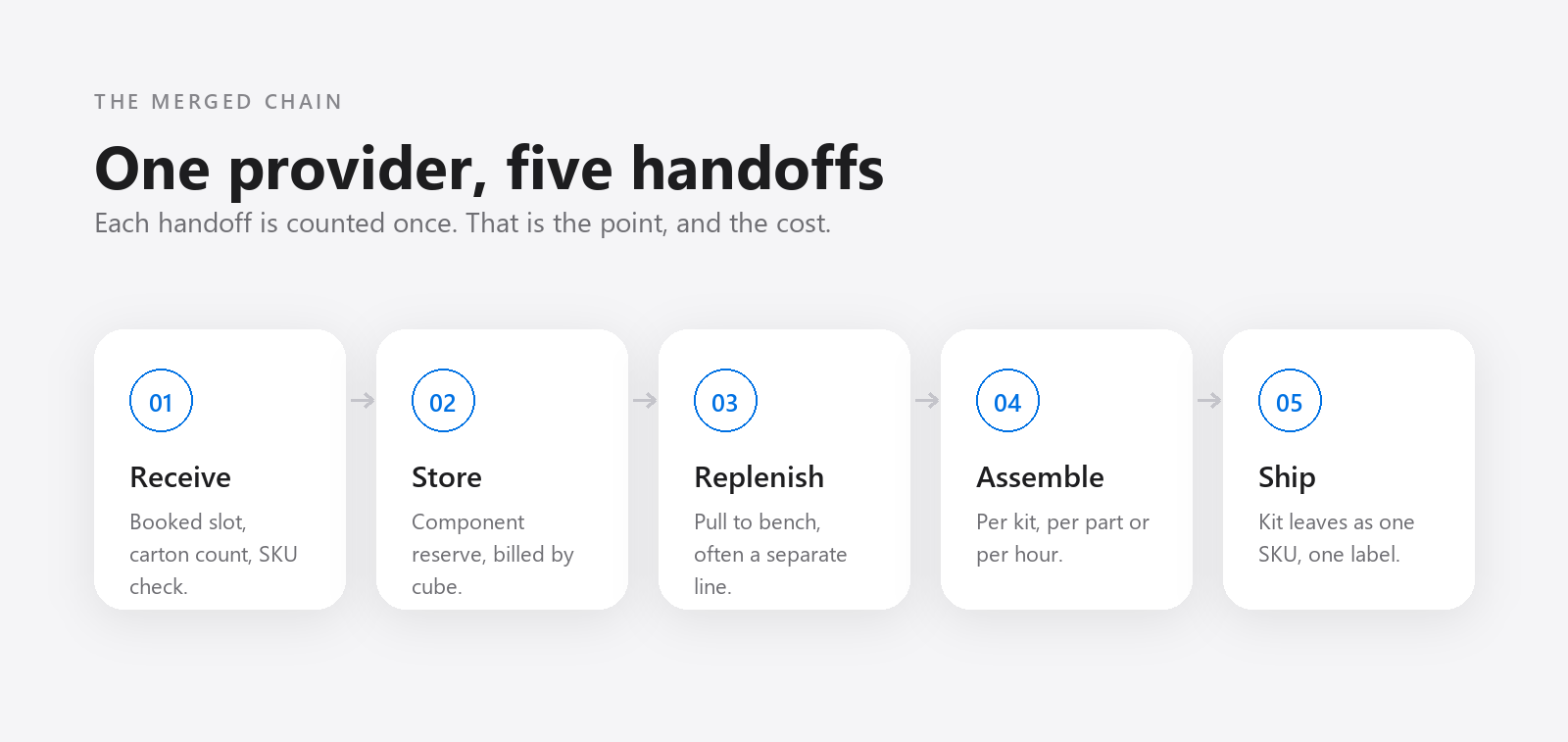
Storage is the easy part: a pallet position, a bin, or a cubic foot, billed monthly. Handling is movement — receiving a carton, putting it away, replenishing the kit bench, pulling components for a build. Assembly is bench labour plus the materials that go inside the kit.
The argument for buying all three from one provider is handoffs. Every time components change hands between a warehouse, an assembler and a shipper, someone re-counts them, and the count is where shortages are born. One provider, one inventory record, one party to call.
The argument against is leverage: one provider controls the whole cost base, and switching after a year of BOM history and custom packaging is not a small project.
Three meters, one invoice
Read a kitting quote as three rate cards, then add them.
| Meter | Billed on | What moves it | Where it hides |
|---|---|---|---|
| Storage | Pallet, bin or cubic foot per month | Kit cube versus component cube, and dwell time | Finished Assembly Custom Kits take more space than the parts did |
| Component handling | Per component received, put away or pulled | Components per kit, replenishment frequency | Bench replenishment is often a separate line |
| Kit assembly | Per kit, per placement, or per hour | Steps, packaging, quality check, batch size | Materials and setup usually sit outside the rate |
A three-component kit with a printed card and a branded mailer is not the same job as a ten-component gift set with tissue and ribbon. One may quote near half a dollar a kit at volume; the other several dollars.
Two structural points matter more than the rates.
Billing unit versus cost driver. Handling is billed per component, but your cost driver is components per kit times kits. An eight-component kit costs roughly two and a half times a three-component kit to handle before assembly labour. A flat per-kit rate averages that away — fine until you Orders After Launch a premium kit and the average collapses.
Finished-kit cube. A kit occupies more space than its components. Stock that fitted on six pallets can need nine. Storage is the smallest line on most kitting invoices and the one most often missed at planning stage, because nobody models it until month two.
The monthly minimum is a fixed cost in disguise
This clause decides whether a small kitting programme is viable.
Most contracts carry a monthly minimum spend. Below it you pay the minimum; above it, actuals. The minimum exists because the provider reserved space, staff and a bench slot, and it does not care that your gift sets sell in one quarter.
Write it down and the effect is simple. Minimum $1,200, January billable work $310 — the invoice is $1,200. The extra $890 belongs to the calendar, not to any kit. Divide it across January's kits and the unit cost looks catastrophic; divide it across the year and it is a rounding error. Both numbers are true, and finance will ask for the first one.
Two responses worth trying. Ask whether assembly counts toward the minimum or sits outside it — some contracts treat value-added work as a separate category with its own threshold, so a heavy kitting month can still leave you short on storage. Ask for a seasonal schedule in writing: a reduced minimum for named slow months against a committed annual volume. Providers will often trade that, because it makes their own staffing plan easier.
Inbound appointments set the build calendar
Kitting compresses your inbound tolerance. Components must arrive, be counted, be put away and be pulled to the bench before a build starts. Every day lost at receiving is a day lost on the calendar.
What constrains you is the appointment window, not the truck. Most shared warehouses run fixed receiving slots, and a container without a booked slot waits — sometimes days, sometimes at a cost. Carton-level inbound behaves the same way: land after the day's cut-off and it is counted tomorrow.
- Book the slot when the shipment is confirmed, not when it sails. A missed appointment is the most common cause of a late kitting start.
- Send the advance notice with carton count, SKU list and pallet configuration. Without it, receiving is charged as manual work and takes longer.
- Keep Friday afternoon arrivals away from a Monday build. End-of-week receiving capacity is thinner than the calendar suggests, and there is no weekend shift to catch up.
Components and finished kits are also often stored in different zones, sometimes different buildings. Ask where the bench sits relative to the component reserve: a line that replenishes from three aisles away burns minutes on every build, and those minutes are billed.
Returns are a second, slower assembly line
A returned kit is a disassembly job. Someone opens it, checks each component, decides what is resaleable, logs the loss, then either rebuilds the kit or returns parts to loose stock.
Most quotes exclude this and most brands forget to ask. The result is a returns line in month three at a rate nobody budgeted, or a pile of returned kits waiting for a decision.
Settle three things before the first return arrives. Who owns the teardown call — the provider should not be deciding whether a component is good enough to reuse, so set the criteria (sealed, undamaged, within lot date). How loss is recorded — a rebuilt kit usually loses a torn insert or a damaged box, and without a scrap code for teardown that loss reappears as an inventory variance you will chase for a week. And whether rebuilt kits sell as new, which is a channel rule.
The volume band where merging pays
The case for one provider strengthens with volume, but not linearly.
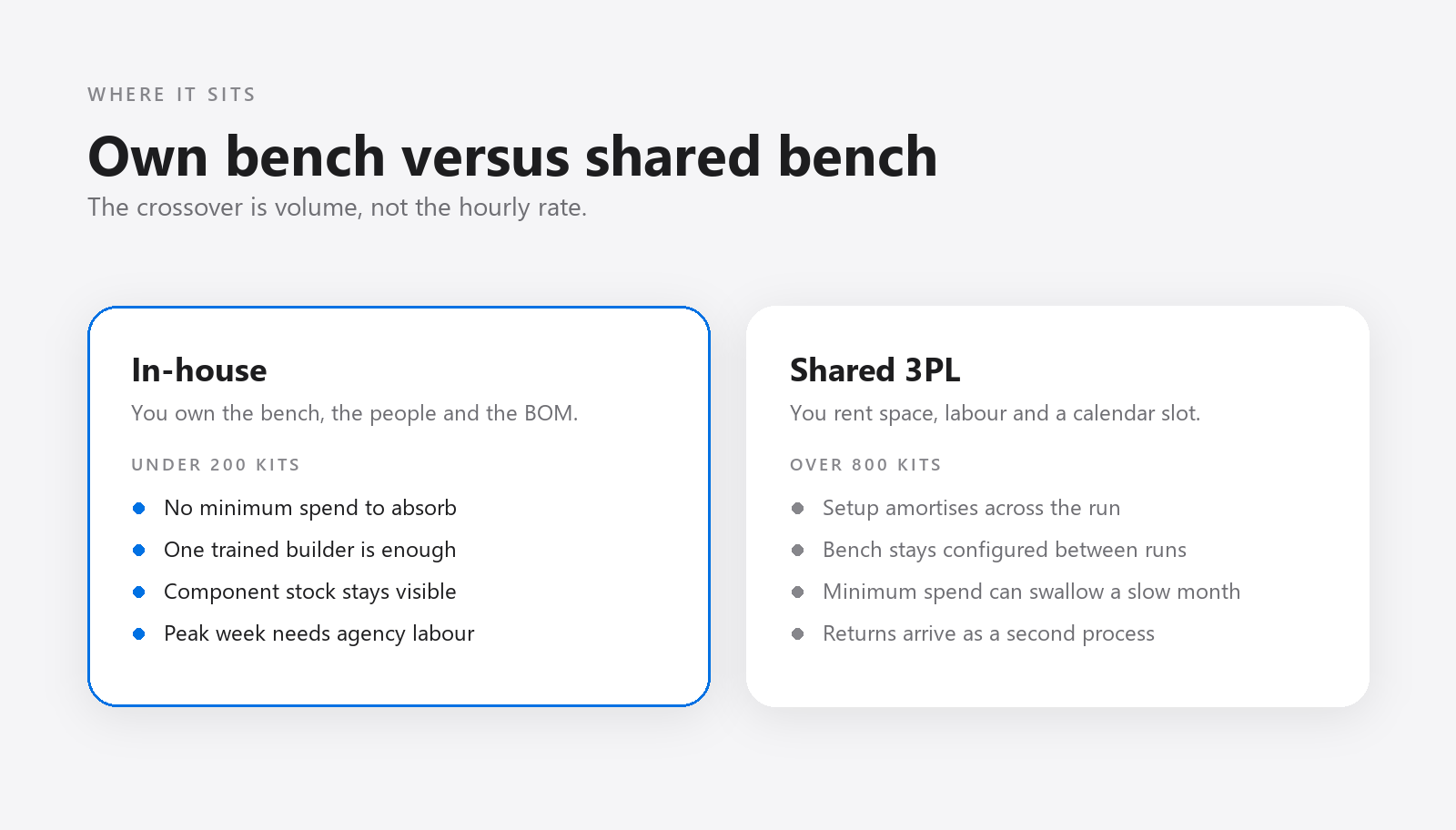
Below roughly 200 kits a month, the minimum spend dominates and the build is usually cheaper at your own bench with one trained person and a shelf. The break-even is not the assembly rate; it is whether you can keep that person busy.
Between roughly 200 and 800 kits a month, the numbers are close and complexity decides. A three-component kit with standard packaging is fine in-house at 400. A seven-component kit with a custom mailer, region-specific inserts and a quality check is not — at that volume the error rate costs more than the price difference.
Above roughly 800 kits a month and two or three configurations, the combined model usually wins clearly. Setup amortises, the bench stays configured, replenishment becomes routine, and the per-kit rate falls with batch size instead of creeping up.
The exception is a product with a two-week selling window and no reorders. Then neither model works: in-house runs out of labour, and the 3PL runs out of calendar, because onboarding a new kit takes days you do not have.
Seven clauses to put in the contract
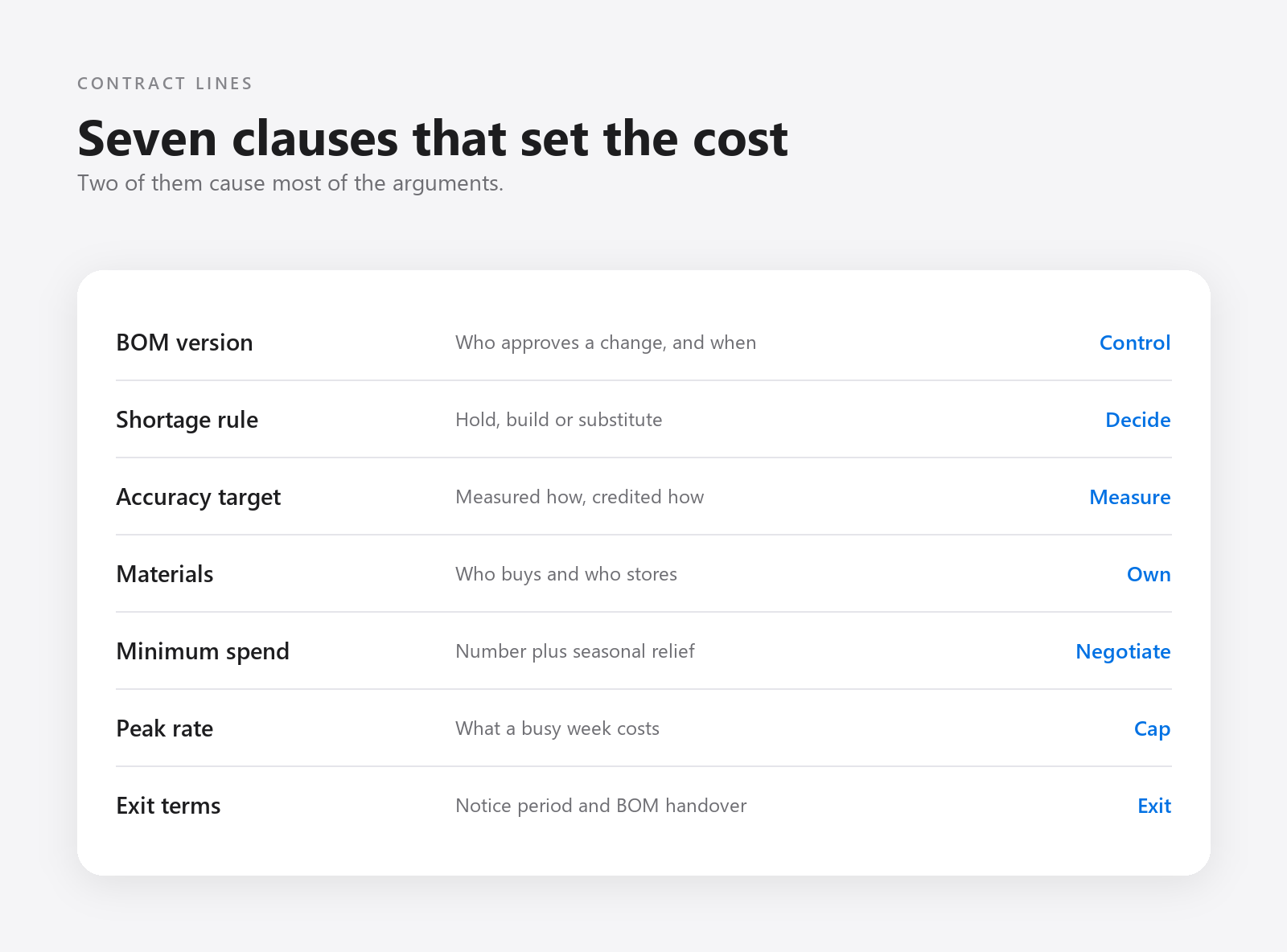
- BOM version control. Which version is in force, who approves a change, what happens to kits already built.
- Component shortage rule. Hold partial kits, build complete ones, or substitute — in writing, with a system status for a partial kit.
- Kit accuracy target and remedy. A stated target, a measurement method, and a credit for the rework that misses it.
- Materials ownership. Who buys the boxes, who stores them, who absorbs the cost when a packaging change obsoletes stock.
- Minimum spend and seasonal relief. The number, what counts toward it, and the months where it drops.
- Peak and changeover rates. What a new configuration costs, and what a busy week costs.
- Termination and data. Notice period, and who gets the BOM and build history when you leave.
Clauses two and five cause most of the arguments, and both are cheaper to settle before go-live.
Two volumes, same kit
Figures are illustrative, in the ranges typically quoted for a five-component kit with standard packaging.
| Line | 400 kits a month | 2,000 kits a month |
|---|---|---|
| Assembly, per kit | $0.95 | $0.70 |
| Component handling, per kit | $0.60 | $0.45 |
| Materials, per kit | $0.80 | $0.80 |
| Storage, allocated per kit | $0.35 | $0.12 |
| Minimum spend absorbed | $2.10 | $0.00 |
| All-in per kit | $4.80 | $2.07 |
At 400 kits the minimum costs more than the assembly. That is an argument for building volume before you move, or for a minimum that phases in over two quarters.
The other pattern: materials do not Gifts That Scale, but everything else falls with volume — which is why a programme that looks expensive at launch can look reasonable a year later without renegotiation.
In-house, hybrid, or hand it over
In-house keeps the BOM, bench and people under one roof, and works to a few hundred kits a month if one supervisor owns the process. The usual mistake is treating it as a side task for the packing team, which is how a bench ends up sharing a table with outbound parcels and losing both.
Hybrid builds fast movers in-house and sends the long tail and seasonal rush out. It keeps control of the core SKU and buys peak capacity without permanent headcount. The mistake is running two component inventories with no authoritative one.
Fully outsourced moves storage, assembly and shipping together. The mistake is handing over a BOM that has never been built at volume — the first production run becomes the specification, and every flaw in it becomes a permanent line in your cost.
Whichever you choose, the first invoice is the real quote. Read it line by line against your model. The gap tells you which assumption was wrong, and it is usually the same one: the time it takes to get components from the reserve to the bench.
The short version
Buying kitting from a 3PL means paying three meters. The rate card matters less than the minimum spend, the inbound appointment discipline and the returns process, because those three decide what the invoice looks like in the months when nothing goes to plan.
Model 400 kits and 2,000 kits before signing. If the 400-kit number is more than double the 2,000-kit number, the contract is front-loaded and you should negotiate a ramp rather than a rate.
Want a second opinion on a quote? Send the component count, monthly volume and the fee schedule with the minimum clause, and we will rebuild the per-kit number.
References (Neutral Third-Party Sources)
- CSCMP — Supply Chain Management Definitions and Glossary: how logistics management is defined, including third-party logistics services, packaging and assembly. https://cscmp.org/CSCMP/Educate/SCM_Definitions_and_Glossary_of_Terms.aspx
- WERC — DC Measures: the benchmark set covering dock-to-stock cycle time, backorders as a share of lines, and on-time shipment performance. https://www.werc.org/page/ASSESS-DC_Measures
- Freightos — What are accessorial charges?: how appointment, waiting time and inside-delivery charges apply when freight does not match the booked conditions. https://www.freightos.com/glossary/what-are-accessorial-charges/
- GS1 — Global Trade Item Number (GTIN): why a kit sold as one unit is identified as its own trade item rather than under a component number. https://www.gs1.org/standards/id-keys/gtin
- OSHA — Warehousing: the hazard profile of warehouse work, including ergonomics and manual handling, which underpin assembly labour rates. https://www.osha.gov/warehousing