
Kitting & Assembly: Custom Kits, Bundles & Pick-Pack
Kitting and assembly is three different jobs wearing one label. Kitting combines separate SKUs into a single sellable unit with its own barcode. Assembly puts that unit together physically — a bottle into a cradle, a cable into a slot, a card under a lid. Packaging makes the result match a brand standard: box, insert, tissue, seal, label placement.
The three have different labour profiles and different price structures, which is why quotes for "kitting" arrive an order of magnitude apart and nobody can tell whether they're comparing the same thing.
The bigger decision sits above all of that, though. There are four ways to get a kit built — in-house, pre-packed at the factory, a contract packer, or a 3PL with an assembly line — and the model you pick fixes your minimum order, your turnaround, and your channel flexibility before you ever negotiate a rate. Get that wrong and switching suppliers won't save you.
Four models, four sets of constraints
| Model | What it works on | Minimums and lead time | Channel flexibility | Best fit | Main risk |
|---|---|---|---|---|---|
| In-house | Finished goods | None, capped by headcount | High | Low volume, simple sets, space and staff already there | Labour productivity badly underestimated |
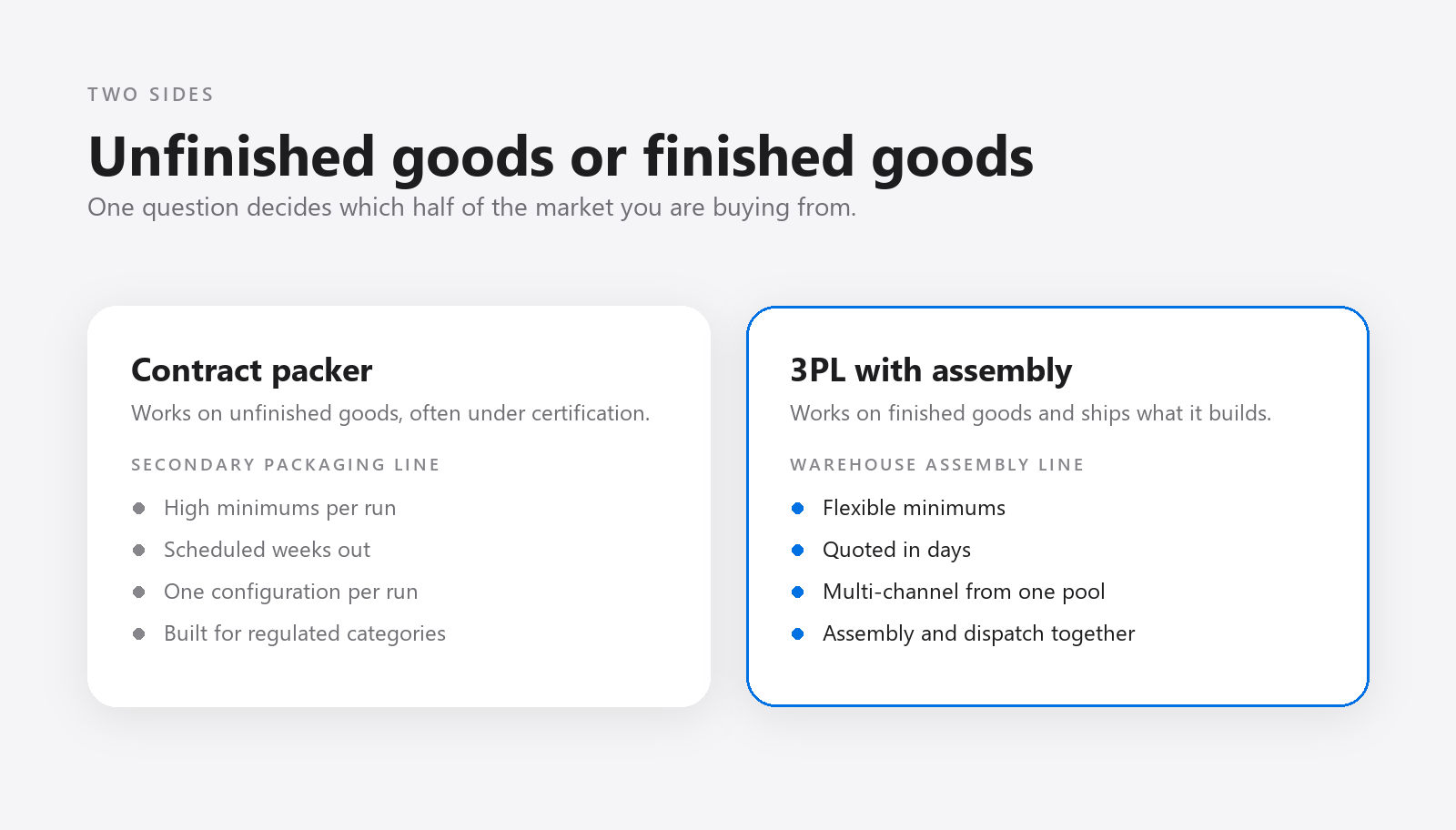
| Factory pre-pack | Unfinished goods | 5,000–50,000 units per run, weeks to months | Low — one configuration per run | Fixed sets, high volume, single channel | A promotional change means a new production run |
| Contract packer | Unfinished or semi-finished | High minimums, scheduled by project | Low to medium | Food, personal care, regulated categories | Usually does not ship to end customers |
| 3PL with assembly | Finished goods | Flexible, quoted in days | High — multi-channel from one pool | Ecommerce, several channels, sets that change | Hand-work precision below a dedicated line |
The split that matters is one sentence: contract packers work on unfinished goods; 3PLs work on finished goods. Ask where your product sits when it lands — does it still need to be physically changed before it can be sold, or does it just need to be stored and picked?
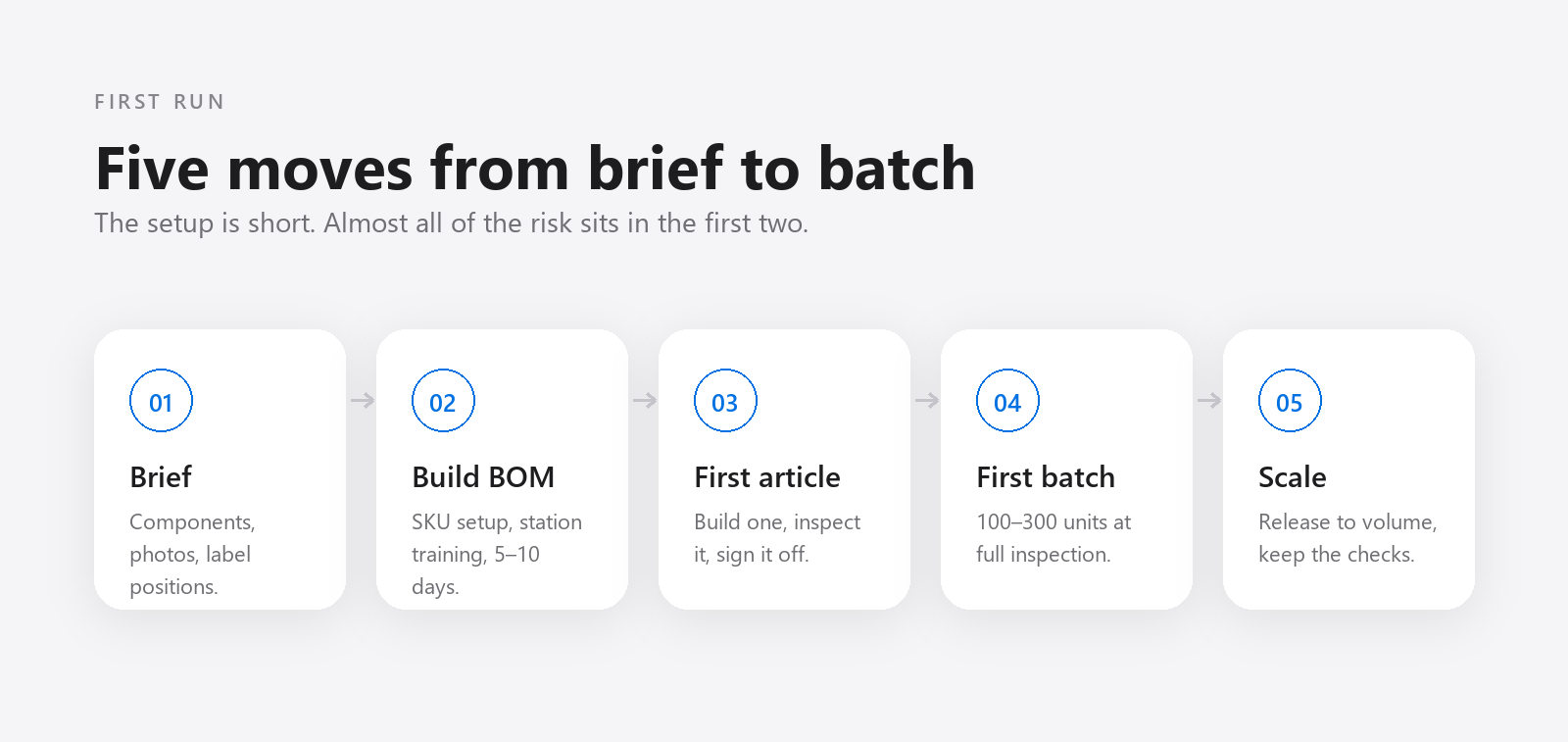
Whichever model you end up in, the first run follows the same shape:
The model decides more than the vendor does
Three constraints come with the model, not the company.
Minimums decide whether you can test at all. A model that starts at 5,000 units cannot test a new combination at 500. Combination testing is how most kit businesses grow — new bundle, new season, new add-on — so a model that blocks it costs you the compounding, not just the unit price.
Turnaround decides whether you can take a spike. Scheduled in weeks, you plan a promotion three months out. Quoted in days, you change a work order and it's done. Same product, different business.
Output format decides whether you can sell in more than one place. A model that produces one configuration per run means three production runs to supply Shopify, a marketplace, and a wholesale order — or a second partner downstream to dismantle and reconfigure.
So the useful question isn't "what's your per-kit price". It's "how fast can you change what's in the kit, and what does that cost me in minimums".
Where the labour actually goes
Brands that build kits in-house usually cost the labour and forget the productivity. The gap is large enough to change the answer.
One documented ecommerce warehouse case is worth keeping in mind. On fixed salaries of roughly 4,000–5,000 yuan a month, 20-plus people shipped about 2,000 parcels in a day — around 100 parcels per person. After switching to piece rates at 0.10 yuan a parcel, twelve people (six packing, six picking) shipped more than 20,000 parcels a day, roughly 1,700 per person, with wages rising to 8,000–10,000.
The lesson isn't about pay. It's that a standardised station with a defined sequence and a check at the end produces several times the output of improvised assembly, and the quality spread widens at the same time. A kit built at a bench with no drawing, no fixed component positions, and no verification step will run at a third to a fifth of the rate of a proper line — and nobody will notice until the complaints arrive.
Materials compound the same way. Taking a carton from $0.22 to $0.17 looks like five cents. On 100,000 parcels a day it is $5,000 a day.
The brief is the product
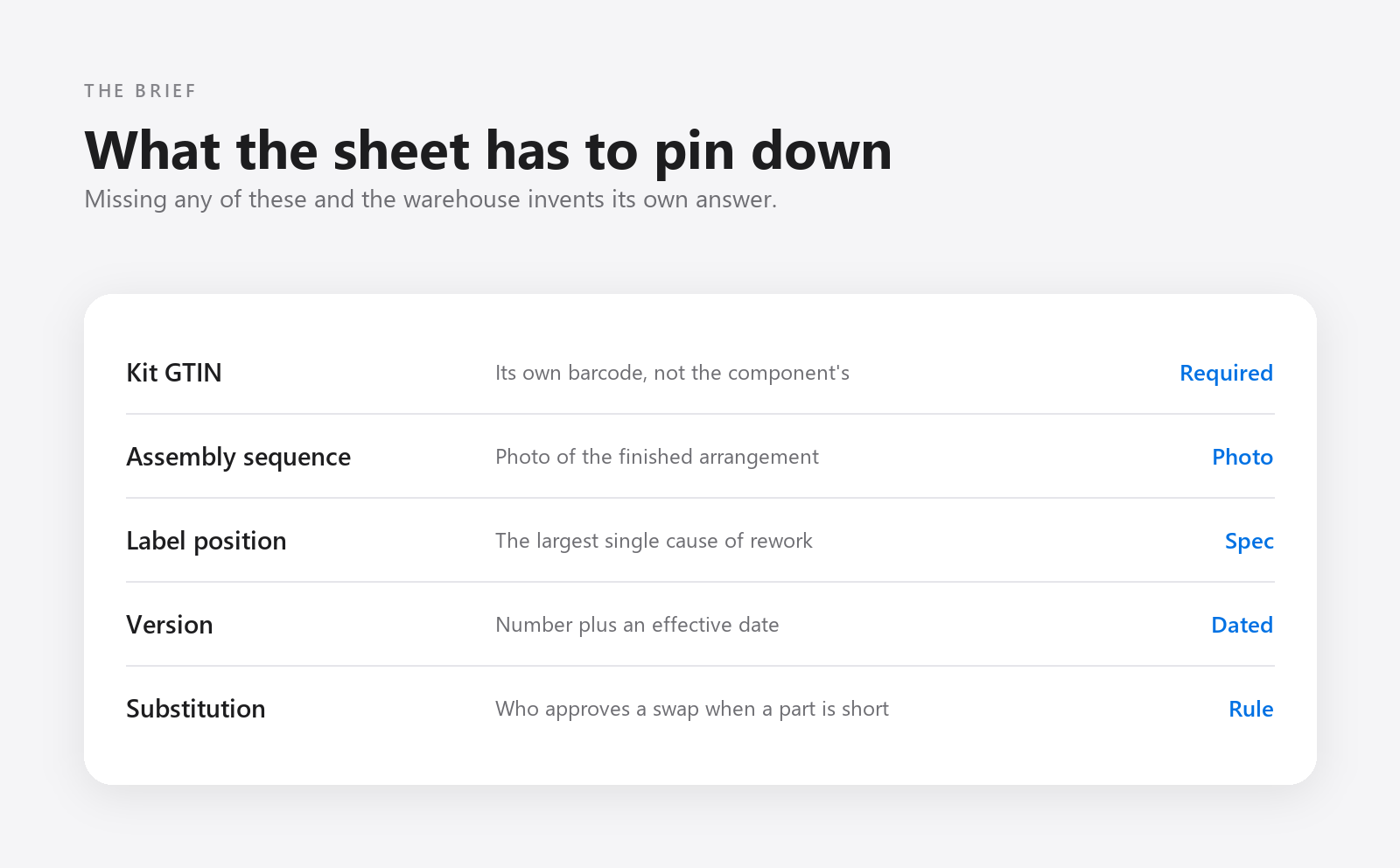
A bill of materials is not a list of what's in the box. It's a work instruction, and if it's incomplete the warehouse improvises.
- Component SKU and quantity per kit
- The barcode each component is scanned by — and the kit's own GTIN, which is not the component's
- Assembly sequence, with a photo of the finished arrangement
- Packaging spec: box type, insert, card position, seal method
- Label position and orientation — the single largest cause of rework
- Quality checkpoints and pass/fail criteria
- Version number and effective date
- Substitution rules: if a component is short, may it be swapped, and who approves
The last two are where disputes are born. No version control and the warehouse builds to last month's sheet. No substitution rule and a missing component stops the line — or gets quietly replaced with something close.
A kit also needs its own GTIN under GS1 rules once it's sold as a distinct trade item, even when every component already has one. Scanning the component's barcode at the packing station is how you get a shipping label for something that isn't the thing inside.
Two models, one price list
Pricing reflects what each model does. Contract packing is priced per unit of labour time, because the work is manual and variable: roughly $0.10–$10 a unit depending on complexity. 3PL assembly is priced per kit plus a pick fee per component, and then per order when it ships.
| Cost line | Typical range (third-party industry data, not a quote) |
|---|---|
| Assembly labour | $0.50–$2.50 per kit |
| Component pick fee | $0.10–$0.30 per component |
| Packaging materials | $0.25–$3.00 per kit |
| Custom insert or branded piece | $0.10–$0.50 per insert |
| Quality check | Included, or $0.10–$0.25 per kit |
| Setup and first run | $50–$250 one-time |
| Finished-kit storage | $0.50–$2.00 per bin per month |
Three lines to interrogate before signing: the setup fee (BOM build, training, first article — usually five to ten working days), the peak surcharge (Q4 commonly adds 15–20%), and any shrinkage allowance written into the contract. A clause that absorbs inventory loss up to 4% of value is a line item you're paying for whether or not it appears on the invoice.
Verify with two scans and a scale
A kit line that only checks at the end is checking too late. The workable pattern is:
- Scan at component pick — is this the right component for this work order.
- Scan at kit completion — does this finished unit carry the right GTIN.
- Weigh the finished kit — a deviation beyond about ±2% catches both the missing item and the extra one.
Run the first 100–300 kits at full inspection, not sampled. Errors found in the first batch cost an hour. The same error found after 5,000 kits costs a recall, a reship wave, and the reviews that come with it.
Know how to unpack
The most valuable capability in a slow quarter is reverse kitting: breaking finished kits back into sellable components. Launch Multi-SKU Bundles that don't move can be re-listed as individual items, which recovers most of the inventory value instead of none of it.
Ask about it before you sign, because it's rarely offered by default. Can they de-kit, how is it charged, and do the components return to sellable stock with their original barcodes intact? A partner that can't answer in detail will hand you a pallet of unsellable boxes the first time a promotion misses.
Where to go next
If you already know you need kits built and want the cost side in more detail — the per-kit breakdown, the in-house tipping point, and the questions that separate a real kitting operation from a warehouse that also tapes boxes — read what kitting services cost and when to outsource.
Send us the SKU count, components per kit, monthly volume, and the channels you sell on. We'll come back with a model recommendation before we talk about pricing.
References (Neutral Third-Party Sources)
Facts and concepts in this article were verified against standards bodies, carrier reference material, and public labour statistics. No competitor pages are cited.
- GS1 — Global Trade Item Number (GTIN): how a trade item is uniquely identified across the supply chain. https://www.gs1.org/standards/id-keys/gtin
- GS1 — GTIN Management Standard: the rules for when a new GTIN must be assigned, including for product variants and bundles. https://www.gs1.org/sites/default/files/docs/barcodes/GS1_GTIN_Management_Standard.pdf
- DHL — Logistics of Things glossary, "Kitting": the definition of kitting in a fulfillment context and the split between logistics and warehouse kitting. https://lot.dhl.com/glossary/kitting/
- U.S. Bureau of Labor Statistics — Occupational Employment and Wage Statistics: wage benchmarks for packing and material-handling roles. https://www.bls.gov/oes/